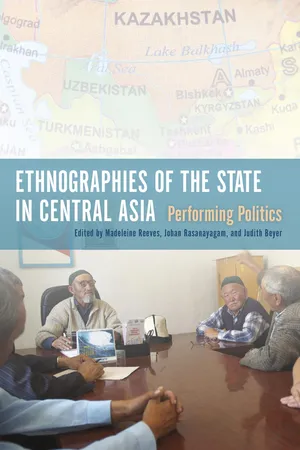
With fresh and provocative insights into the everyday reality of politics in post-Soviet Central Asia, this volume moves beyond commonplaces about strong and weak states to ask critical questions about how democracy, authority, and justice are understood in this important region. In conversation with current theories of state power, the contributions draw on extensive ethnographic research in settings that range from the local to the transnational, the mundane to the spectacular, to provide a unique perspective on how politics is performed in everyday life.
eBook - ePub
Ethnographies of the State in Central Asia
Performing Politics
- 332 pages
- English
- ePUB (mobile friendly)
- Available on iOS & Android
eBook - ePub
Ethnographies of the State in Central Asia
Performing Politics
About this book
Information
Staging the Political
1. The Global Performance State
A Reconsideration of the Central Asian “Weak State”
John Heathershaw
Strolling through Tajikistan’s capital city of Dushanbe in April 2010, almost twenty years after its declaration of independence from the Soviet Union, one is bombarded with images of the state, the president who represents it, and his appearances on the global stage. The state and its personal embodiment are apparently everywhere—monopolizing legitimate violence and defining legitimate public space in Tajikistan. Its citizens walk and chat in safety along a thoroughfare, which not fifteen years before saw violent demonstrations, sniper attacks, and guerilla warfare during the brutal civil war over control of the state. Just ten years earlier they would have rushed home to be indoors for the regular curfew. Across the street, the last wedding of the day spills joyfully out from the state registrar’s office, yet the cost of festivities has been reduced due to the 2007 state law that limited expenditures on traditional celebrations. As the wedding party departs, its vehicles pass under banners that are hung above the road and draped over state buildings, envisioning the construction of the Roghun Dam, a state project of Soviet origin and gigantic scale. Images of President Emomoli Rahmon, the safety helmet–wearing engineer-in-chief, adorn these banners.
Moreover, these are no Potemkin villages.1 Behind these signs of the state we find institutional, material, and coercive power attached to these state forms. Numerous side roads are closed to traffic to facilitate the reconstruction of the city according to the high-modernist plans of its mayor. Police gather ready to clear the streets for the presidential motorcade travelling between the presidential administration building and official residence little over a kilometer along the road. Whistles are blown, illuminous sticks are waved, police officers glare. In a jail just off Rudaki Avenue, and unbeknownst to most Tajiks, enemies of the state that have been captured by the security services and convicted of terrorist offenses in the courts are confined to a high-security state prison. The state has, by a mixture of coercion and persuasion, collected in excess of US$160 million in local currency from its citizens in the form of shares in the ongoing Roghun project. Officials of the Tajikistani state have considerable declaratory and commissary powers that have changed the political environment from one of armed conflict, little more than ten years ago, to hegemonic and relatively stable authoritarian governance today.
However, another story can be told. Apparent state strength seems to conceal another reality of systemic state weakness. In August 2010, the forty-nine prisoners of the high-security prison, including the aforementioned “terrorists” escaped. The police, loathed by many of those excluded from the patronage networks that distribute posts, stop drivers, and take payments. The funds collected for the Roghun project may not be convertible on foreign markets without driving down the value of the somoni. Their most significant effect has been to increase poverty. While most Tajiks deem the Roghun project essential for national development, they are often skeptical in private about whether it is realistic. Many of the citizens who walk the streets rely on remittances from relatives working in Russia, but few have confidence to save their extra monies in banks or have the connections to set up and grow a business free from state intimidation.2 They still look to the state for pensions, healthcare, and education but are growing increasingly cynical about its corruption and ineffectiveness.
We are thus faced with a contradictory picture regarding the sovereign state that was brought forth unexpectedly after the unraveling of the Soviet Union in 1991. The state seems at once omnipresent and perennially absent, both omniscient and powerless, both omnific and wholly lacking in productive capacity. What is the significance of these gigantic flagpoles and the proliferation of images of statehood across the capitals and countrysides of Central Asian states? Are they merely a symbolic gloss deployed to conceal institutional failure and the lack of the basic materials of statehood (armed forces, balanced budgets, and so forth)? Or do they point to a deeper reality of the conditions of statehood in an era of “reputation management” and increasing global connectedness of new media and vastly increased rates of overseas development assistance? This chapter seeks to address, conceptually and empirically, this tension found in political science studies of Central Asian and other postcolonial states.
This polyvalent picture and these outstanding questions are reflected in a literature which has barely begun to grasp these apparent contradictions and oftentimes favors premature declarations of the weakness or collapse of a given state. It is increasingly said that the Central Asian state is dysfunctional and, in Tajikistan’s case, “on the road to failure” (ICG 2009). Political scientists of Central Asia have sought to understand the dysfunctionalities in terms of hybrid forms of statehood and political life, such as “strong-weak states” (Migdal 1994; McMann 2004), the “state against itself” or the “dispersed” state (Jones-Luong 2004), and “modern clan politics” (Schatz 2004). Many of these analyses are informed by the conceptual precepts of neo-institutionalism. In the same vein, Mark Beissinger and Crawford Young (2002) compared post-Soviet Eurasian states to those of postcolonial Africa and argued that such state-societal intertwining is a sign not of strength but of weakness (Beissinger and Young 2002). On the other hand, the Central Asian state is also denoted as “spectacular” (Adams 2010), having a hyper-real quality that sustains it despite its supposed weakness. One promising intellectual response to these developments has been to chart what Andrew Wilson labels the “virtual politics” of the post-Soviet state—how authoritarian regimes directly and strategically fake democracy in its absence through political technologies, staged elections, and faux opposition parties. This approach is increasingly applied or adapted to the Central Asian region (Allison 2008; Heathershaw 2009b; Lewis 2008a).
However, there is little attempt to theorize the “virtual state” in this work, and overall there remains a distinct lack of clarity on the nature of symbolic, spectacular, or virtual politics in the region. Although virtual politics is said to be “radically top-down” (Wilson 2005, 48), such conclusions dodge the question of the “hegemony of form” (Yurchak 2006) raised in cultural studies—that is, in Adams’s terms, “the meaning being made within the models” (2008, 617). While empirical accounts of virtual politics in political science are useful supplements to materialist and behavioralist analyses, they are often conceptually and theoretically limited. Many of these authors assume a clear distinction between constructed fakes (virtual politics) and real practices (”inner politics” [Wilson 2005, 47]). Here “the state” is pared down to “the regime,” which maintains a bare semblance of order under conditions of weak statehood or state failure. The problem with such an approach is that it concentrates on the instrumentality of virtual politics while failing to recognize its constitutive functions—semiological and sociological.
In particular, two conditions or dimensions of Central Asian states are often overlooked by political scientists who dismiss them as weak, postcolonial forms. Firstly, limited by the dichotomy of state-idea and state-system, they disregard the performative dimension of its signs and their enactments. Signs of the state don’t float freely but are performed by state representatives and their interlocutors. Such signs are not merely representative of abstract ideas or ideology but they themselves may legitimize the authority of the state within its societal context. Secondly, hamstrung by the Weberian conception of the territoriality of the state, they disregard the global dimension of the society of the state.3 The social constitution of Central Asian states that have been born in an era of global governmentality is not limited to the activities of the national territorial unit. Moreover, such states neither monopolize their own territories nor are they confined to them. Their representatives launch off-shore yet fully state-owned companies just as they allow international organizations to set up project teams inside their own ministries or create new executive agencies at the behest of donors. The contention of this chapter is that these two aspects of performance and globality should be considered as intertwined dimensions of what can be defined as “the global performance state.” Such statehood is not fake—not a facade that conceals an underlying reality. However, it is not discernible if one insists on imposing dichotomies of state versus society, idea versus system, or inside versus outside. This performative and global statehood is perhaps particularly acute amongst postcolonial states that have only recently gained independence.
The argument is elaborated across three sections. Each draws on theoretical literature and empirical examples taken from my work on Tajikistan and research on other Central Asian states, to propose a new concept of the global performance state in the study of Central Asia. The three sections each begin by critically engaging one of three false dichotomies of the state that are foundational to the state weakness literature. Section one considers the state/society dichotomy itself and examines how the state is viewed in political science, particularly in terms of virtual politics (Wilson 2005). As is shown with reference to my research on post-conflict peace-building in Tajikistan, those that occupy places in the state are able to deploy fakes and simulate real politics (Heathershaw 2009a). However, acts of virtual politics such as donor-sponsored dialogue exercises must be considered not as purely epiphenomenal but as constituting and constituted by a symbolic order where the state is pre-eminent. The following sections consider the two conditions that sustain such “virtual states”: performance and globality. Section two interrogates the idea/system dichotomy and considers research in Soviet and post-Soviet studies on the performative nature of statehood and politics more broadly, especially the work of Alexei Yurchak (2006). In the example of the handover of the Tajikistan-Afghanistan border from Russian to national control we find state performance in the process by which state sovereignty is simulated and dissimulated by national and international actors. Finally, in section three, the global aspect of the Central Asian state is foregrounded as the chapter interrogates the inside/outside dichotomy of the state. The chapter considers the adoption of the Law on Self-Governance by Tajikistan in 2009, a process directed by the United States Agency for International Development, in light of the arguments of this chapter and the literature on “global assemblages” and the denationalization of the state (Sassen 2006).
State/Society: Virtual States?
The state is commonly defined in political science as “a distinct set of political institutions whose specific concern is with the organization of domination, in the name of the common interest, within a delimited territory” (Burnham 2005, 512).4 The use of the term “distinct” in this definition is illuminating, as it reflects the intellectual preference to conceptualize the state as an autonomous institution while recognizing that it is “in society” (Migdal 1994). However, for other state theorists this search for distinctness is a blind alley. Timothy Mitchell notes that “the elusiveness of the state-society boundary needs to be taken seriously, not as a problem of conceptual precision but as a clue to the nature of the phenomenon” (Mitchell 1999, 78). Moreover, “the appearance that state and society are separate things is part of the way a given financial and economic order is maintained” (ibid., 90). Contra Mitchell, most state theorists have nevertheless dealt with the elusiveness of the state-society boundary as a matter of degree that is subject to measurement and/or categorization. For Migdal (1994) and those that seek to measure amount of state on a strength-weakness scale, stateness is a quantifiable condition, from state failure on the one end of the spectrum to the complete objectification of the state at the other. This is in keeping with a literature on state weakness and collapse largely begun in African studies (Zartman 1995), which diagnoses that “the real business of politics is taking place where analysts are often not looking” (Chabal and Daloz 1999, 1). Political scientists of Central Asia, following the lead of these and similar scholars, have explained the state’s weakness in terms of its capture by regional factions (Jones-Luong 2002), clans (Schatz 2004; Collins 2006), warlords and criminal networks (Nourzhanov 2005; Marat 2006), or coalitions of disaffected elites (Radnitz 2010). Taken to the extreme, such analysis suggests that institutions of the state then become mere tools of a regime th...
Table of contents
- Cover
- Half title
- Title
- Copyright
- Contents
- Note on Transliteration
- Acknowledgments
- Introduction: Performances, Possibilities, and Practices of the Political in Central Asia
- Part 1. Staging the Political
- Part 2. Political Materials, Political Fantasies
- Part 3. Moral Positionings
- Contributors
- Index
Trusted by 375,005 students
Access to over 1.5 million titles for a fair monthly price.
Study more efficiently using our study tools.
Frequently asked questions
Yes, you can cancel anytime from the Subscription tab in your account settings on the Perlego website. Your subscription will stay active until the end of your current billing period. Learn how to cancel your subscription
No, books cannot be downloaded as external files, such as PDFs, for use outside of Perlego. However, you can download books within the Perlego app for offline reading on mobile or tablet. Learn how to download books offline
Perlego offers two plans: Essential and Complete
- Essential is ideal for learners and professionals who enjoy exploring a wide range of subjects. Access the Essential Library with 800,000+ trusted titles and best-sellers across business, personal growth, and the humanities. Includes unlimited reading time and Standard Read Aloud voice.
- Complete: Perfect for advanced learners and researchers needing full, unrestricted access. Unlock 1.5M+ books across hundreds of subjects, including academic and specialized titles. The Complete Plan also includes advanced features like Premium Read Aloud and Research Assistant.
We are an online textbook subscription service, where you can get access to an entire online library for less than the price of a single book per month. With over 1.5 million books across 990+ topics, we’ve got you covered! Learn about our mission
Look out for the read-aloud symbol on your next book to see if you can listen to it. The read-aloud tool reads text aloud for you, highlighting the text as it is being read. You can pause it, speed it up and slow it down. Learn more about Read Aloud
Yes! You can use the Perlego app on both iOS and Android devices to read anytime, anywhere — even offline. Perfect for commutes or when you’re on the go.
Please note we cannot support devices running on iOS 13 and Android 7 or earlier. Learn more about using the app
Please note we cannot support devices running on iOS 13 and Android 7 or earlier. Learn more about using the app
Yes, you can access Ethnographies of the State in Central Asia by Madeleine Reeves, Johan Rasanayagam, Judith Beyer, Madeleine Reeves,Johan Rasanayagam,Judith Beyer in PDF and/or ePUB format, as well as other popular books in History & Central Asian History. We have over 1.5 million books available in our catalogue for you to explore.