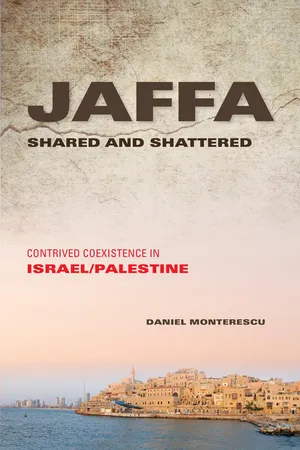
Binational cities play a pivotal role in situations of long-term conflict, and few places have been more marked by the tension between intimate proximity and visceral hostility than Jaffa, one of the "mixed towns" of Israel/Palestine. In this nuanced ethnographic and historical study, Daniel Monterescu argues that such places challenge our assumptions about cities and nationalism, calling into question the Israeli state's policy of maintaining homogeneous, segregated, and ethnically stable spaces. Analyzing everyday interactions, life stories, and histories of violence, he reveals the politics of gentrification and the circumstantial coalitions that define the city. Drawing on key theorists in anthropology, sociology, urban studies, and political science, he outlines a new relational theory of sociality and spatiality.
- 384 pages
- English
- ePUB (mobile friendly)
- Available on iOS & Android
eBook - ePub
About this book
Information
PART ONE
Beyond Methodological Nationalism:
Communal Formations and
Ambivalent Belonging
ONE
Spatial Relationality
Theorizing Space and Sociality in
Jewish-Arab “Mixed Towns”
In the Mediterranean, birthplace of the City-State, the State, whether it be inside or outside the city, always remains brutal and powerless, violent but weak, unifying but always undermined, under threat. . . . Every form of hegemony and homogeneity are refused in the Mediterranean. . . . The very idea of centrality is refused because each group, each entity, each religion and each culture considers itself a center. . . . The polyrhythmy of Mediterranean cities highlights their common character through their differences.
—HENRI LEFEBVRE, “Rhythmanalysis of Mediterranean Cities”
SITUATED VIOLENCE: THE OCTOBER 2000 EVENTS IN JAFFA
The large-scale protest demonstrations staged by the Palestinian citizens of Israel throughout the country in the first two weeks of October 2000, now widely known as “the October 2000 events,” did not bypass Jaffa. For a few days in early October, Palestinian youngsters marched through the streets in solidarity with the casualties of the Al-Aqsa Intifada, destroying public symbols and state institutions including banks, post offices, and Jewish-owned stores.
Shortly after these events I met with my Jaffa-born sister, Aurélie, who lives in the heart of Jaffa’s predominantly Arab ‘Ajami quarter, and with Hicham, a Palestinian high school classmate from my own Jaffa days twenty years ago. Inescapably, the conversation turned to the recent upheaval and its implications for Jewish-Arab relations in Jaffa. I asked my sister how she had coped with the “riots,” referring to an incident in which Palestinian youths burned down a lottery booth a block away from where she lives. Her answer surprised me, as it stood in sharp contrast to the biased and hysterical anti-Arab media reports and to the anxious responses of most Israeli residents of neighboring Tel-Aviv. Dismissing the notion that these events were in any way dangerous, she said dryly that all she had to do was detour to avoid whatever demonstrations were going on and go home from work another way. At the end of the day, she concluded, Tel-Aviv is more dangerous than Jaffa, if only for the fact that Jaffa, where many of the residents are Arabs, is immune to suicide attacks by Palestinian terrorists. She said,
The whole thing was not a big deal. Nothing happened to me. They [the demonstrators] never reached my house. From the outside it looked much worse than it actually was. Some Jerusalemite Palestinians arrived to agitate and nationalize the atmosphere, and some youngsters from Jaffa went along. I know that for Tel-Avivans it looked awful, but I wasn’t afraid. Friends suggested that I stay with them in Tel-Aviv, and some of them did not visit me for months. . . .
I live in the ideal location, you see. They didn’t enter the houses and there were no pogroms. They were not brutes like Sharon’s people. They focused on expressing their protest—with no looting or rape. They didn’t hurt civilians because so many of them are Arabs like them. They looked for external Jewish elements—people from Bat-Yam [a coastal town just south of Jaffa], for example, who never try to integrate with them. The post office represents the Jewish-Israeli establishment. But they did not think it through: damaging it eventually hurt them, since they are the ones who use it. For me, as someone who lives in the area, it wasn’t serious. Tel-Aviv, with all those suicide bombs, is much more dangerous.
Proceeding with this surprisingly sympathetic view of the events, Aurélie described them in apolitical and non-national terms. Her description was of what might be called “collective effervescence”—a ritual of semi-spontaneous gathering involving in-group agents (“Jaffans”) and out-group agents (“Jerusalemites”) alike. Rather than a threatening and frightening occurrence, Aurelie’s account of the October Events took a Durkheimian tenor, whereby Jaffans recognized their collective unity by means of a primarily social and quasi-ludic practice of opposition. In her words,
The atmosphere was like a festival; people enjoyed the action. Evening comes and everyone goes out to the streets. The gutsy ones throw some stones, but the driving force were those Jerusalemites. I told my friends that it all took place at certain hours in the evening, around six or seven, as youngsters come home from school or work. Jaffans are usually calm and quiescent, but when the Jerusalemites arrived it made the locals finally feel they were part of the whole thing, of the Palestinian people. Also you have to remember in October the air outside is pleasant in the evening.
Disagreeing with what my sister described as the pivotal role of the demonstrators from outside of Jaffa (the “Jerusalemites”), Hicham, who took part in the demonstrations, insisted on the political dimension of the violent events. Aurélie’s association of the events with undisciplined working-class and youth-based leisure practice was wrong, he thought.1 He said,
Even though the demonstrations were pretty lame, the Israeli newspapers depicted Jaffa as a “ticking bomb.” Most gatherings took place when we thought that people from Bat-Yam were about to attack Jabaliyye [a southern neighborhood in Jaffa]. At least two hundred people came out to defend the neighborhood’s mosque. Luckily, the police stood between us and the Jews and after a few days the tension dissolved. What made most people happy—me too—is that they closed Yefet Street. It was a festive atmosphere, like that on Yom Kippur [when in Jaffa both Jews and Arabs fill the streets]. An atmosphere of disorder and festival. We were happy that the Jews were afraid to enter Jaffa.
Referring to the de facto Israeli boycott of Jaffa in the weeks that followed, Hicham continued:
Abu Hassan’s hummus restaurant was already empty at ten or eleven in the morning, and people started going there more to prove to ourselves that the Jewish boycott was not getting to us. There was one day when Abu Hassan was really moved as Jaffan Arabs filled the place. We proved that he is not here only because of the Jewish market.
These were strange months, with Jaffa completely empty on Saturdays. Then the situation gradually went back to normal. The following year the Rabita [Jaffa’s national-secular association] spread flyers calling for a general strike, with absolutely no effect. October succeeded because it wasn’t planned. Jaffans don’t go to the streets when they are organized.
Hicham then gave two examples of what he called “the dynamic of destruction”: One was Ha-Sukkah ha-Levana (the White Sukkah), a restaurant owned by a Jew and run by Sabbagh, a Christian-Arab. The second was Ochayon, a Jewish Moroccan tailor who also owns a clothes shop:
The demonstrations were not completely ideological. There was a dynamic of destruction and there was a separate nationalist dynamic that led people to attack stores owned by Jews. Had they demolished Andre’s ice cream place [a Christian well-to-do business], I wouldn’t be surprised—they are a weak family. Messing with the Kheils’ restaurant is a completely different matter—no one wants to have to deal with that family. The dynamic was to break everything. They stoned Jews who had no strong backup. The White Sukkah restaurant is managed by Sabbagh—a Christian Arab. Everybody knows that. His place was totally destroyed, but Ra’uf’s restaurant just across the street was left intact. Both Sabbagh and Ra’uf are Christians but Ra’uf is cool, he has many Muslim friends. The idea was to break everything, but some things are more easily broken than others.
In Ochayon’s case, although the demonstrators stoned his store, he showed up the next day and reopened soon after, taking this opportunity to renovate the place—and now he’s actually doing better in a much nicer store. Ochayon sells expensive jeans and his store is often broken into. There are Jews in Jaffa, but no one thought of breaking into houses of Jews. It didn’t occur to anyone. From demonstration to demonstration in Jaffa, Ochayon has been upgraded and got more and more successful. Ochayon is no gentrifier—he’s been here for fifty years. It’s the preferred jeans store in Jaffa. One hundred percent of his clientele are Arabs—everyone buys at his store.
In spite of their disagreement, resulting in part from their different ethnonational affiliations and their respective access to social networks in Jaffa, Aurélie’s and Hicham’s reactions both stand in sharp contrast to the flat and hysterical coverage of these events in the Israeli media.2 Their accounts differ substantially from the stereotypical perceptions of most Jewish Israelis and the violent “counter-rioting” of the police.3
The October events illustrate the overwhelming power of nationalist forces but also their limits, and bring to the fore three levels of the constitutive tensions which characterize Jaffa. First, they reveal the complicated relations between the political and the social realms, namely, between Palestinian nationalist mobilization and non-national social dynamics stemming from the urban mix with Jewish residents and from internal dynamics within the Palestinian community. From the point of view of a Jewish resident who could have been a victim of this mobilization, the demonstrations were both legitimate and harmless. For a Palestinian resident, these demonstrations reveal the social intervention of communal and non-national forces that determined the nature of violence in Jaffa, such as mass behavior and internal clan-based power relations and religious divisions. Power is woven into the social fabric and is thus both structural and situational. In this relational approach, “the concept of power is transformed from a concept of substance to a concept of relationship” (Elias 1978, 131; also see Emirbayer 1997).4
Second, this case demonstrates the productive and dialectic aspect of conflict qua social form which Simmel theorized almost a century ago ([1922] 1955). Ochayon’s increasing success with Jaffa’s Arab clientele and his determination to remain in town despite recurrent attacks on his store show that the Palestinian demonstrations were not perceived by veteran Jewish Jaffans to be personally targeting individual Jews.5 More precisely, the story illustrates that individual Jews were not targeted as emblems of the Jewish state and remained social persons with relational identifications with their Palestinian neighbors.
Third, it is striking that during the October Events and in their immediate aftermath, the farther one got away from the actual scene in terms of social and physical distance, the more stereotypical the image and representation of the conflict became, and the more it was narrated in dichotomous collective terms of “them” and “us.” When one got to the neighboring city of Bat-Yam one already had encountered a collective melee of two armed crowds, set apart only by the police. The October Events in Jaffa thus expose the relevance of “social distance” (Simmel [1908] 1971) and spatial proximity for political action as well as its representations in ethnically mixed urban contexts. Such moments of conflict and collective mobilization stand in diametric opposition to the perspective “methodological nationalism,” namely, the analytic bias which conflates social boundaries with state boundaries, and allows national categories to seep into sociological analysis (Beck 2003).
In an attempt to interpret such ambivalent behaviors, the argument I put forth is not a liberal argument of multicultural peaceful coexistence,6 nor is it an argument of urban ethnocracy as total exclusion (Yiftachel and Yacobi 2003). Within this theoretical context I suggest a third alternative that perceives Jaffa as a relational field in which nationalism and urbanism, identity, and place are simultaneously contested and confirmed in everyday interactions (Brubaker et al. 2006). My argument describes the systemic complexity embedding the “political” and the “social” which implicates nation and class in dialectic and contradictory ways. I deconstruct the reified notions of ethnically bounded “communities” and the politicized concepts of indigenous locals and alien immigrants in order to address inter- and intracommunal relations between different populations in Jaffa. The complexity of what Simmel ([1922] 1955) calls the intersecting “webs of affiliations” is one of the reasons for the relative lack of intercommunal violence in Jaffa, where networks and social relations between Jews and Arabs are intricately implicated by the mixed urban scene.
The argument proceeds in five steps to outline a dialectical theory of sociality and spatiality. The first section criticizes the “dual society” paradigm in Palestinian-Israeli studies (Lockman 1996; Shamir 2000), which posited the existence of two essentially separate societies with distinct and disconnected historical trajectories. As an instance of the broader analytic bias which Martins (1974) had termed methodological nationalism (also see Wimmer and Glick-Schiller 2002), this paradigm chained sociological analysis of ethnically mixed towns to the category of the nation-state and thus concealed much of their interstitial complexities. The theoretical perspective of relationalism (Emirbayer 1997) is proposed to address the deficiencies of current approaches to Palestinian-Israeli relations and thus change the focus of analysis from a priori relations of exclusion between reified communities to a space of social transaction and mediation where projects of exclusion operate and often fail in one way or another. Linking the concepts of spatial heteronomy, collective strangeness, and cultural indeterminacy, the following sections put forth three propositions, which locate the foundations of the spatiality-sociality-culture nexus in three sites of productive conflict: the spatial history of the city, the social relations it produces, and its contested cultural representation. Reformulating urban nationalism as a problem of mediation, the analysis concludes with the implications of this approach for the comparative study of mixed towns, toward a new understanding of scales of mediation and transaction extending from the city to the state and beyond.
RELATIONAL ANTHROPOLOGY VERSUS METHODOLOGICAL NATIONALISM
While social scientists have been increasingly sensitive to the ideological and analytic reification of the category of the nation-state (Abrams [1977] 1988; Appadurai 2000; Beck 2003; Brubaker 1996; Wimmer and Glick-Schiller 2002), Mustafa Emirbayer (1997) has framed the critique of methodological nationalism within a much broader alternative theoretical perspective, which he termed “relationalism” (as opposed to substantialism).7 Following a long list of social theorists from Simmel and Elias through Maffesoli and Bourdieu, “relational theorists reject the notion that one can posit discrete, pre-given units such as the individual, class, minority, state, nation or society as ultimate starting points of sociological analysis.” He explains, “What is distinct about the relational approach is that it sees relations between social units and actors as preeminently dynamic in nature, as unfolding ongoing processes rather that as static ties among inert substances or structures” (287). It is the mutually constitutive relationship between individuals, political groups, and cultural categories that determines their nature, and not vice versa.
The theoretical implications of the relational approach are far-reaching, proposing a profound reformulation of social science’s basic concepts such as power, society, and culture. Thus Strathern (1988, 13) ingeniously leads us out of the conceptual cul-de-sac of the reified notions of individual and society “imagined as conceptually distinct from the relations that bring them together.” And as Brubaker (1996) shows, the concept of the nation-state changes, and instead of signifying a naturally bounded, integrated, sovereign entity, designates a figuration of power, namely, a complex intercommunal and intra-organizational network or, in short, a relational field. This interpretive paradigm also enables a revisionary conceptualization of the colonial encounter as a site of rupture and negotiation (Comaroff and...
Table of contents
- Cover
- Half title
- Title
- Copyright
- Dedication
- Contents
- Acknowledgments
- Note on Transliteration and Translation
- Introduction Contrived Coexistence: Relational Histories of Urban Mix in Israel/Palestine
- Part One Beyond Methodological Nationalism: Communal Formations and Ambivalent Belonging
- Part Two Sharing Place or Consuming Space: The Neoliberal City
- Part Three Being and Belonging in the Binational City: A Phenomenology of the Urban
- Notes
- References
- Index
Trusted by 375,005 students
Access to over 1.5 million titles for a fair monthly price.
Study more efficiently using our study tools.
Frequently asked questions
Yes, you can cancel anytime from the Subscription tab in your account settings on the Perlego website. Your subscription will stay active until the end of your current billing period. Learn how to cancel your subscription
No, books cannot be downloaded as external files, such as PDFs, for use outside of Perlego. However, you can download books within the Perlego app for offline reading on mobile or tablet. Learn how to download books offline
We are an online textbook subscription service, where you can get access to an entire online library for less than the price of a single book per month. With over 1.5 million books across 990+ topics, we’ve got you covered! Learn about our mission
Look out for the read-aloud symbol on your next book to see if you can listen to it. The read-aloud tool reads text aloud for you, highlighting the text as it is being read. You can pause it, speed it up and slow it down. Learn more about Read Aloud
Yes! You can use the Perlego app on both iOS and Android devices to read anytime, anywhere — even offline. Perfect for commutes or when you’re on the go.
Please note we cannot support devices running on iOS 13 and Android 7 or earlier. Learn more about using the app
Please note we cannot support devices running on iOS 13 and Android 7 or earlier. Learn more about using the app
Yes, you can access Jaffa Shared and Shattered by Daniel Monterescu in PDF and/or ePUB format, as well as other popular books in History & Middle Eastern History. We have over 1.5 million books available in our catalogue for you to explore.