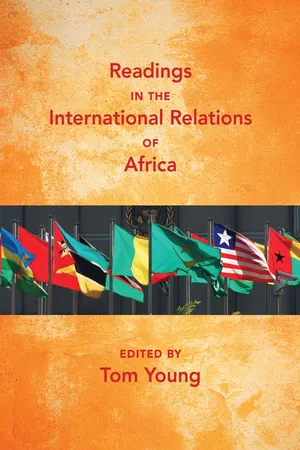
These readings in international relations in Africa grapple with the continent's changing place in the world. The essays confront issues such as the increasing tempo of armed conflict, the tendency of Western states and agencies to intervene in African settings, the presence of China, and the health of African states and their ability to participate in the global economy. Questions regarding sovereignty, leading regional actors, conflict and resolution, and the neoliberal African renaissance add to the broad thematic coverage presented in this timely volume.
- 384 pages
- English
- ePUB (mobile friendly)
- Available on iOS & Android
eBook - ePub
Readings in the International Relations of Africa
About this book
Information
Part One
Sovereignty and
Statehood
INTRODUCTION
These texts provide some historical background to the period of African decolonization. They also raise, and discuss, some key questions about sovereignty and statehood, and in so doing, point to some of the theoretical debates about these matters. Jackson tells the story of the decolonization of Africa in terms of the idea of “quasi-states,” suggesting that decolonization was driven by an international normative shift that rendered anything less than full sovereignty illegitimate. The effect of this was that African states were treated as states but in fact lacked many of the key characteristics of states. Grovogui approaches things from a different theoretical angle, bringing together an argument about the African state and the international order to make a critique of the idea of the quasi-state. He suggests (and there are some similarities with Warner’s arguments here) that Jackson’s account neglects both the colonial impact on Africa’s states and the unequal structure of the postwar international order. As a result, he also raises important questions about later ideas, such as “failed states.” Warner reviews a huge amount of evidence about precolonial African polities and links her discussion to controversies concerning the meaning of the term state.
1
Independence by Right
THE REVOLT AGAINST THE WEST
The historical change from positive to negative sovereignty is most specifically and concretely evident in European political disengagement from Asia, Africa, and Oceania. As indicated in the last chapter, the right to independence and the corresponding duty to decolonize was installed as an international categorical imperative following the second world war and by 1960 it was the unchallenged and unchallengeable declaration of the United Nations. There is no better place to look for changing norms and assumptions about sovereign statehood, therefore, than in the sphere of decolonization. It is one of the momentous international reversals of the twentieth century whose consequences—material and moral, intended and unintended—continue to reverberate and will for decades to come. We live in a post-colonial world which has undoubted significance for international relations.
Decolonization is often understood as a successful revolt against the West and there is evidence to recommend this positive sovereignty view. The usual image is of a decline of European primacy by the devastation and demoralization of two global wars and the rise of powers on the peripheries of Europe (United States, Russia) and beyond (Japan) which ‘ultimately displaced the European system’. It is indicated by vigorous anti-colonialism during and following the second world war which made it impossible to re-establish Dutch rule in the East Indies and French colonialism in Indochina. British decolonization in the subcontinent in reaction to credible nationalist movements, such as the long-established Indian Congress, is a further instance. The successful anti-colonial war of liberation against the French in Algeria is yet another. These episodes are consistent with positive sovereignty: new statehood is primarily a question of fact.
In many other parts of the Third World, however, forceful and credible anti-colonial nationalism capable of inheriting sovereignty in rough conformity with positive international law usually did not develop. This is evident from British revisionist colonial historiography based on the post-1945 imperial archives. And in government discussion papers of the day ‘there was little sense . . . of Britain being too impoverished for the task of colonial rule, or of her retreating in the face of nationalist hostility’. Nor was there any conviction that Africans were now adequately trained and equipped for self-government.
The pressures for transferring sovereignty were to an increasing extent international and principled. The post-war era witnessed an anti-colonial ideology expressed with growing conviction by the annually enlarging number of newly enfranchised states. Anti-colonialism in retrospect looks more and more like a sea change in international legitimacy. Their claims of domestic jurisdiction in the colonies and of the lack of indigenous capacity for self-government fell increasingly on deaf ears—especially at the UN. By the late 1950s international opinion had turned fundamentally against colonialism.
The image of a massive and violent revolt against the West is most apt as regards the break-up of the Dutch East Indies and French Indochina. The successful invasions of these territories and others by Japan during the second world war are unambiguous instances of the decline of European power in that part of the world. At the time, however, it was far from certain that colonialism would not be restored when Japan was defeated. In 1942, according to Lord Hailey, the Netherlands government contemplated granting ‘autonomy’ to the East Indies but within the framework of a continuing union with Holland.
European decolonization in these parts of Asia signaled ‘the end of empire-as-power’. In most places after the mid-1950s the revolt against the West ceased to be a credible rebellion against colonial power and became instead a worldwide moral campaign against the ideology and institutions of colonialism. The doctrine of negative sovereignty in post-war decolonization is therefore seen most clearly in the international emergence of Black Africa and Oceania. Before this sea change of international legitimacy the complete independence of these areas was rarely contemplated.
Although there is wide agreement about the significance of the episode, the underlying causes of decolonization continue to be debated and no consensus among scholars has yet emerged. What is important from the perspective of this study, however, is not only its significance but also its character. Independence became an unqualified right of all colonial peoples: self-determination. Colonialism likewise became an absolute wrong: an injury to the dignity and autonomy of those peoples and of course a vehicle for their economic exploitation and political oppression. This is a noteworthy historical shift in moral reasoning because European overseas colonialism was originally and for a long time justified on legal positivist and paternalist grounds which postulated the unpreparedness of such peoples for self-government and the responsibility of ‘civilized’ states to govern them until they were prepared. It is difficult to make this point today without seeming to be a colonial apologist. But the fact is that until the second world war and even for some time afterwards this was the predominant doctrine of international legitimacy and law. Decolonization amounted to nothing less than an international revolution on this question in which traditional assumptions about the right to sovereign statehood were turned upside down.
EVOLUTIONARY DECOLONIZATION
British colonialism operated with the idea of trusteeship: colonies were held in trust by Great Britain until such time as they were able to govern themselves in accordance with ‘modern ideas of civilized rule’, as Lord Hailey once put it. In British political thought this idea was at least as old as Burke. Not every people were yet able to stand alone under the arduous conditions of the modern world. Nor were all indigenous rulers capable of civil government. Just as it was a dereliction of duty for a British colonial ruler to act unconstitutionally so also would it be a dereliction of duty if, for example, northern Nigeria were restored ‘to the uncontrolled rule of the emirs, or Malay to that of its sultans’. Indeed, the policy of indirect rule or what Lord Lugard called ‘The Dual Mandate’—which pursued the goal of transforming traditional authorities into modern local governments—was intended to avoid this.
Moreover, it would be premature to assume that every unit within the British Empire would eventually attain complete sovereignty. Many had populations which were still almost entirely illiterate not only in the strict linguistic sense but also—and perhaps more importantly—in the institutional sense of having little or no understanding of the workings of a modern state and the responsibilities of citizenship. Many were plagued by divisions among their population which were so deeply rooted in religion, language, or custom that democratic self-government without an impartial external referee seemed impossible. Many were too small for independence regardless of their level of development. And furthermore it could not be assumed that every colony would necessarily seek self-government: a policy of categorical independence for all would abandon many against their will. The only practical and responsible course of action was the continuation of colonial development following the distinctive lines of each particular colony under the overall protection, freedom, and justice afforded by the imperial system.
The British had long operated with the apparently contradictory concept of ‘colonial self-government’. Since Lord Durham’s Report of 1839 which launched responsible government in Canada, decolonization meant achieving self-government within the empire. Britain, according to John Stuart Mill, had ‘always felt under a certain degree of obligation to bestow on such of her outlying populations as were of her own blood and language, and on some who were not, representative institutions formed in imitation of her own’. Britain could not transfer sovereignty to non-constitutional governments and remain faithful to her ideology of developing the civil and political as well as the social and economic conditions of colonies.
The British Empire and Commonwealth was likened to a grand political procession whose members were positioned according to their degree of self-government with Britain and the independent dominions in the vanguard and the least developed African and Pacific colonies bringing up the rear. This Whiggish metaphor of colonial development contrasted sharply with the static image of the old British Empire in which dependencies revolved around the mother country in perpetuity like the solar system and could never develop to equality with it. The constitutional shape of the new empire was constantly evolving, therefore, and the position of each colonial unit was only a temporary stopping place along the road to eventual self-government.
For those many backward territories at the rear of the procession, however, the road ahead was still long and difficult. The British were operating within a familiar tradition of colonial development which had already led to dominion status for white colonies and, according to Margery Perham, ‘there was no reason why it should cease to operate for brown or black ones’. Constitutional development was a far more formidable assignment in Asia, Africa, and Oceania than it had been in the dominions, however, where it occurred more or less naturally within predominant European communities. New Zealanders were as capable of self-government as their first cousins in the British Isles. The same could not be said of Nigerians or Fijians who sprang from entirely different stocks.
After the 1941 entry of the United States into the second world war, however, significant new demands were placed on the colonial powers to make plans for decolonization. It was now necessary to explain the practices and institutions of colonialism which were no longer self-justifying as they previously had been—at least within the Eurocentric international community. The British in particular were faced with justifying their long-standing conception of evolutionary decolonization to suspicious if not outright anti-colonial American allies who were now in the driver’s seat. The American view of decolonization was almost exactly the opposite: idealist and revolutionary.
This questioning of the European empires by the superpower at the moment of its ascendancy could not but undermine their international legitimacy to some degree. Although the United States’ enthusiasm for universal decolonization declined following the advent of the cold war and its new realities and complexities, from this time the practices and institutions of colonialism had to be supported by an ideology which could communicate to states that were constitutionally unsympathetic to the enterprise and more likely to construe it as exploitation than benevolence and enlightenment. During the war when Britain was heavily dependent on the United States this required diplomacy and careful attention to terminology, as when Lord Hailey, the foremost colonial theorist of the time, noted to his British colleagues that any attempt to draw a distinction between ‘self-government and independence suggests a refinement which will be viewed with a great deal of suspicion in the USA’. Hailey was commissioned by the British government during the war to report on prospects for political development in the colonies. He cautioned against premature and ill-considered changes.
In defending the empire against criticism, leading British spokesmen felt obliged to point out, repeatedly, that the conditions for granting independence were far from existing in many colonies which still required tutelage and would require it for some time to come. The British government frequently confronted critical opinion within parliament particularly from the Labour Party left wing. Colonial Secretaries or Under-Secretaries had to defend their policies in parliamentary statements. In 1943 the Colonial Secretary declared in the House of Commons that ‘it is no part of our policy to confer political advances which are unjustified by circumstances, or to grant self-government to those who are not yet trained in its use’. A year later a British memorandum prepared for the Dumbarton Oaks Conference observed that ‘the development of self-government within the British Commonwealth’ must occur ‘in forms appropriate to the varying circumstances of Colonial peoples’. And in an influential 1945 Foreign Affairs article written for a select American audience Marjory Perham revealed not only the official British mind but also uncanny foresight about the likely consequences of rapid universal decolonization: ‘Were they [the colonies] thus cut loose, they would probably be set up as very weak units under an experimental world organization.’ Here was the emergent imperial riposte to those who assumed that independence was a categorical good which required no further justification.
The British continued after the war to regard American attitudes to decolonization as a simplistic and an uninformed belief that colonialism was but a mask on simple ‘exploitation’. The task was to counter these attitudes with facts about the reality of the colonial situation which varied greatly from one place to the next. However, the idealist outlook in favour of universal decolonization was also reflected by official pronouncements of Soviet bloc countries, many Latin American governments, and the UN General Assembly—whose anti-colonial voice strengthened with the admission of every new ex-colonial member. It was also expressed by articulate liberal and left-wing opinion in the imperial countries themselves.
In 1946 it was evident to Margery Perham that the gradual pace of constitutional development in British colonies had to be more rapid than was previously thought desirable or even possible in some cases. However, she felt obliged to identify ‘four chief obstacles to the achievement of early and effective self-government’: (1) the general populations of many colonies if not most were still ‘too unaware’ of the operations of modern, large-scale government to be capable of citizenship; (2) most colonies as yet lacked any basis of national unity; (3) a number of colonies were so insubstantial that ‘anything more than a limited internal self-government’ was impossible; and lastly (4) the level of economic development was still far too low to support a modern state.
British colonial policymakers were at one in assuming self-government to be generations distant. Although in public it was becoming impolitic to say so, in private memoranda colonial officials still spoke of political change in terms of generations or longer. Commentators took it for granted that some dependencies were so far removed from the conditions of a modern sovereign state that they would probably have to remain as colonies indefinitely.
There was also a moral issue: the concern that a premature transfer of power would leave many simple, rural folk in the colonies vulnerable to inefficiency, exploitation and even oppression by indigenous governments staffed by inexperienced or inadequately educated or self-serving elites. British commentaries on imperial subjects in the late 1940s therefore reveal a continuing assumption that indigenous peoples must achieve an acceptable level of competence and responsibility before self-government could be granted. In private the point was made with greater candour. The point was made with less restraint in a 1947 diary entry of Sir Philip Mitchell, then Governor of Kenya, who observed that as yet there was no reason ‘to suppose that any African can be cashier of a village council for 3 weeks without stealing the cash’.
DECOLONIZATION AND DEVELOPMENT
Evolutionism was reflected in British decolonization policy by both Conservative and Labour governments, although the former were more inclined to believe that some colonies would never achieve independence whereas the latter felt that it was a question ultimately of colonial development. This idea eventually prevailed. Since 1929 the Labour Party had strongly supported the progressive policy reflected in Colonial Development and Welfare Acts which were renewed in 1940 and 1945. In 1944 the Colonial Office saw ‘a dynamic programme of colonial development’ as the most effective way of addressing critics who were demanding decolonization. Development would later become an international doctrine, except that independence would no longer depend on it and the international community—including particularly the rich countries—would then be responsible for assisting the development of poor countries.
Before the great depression of the 1930s, however, colonies were not usually conceived in terms of development planning. Instead, they were opportunities for private investment in agriculture or mines or infrastructure, and sometimes for European settlement. The earliest organized expressions of European colonialism were profit-seeking companies of private adventurers: the Hudson’s Bay, Dutch East Indies, Royal Niger, and British South Africa Companies—among many others. Burke characterized the British East India Company as ‘a state disguised as a merchant’ but the reverse could equally be said of many colonies. They were commercial enterprises whose native inhabitants were treated as economic instruments: suppliers of cheap labour who could be exploited to enhance the profitability of foreign capital. The role of colonial government was limited to that of providing law, order, and perhaps education—if missionaries were not available to take on the latter task. This instrumental and inhumane orientation undoubtedly shaped the current image of colonialism as the institutionalization of exploitation or at least capitalist profit-seeking.
However, as with any significant institution there were other facets of colonialism, including, as indicated, a trusteeship idea that colonies were to be developed at least in part for the benefit of indigenous inhabitants. This was the doctrine which prevailed in international law. It is evident in Article 6 of the General Act of the Berlin Conference (1885), which bound all colonial powers in Africa ‘to watch over the preservation of the native tribes, and to care for the improvement of the conditions of their moral and material well-being’. The idea was expanded in the League Mandates and UN Trusteeship Systems.
British Colonial Development and Welfare Acts also disclosed the ideology. The 1929 Act gave the Treasury and the Colonial Secretary concurrent authority to allocate funds for agricultural and industrial development in the colonies. The object, as Barbu Niculescu comments, was not ‘to exploit’ the natural resources of the colonies but ‘to use’ the capital and technology of Britain ‘to enable’ their development. Likewise, the aim of the 1940 Act was to establish ‘the duty’ of British taxpayers ‘to contribute directly and for its own sake’ to the development of colonial peoples. Of course, this did not exclude the desire that colonies be economically self-sustaining or that colonial development contribute to British power and prestige. But it did provide explicitly for the economic welfare of indigenous peoples.
Once the prospect of decolonization began to appear the British believed, as previously indicated, that substantial colonial economic development was necessary before sovereignty could be transferred. Until that time it was a colonial responsibility to promote development. Development was evidently the highest stage of colonialism.
In December 1948 the colonial theorist and then Labour Colonial Secretary, Arthur Creech-Jones, told the Commonwealth Affairs Committee that complete independence could be achieved only if a territory was ‘economically viable and capable of defending its own...
Table of contents
- Cover
- Half title
- Title
- Copyright
- Contents
- Acknowledgments
- Note On Original Sources
- Introduction
- Part I. Sovereignty and Statehood
- Part II. Africa and the International Order
- Part III. New States and the Continental Order
- Part IV. Africa and the Great Powers
- Part V. Conflict, War, and Intervention
- Part VI. Globalization and a New World Order?
- Part VII. African Renaissance? The African Union and NEPAD
- Part VIII. The Return of Geopolitics?
- List Of Original Sources
- List Of Contributors
- Index
Trusted by 375,005 students
Access to over 1.5 million titles for a fair monthly price.
Study more efficiently using our study tools.
Frequently asked questions
Yes, you can cancel anytime from the Subscription tab in your account settings on the Perlego website. Your subscription will stay active until the end of your current billing period. Learn how to cancel your subscription
No, books cannot be downloaded as external files, such as PDFs, for use outside of Perlego. However, you can download books within the Perlego app for offline reading on mobile or tablet. Learn how to download books offline
Perlego offers two plans: Essential and Complete
- Essential is ideal for learners and professionals who enjoy exploring a wide range of subjects. Access the Essential Library with 800,000+ trusted titles and best-sellers across business, personal growth, and the humanities. Includes unlimited reading time and Standard Read Aloud voice.
- Complete: Perfect for advanced learners and researchers needing full, unrestricted access. Unlock 1.5M+ books across hundreds of subjects, including academic and specialized titles. The Complete Plan also includes advanced features like Premium Read Aloud and Research Assistant.
We are an online textbook subscription service, where you can get access to an entire online library for less than the price of a single book per month. With over 1.5 million books across 990+ topics, we’ve got you covered! Learn about our mission
Look out for the read-aloud symbol on your next book to see if you can listen to it. The read-aloud tool reads text aloud for you, highlighting the text as it is being read. You can pause it, speed it up and slow it down. Learn more about Read Aloud
Yes! You can use the Perlego app on both iOS and Android devices to read anytime, anywhere — even offline. Perfect for commutes or when you’re on the go.
Please note we cannot support devices running on iOS 13 and Android 7 or earlier. Learn more about using the app
Please note we cannot support devices running on iOS 13 and Android 7 or earlier. Learn more about using the app
Yes, you can access Readings in the International Relations of Africa by Tom Young in PDF and/or ePUB format, as well as other popular books in Politics & International Relations & Globalisation. We have over 1.5 million books available in our catalogue for you to explore.