"In this first of three volumes on sea power, the author reviews the story of political, economic, and military oceanic control from the 1890s through WWI." —
Choice
The transition to modern war at sea began during the period of the Sino-Japanese War (1894–1895) and the Spanish-American War (1898) and was propelled forward rapidly by the advent of the dreadnought and the nearly continuous state of war that culminated in World War I. By 1922, most of the elements that would define sea power in the 20th century were in place.
Written by one of our foremost military historians, this volume acknowledges the complex nature of this transformation, focusing on imperialism, the growth of fleets, changes in shipbuilding and armament technology, and doctrines about the deployment and use of force at sea, among other factors. There is careful attention to the many battles fought at sea during this period and their impact on the future of sea power. The narrative is supplemented by a wide range of reference materials, including a detailed census of capital ships built during this period and a remarkable chronology of actions at sea during World War I.
"The author, dean of naval historians, provides a sweeping look at, and analysis of, the transformation of naval power . . . [His] dry wit and sense of irony add spice to the impressive array of facts and analysis of the greatest period of naval warfare. Wilmott is fearless in his judgments." —
Seapower
"This book, first of a series, contains a wealth of facts and opinions, the latter provided with Willmott's unerring analytical eye and mordant wit." —Bernard D. Cole, National War College
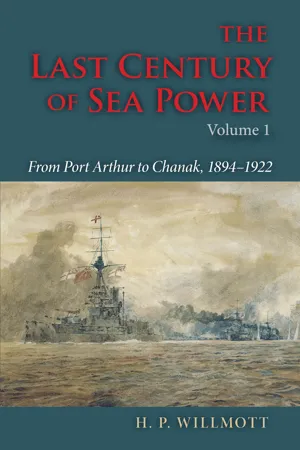
eBook - ePub
The Last Century of Sea Power, Volume 1
From Port Arthur to Chanak, 1894–1922
- 568 pages
- English
- ePUB (mobile friendly)
- Available on iOS & Android
eBook - ePub
About this book
Information
PART 1

DEFINITIONS
AND TERMS OF
REFERENCE

INTRODUCTION
THE COMING OF THE NEW millennium invited any number of histories, real and alleged, constructed on the basis of noughts. It is one of the curses of history that, depending on the prejudices of the writer, either a decade or a century is an age, its counterpart an era, and that in neighboring periods there are elements of contrast that so determine character. In reality, history concerns itself with elements of constancy and change, and very seldom affords consideration to simplistic, single-cause representation and for very obvious reason: for every complicated human problem there is a simple explanation, which is neat, plausible, and invariably wrong.

Within two decades of the end of the Second World War the British historian Stephen Wentworth Roskill (1903–1982), writing in The Strategy of Sea Power, set out definitions of sea power and its constituent elements.1 One would provide one’s own definition of the historical role of naval power, which is that
The purpose of sea power is to ensure in times of war those rights automatically commanded in times of peace, specifically the security of homeland and overseas possessions against raid and invasion and of sea-borne trade, while denying those same rights to an enemy in terms of the conduct of amphibious operations and attacks on shipping.2
The crucial point herein is that while in a general war the offensive use of sea power in terms of assault or landing on enemy territory cannot necessarily be undertaken before and until a measure of defensive primacy has been secured, the line of demarcation between the offense and defense at sea is very different from that ashore, and battle itself is very different. The battle at sea does not possess those elements such as rivers, mountains, lines of communication, and settlement that ashore spell out the difference between offense and defense: the battle at sea has terms of reference supplied by latitude and longitude, daylight hours, and factors of time and distance that necessarily ally themselves with coastline and off-shore hazard. The battle at sea has to be fought repeatedly over the same reaches of sea and ocean in a way that the battle on land does not, and lest the point be doubted reference may be made to just one war and campaign. In the course of the Second World War the German offensive against shipping was defeated in May 1945. Various commentators—one hesitates to use the word “historians”—have tended to focus upon the month of May 1943 as the time when the German campaign againstAllied shipping was defeated, and it cannot be denied that in this month the German U-boat offensive suffered a defeat singular in significance. In this single month the German Navy lost no fewer than forty-one U-boats from all causes, and this total stands in very sharp contrast to the totals of nine, twenty-four, thirty-five, and eighty-seven U-boats lost to all causes in (3 September–31 December) 1939, 1940, 1941, and 1942, respectively. But the point was that the victory that was won by Allied forces in May 1943 had to be repeated until the very end of the European war, and Allied shipping had to be provided with escort and nonetheless took losses virtually to the very last day of the German war. The victory that was won in May 1943 was indeed repeated, most obviously in July–August and again in October–November 1943, and the victories that were recorded in these subsequent months were every bit as important as the victory won in May for the very simple reason that these subsequent losses were sustained by a U-boat service that had been re-organized, re-equipped, and committed afresh to the campaign in the North Atlantic. Losses in July and August 1943 were thirty-seven and twenty-five, respectively, and in October and November twenty-six and nineteen, respectively,3 and in terms of the war at sea and the proper recounting of history the crucial point is to see these subsequent Allied successes in terms of complementary victories, not episodes complete in their own right. The victories that were won between May and November 1943 undoubtedly served to ensure that the initiative at sea passed finally and irreversibly into Allied hands, but the basic reality—that the defensive commitment remained until the end of the war and that the victories of 1943 had to be fought for and won every week, every month, of what remained of the war—cannot be gainsaid.
One is very conscious that in setting out such an argument one comes close to infringing upon a related matter, the impermanence of victory, which comes associated with its complementary point, namely that great powers are not powers that win wars but powers that lose wars but keep going: defeat and failure, and the reaction to failure and defeat, are the measure of a great power, not victory—the weakness of this particular argument being that it would suggest that perhaps the greatest of all powers was Austria-Hungary. That final point aside, the nature of sea power and its related parts demand definition. With reference to the latter Roskill set out naval power in terms of fleets and warships, industrial infrastructure and bases, merchant and fishing fleets, and trained manpower, and with reference to the merchant and fishing fleets and trained manpower there was the obvious link in terms of the former in part providing navies in times of war with manpower trained in the ways of the sea. The element of impermanence to which reference was made presents itself herein because one can seriously question, on the basis of Roskill’s definition, what presently provides the foundation of sea power for such countries as the United States and Britain. These two countries were, at the end of the Second World War, possessed of naval strengths that rendered them impervious to challenge at sea, yet at the present time, in the first decade of the new millennium, Britain most certainly does not possess the industrial basis of Roskillian naval power and obvious question marks must be set against the United States in this same dimension: in 1990 the U.S. Navy had to go to suppliers in no fewer than eight countries in order to ready itself for war in the Middle East, a state of affairs that in industrial terms would have been unthinkable even twenty years previously, during the Vietnam War. No less obviously, the lack of shipping lines and trained manpower reserves were barely finessed by the U.S. Navy in 1990 when septuagenarians had to man the engine rooms of supply transports from the reserve that should have been scrapped and replaced at least one, perhaps two, decades earlier. The simple fact is that changed patterns of production, and certainly for European navies the lack of bases beyond Europe, necessarily have involved new definition of the role of naval power, and in ways that would never have been given real consideration even as late as the 1960s and 1970s. And to these matters there is a codicil. The Japanese dimension of the Second World War was unusual in the sense that this was a war decided by sea power, and it was very unusual in the sense that it was decided by sea power directed across an ocean, and it was a war that was won primarily by naval power. Certainly the American effort was necessarily joint in a way seldom properly defined, but the basic pattern was that land-based air power neutralized objectives, naval power isolated the latter, and amphibious assault then secured islands and airfields from which the process began anew. But the basis of this effort was naval: it was the sea that carried supplies for both the air and military endeavors. It was the U.S. Navy that was the main agency of American national power in the war in the Pacific, and at war’s end the U.S. Navy had its own air force—the air groups of the fleet and escort carriers—and its own military, the U.S. Marine Corps. By 2003, and say it sotto voce, the U.S. Marine Corps had its own navy. The basic point herein is that in times of peace navies always fare badly: their costs are high and invariably they, historically, took second place to armies. The period immediately after the Second World War conformed to historical precedence, but in the 1950s and 1960s the navies of the great powers were to be strengthened institutionally by the vesting of the main elements of strategic deterrence in submarines, while carriers recovered if not their numbers then their relevance in the aftermath of the Korean War. With the end of the Cold War, however, navies have come under pressure on four counts: the strategic nuclear deterrence role may still be in place but it is of dubious relevance; the demands of peace-enforcement and peace-keeping necessarily are directed primarily to armies, not navies; navies, and particularly the U.S. Navy, have been overtaken by air forces and now are third in the defense pecking order; and the sheer cost of units in terms of money and manpower places obvious question marks against future role and capability. It may very well be that navies, no longer facing blue-water enemies and with very limited capacity to engage targets ashore, are in a decline that will mark the end of their role as defined by fleets in two world wars and summarized by Roskill, and that in the future their role will be with those secondary aspects of sea power, such as suppression of smuggling, piracy, and slavery, that previously have been dismissed as unbecoming. It is perhaps worth noting that by 2007 the British Navy had reached a point of decline, specifically in the number of warships in commission, that really pointed to a decline of status that corresponds to that of the nineteenth-century Dutch Navy.
But in setting out these matters, and these are presented as the basis of discussion and not definitive, one must note the obvious, namely that so many accounts of proceedings set out sea power and naval power as the same, whereas in reality sea power embraces very distinct naval and maritime parts. The story of sea power is not simply concerned with naval formations and units and with the nature and conduct of war, and operations, at sea: matters relating to merchant shipping, the volume and nature of sea-borne trade, and the relationship between (on the one side) power, industry, and commerce and (on the other) the sea need be defined because the various elements herein are complementary. This point is so obvious that it is very seldom addressed. For example, very few accounts of the campaigns against shipping in the two world wars of the twentieth century provide proper analysis of the merchant fleets, cargo capacity, and the ship-building and maintenance facilities of the major combatant states, and most certainly such matters relating to neutrals are even less well documented even though in the First World War the importance of neutral shipping to British survival and Allied victory is not to be under-estimated: in the Second World War such nations as Denmark and Norway, the Netherlands, Belgium and France, and Greece contributed significantly to eventual Allied victory by virtue of their shipping despite defeat and occupation by German forces. Likewise, while accounts of the defeat of the German campaigns against shipping concentrate primarily upon such matters as the gradual extension and increased effectiveness of convoy, the resultant reduction of shipping losses to manageable proportions, and U-boat losses, such matters as the volume of imports arriving in ports, the state provision of objectives and rationing priorities, and details of ship requisitioning are seldom afforded much in the way of attention and consideration in naval histories. The fact is, however, that between August 1914 and October 1918 the British Transport Department provided tonnage sufficient to ensure no fewer than 23,700,000 individual passages—the equivalent of one for every two people in the British Isles—while transports dispatched almost 50,000,000 tons of military stores and supplies, 500,000 guns and motor vehicles, and 2,200,000 animals from British ports to various theaters of operation. The total of military stores and supplies dispatched as part of the national capacity to wage war represented the equivalent of a year’s total imports prior to the outbreak of war, yet in most naval histories these are matters that are seldom afforded even as much as historical footnotes.4
Sea power, in its historical context, has been concerned with naval power and the use of the sea, and in seeking to set out the story of sea power and the twentieth century the two parts necessarily need to be considered together in setting out the definition of the twentieth century. How one defines the twentieth century is a matter of personal persuasion and prejudice, but leaving aside the dictates of chronological exactness and thereby discarding the 1901–2000 option, one would suggest that there are three possible naval matters that might provide a suitable start line: the Russo-Japanese War of 1904–1905, the Spanish-American War of 1898, and the Sino-Japanese War of 1894–1895. One would suggest that in many ways the claims of the second, the Spanish-American War, really do provide a suitable point of departure, and on two counts: it was primarily a naval war and one that involved the defeat of a European imperial power—albeit one long past its peak—by a non-European state, and it was a war in which one battle, fought on 1 May 1898 in Manila Bay, may be regarded as the last battle of the Age of Sail. It was an action fought on the one side by five American cruisers and two gunboats and on the other by four Spanish cruisers, three gunboats, and three other vessels. The Spanish warships, inferior in gun power and of dubious seaworthiness, were anchored under the cover of guns in the fortified base of Cavite. Why this action should be considered the last battle of the Age of Sail is on account of the nature of the action. It was fought without reference to mines, torpedoes, and submarines, and it was fought without reference to central gunnery control systems, radio, airships, and aircraft, all of which were to figure so prominently in war at sea in the twentieth century. It was a battle fought in line ahead with broadsides at ranges that were reduced to 250 yards/230 m, at which distance, and with no means of aiming other than the eye, thirty-nine rounds in every forty still managed to miss their intended target. It was an action that should immediately invoke thoughts of Quiberon Bay (20 November 1759), the Nile (1 August 1798). and, particularly, first and second Copenhagen (2 April 1801 and 2–7 September 1807) in terms of pedigree. Despite the fact that the warships in Manila Bay in May 1898 we...
Table of contents
- Cover
- Half title
- Tilte
- Copyright
- Dedication
- Contents
- List of Maps
- Preface and Acknowledgments
- Part 1. Definitions and Terms of Reference
- Part 2. From Port Arthur to Bucharest, 1898 to 1913
- Part 3. From Sarajevo to Constantinople, 1914 to 1922
- Part 4. Not So Much Finis as . . .
- Chronology of the First World War at Sea
- Notes
- Selected Bibliography
- General Index
- Index of Warships, Auxiliaries and Merchantmen, and Submarines
Trusted by 375,005 students
Access to over 1.5 million titles for a fair monthly price.
Study more efficiently using our study tools.
Frequently asked questions
Yes, you can cancel anytime from the Subscription tab in your account settings on the Perlego website. Your subscription will stay active until the end of your current billing period. Learn how to cancel your subscription
No, books cannot be downloaded as external files, such as PDFs, for use outside of Perlego. However, you can download books within the Perlego app for offline reading on mobile or tablet. Learn how to download books offline
Perlego offers two plans: Essential and Complete
- Essential is ideal for learners and professionals who enjoy exploring a wide range of subjects. Access the Essential Library with 800,000+ trusted titles and best-sellers across business, personal growth, and the humanities. Includes unlimited reading time and Standard Read Aloud voice.
- Complete: Perfect for advanced learners and researchers needing full, unrestricted access. Unlock 1.5M+ books across hundreds of subjects, including academic and specialized titles. The Complete Plan also includes advanced features like Premium Read Aloud and Research Assistant.
We are an online textbook subscription service, where you can get access to an entire online library for less than the price of a single book per month. With over 1.5 million books across 990+ topics, we’ve got you covered! Learn about our mission
Look out for the read-aloud symbol on your next book to see if you can listen to it. The read-aloud tool reads text aloud for you, highlighting the text as it is being read. You can pause it, speed it up and slow it down. Learn more about Read Aloud
Yes! You can use the Perlego app on both iOS and Android devices to read anytime, anywhere — even offline. Perfect for commutes or when you’re on the go.
Please note we cannot support devices running on iOS 13 and Android 7 or earlier. Learn more about using the app
Please note we cannot support devices running on iOS 13 and Android 7 or earlier. Learn more about using the app
Yes, you can access The Last Century of Sea Power, Volume 1 by H. P. Willmott in PDF and/or ePUB format, as well as other popular books in History & 20th Century History. We have over 1.5 million books available in our catalogue for you to explore.