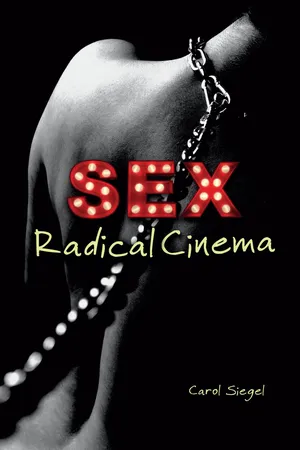
In this provocative study of cinematic and televisual representations of "sex radicalism," Carol Siegel explores how representations of sexually explicit content on film have shaped American cultural visions of sex and sexual politics in the 21st century. Siegel distinguishes between a liberal approach to visual representations, which has over-emphasized normative equal opportunity while undervaluing our distinctive erotic selves, and a radical approach to visual representation, which portrays forbidden sexualities and desires. She illustrates how visual media participates in and even drives political policies related to pedophilia, prostitution, interracial relationships, and war. By examining such popular film and television shows as Mystic River, The Wire, Fifty Shades of Grey, Batman Returns, and the HBO hits, Sex and the City and Girls, Siegel takes the discussion of radical sex in the movies out of the margins of political discussions and puts it in the center, where, she argues, it has belonged all along.
- 244 pages
- English
- ePUB (mobile friendly)
- Available on iOS & Android
eBook - ePub
Sex Radical Cinema
About this book
Information
Subtopic
Film History & Criticism1AMERICA’S VIRGINITY FETISH AND THE MYSTERIES OF CHILD MOLESTATION
CHILD MOLESTATION IS, and has been for decades, one of American’s current greatest obsessions. As of this writing, the Internet Movie Database lists 386 films and television series or episodes in which pedophilia or the sexual abuse of a child or children is a key plot element. But this is by no means a complete list. It leaves out dozens of horror and straight-to-video action films in which sexual molestation of a child motivates the heroic actions of an avenging hero or heroine, as well as many films that reference molestation as a motivation for a character’s behavior or emotional responses without actually showing the molestation. Leaving aside the numerous documentaries on the topic, many of which deal with child molestation within the Catholic Church, a short list of well-known films made in recent years that dramatize and unambiguously condemn the damage done by pedophiles includes the following: The Boys of St. Vincent (dir. John N. Smith, 1992), Sleepers (dir. Barry Levinson, 1996), Bastard Out of Carolina (dir. Angelica Huston, 1996), Adrian Lyne’s remake of Lolita (1997), A Thousand Acres (dir. Jocelyn Moor-house, 1997), Happiness (dir. Todd Solondz, 1998), The Woodsman (dir. Nicole Kassell, 2004), La mala education (Bad Education, dir. Pedro Almodóvar, 2004), Hard Candy (dir. David Slade, 2005), The Kite Runner (dir. Marc Forster, 2007), Precious (dir. Lee Daniels, 2009), and Big Bad Wolves (dir. Aharon Keshales and Navot Papushado, 2013). As is the case in the last film listed, numerous films and television episodes treat child molestation as intrinsically connected to murder, suggesting that the ultimate aim of all pedophiles is to kill children. Many others, such as Hannibal (dir. Ridley Scott, 2001), feature torture deaths of pedophiles, presented as entirely justified due to the terribleness of the men’s crimes. Other traditions of dramatizing the damage done by pedophiles follow different traditions. For instance, the film Precious is true to Sapphire’s novel, Push (1996), on which it is based. Both follow the tradition of the landmark novels I Know Why the Caged Bird Sings by Maya Angelou (1969), The Bluest Eye by Toni Morrison (1970), and The Color Purple by Alice Walker (1982) in representing the sexual abuse of black girls as both a brutal reality and an emblem of the oppression of their race. In the challenge they represent to traditional patriarchal domination of children, they are radical. However, in that their treatment of pedophilia reflects and promulgates current cultural ideology, which holds pedophilia to be the worst possible moral failing, they are liberal rather than radical. Moreover, most films that depict childhood and adolescent sexual experiences uphold the traditional construction of youth as a time of sexual purity that is foundational to the vision of intergenerational sex as inevitably being monstrous violation.
In this chapter I first examine a group of films that, through contrast with one another, provide an overview of international cinematic treatments of the loss of virginity, a narrative topic that reveals much about current constructions of female sexuality and their often surprisingly close relation to concepts of the sexuality of children. In particular, Catherine Hardwicke’s Thirteen (2003) and Catherine Breillat’s À ma soeur! (2001, released as Fat Girl in the United States) are shown to reveal much about how basically laudable liberal feminist attempts to protect young girls can go tragically awry because of their insistence on totalizing female and youthful sexualities. I then discuss two films that offer opposed perspectives on child molestation—one, Mystic River (2003), directed by Clint Eastwood, that was well received and adheres to the conventions of liberal representation of the crime but takes them to an unsettling extreme, and another, Mysterious Skin (2004), directed by Gregg Araki, that received more negative attention and is equally disturbing, but for truly radically different reasons.
From the onset I want to emphasize again that I do not advocate changes in statutory rape laws, although some of the queer theorists and sexuality studies authors I cite do. Recommending legislative changes is beyond the scope of this book. As Chuck Kleinhans observes, “We live in a time of contested understandings of childhood,” and as a result “of proliferating erotic images of children, other forces at many social levels attempt to control and contain child sexuality, especially in image culture,” and this is as true of art and popular cinematic allusions to the sexual experiences of children and adolescents as it is of anything that could be called pornographic (71). The point of the chapter is to show that by attending to sex radical cinematic representations of young people’s sexuality, we can gain useful understanding of the complexities involved in regulating the sexuality of minors for their own protection. Perhaps, too, we can begin to understand how a liberal approach to protecting the young from premature sexual experiences can sometimes unexpectedly increase the problems of victims of sexual abuse by denying their own feelings and silencing their voices.
But before discussing these films, for the necessary contextualization it offers, I take a long look at the fetishization of childhood purity that serves as the foundation of our culture’s consuming fear that the young will be sexually corrupted. Controversial as this statement might initially seem, it becomes easier to understand the panic white people often exhibit about the possible effects of integration on their children if we can acknowledge that African Americans often do seem to have more progressive ideas about sexuality than mainstream white people, at least as those ideas are expressed in popular culture media, including the movies.
One might not reach this conclusion from talking to African American feminist scholars, who are often engaged in counteracting the racist myth of the hypersexualized black woman, but as Shayne Lee provocatively puts it, “While Black feminist scholars patrol the airways for degrading images of women, African-American women in popular culture recommence a legacy of insubordination against the politics of respectability” (xii). In his celebratory survey of fictional and self-help books, television shows, comedy performances, and popular music, Lee emphasizes a subordinated culture in which black women consistently represent themselves as “sensual, sexual beings” with agency rather than as the nasty animals in heat that the mainstream culture has often deemed them. He also demonstrates ways that this culture has spoken back to the racism of a mainstream that demands that they must be either sexless Mammies or whores available to all men (41). Lee attributes his sense that sexual activity can empower women to having grown up in “an unprecedented era where Black women in popular culture champion[ed] sexual agency in the public sphere” (109, 124).1
The tendency of African Americans to be less rigidly judgmental about sexual issues than whites was a major issue during the Clinton-Lewinski scandal, for example, when “no constituency [was] more visible in its support for the beleaguered president than African Americans. And no group of lawmakers may be more critical in protecting him against an increasingly hostile Congress than the Black Caucus,” according to an article in the Washington Post by Ceci Connolly and Robert Pierre, who attribute this loyalty to the tradition of forgiveness within their communities. Obviously, attitudes about sex are not racial characteristics, but, if they exist at all, are created by specific cultures. Thus, for instance, British people of African descent, like the filmmaker Steve McQueen, may exhibit the same sort of liberal but majoritarian antisex attitudes that characterize white Americans in the mainstream, as are on display in McQueen’s 2011 film, Shame, which dramatizes the sufferings of a victim of so-called sex addiction, in this case a single man who pursues casual sexual encounters and masturbates.
In contrast to McQueen’s drama, African American romantic comedies typically provide interesting examples of attitudes about sexuality that seem markedly different from those of the American white mainstream, as I discuss in New Millennial Sexstyles. A case in point is Jumping the Broom (2011), directed by Salim Akil and written by Elizabeth Hunter and Arlene Gibbs. The story seems intended to appeal to a religious conservative audience, but that audience is also obviously imagined as African American. The film begins with Sabrina (Paula Patton), a successful and beautiful young black woman from a wealthy family, suffering humiliation and profound disappointment when the morning after a casual sexual encounter, she overhears her partner speaking sweetly of the love he feels. She believes he is talking to her, until she realizes that he is on his cell phone with another woman. She promises God not to have sex again until after marriage but in return asks him to find her a soul mate. When the soul mate, in the form of up-and-coming Jason (Laz Alonso), is divinely delivered to her, their wedding nearly fails to take place due to the machinations of the groom’s possessive, postal clerk mother, Pam (Loretta Devine). Pam feels threatened by the wealth and privilege of the bride’s family, whose mansion on Martha’s Vineyard is stunningly impressive and whose French-speaking maternal line is represented by snobbish Claudine (Angela Bassett), the bride’s mother. Claudine proudly explains that their ancestors never were slaves and instead had slaves.
“Jumping the broom” is the symbolic act that can bring together the two family traditions. If the bride chooses to include it in the wedding ceremony, then the legacy of African American practices developed in resistance to slavery will be brought into the ceremony that otherwise represents the groom’s entry into the bride’s world of upper-class privilege. Subplots include the revelation that the bride is the biological daughter of the woman she knows as her aunt Geneva (Valarie Pettiford), a sexy cosmopolitan singer; Claudine’s struggle with her husband’s withdrawal from her because of his guilt about having lost the bulk of her family fortune through bad investments; and the efforts of Sebastian (Romeo Miller), a small and very young-looking twenty-year-old on the bride’s side of the family, to seduce Shonda (Tasha Smith), the big, sexy, over-forty best friend of the groom’s mother.
There are several notable features of the film in relation to mainstream—that is, white—advocacy of premarital abstinence. No one, including the avuncular minister who performs the ceremony, pressures the young couple to be celibate prior to marriage. One might compare his sophisticated acceptance of premarital sexuality to that of some of the exemplary preachers and authors of religious instructional texts discussed by Lee in his chapter “Black Clergywomen and Sexual Discourse” (82–94), whose “books and sermons provide honest discourses on sexual realism” despite the “regressive elements of their sexual politics” that come from their religious conservatism (90).
Instead of depicting Sabrina and Jason’s decision to maintain celibacy until marriage as demanded by their religion, the film represents it as a free and idiosyncratic choice. Yet the members of both families are clearly very religious, often referring to having “prayed on” this or that decision. And both families are sexually respectable in their own ways. Pam is obviously proud of the broom she and her husband jumped at their wedding, which represents her son’s legal legitimacy, although this is not explicitly mentioned. And proper Claudine reacts with moral outrage when it is suggested (erroneously) that her husband is having an affair. But both families treat Sabrina’s vow to God as bizarrely loony; no one expresses disapproval of Jason’s explanation that keeping the vow has necessitated a lot of masturbation; no one expresses disapproval of the promiscuity Sabrina enjoyed before making the vow or that of her best friend, Blythe (Meagan Goode), who continues to have sex as she pleases; and, finally, no one expresses disapproval of Sabrina’s biological mother’s having had an affair when she was sixteen years old, only of her having given up the baby to her sister and then later trying to be recognized as the girl’s real mother. Sebastian’s attempts to seduce Shonda, who is easily old enough to be his mother, are treated jocularly by all, although some, including Shonda, jokingly claim that if she responded to his advances it could be considered statutory rape. When he finally succeeds in getting her to make out with him and acquires her email address so that they can arrange to consummate their relationship, everyone seems amused but approving. Consequently, the film’s message about abstinence is that this can be a good choice for mature people (the groom says he respects the bride because of her adherence to her promise to God), but there is no reason to impose it on the young. Much more important than when one has sex and with how many partners is the maintenance of family values, here defined insistently as acceptance of all family members no matter what their histories or current social status.
The film has two emotional climaxes. The first comes when Sabrina’s parents invite Geneva, her biological mother, to join hands with them as all three stand to proudly give the bride away. The second comes when Sabrina insists on what she had rejected before as déclassé, jumping the broom with her new spouse. Forgiveness is not necessary to acceptance, because no one is seen as more of a sinner than anyone else. But understanding is. Jason’s mother and his extended family dislike Sabrina’s family because of their wealth and privilege, seeing them as pretentious and false (speaking like whites), while the members of Sabrina’s family are mostly horrified by the vulgarity of Jason’s working-class family. They must all learn that their race and its traditions, including belief in God, are what unites them. Legal marriage is important to sex because it extends the family, creating larger units of relationship and acceptance. That Sabrina will never know her biological father (a married Frenchman who, because Sabrina has very light skin, presumably was white) is somewhat sad. But the revelation of her true parentage is ultimately joyous because she has gained new relatives to love.
Choice is also strongly emphasized, both explicitly, in Sabrina’s decision to become abstinent until marriage, and implicitly, although in keeping with American films generally, religious or secular, in that abortion is not mentioned as an option for pregnancies outside marriage. The groom, Jason, chooses first to identify with a higher social class than his education and success allows him to enter, then to solidify that new identity by marrying far above his original station, and finally to move to China with his new bride because of the career opportunity she has there. Sabrina chooses not only how to manage her sex life but also how to prioritize her career so that Jason must move with her or lose her. And most importantly to the plot, she chooses whom she will recognize as family, deciding in favor of a generous (and in Deleuzian terms, minoritarian) inclusivity.
This vision resonates with the depictions of the relation of female sexuality to family life depicted in the magnificent climax of Julie Dash’s influential feminist film, Daughters of the Dust (1991), which depicts the struggle of the Peazants to preserve their history and traditions on the eve of their diasporic journey from the Sea Islands. As Toni Cade Bambara observes, the film presents “family as a liberated zone, women as a source of value,” as is exemplified when the matriarch insists that they all embrace Yellow Mary, a formerly prostituted lesbian, and Eula, a pregnant rape victim, as no different or less morally upright than the rest of them (121). As J. Jack Halberstam shows, although it is light entertainment, Jumping the Broom, like Daughters of the Dust, focuses on the survival of the black family and by extension the black community, a focus that is typical not only of “black wedding films,” but of African American cinema generally (Gaga Feminism 124). Quite radically, the way the family expands to embrace people whose sexual histories and even current practices the dominant white culture deems immoral is offered as being in accord with Christian values.
The theme of intergenerational sex, represented by Sebastian’s seduction of Shonda and by Geneva’s love affair at sixteen with an older man, and the theme of young people’s premarital sex with youthful peers, represented by Sabrina’s behavior before making her vow and by Blythe, who does not choose celibacy (but is still given a true love of her own), are shown to create occasions for indulgent understanding. Young people have strong sex drives, and adults must accept that the young will act on these feelings, sometimes in ways that are inconvenient to the maintenance of strict social standards, such as containing procreation within marriage. The tension between young sexuality and respectability is treated as being primarily funny, as is dramatized when Shonda fends off and then gives in to Sebastian’s insistent advances, laughing merrily all the while.
This comedic treatment of a young person’s successful attempt to alleviate horniness is much different from the near hysterical view of youthful sexuality offered in most films made about white people for predominantly white (or unmarked) audiences. Robin Bernstein gives a plausible explanation for this phenomenon in Racial Innocence: Performing American Childhood from Slavery to Civil Rights. She argues that while “by the mid-nineteenth century, sentimental culture had woven childhood and innocence together wholly . . . this innocence was raced white” (4). White children were seen as delicately vulnerable not only to sexual corruption but also to the physical dangers it might bring, yet black children were understood to be impervious to pain and thus immune to dangers of sexual corruption. Cultural scripts enacted through all sorts of performances, from minstrel shows to children’s play with dolls, reinforced the “libel that African American juveniles were invulnerable” and thus in no need of protection from sexuality, which was otherwise considered a deathly threat (42). Therefore anxiety about youthful sex has come down to us as a specifically white concern. This disagreeable scripting appears as a subtext in many films about white American girls’ initiations into sexuality, as will become evident through comparison of two films that represent opposed views of girls’ first sexual experiences: À ma soeur! and Thirteen.
Since the first wave of feminism as a political movement in the nineteenth century, women’s narratives of girls’ sexual initiation have been taken increasingly seriously as authoritative sources for creating generalized concepts of female sexuality. While such narratives almost always receive respectful attention from feminist critics as correctives to traditional, masculinist perspectives on female sexuality, they are also usually stripped of their particularity and incorporated into feminist theories as evidence for some posited areas of commonality among women. The construction of an agreed-upon account of female sexual development is necessary to psychoanalytic theory, which provides our primary approach to understanding sexuality, because the emphasis on the unconscious in the putative science of the mind calls into question the accuracy of individual women’s memories of our own sexual awakening, which might otherwise challenge the idea that because of our gender we share a basic sexuality. However, construction of a consensus is also necessary to women’s collective contestation of the misogynistic view of female sexuality that is central to...
Table of contents
- Cover
- Half title
- Title
- Copyright
- Dedication
- Contents
- Acknowledgments
- Introduction: Recent Changes in the Representation of Sex and Politics in American Cinema
- 1 America’s Virginity Fetish and the Mysteries of Child Molestation
- 2 Sex Trafficking Films, or Taken for a Ride
- 3 Sex and Antimilitarism
- 4 Interracial Sex and Architectures of American Horror
- 5 Tim Burton’s Films, Children, and Perversity
- Conclusion: The Future, No Future
- Notes
- Bibliography
- Index
Trusted by 375,005 students
Access to over 1.5 million titles for a fair monthly price.
Study more efficiently using our study tools.
Frequently asked questions
Yes, you can cancel anytime from the Subscription tab in your account settings on the Perlego website. Your subscription will stay active until the end of your current billing period. Learn how to cancel your subscription
No, books cannot be downloaded as external files, such as PDFs, for use outside of Perlego. However, you can download books within the Perlego app for offline reading on mobile or tablet. Learn how to download books offline
Perlego offers two plans: Essential and Complete
- Essential is ideal for learners and professionals who enjoy exploring a wide range of subjects. Access the Essential Library with 800,000+ trusted titles and best-sellers across business, personal growth, and the humanities. Includes unlimited reading time and Standard Read Aloud voice.
- Complete: Perfect for advanced learners and researchers needing full, unrestricted access. Unlock 1.5M+ books across hundreds of subjects, including academic and specialized titles. The Complete Plan also includes advanced features like Premium Read Aloud and Research Assistant.
We are an online textbook subscription service, where you can get access to an entire online library for less than the price of a single book per month. With over 1.5 million books across 990+ topics, we’ve got you covered! Learn about our mission
Look out for the read-aloud symbol on your next book to see if you can listen to it. The read-aloud tool reads text aloud for you, highlighting the text as it is being read. You can pause it, speed it up and slow it down. Learn more about Read Aloud
Yes! You can use the Perlego app on both iOS and Android devices to read anytime, anywhere — even offline. Perfect for commutes or when you’re on the go.
Please note we cannot support devices running on iOS 13 and Android 7 or earlier. Learn more about using the app
Please note we cannot support devices running on iOS 13 and Android 7 or earlier. Learn more about using the app
Yes, you can access Sex Radical Cinema by Carol Siegel in PDF and/or ePUB format, as well as other popular books in Media & Performing Arts & Film History & Criticism. We have over 1.5 million books available in our catalogue for you to explore.