A study of the musical discourse among Ottoman Greek Orthodox Christians during a complicated time for them in the nineteenth and early twentieth centuries.
During the late Ottoman period (1856–1922), a time of contestation about imperial policy toward minority groups, music helped the Ottoman Greeks in Istanbul define themselves as a distinct cultural group. A part of the largest non-Muslim minority within a multi-ethnic and multi-religious empire, the Greek Orthodox educated elite engaged in heated discussions about their cultural identity, Byzantine heritage, and prospects for the future, at the heart of which were debates about the place of traditional liturgical music in a community that was confronting modernity and westernization. Merih Erol draws on archival evidence from ecclesiastical and lay sources dealing with understandings of Byzantine music and history, forms of religious chanting, the life stories of individual cantors, and other popular and scholarly sources of the period. Audio examples keyed to the text are available online.
"Merih Erol's careful examination of the prominent church cantors of this period, their opinions on Byzantine, Ottoman and European musics as well as their relationship with both the Patriarchate and wealthy Greeks of Istanbul presents a detailed picture of a community trying to define their national identity during a transition. . . . Her study is unique and detailed, and her call to pluralism is timely." —Mehmet Ali Sanlikol, author of
The Musician Mehters
"Overall, the book impresses me as a sophisticated work that avoids the standard nationalist views on the history of the Ottoman Greeks." —Risto Pekka Pennanen, University of Tampere, Finland
"This book is a great contribution to the fields of historical ethnomusicology, religious studies, ethnic studies, and Ottoman and Greek studies. It offers timely research during a critical period for ethnic minorities in the Middle East in general and Christians in particular as they undergo persecution and forced migration." —
Journal of the American Academy of Religion
eBook - ePub
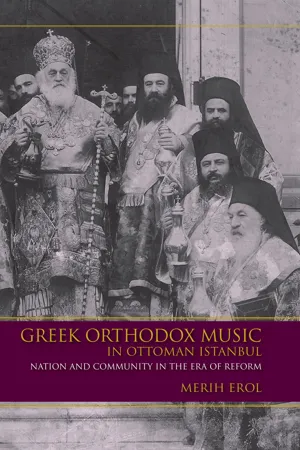
Greek Orthodox Music in Ottoman Istanbul
Nation and Community in the Era of Reform
- 288 pages
- English
- ePUB (mobile friendly)
- Available on iOS & Android
eBook - ePub
About this book
Trusted by 375,005 students
Access to over 1.5 million titles for a fair monthly price.
Study more efficiently using our study tools.
Information
Subtopic
Middle Eastern History1 The City’s Greek Orthodox
An Overview
The Rum Millet in the Era of Reforms
Around the mid-nineteenth century, Ottoman statesmen initiated extensive reforms to bring the empire into the fold of a new and modern administrative model. They were inspired by the system of state and society in Europe. More precisely, Ottoman bureaucrats introduced reforms and new institutions in the legal and fiscal realms with the aim of centralizing the administration and taxation of the empire’s subjects. Arguably, in order to save the empire, they tried to create an imperial system of governance based on universal laws. They introduced new notions of government and a new concept of authority that heralded radical changes both in the administration of the millets1 and in the relations between the sultan and his subjects. The reforms ultimately had important consequences for Ottoman subjects’ view of their polity and their imaginings of the future. The ground-work for this official attempt to redefine and reshape the nature of the Ottoman government was laid during the reign of Mahmud II (r. 1808–1839), which saw several separatist uprisings in the Balkans and the eventual emergence of an independent Greek state. With the promulgation of the Hatt-ı Şerif (Imperial Rescript of Gülhane) on November 3, 1839, a period of reforms began that is generally referred to as the Tanzimat era (1839–1876). With the edict, Muslim and non-Muslim subjects were made equal before the law, at least in principle, and the notion of a state based on law was promoted.2
Two decades later, a new reform decree, the Islahat Fermanı (Imperial Rescript of Reform), which consolidated the spirit of the Tanzimat, was declared by the Ottoman government almost simultaneously with the Congress of Paris in 1856, which was held to make peace after the Crimean War. The Tanzimat reforms were encouraged, if not “dictated” by liberal Europe, especially Great Britain. In this state of affairs, Ottoman bureaucrats realized that domestic reform was linked with international recognition.3
Within the new framework introduced by the Tanzimat, the Ottoman state recognized the Orthodox Christians of the empire as the Rum millet and institutionalized its privileges as belonging to the millet, not to its religious leader, the patriarch, as had previously been the case.4 The Islahat Fermanı (1856) further recognized the Orthodox patriarch of Constantinople as the only interlocutor regarding the affairs of the Orthodox Christians in the empire. For instance, the latter’s demands for church construction or establishing other institutions was to be conveyed to the imperial government through the patriarch, who had full control over them. Another significant change was that the millet leaders, the Greek Orthodox and Armenian patriarchs, and the hahambaṣi of the Jews were now held responsible for the “homogenization” of their communities and their harmonious integration into the broader society.
A careful analysis is required in order to fully grasp the new challenges the millet leaders faced. As Sia Anagnostopoulou has cogently noted, along with the new regulations, those spiritual leaders’ authority over their millets was undermined, as they had now become agents of lay education and the secularization of the institutional framework of the millets.5 Further complicating matters was the fact that, within the Tanzimat framework, the religious leaders of the millets had to legitimate not only their spiritual but also their political authority, as the “millet” in the nineteenth century was no longer just a traditional-religious but also a modern political entity.6
The mid-century reforms continued to recognize the religious foundation of the millets while at the same time creating new hierarchies in them. In the spirit of the reforms, the Greek Orthodox, Armenian (Apostolic Church), and Jewish millets enacted statutes (nizamname) in 1862, 1863, and 1865, respectively, for the regulation of their internal administrations.7 The General Regulations (Genikoi kanonismoi) were an attempt at administrative reorganization. According to these, the Rum millet would be administered by two organs: the Holy Synod, composed of twelve Metropolitans; and the Permanent National Mixed Council, composed of eight lay and four clerical members. The former would appoint bishops and be responsible for the spiritual affairs of the millet. The latter would deal with non-spiritual issues, for instance, supervising the functioning and financing of the schools, hospitals, and similar institutions of the millet.8 In the new state of affairs, obviously, the church had to share power with the lay element. Due to their economic power, the voice of the lay members of the community was heard more and more in the decision making about community affairs. Nevertheless, in the Rum millet, the religious establishment and the clerical element were still very powerful, especially in comparison to the overwhelming authority of the lay people in Armenian and Jewish millets.9
A bone of contention between the leaders of the Rum millet and the Ottoman government throughout the second half of the nineteenth century was the issue of communal privileges.10 These privileges guaranteed a degree of autonomy to the Greek Orthodox millet primarily in the realms of religion, family affairs, and education. In the Tanzimat era, some segments of the Rum millet—especially the Greek Orthodox clergy—saw the principle of equality, which was enacted by the previously mentioned two imperial edicts, as a threat to the privileges the Greek Orthodox came to hold as a community. They insisted on communal privileges and further demanded that any new privileges had to be conferred on them as a distinct community, not as Ottomans.11
In the second half of the nineteenth century, the Greek Orthodox millet was more autonomous in its internal affairs in comparison to the previous decades and centuries.12 What might this mean in terms of the existence or the intensity of intercommunal contacts in daily life? Research on Ottoman non-Muslims in the seventeenth and eighteenth centuries has drawn attention to the flexibility in Ottoman Christians’ and Jews’ use of noncommunal institutions in their everyday matters, hence challenging the older view of rigid borders separating the millets.13
As argued by Ayşe Ozil, in the late Ottoman Empire the development of modern administrative and fiscal structures and other factors, such as mass education and the emergence of modern nationality, contributed to diversity among the Orthodox Christians, while at the same time they highlighted the difference between the individual and the communal spheres.14 Thus, nowhere in the empire were the Orthodox Christian communities compact and homogenizing entities. Relatedly, communal institutions and networks were far from being the exclusive determinants of Greek Orthodox individuals’ choices in matters of daily life. Many Greek Orthodox exploited professional opportunities outside their communal institutions and networks and came into contact with individuals and institutions beyond their own communities.
The false conviction that the millets were homogeneous and self-sufficient entities might mislead us to a simplistic model of continuity from the millets to modern nations. The emergence of national communities in the late Ottoman Empire has often been explained as a paradox of the Tanzimat era or an unintended consequence of the millet reforms. According to this interpretation, those reforms eventually amalgamated the religious communities into larger national communities and, by allowing them to run their internal affairs on their own, undermined the ideal of the union of Ottoman subjects and their loyalty to the Porte.15 Others considered the rise of new and economically powerful social groups that challenged the traditional authority of the clergy to be the primary factor in nation formation among Ottoman subjects. Kemal Karpat summarized the factors in the process, which extended back to the early eighteenth century, as being the structural transformation of the traditional communities, the changing role and positions of community leaders, the rise of new social groups, the enhancement of the role of lay primates, and, concomitantly in the nineteenth century, the development of a new sense of identity and belonging in new sociopolitical units.16 Both views have enormous explanatory merit and valuable insight. However, such explanations have more or less focused on the issue of the breakup of the empire as a clash between the supranational ideology of “Ottomanism” (Osmanlılık) and the nationalist/irredentist ideologies that were influential among the empire’s subjects. Recently, the paradigm of the clash of separate ethno-national identities (Turks vs. Greeks, Armenians vs. Turks, etc.) and ideologies has been attacked by scholars whose analyses focus on political culture and citizenship discourses.17 Such studies have pointed to a new way of approaching and studying national identities. Dismantling them from notions of territory, they treat national identities as a factor in the formation of imperial citizenship discourses that, according to these studies, were the real parameters at stake between the non-Muslim elites and the ruling Ottoman elite. A critical distance between ethno-national identities and territorial nationalism is necessary. Regarding the empire’s Greek Orthodox populations, a nation-state-oriented Greek irredentism was only one of the options, even a marginal one. For different groups and individuals in different positions in the Ottoman administrative and social structure, there were competing definitions and meanings of being a Greek Orthodox.
Once again, it is worthwhile to rethink the “contradictory” nature of the mid-century reforms and revise the from-millets-to-nations thesis along more sophisticated lines. Complying with the principle of equality among the empire’s subjects, the reforms sought to minimize clerical influence in non-Muslim communities and increase the participation of the lay element in their administration. Yet they affirmed the organization of Ottoman subjects along religious lines and confirmed the role of religion as the main structuring element of the society.18 In later decades, religion gained further importance as the basis of social and political solidarity, as the Ottoman Empire, akin to contemporary modern European empires, began to appeal to religion as an instrument of integration and control.19
In the late Ottoman Empire, the boundaries between religion and ethnicity were blurred, and as the traditional religious structures were transformed, religious and national identities converged. As observed by Selim Deringil, similar to the other monarchies of the nineteenth century, the Ottoman ruling elite sought to create a national basis in order to legitimize its own existence. Particularly during the Hamidian regime, Islamic institutions, sharia, and the caliphate were endowed with new content as part of a search for a new imperial/national ideology.20 Similarly, as Kemal Karpat described it, though for an earlier period, faith as an individual religious commitment increasingly coincided with faith as a form of political identification and as a means of integration into a new form of political organization.21 This brought forth the nationalization of the religious communities. As argued by Sia Anagnostopoulou, two prominent and parallel cases were the Ottomanization of the Umma (the entire community of Muslims) and the Hellenization of the Orthodox Genos (Christian Orthodox “race”).22 In the Orthodox millet, religious identity was especially precarious at a time when the fear of fragmentation of the Orthodox Christians along ethnic/national lines was a serious concern. In the mid-decades of the century, Bulgarians began to emerge as a distinct ethnic group demanding a national church. In 1870, a Bulgarian exarchate was established.
Remarkably in the last quarter of the century, Orthodoxy was increasingly mobilized for the unification of the Orthodox Christians living in the Balkans, Eastern Mediterranean, and the Black Sea region. In 1880, Patriarch Iōakeim III (1878–1884, 1901–1912) established in Istanbul the educational and philanthropical brotherhood Agapate Allēlous (Love one another) with the aim of supporting the education and nurturing of poor Orthodox Christians in and outside the Ottoman Empire. The message framing the initiative as a Christian charity was well taken; the brotherhood’s founders, the influential lay elite of the Greek Orthodox community in Pera, perceived and promoted it as a pious deed pleasing to God.23 Except for using education and charity as channels for enlarging and cementing the religious community, Patriarch Iōakeim III resorted to what can be described as “invented traditions.” He heavily employed religious symbolism to serve for his inclusive and “ecumenist” project, reviving Byzantine imperial and religious symbols, and inspired an increased interest within the Greek Orthodox community in Byzantine traditions, one of which was Eastern Orthodox chant.24
In order to investigate the musical discourse in the Greek Orthodox community in nineteenth-century Istanbul as a microcosm of Ottoman Greek Orthodox identities and the imaginations of a religious-national community, one needs further elaboration on issues related to political allegiance and ideology among the Ottoman Greek Orthodox in the nineteenth century.
The Sultan’s Subjects
Beginning in the reform-era Tanzimat, Ottoman statesmen espoused the ideology of a supranational patriotism, which came to be known as Ottomanism (ittihad-ı Osmani or ittihad-ı Anasır). As a scholar of the Ottoman Empire has defined it, Ottomanism was “the policy of the Sublime Porte to promote the notion of one Ottoman nation, consisting of individuals with equal rights, sharing the same mother country, and loyal to the state and the sultan.”25 According to some Ottomanists, this top-down ideology failed to secure the loyalty of all the subjects of the Ottoman...
Table of contents
- Cover
- Title Page
- Copyright
- Dedication
- Contents
- Ethnomusicology Multimedia Series Preface
- Preface
- Acknowledgments
- A Note on Pronunciation and Transliteration
- Introduction
- 1 The City’s Greek Orthodox: An Overview
- 2 Liturgical Music and the Middle Class
- 3 Confronting the Musical Past
- 4 The Music Debate and Tradition
- 5 Music and National Identity
- 6 Singing and Political Allegiance
- Conclusion
- Notes
- Bibliography
- Index
Frequently asked questions
Yes, you can cancel anytime from the Subscription tab in your account settings on the Perlego website. Your subscription will stay active until the end of your current billing period. Learn how to cancel your subscription
No, books cannot be downloaded as external files, such as PDFs, for use outside of Perlego. However, you can download books within the Perlego app for offline reading on mobile or tablet. Learn how to download books offline
Perlego offers two plans: Essential and Complete
- Essential is ideal for learners and professionals who enjoy exploring a wide range of subjects. Access the Essential Library with 800,000+ trusted titles and best-sellers across business, personal growth, and the humanities. Includes unlimited reading time and Standard Read Aloud voice.
- Complete: Perfect for advanced learners and researchers needing full, unrestricted access. Unlock 1.5M+ books across hundreds of subjects, including academic and specialized titles. The Complete Plan also includes advanced features like Premium Read Aloud and Research Assistant.
We are an online textbook subscription service, where you can get access to an entire online library for less than the price of a single book per month. With over 1.5 million books across 990+ topics, we’ve got you covered! Learn about our mission
Look out for the read-aloud symbol on your next book to see if you can listen to it. The read-aloud tool reads text aloud for you, highlighting the text as it is being read. You can pause it, speed it up and slow it down. Learn more about Read Aloud
Yes! You can use the Perlego app on both iOS and Android devices to read anytime, anywhere — even offline. Perfect for commutes or when you’re on the go.
Please note we cannot support devices running on iOS 13 and Android 7 or earlier. Learn more about using the app
Please note we cannot support devices running on iOS 13 and Android 7 or earlier. Learn more about using the app
Yes, you can access Greek Orthodox Music in Ottoman Istanbul by Merih Erol in PDF and/or ePUB format, as well as other popular books in Media & Performing Arts & Middle Eastern History. We have over 1.5 million books available in our catalogue for you to explore.