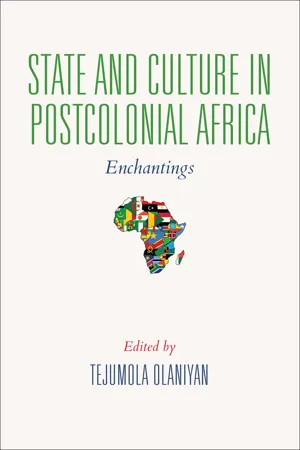
How has the state impacted culture and cultural production in Africa? How has culture challenged and transformed the state and our understandings of its nature, functions, and legitimacy? Compelled by complex realities on the ground as well as interdisciplinary scholarly debates on the state-culture dynamic, senior scholars and emerging voices examine the intersections of the state, culture, and politics in postcolonial Africa in this lively and wide-ranging volume. The coverage here is continental and topics include literature, politics, philosophy, music, religion, theatre, film, television, sports, child trafficking, journalism, city planning, and architecture. Together, the essays provide an energetic and nuanced portrait of the cultural forms of politics and the political forms of culture in contemporary Africa.
- English
- ePUB (mobile friendly)
- Available on iOS & Android
eBook - ePub
About this book
Trusted by 375,005 students
Access to over 1.5 million titles for a fair monthly price.
Study more efficiently using our study tools.
Information
PART I
CULTURE AND GOVERNANCE: CONCEPTUAL AND PRACTICAL EXPLORATIONS
1 Culture and the Study of Politics in Postcolonial Africa
Patrick Chabal
WHAT DO POLITICAL scientists make of culture, particularly when they study postcolonial Africa? Why is it that the mere mention of “culture” should provoke what can only be described as a lively debate in Africanist circles? Can we ever hope to overcome the academic and political hurdles that make the study of culture so contentious?1
For the past ten years, I have been working on two broad themes. One turns around the use of culture in political science analysis. The aim here is to suggest ways of conceptualizing culture that would make it possible to compare Africa with other parts of the world, including contemporary Europe. The other is a more wide-ranging study of Western social sciences. Here I try to go beyond postcolonial analysis by grappling with the ways in which what I call the non-West (or what is often dubbed the South) has challenged Western rationality—that is, the instruments we use to understand and act on the world in which we live. This involves a wholesale reassessment of Western social sciences. In my last book I explain how the West is now finding it increasingly difficult to understand the social and political dilemmas it faces at home and abroad.2 I show how the conceptual and theoretical instruments the West deploys no longer manage to make sense of these challenges. I conclude that Western social sciences have now reached their limits, which will only be overcome when we refashion theory to include the postcolonial realities in which we all live.
However, I want here to focus on the question of culture in political science, which led me a few years ago to rethink the ends and means of comparative politics. I felt compelled to do so because it became obvious to me that the standard political science we are taught in the academy (especially in the United States) has failed miserably to come to terms with the cultural realities political scientists face when coming into contact with the cultures of Africa. Indeed, I reached the conclusion that African cultures have exposed Western social science for what it is: an ill-conceived attempt to apply to the continent the theories that have been developed to explain the West’s social and political development. In other words, the study of Africa made plain to me that social sciences as taught and practiced in the West are but a way to force the non-West into the Western experience. Or, to put it another way, social sciences are built on the assumption that modernization means Westernization.
It is tempting, but ultimately futile, for students of the comparative politics of Africa to attempt to conceptualize culture by searching for a comprehensive definition, identifying in the process all its politically significant constituent parts. The very method that consists in seeking to list the attributes of human life that could be classified as cultural is itself the outcome of the vain quest to endow political science with the quality of a hard science. It is indeed precisely because such a quest has more often than not frustrated political scientists that they have been induced to look on culture as a residual category, fit only to reclaim those areas of politics for which there is no good conceptual home. It is also for this reason that a good number of cultural analyses as practiced by political scientists have appeared to be constructed on weak theoretical grounds, placing them immediately on the defensive within a discipline with aspirations to the highest scientific ideals.
My approach starts from an opposite premise. Culture is not to be defined exhaustively, by reference to all the possible elements that might come to represent what it is at a particular (and inevitably frozen) point in time. It is best understood as an environment, a constantly evolving setting, within which human behavior follows a number of particular courses—many of which may be contradictory. Culture is not merely an additional dimension of politics that requires attention. It is quite simply one of the fundaments of social life, the matrix within which what we understand as political agency takes place. In other words, the field of politics itself has to be examined within its appropriate cultural milieu, as it were. Far from being a residual category, culture is that which constitutes the coordinates, the mapping, the language, or the very blueprint of politics.3
The key here is an analysis of culture as a system of meanings and not as values. To look at culture in terms of values, on the one hand, is to approach the question from a normative and, frequently, ethnocentric perspective—making it difficult, for instance, to explain “cultural” differences within a single society. To look at it in terms of meanings, on the other hand, is to attempt to reveal the language in which people who may disagree about values or political ends can do so within a shared perspective. In this way, an explanation of the cultural context no longer requires an explicit definition of culture in terms of norms and beliefs—or even an analysis of how these differ from our own, in the West. My work, therefore, offers a study of politics that is different from the standard political science approach in terms of political culture. It also provides an analytical framework that is radically at variance with that adopted in a volume like Culture Matters, in which, typically, culture is equated with values.4
My approach is not just an effort to explain how culture is germane to comparative analysis; it is an attempt to show how the very business of political science needs theoretically to be grounded in a proper cultural perspective. This does not mean that culture necessarily explains, even less determines, the outcome of political action. Rather, it implies that the elucidation of such action calls for proper recourse to theories that allow relevant consideration of the appropriate cultural environment(s).5 Thus, culture is not simply useful to comparative politics. Comparative politics can only be meaningful insofar as it succeeds in making sense of the cultural setting within which local politics take place.
When conceptualizing culture for the political analysis of contemporary Africa, I, like many, am stimulated by the work of Clifford Geertz; his work itself is a reflection on comparative analysis deeply informed by the historical legacy of a number of social scientists. Therefore, I develop my views from three of his best-known arguments. The first tackles the question of definition:
The culture concept to which I adhere has neither multiple referents nor, so far as I can see, any unusual ambiguity: it denotes an historically transmitted pattern of meanings embodied in symbols, a system of inherited conceptions expressed in symbolic forms by means of which men communicate, perpetuate, and develop their knowledge about and attitudes towards life.6
What does this characterization imply for political analysis? The key notion here is that culture is a “system of inherited conceptions expressed in symbolic forms.” This makes it plain, first, that what may appear merely as a conglomeration of discrete values is in fact an interrelated and structured whole. Second, it highlights the historical dimension of culture, which is to be understood not as being simply the current language of norms and habits (synchronically) but as the living environment, evolved in the longue durée (diachronically). Finally, the emphasis is clearly placed on the fact that culture is expressed in symbolic form, and not, as is sometimes believed, only in factual statements. Comparative analysis, therefore, must concern itself with all three aspects of culture, and not just with those that may appear to be more directly applicable to the business of politics.
Further, Geertz writes:
The concept of culture I espouse … is essentially a semiotic one. Believing, with Max Weber, that man is an animal suspended in webs of significance he himself has spun, I take culture to be those webs, and the analysis of it to be therefore not an experimental science in search of law but an interpretive one in search of meaning. It is explication I am after, construing social expressions on their surface enigmatical.7
The second key element of Geertz’s proposition is thus that the concept of culture is first and foremost semiotic, in the sense in which it is defined above—that is, having to do with signs as modes of communication.8 This is critical and needs reasserting forcefully, not only because it is an aspect of the question that is habitually elided in political science but also because it informs the method I have used in the analysis of politics in Africa. The reason this notion of culture is unpalatable to political scientists is twofold. First, because it touches on what appear to be subjective characteristics of human agency—the words and symbols by which people recognize and express themselves. And second, because an acceptance of such a conception of culture would imply a research agenda with which most political scientists are uncomfortable, since it puts a premium on the study of meanings as they matter to the individuals and communities they try to understand. This is admittedly a demanding requirement, but I believe it is imperative to place it at the heart of comparative analysis if we are to advance the analytical value of the discipline.
Indeed, Geertz’s reminder of Weber’s understanding of culture should be a timely prompt to comparative analysts for, whatever our view of the German social scientist, it cannot be disputed that he was the pioneer of comparative historical sociology, and there is much to be gained by reexamining his methods.
Finally, addressing specifically the issue of culture and politics, Geertz comments, “Culture, here, is not cults and customs, but the structures of meaning through which men give shape to their experience; and politics is not coups and constitutions, but one of the principal arenas in which such structures publicly unfold.”9 This statement is useful in that it focuses attention both on the object of political analysis and on the method most relevantly used to study politics. By suggesting that politics is an arena, rather than a black box, Geertz goes right to the heart of the question.10 From this point of view, what is consequential is not so much the study of functional equivalents within the body politic but the translation of the meanings, the symbols, of what is political in a particular society into a language that lends itself to comparative analysis.
It may be thought that my discussion of the concept of culture is all too Geertz-centered, or at the very least excessively dependent on an anthropological approach. Are none of the definitions used in political science of any use?11 The question is not purely rhetorical because the answer is important to our approach. For reasons developed at length elsewhere, I believe that political theory as it is commonly understood today propounds a concept of culture that is inimical to the type of analysis I propose. Not only does it seek to narrow down the scope of culture to variously operational common denominators, often dubbed variables, but it fails to take seriously the question of the “webs of significance,” which Weber quite rightly considers critical for comparative analysis. However, the current resurgence of interest in Weber’s work is proof that his method is once again attractive to social scientists dissatisfied with the state of their disciplines.12
I make no apology for taking as my starting point a conceptual perspective best expounded by an anthropologist. Nor do I feel it incumbent on me to defend Geertz’s position on the subject, even if I recognize that it has been contested by his professional colleagues.13 Mine is not a quest for a definitive characterization of culture but for an approach that manages to respond to the dilemmas faced by practitioners of comparative politics as they grapple with the contextual and historical complexities of their very diverse case studies. In my work on Africa, I find it immensely rewarding to integrate some of the most illuminating insights derived from anthropology.14 And I believe firmly that the most convincing comparative accounts of political processes are those that have combined solid historical and anthropological research with the use of concepts from other appropriate, relevant social sciences.
My advocacy of a cultural approach to the comparative study of politics does not simply derive from an a priori bias. It stems from the conviction that the discipline as it now stands is in danger of reducing the scope of its activities to what is easily quantifiable. It is in this way liable to forget that the only justification for what we do, other than to construct models in the air, is to further the understanding of politics across the world. Comparison is warranted if it provides a more plausible account of what is happening politically in various settings. The so-called science of politics can only aim at explaining political events and processes more credibly than mere common sense when its theoretical framework enables a new, and more meaningful, elucidation of the facts.15
Of course, theory in the social sciences provides a simplified model of how human beings behave and form social relations over time, but the litmus test of theory, here as in the natural sciences, is how it facilitates the explanation of observable events—or to put it differently, how it allows us meaningfully to unpack the complexities of real life. Comparative analysts should explain, not simply paraphrase, actual politics. And they can scarcely hope to do that unless they begin to develop methods that allow them to integrate a cultural approach—that is, not just pay lip service to a few self-evidently important cultural factors, like ethnicity or language, but to disentangle the relevant webs of significance that impinge on political agency. Why is this? Let me explain by reference to Africa.
It is generally argued by comparative analysts in the field that there is in sub-Saharan Africa, as elsewhere, a trend toward democracy. On the face of it the evidence is strong, since in the last two decades most countries have held (single or repeated) multiparty elections.16 Furthermore, recent comparative research appears to confirm, by means of large-scale surveys, that there is increasing support among the population at large for democracy.17 Based on such work, then, it would seem legitimate to conclude that Africa is indeed moving in the same direction as other regions of the globe. This would not be an inaccurate inference, given the limited procedural definition that is usually given ...
Table of contents
- Cover
- Title Page
- Copyright
- Contents
- Acknowledgments
- Introduction: State and Culture in Africa: The Possibilities of Strangeness
- Part I. Culture and Governance: Conceptual and Practical Explorations
- Part II. Creative Adversities and the Truly Productive State
- Part III. The State in the City: Urban Negotiations of the Necessary
- Index
Frequently asked questions
Yes, you can cancel anytime from the Subscription tab in your account settings on the Perlego website. Your subscription will stay active until the end of your current billing period. Learn how to cancel your subscription
No, books cannot be downloaded as external files, such as PDFs, for use outside of Perlego. However, you can download books within the Perlego app for offline reading on mobile or tablet. Learn how to download books offline
Perlego offers two plans: Essential and Complete
- Essential is ideal for learners and professionals who enjoy exploring a wide range of subjects. Access the Essential Library with 800,000+ trusted titles and best-sellers across business, personal growth, and the humanities. Includes unlimited reading time and Standard Read Aloud voice.
- Complete: Perfect for advanced learners and researchers needing full, unrestricted access. Unlock 1.5M+ books across hundreds of subjects, including academic and specialized titles. The Complete Plan also includes advanced features like Premium Read Aloud and Research Assistant.
We are an online textbook subscription service, where you can get access to an entire online library for less than the price of a single book per month. With over 1.5 million books across 990+ topics, we’ve got you covered! Learn about our mission
Look out for the read-aloud symbol on your next book to see if you can listen to it. The read-aloud tool reads text aloud for you, highlighting the text as it is being read. You can pause it, speed it up and slow it down. Learn more about Read Aloud
Yes! You can use the Perlego app on both iOS and Android devices to read anytime, anywhere — even offline. Perfect for commutes or when you’re on the go.
Please note we cannot support devices running on iOS 13 and Android 7 or earlier. Learn more about using the app
Please note we cannot support devices running on iOS 13 and Android 7 or earlier. Learn more about using the app
Yes, you can access State and Culture in Postcolonial Africa by Tejumola Olaniyan, TEJUMOLA OLANIYAN in PDF and/or ePUB format, as well as other popular books in Social Sciences & Cultural & Social Anthropology. We have over 1.5 million books available in our catalogue for you to explore.