![]()
PART I
DEFINING THE WEST
![]()
ARE WE TALKING ABOUT A PLACE? WHAT IS IT? WHERE IS IT?
1 WHERE IS THE AMERICAN WEST? REPORT ON A SURVEY
Walter Nugent
The answer to the question “Where is the American West?” seems obvious—
hut in very different ways to different people. Some answer immediately, “It’s out here,” or “It’s out there,” pointing to the western third, half or two-thirds of the United States as it appears on a map. Others answer just as quickly, “It’s part of our minds and culture. “ One definition is steadfastly geographical; the other is defiantly mental and mythical. In this essay, the author reports on a survey he conducted in 1991 of several hundred historians, fiction writers, and journalists. He asked them three questions: Where are the boundaries of the West! Where do you think you have to go to get in or out of the West? And why do you think so—what are its distinguishing characteristics, making it different from the Midwest, South, and Northeast? The historians generally gave geographical answers, most of them setting the eastern boundary at the Mississippi or the Great Plains, and the other boundaries at the Canadian and Mexican borders and the Pacific. The writers, as often as not, refused to put “the West” on the map and insisted it lives only in our minds and myths. In each group, the majority insisted that the West can’t be defined without reference to time, because it moved across the West (and in our minds) over time; and a minority said that the Pacific Coast, especially California and the big coastal cities, is not western at all (although those who lived in those cities insisted they were both at the edge and the center of the West).
Where do you think the West is, or was? Is it a geographical or a mythical entity! What, to you, makes the West western?—editors
DISAGREEMENTS ABOUT how to define “West” and “frontier” and how to distinguish the two terms are nothing new to historians of both. The urgency of these problems has ebbed and flowed. Lately it has flooded like a spring torrent, fed by the assertions of some “new western historians” that the West is a place, not a Turnerian process. Before the day is done, the torrent may further swell by the melting snowpack from “old western historians” who think that process remains very much part of the story.
But new western historians have raised the place-versus-process issue, and hence, questioned anew the definition of “the West.” They have stated their premises clearly in several recent publications.1 Among these premises (though not every new western historian agrees on all of them) are these: that western history hardly stopped in 1890 or 1893 or any other years; that it has been marked less by “progress” than by “conquest” and conflict; that the West is a place where this conquest has taken place, a definite place on the map, rather than the process that Frederick Jackson Turner stated was essential to the frontier idea. As Patricia Nelson Limerick wrote in Legacy of Conquest, “De-emphasize the frontier and its supposed end, conceive of the West as a place and not a process, and Western American history has a new look.”2 Richard White, in his massive new history of the western region, avoids the term “frontier.” In the set of essays edited by William Cronon, George Miles, and Jay Gitlin, Limerick explains that
To Frederick Jackson Turner and his followers in conventional western history, the frontier (and, by extension, the West) was a process, not a place; a concept, not an actual geographical location. In this way of thinking, the West is wherever the American mind puts it— a pretty vague and ephemeral target for “image” analysis.3
It seemed to me, since the new western history continued to gain attention and generate controversy, that it would be interesting and useful to know how widely the “place versus process” antinomy operates in people’s minds, and where people believe the true West to be. That question leads, of course, to what the West signifies. Since the frontier idea, as William Goetzmann and others have said, has been our great American creation myth, the question touches not just on images of the West but on conceptions of the whole of America.
But does not the question of “where” the West is also suggest “when” the West was? And this suggests yet another question—do frontiers end, do regions come and go, and if so how can we tell? That last question must wait for another occasion. It is enough for now to inquire of people seriously interested in the West, from different perspectives, how they feel about the place-versus-process argument. I have also been curious, long before the new western history appeared, about the simple question of where other people began to sense westernness as they traveled from east to west across the country (or where they no longer felt “western” if they were leaving the region). The answers should help define regionalism.
What interested parties think about place-versus-process and where one starts or stops feeling “western” are questions resolvable by a survey. Therefore, in the spring of 1991, I designed and mailed out nearly five hundred questionnaires to members of the Western History Association, a list of editors and publishers of newspapers and magazines from Colorado to California, and members of the Western Writers of America. The response was remarkable for size, vehemence, and content. The results appear below.
THE QUESTIONS
The questionnaire consisted of three short questions: (1) “How would you describe the boundaries of ‘the West’ (on the east, south, north, and west)?”; (2) “Where are you now (i.e. in what section of the country), and where would you have to go to get to the edge of the West?”; (3) “What characteristics set apart the West, as you have defined it, from other regions?” Each person also received a personal data form so that answers could be linked to age, sex, place of residence, and occupation.4 The three questions are increasingly open ended. The first asks for a specific geographic response; the second for a more personal but still presumably geographic response; while the third is almost completely open, and to it many people have several answers—Wests of geography, climate, myth, history, imagination, and more.
The cover letter explained that various people have defined the West differently. Bernard DeVoto and Joan Didion said it starts “where rainfall drops below twenty inches a year.” But that excludes San Francisco and the coast north of it. An “eminent historian of the West who lives in New England” felt “western,” so he once told me, when he crossed Indiana. The columnist Richard Reeves said he “got the notion that Chillicothe, Ohio, was where the West really began.”
On the back of the data sheet was a map, and it contained one of the two major biases in the questionnaire—both unavoidable but also not without malice aforethought. The map was of the continental United States, with insets of Hawaii, Alaska, and Puerto Rico. State boundaries were indicated but rivers and other natural features were not, nor were Canada or Mexico. The map was therefore skewed toward a political response and against including Canada or Mexico. My alternative was to provide a map of North America, but that, I thought, would have introduced an even stronger bias toward including Canada and Mexico. The very presence of a map invited responses that were geographical and also presentist. It discouraged responses that located or defined the West as it may have been at any past time, or as it may now exist in people’s minds.
Despite these biases, many respondents insisted on including Canada and/or Mexico; many insisted that the “West” must be defined not only by “where,” but also by “when?”; and many pronounced it not a geographical entity at all, but a cultural one. Many insisted, explicitly, on the West as process rather than just as place. One respondent, in a personal letter, upbraided me for the questionnaire’s “refusal to situate itself in time,” but concluded, “My suspicion is that you probably share a number of the reservations [about defining the West exclusively as place] I’ve expressed ... [and] your strategy in framing the questions as you have is no doubt cleverer and sneakier than I’ve realized.” True. Also, given the geographic and presentist bias of the questionnaire, we can assume that historical and cultural definitions are even stronger in the respondents’ minds than the numerical results indicate.
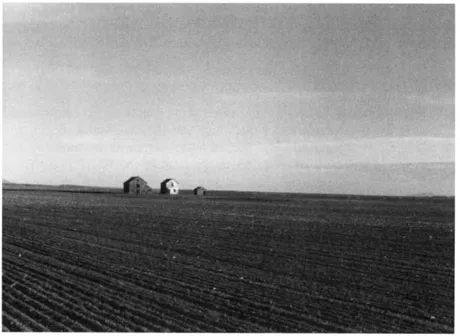
1. Judith Basin homestead, about 1910.
Courtesy of Robert Lacy.
THE QUESTIONNAIRE
The questionnaire went to three groups of people. The first and largest was a roughly one-fifth sample, basically random, of the members of the Western History Association (WHA)—307 people.5 The second was a group of 97 editors and publishers ranging from metropolitan dailies to special interest magazines.6 The third was a roughly one-fifth sample, 76 people, of the Western Writers of America (WWA). These 480 questionnaires were mailed in March and April 1991.
THE RESPONSES
By the end of June we received 251 responses: 188 from WHA members (61 percent); 25 from journalists (26 percent); and 38 from WWA members (50 percent).7 The WHA responses were especially gratifying. Reading them was like arriving at a WHA meeting on an October Thursday and actually having time to talk with almost two hundred friends and colleagues about an ostensibly casual but really quite complex question.8 Clearly the great majority of respondents regarded these as serious questions.9 The respondents had lived, on average, nineteen years in their state of present residence, and divided about equally among large, medium, and small cities, and rural places.10 The WWA people were more reclusive—fully a quarter of them live on farms, ranches, and in villages, compared to only 4 percent of historians and none of the journalists. Two-thirds were between thirty and sixty years old, most of the rest were over sixty, and only 2 percent were under thirty. Of the WWA group, 43 percent were female compared to 19 percent of the WHA group and 20 percent of the journalists. Only 8 percent of the WHA and WWA respondents—but 21 percent of the journalists!—asked not to be quoted.
The personal data sheets were not dry profiles. To the question, “how long have you lived in your present state of residence” and how long elsewhere, Michael Harrison answered, “57 years in California (present), plus 10 in Arizona, 3 in New Mexico, and 25 in New Jersey; total 95.” A WWA member from Buena Vista, Colorado, replied that “I’ve lived here as a child, student, teacher, wife, widow, mother, journalist, writer, camper, rockhound” and another, from Santa Fe, wrote, “I write under a man’s name. Please don’t use my real name. Ladies don’t sell westerns.” One WWA member, Lauran Paine of Siskiyou County, California, wrote,
I have worked and lived in most Far Western and Southwestern states. Cattle ranching, wild horse trapping, blacksmithing, even sank so low as to become a motion picture rider, and upon discovering that none of these vocations would provide the income I aspired to ... I began writing. Total published books to date 912 of which 714 Westerns have been for one publisher.
But now for the meat and potatoes. Where do these people think the West is, and why?
Question I:
Where are the West’s boundaries?
The answers may be summed up in these ten points:
1. Respondents focused much more on the eastern boundary than the other three. Everyone made a choice, and only about 5 percent were unclear (10/211). Regarding the western boundary, again only 5 percent were unclear, but 22 percent gave no response.
2. Respondents were more indecisive, or just inattentive, about the northern and southern boundaries. Many probably took the Canadian and Mexican borders for granted. In both cases 5 percent answered unclearly; and 25 percent simply did not state a northern boundary and 27 percent did not state a southern one. Differences were not great among the three groups (WHA, journalists, WWA).
3. A number of people identified only an eastern boundary, perhaps having mentally exhausted themselves in so doing. And a few who were reluctant to set any geographical boundaries said, well, if you insist, I’d place the eastern one at X or Y, then left it at that.
4. About one out of 6 (40/251=15.9%) refused to name any geographical boundaries. Instead they said the West is a “state of mind,” an “idea,” “myth,” or “mental construct,” or something similar. Of the three groups, about one-eighth of the WHA members took this position (23/187= 12.3%), only one of the editors did so (1/25 = 4%), but nearly half of the western writers (16/39 = 41%). The writers, or many of them, believe the West is myth, and they write about and perpetuate the myth.
Many of th...