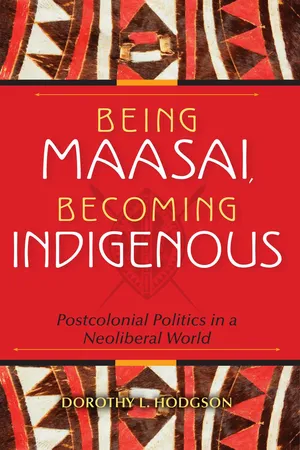
What happens to marginalized groups from Africa when they ally with the indigenous peoples' movement? Who claims to be indigenous and why? Dorothy L. Hodgson explores how indigenous identity, both in concept and in practice, plays out in the context of economic liberalization, transnational capitalism, state restructuring, and political democratization. Hodgson brings her long experience with Maasai to her understanding of the shifting contours of their contemporary struggles for recognition, representation, rights, and resources. Being Maasai, Becoming Indigenous is a deep and sensitive reflection on the possibilities and limits of transnational advocacy and the dilemmas of political action, civil society, and change in Maasai communities.
eBook - ePub
Being Maasai, Becoming Indigenous
Postcolonial Politics in a Neoliberal World
- 288 pages
- English
- ePUB (mobile friendly)
- Available on iOS & Android
eBook - ePub
About this book
Trusted by 375,005 students
Access to over 1.5 million titles for a fair monthly price.
Study more efficiently using our study tools.
Information
1

BECOMING INDIGENOUS IN AFRICA
On August 3rd, 1989, Moringe ole Parkipuny, long-time Maasai activist and former member of the Tanzanian Parliament, addressed the sixth session of the United Nations Working Group on Indigenous Populations (UN Working Group) in Geneva, Switzerland. After noting that this was a “historic moment,” since he and a Hadza man from Tanzania were the “first representatives of any community in Africa that have been able to attend this very important forum,” he described in vivid terms the contemporary situation in Africa: “The environment for human rights in Africa is severely polluted by the ramifications of colonialism and neo-colonial social and economic relationships in which we are compelled to pursue our development and our sovereignty in a global system replete with injustices and exploitation” (Parkipuny 1989). He discussed the relative recentness of political independence for most African countries; the difficulties of overcoming colonial legacies of unequal rights, resources, and access to political power; and the “might of Western economic hegemony.” But, he warned, the intense efforts by many African nation-states to build national solidarity through the production of national identities “have thrown wide open the floor for prejudices against the fundamental rights and social values of those peoples with cultures that are distinctly different from those of the mainstream national population. Such prejudices have crystallized in many African countries into blatant cultural intolerance, domination and persistent violations of the fundamental rights of minorities” (Parkipuny 1989). In East Africa, he claimed, two of the most “vulnerable minority peoples” were hunter-gatherers and pastoralists:
These minorities suffer from common problems which characterize the plight of indigenous peoples throughout the world. The most fundamental rights to maintain our specific cultural identity and the land that constitutes the foundation of our existence as a people are not respected by the state and fellow citizens who belong to the mainstream population. In our societies the land and natural resources are the means of livelihood, the media of cultural and spiritual integrity for the entire community as opposed to individual appropriation.
As a result, “our cultures and way of life are viewed as outmoded, inimical to national pride and a hindrance to progress. What is more, access to education and other basic services are minimal relative to the mainstream of the population of the countries to which we are citizens in common with other people” (Parkipuny 1989).
As Parkipuny claimed, this speech did indeed mark a historic moment in local, national, and international affairs; it was the first public assertion by a Maasai leader that Maasai, and indeed, certain other historically marginalized groups in Africa, were part of the transnational community of indigenous peoples. Moreover, the forum for this pronouncement, the UN Working Group, indicated a new willingness of that body to entertain claims that African groups such as Maasai shared common histories, grievances, and structural positions within their nation-states with long-recognized “first peoples” from white settler colonies in the Americas, New Zealand, Australia, and elsewhere. As such, long-accepted definitions of “indigenous” were being challenged, with pressure to expand their meanings to encompass new categories of similarly disenfranchised peoples.
Over the next twenty years, Maasai, Kung San, Batwa, and other African groups became actively involved in the international indigenous peoples’ movement with the support of transnational advocacy groups. They also formed regional and continental networks to pressure African states to recognize the presence and rights of indigenous peoples within their borders, to support and coordinate the activities of African NGOs within the UN process, and, more specifically, to promote ratification of the UN Declaration on the Rights of Indigenous Peoples (Declaration). Although they quickly achieved international recognition and visibility for their struggles, they encountered deep hostility from most African nation-states, who claimed that all of their citizens were indigenous, argued that indigenous rights fomented “tribalism,” and challenged any discussion of collective rights or restitution. As I was told (sometimes quite forcefully) every time I presented my research in Tanzania, “we are all indigenous in Africa.”
Given the hostility of their nation-states and fellow citizens, how and why did certain historically marginalized people in Africa decide to become “indigenous”? This chapter traces the history of the engagement of African groups with the international indigenous peoples’ movement; how the concept of “indigenous” has been imagined, understood, and used by African activists, donors, advocates, and states; and the experience and impact of the participation of African groups in the movement.1 As suggested by the comment “we are all indigenous in Africa,” the key struggle for African activists has been to translate their hard-won international recognition as indigenous peoples into national recognition. As described in detail below and in subsequent chapters, not only did this tension shape the dynamics of their participation in the movement, but it also demonstrated the ongoing significance of states in shaping the contours and content of transnational advocacy.
The Spread of the Indigenous Peoples
Movement in Africa
The involvement of various African groups with the indigenous peoples’ movement is the product of the historical convergence of several factors: visionary leaders such as Parkipuny who saw the connections and were able to reframe long-standing claims to land rights and cultural self-determination in the language of indigenous rights; shifts in donor agendas from financing huge state-run development programs to supporting the initiatives of “grassoots” organizations (Edwards and Hulme 1992; Hulme and Edwards 1997); the new political possibilities and economic exigencies produced by the neo-liberal restructuring of states and economies under pressure from the World Bank, IMF, and other global institutions (Gledhill 2004; Harvey 2005); the seeming failure of prior forms of political struggle to produce effective results (e.g., Hodgson 2001a); and chance encounters and connections.
Exploring how Parkipuny came to speak before the UN Working Group offers insights into these complex articulations. Parkipuny was born in Nayobi, a Maasai village on the edge of the Rift Wall in Tanzania, and sent to school when his grandfather was forced by colonial officers to “contribute” one son for schooling. Although his grandfather urged him to purposefully fail the exam to qualify for middle school, Parkipuny refused: “I already had a sense of how Maasai were being treated. I decided I must go on.”2 He completed secondary school and eventually received his BA and then MA in development studies from the University of Dar es Salaam. His MA thesis was a critique of the huge, ten-year, $20 million USAID Masai Range Project that was taking place at the time, a “development” project designed to increase the productivity and offtake of Maasai livestock for the benefit of the national economy (Parkipuny 1975; see also Hodgson 1999b, 2001a).
As we sat one night in September of 2005 over a dinner of roasted goat meat and beer in a bar in Arusha, Tanzania, he explained how and why he had decided to link up with the indigenous rights movement. In 1977, he was hired by the Tanzanian government to work for the Masai Range project. But USAID balked, given his harsh critiques of the project in both his thesis and published newspaper editorials. As a compromise, they sent him on a study tour of the United States to visit “proper ranches”:
I traveled to Washington, D.C., Oregon, California, Arizona, and more to visit extension schools, ranches, and so forth. But I became fed up; it was too monotonous. So at the airport one day, I met a Navaho from Windrock. We talked some and he invited me to visit. I said, “Let’s go!” So I stayed with them for two weeks, and then with the Hopi for two weeks. It was my first introduction to the indigenous world. I was struck by the similarities of our problems. I looked at Windrock, the poor state of the roads and reservations, it was just like the cattle trails in Maasailand. But this was in the United States!
For Parkipuny, as for many African activists, this epiphany was transformative. Seeing the similarities between the contemporary situation and historical struggles of Maasai and that of Native Americans enabled Parkipuny to think beyond the specifics of Maasai circumstances to a deeper understanding of the exploitative relationships between nation-states and certain kinds of people, relationships that had been produced and exacerbated by colonialism, nation building, and economic modernization (cf. Niezen 2003, Maybury-Lewis 2002). He quickly realized that the Maasai experience of land alienation, forced settlement, deep disparities in the provision of social services such as education and health, cultural disparagement, and, at times, forced assimilation first by the colonial and then by the postcolonial state were not unique, but part of a global pattern (Parkipuny 1979).
Eventually, in search of a political space to advocate for justice, Parkipuny ran for and was elected to serve as a member of the Tanzanian Parliament in 1980. As he explained, “At the time, it was the only door open under the one-party system to voice outcry. There were no civil society organizations at the time. You had to work through the party.” During his ten years as a member of Parliament (MP), he fought tirelessly, especially against the rising tide of illegal land alienation by the government, speaking in Parliament, filing court case after court case against the government, pleading with political leaders, and rallying Maasai. As his reputation as a formidable intellectual and political leader of Maasai grew, so did the number of his enemies inside and outside of Parliament. “They all kept their distance from me. And when I would go to Parliament and voice problems, nothing would happen, there was no action.”
I first met Parkipuny in 1986 in my capacity as coordinator of the Arusha Diocesan Development Team (ADDO), when I was visiting the town of Loliondo, the headquarters of Ngorongoro District, which was the district he represented as MP. ADDO was refurbishing one of the town’s water systems, and Parkipuny had been helping us to negotiate the bureaucratic thicket of permits, procurement of supplies, and so forth in a time of rationing, “black” markets, restrictions on foreign currency, and general economic distress. He was a tall, slim man, dressed in a navy suit, with a warm manner, piercing gaze, and effortless English. I was immediately struck by his intensity, remarkable intelligence, and political-economic savvy. Our conversation quickly shifted from the mundane details of the water project to the politics of the World Bank, U.S. imperialism, and the marginalization of Maasai. By that time, Parkipuny was clearly weary of the constant political struggles and accusations he was experiencing as MP, yet continued to challenge what he perceived as the many injustices perpetrated on Maasai by the Tanzanian state.
Despite, or perhaps because of, his political battles with representatives of the Tanzanian state, Parkipuny continued to nurture and develop his transnational connections, including communicating, through a mutual friend, with Jens Dahl, an anthropologist who was a board member (and later director) of the International Work Group for Indigenous Affairs (IWGIA). In 1983, Parkipuny toured Europe and Canada to publicize the plight of Maasai. During his travels, he visited the offices of IWGIA in Copenhagen, where he was interviewed for their newsletter (IWGIA 1983). As the title of the article (“Wildlife Have More Rights than Maasai”) suggests, Parkipuny described the predicament of Maasai living in the Ngorongoro Conservation Area in Tanzania, where wildlife conservation policies premised on separating wildlife from humans were undermining Maasai rights to land, endangering their livelihoods, and possibly promoting the further eviction of Maasai from Ngorongoro. As he argued, “to separate Maasai, their cattle and wildlife would be a disaster both ethically and ecologically” (IWGIA 1983:183). In response, IWGIA commissioned a research report on the situation of Maasai in Ngorongoro by Swedish anthropologist Kaj Århem (1985a, see also 1985b). Impressed by Parkipuny’s mission and message, Dahl invited Parkipuny to Canada to present on a panel he had organized on indigenous peoples and human rights3 and later sponsored (through IWGIA) Parkipuny’s participation in the 1989 UN Working Group.4 Although Dahl recognized the possible political repercussions for any African who addressed the UN Working Group, he believed that “Parkipuny was the perfect person, since as a Member of Parliament he had much less risk of being arrested when he returned to Tanzania.”5 By 1989, Parkipuny was feeling embattled by Tanzanian politics and ready to “get out of this place.” Through the support of friends and a progressive advocacy network in the United States, “I traveled to Europe, the U.S., as far as Berkeley!” Before his speech in Geneva, he met with Native Americans in New Mexico and Canada to further his comparative understanding of indigenous issues. Parkipuny returned to the UN Working Group several more times,6 but his last trip was in 1991, after he had decided not to run again for MP: “finally I decided that I can’t keep coming [to the UN], I have to stay home and concentrate on grass-roots organizing.”
IWGIA, a transnational advocacy network of human rights activists and researchers based in Denmark, was instrumental in encouraging certain African groups to link their struggles to the indigenous rights movement, promoting the participation of Africans such as Parkipuny at the relevant UN meetings, and expanding the working definition of “indigenous” to embrace their positions and claims.7 In 1990 in an article in the annual IWGIA Yearbook, Espen Wæhle, an IWGIA board member, argued for the applicability of the concept of “indigenous” “in a structural sense” to certain African groups (Wæhle 1990). Echoing Parkipuny’s speech to the UN Working Group, he described three key parallels between African political struggles and those of recognized indigenous peoples: “1) the assertion of group rights which parallels ethnic/indigenous assertion of rights elsewhere; 2) the grave situation of human rights in many parts of Africa (also in the sense of collective group rights); and 3) African concerns for self-development and self-determination” (Wæhle 1990:147). With the support of IWGIA, Wæhle then co-organized an international “Conference on Indigenous Peoples in Africa” in Denmark in 1993, which included representatives from select African groups. Most of the papers in the published conference proceedings (Veber et al. 1993) focused on specific peoples with possible claims to indigeneity: “Pastoralists of Eastern Africa,” “Bushmen of Southern Africa,” “Pygmies of Central Africa,” and “The Tuareg Pastoralists of Northwestern Africa.”
As the UN Year of the World’s Indigenous People (1993) was followed by the UN Decade of the World’s Indigenous People (1995–2004), IWGIA expanded its efforts to promote the involvement of African groups (especially representatives of the four groups listed above) in the international indigenous rights movement. They sponsored national, regional, and international workshops to encourage awareness and discussion of the applicability of the concept;8 publicized the debates and initiatives in their annual Yearbook and quarterly periodical, Indigenous Affairs; financed and nurtured the participation of African activists at the annual meetings of the UN Working Group, the UN Permanent Forum on Indigenous Issues (UN Permanent Forum), and relevant UN World Summits; and funded the capacity-building, land-rights, and human-rights programs of some African NGOs (Dahl 2009).9 Many of the activists whom I interviewed attributed their awareness of the indigenous peoples’ movement and their involvement with the UN to a 1999 conference co-sponsored by IWGIA and PINGOs (a network of organizations representing pastoralists and hunter-gatherers in Tanzania; see chapter 2) in Tanzania (the “Conference on Indigenous Peoples in Eastern, Central and Southern Africa”) and a three-week follow-up training course on indigenous rights and international legal frameworks in September 1999 that was sponsored by PINGOs and funded by the European Union and the Saami Council (from Norway).10 IWGIA’s logic in promoting the participation of Africans and others in the movement was straightforward; IWGIA was convinced that participation in UN meetings offered unique opportunities for indigenous peoples to convey their situation and compel the international community and national governments to fully live up to their obligations to respect and protect human rights in order to secure the cultural and physical survival of indigenous peoples (Dahl 2009). Other international transnational advocacy groups also supported the expansion of the indigenous rights movement in Africa through workshops, funding, and publicity, although their motivations differed and sometimes conflicted. These organizations included the International Institute for Environment and Development (United Kingdom),11 Survival International (United Kingdom), Minority Rights International (United Kingdom), and Cultural Survival (United States), and their agendas ranged from ecological sustainability to cultural preservat...
Table of contents
- Cover
- Title
- Copyright
- Contents
- Preface
- List of Key Organizations and Documents
- Introduction
- 1 Becoming Indigenous in Africa
- 2 Maasai NGOs, the Tanzanian State, and the Politics of Indigeneity
- 3 Precarious Alliances
- 4 Repositionings
- 5 “If We Had Our Cows”
- Conclusion
- Notes
- Bibliography
- Index
- Illustrations
Frequently asked questions
Yes, you can cancel anytime from the Subscription tab in your account settings on the Perlego website. Your subscription will stay active until the end of your current billing period. Learn how to cancel your subscription
No, books cannot be downloaded as external files, such as PDFs, for use outside of Perlego. However, you can download books within the Perlego app for offline reading on mobile or tablet. Learn how to download books offline
Perlego offers two plans: Essential and Complete
- Essential is ideal for learners and professionals who enjoy exploring a wide range of subjects. Access the Essential Library with 800,000+ trusted titles and best-sellers across business, personal growth, and the humanities. Includes unlimited reading time and Standard Read Aloud voice.
- Complete: Perfect for advanced learners and researchers needing full, unrestricted access. Unlock 1.5M+ books across hundreds of subjects, including academic and specialized titles. The Complete Plan also includes advanced features like Premium Read Aloud and Research Assistant.
We are an online textbook subscription service, where you can get access to an entire online library for less than the price of a single book per month. With over 1.5 million books across 990+ topics, we’ve got you covered! Learn about our mission
Look out for the read-aloud symbol on your next book to see if you can listen to it. The read-aloud tool reads text aloud for you, highlighting the text as it is being read. You can pause it, speed it up and slow it down. Learn more about Read Aloud
Yes! You can use the Perlego app on both iOS and Android devices to read anytime, anywhere — even offline. Perfect for commutes or when you’re on the go.
Please note we cannot support devices running on iOS 13 and Android 7 or earlier. Learn more about using the app
Please note we cannot support devices running on iOS 13 and Android 7 or earlier. Learn more about using the app
Yes, you can access Being Maasai, Becoming Indigenous by Dorothy L. Hodgson in PDF and/or ePUB format, as well as other popular books in History & African History. We have over 1.5 million books available in our catalogue for you to explore.