A folklorist explores the storytelling traditions of a small Irish town where local character anecdotes build community across sectarian divides.
More than quaint local color, folklore is a crucial part of life in Aghyaran, a mixed Catholic-Protestant border community in Northern Ireland. Neighbors socialize during wakes and ceilis—informal nighttime gatherings—without regard to religious, ethnic, or political affiliation. The witty, sometimes raucous stories swapped on these occasions offer a window into Aghyaran residents' views of self and other in the wake of decades of violent conflict.
Through anecdotes about local characters, participants explore the nature of community and identity in ways that transcend Catholic or Protestant sectarian histories. Ray Cashman analyzes local character anecdotes in detail and argues that while politicians may take credit for the peace process in Northern Ireland, no political progress would be possible without ordinary people using shared resources of storytelling and socializing to imagine and maintain community.
- 320 pages
- English
- ePUB (mobile friendly)
- Available on iOS & Android
eBook - ePub
About this book
Information
Storytelling on the
Northern Irish Border
1
Goals and Orientations
This book examines how local social life and culture are both represented and enacted through storytelling in one Northern Irish community, Aghyaran. Extending language philosopher J. L. Austin’s memorable formulation that people “do things with words” (1997 [1962]), we can also say that people do things with stories. What they do depends on who is talking to whom, in what contexts, and to what ends. It also depends on the type of story being told, for different genres implicate different subjectivities and ideological orientations toward the world (Seitel 1999, Bauman 2004). Typically, however, people’s stories relay shared beliefs, values, and norms. Stories provide a vehicle through which personal and shared orientations may be passed on, instilled, or indeed critically evaluated and reconsidered. Likewise, stories—especially those that appeal to the authority of tradition—provide powerful rhetorical tools in the construction, maintenance, and revision of individual and group identities. Given that narratives are often commemorative orderings of previous happenings, everywhere people tell stories to depict a meaningful past they can use to assess their present and to bolster themselves as they meet an uncertain future.
If these are some of the typical, universal functions of stories, my goals here are to determine to what ends stories are told in Aghyaran, to contemplate what lasting effects oral traditions have there, and to suggest what the common preoccupations, values, and themes evident in a large body of Aghyaran folklore tell us as outsiders about contemporary culture on the Irish border.1 Part of my task, in pursuit of these goals, is to demonstrate when and in what recurring circumstances people in Aghyaran tell stories, and how these stories and social contexts mutually constitute each other. This requires investigation of primary situational contexts for storytelling, such as ceilis and wakes, to be discussed in detail in chapters 3 and 4. Another part of my overall project is to investigate what types of stories are told and, in effect, what certain types of stories are good for. This takes us into a consideration of genre as, paraphrasing Richard Bauman (2004), an orienting framework for the production and reception of narrative—one theme in chapters 5 and 6. A third part of this undertaking is to demonstrate what social work is accomplished by certain stories told in particular storytelling contexts, and how this work is accomplished through the ways in which people construct stories. Such contextualized narrative exegesis is the focus of chapters 7 through 10. Brought together in the final chapter, these investigations shed light on how people in one Irish community use stories to sustain and critically evaluate themselves as individuals within a group in the midst of change. Throughout, folklore will be our window into community and identity as they are imagined, articulated, and enacted on the Irish border today.

Through low tumbling clouds the sun shone reluctantly at best, then retired early behind the sodden black tumulus of Mullyfa mountain. September. With days beginning to grow darker I did as my neighbors did. By convention Tuesday was the night for visiting Paddy and Tommy Mongan; there were no scheduled bingo or card games to lure the brothers from home and they had no interest in Tuesday night’s television line-up. This particular Tuesday elder brother Paddy was in the hospital for testing, so calling on Tommy was simply the thing to do.
The road from my house to the Mongans’ was relatively short. Still, the pitch black coupled with the press of water—not straightforward rain, mind you, but an unrelenting omnidirectional pelting of something too robust to be called mist—left me with the impression of tunneling more than walking. Surfacing from the murk, I crossed the Mongans’ threshold into the bright turf-toasted warmth of the crowded living room. “Good man yourself, Ray,” Tommy welcomed me as I took my place. “How’s Tommy . . . Mickey, Barney, Francis, Mary, Charlie, Mary, Sadie?” Chat focused first on the bad weather, then on reports of Paddy in hospital—not fully “at himself” but “eating like a horse”—followed by concerns over the accuracy of diagnoses and the state of Omagh Hospital.
Tommy shifted gears to introduce me to another Ballymongan man, Jim Connolly, who after making the connection that I was living in John McHugh’s old house launched into an anecdote about the time Mr. McHugh gave him a savage “tongue-banging” about a defective tire pump. Apparently Mr. McHugh was enraged that the pump Jim sold him, when attached to a deflated inner tube, was not a sufficient handhold for stopping his Ford Cortina as it rolled downhill during an ill-fated tire change. The story inspired the company to share several related anecdotes about Mr. McHugh and other irascible characters of the recent past. This sustained conversation for about half an hour before tea was served and chat turned to other topics, mostly an oscillation between childhood reminiscences and the daily news.
Later, after the women had gone, it was suggested that Tommy show off his new gift from a friend who spent a holiday in San Francisco. “Oh aye,” chuckled Tommy, who produced a box and unpacked a wind-up toy. The plastic clown was about five inches tall with an ear-to-ear grin and half-mast eyes that put me in mind of actor James Spader. With a few turns of the key the toy began to wobble from side to side, lurching forward. More to the point, the front of his striped cloth trousers dropped while his hands jerked up and down, doing to his exposed plastic self about what you would expect of a toy clown named “Happy.”
Remarkable feat of engineering aside, that’s a tough act to follow. Once our laughter subsided, it was after midnight and our ceili began to break up with a few last bids at repartee and words of farewell: “God bless,” “Safe home.” Not every ceili—not even every all-male ceili—would make such ribald sport of convention and respectability, but it became a theme worth noting. Tamer nights preceded and followed that night at Tommy’s home, but each one progressed toward, revolved around, and was animated by stories.
Having been settled in the townland of Ballymongan for a little over a month, I began to appreciate nighttime ceilis among neighbors as a primary site for conversational storytelling and craic.2 I began to take mental notes on the types of stories told and their plot outlines, writing all this down soon after the event. I was still feeling my way through what my role in these situations should be when one evening my neighbor Danny Gallen presented me with yet another opportunity to meet the neighbors. He offered me a ride to a wake. Having never met the deceased, I was apprehensive about attending her wake, but then I also would have felt awkward declining Danny’s invitation. The deceased was a sister of my landlord, so I figured that attending her wake and paying my respects was simply the thing to do.
Danny said little to prepare me, and since I had never been to a wake in Ireland I had little idea of what to expect. When we arrived around 10 PM the house was crowded, and I followed Danny’s every lead—whose hand to shake, how to offer condolences, when to pray, when to find a seat and have a chat, when to leave. As we approached the wake house, the widower and male relatives lined the entryway to the home and the stairs in a sort of informal receiving line. Upstairs in the bedroom where the body lay, newly arrived mourners said prayers and expressed their regrets to the female friends and relatives who sat in chairs lining three walls. After paying our respects, Danny and I made our way back downstairs and, finding the house packed, out to chairs in the front garden where we were served tea, sweets, and sandwiches by a young woman. Outside, the company was less somber and entirely male, and we joined Mickey Byrne, our Ballymongan neighbor, for a chat under the stars of a clear night sky.
Soon the widower joined us with a tired but faintly conspiratorial smile, possibly hoping for a bit of craic from Mickey, whose reputation as a character precedes him. My company began to swap stories about local characters whom I did not know, but the themes of these stories and especially the reports of others’ battles of wits through repartee were already becoming familiar to me from the conversational exchange at ceilis. The floor was open to anecdotes about past local eccentrics, so with the theme established Mickey took the opportunity to recall one of his favorite stories about a long-deceased fellow bachelor nicknamed Neil the Bucket, a story I recorded Mickey telling several months later during a ceili:
Neil was a wild drinker, you see. He’d have been an alcoholic, I suppose. And Fr. Doherty, he, he was fond of drink himself, you see.
So anyhow, Fr. Doherty told Neil for to stop the drinking, you see, and this day he give Neil a great deal about drinking so much.
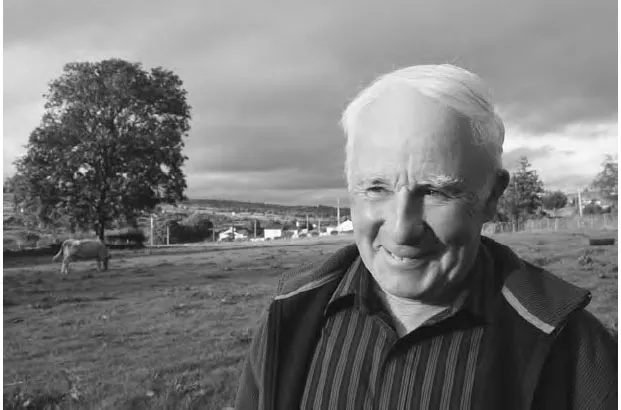
Figure 1.1. Danny Gallen
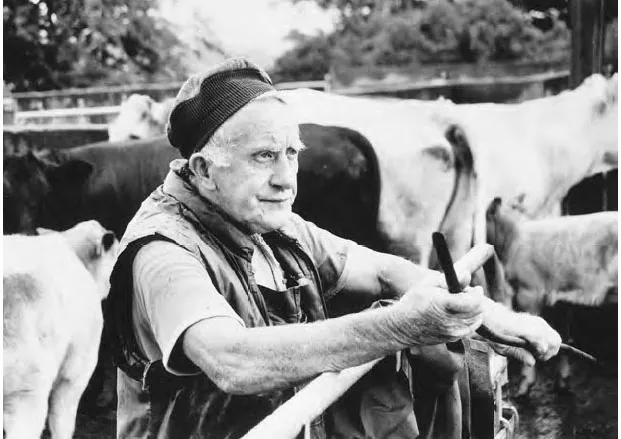
Figure 1.2. Mickey Byrne
So the following Friday, anyhow, or so, the two of them met up in the town, you see, and Fr. Doherty says to Neil—Neil was very drunk again, you see—and Fr. Doherty says, “Drunk today again, Neil!”
“Well, aye Father, indeed so am I!”
The widower had a genuine laugh, and after a few more minutes of chat, he withdrew to resume his duties in the receiving line at the door. About an hour after our arrival, the crowd had not diminished, and since we were neither related to, nor near neighbors of, the deceased, Danny and I headed for home, our minimal social duty done. Closer friends and relatives would settle in for the night, swapping stories and passing the time until dawn cast shadows from the Sperrin mountains.
Nine years, fourteen wakes, and numerous ceilis and interviews later, I can assert with confidence that both wakes and ceilis are the primary social contexts in Aghyaran for the neighborly exchange of stories from a range of genres—jokes, tall tales, historical and supernatural legends, personal narratives of both everyday and supernatural experience. Close attention to wakes and ceilis have taught me, however, that another genre is most popular: the local character anecdote.
Although relatively little studied by folklorists, with notable exceptions, the most frequent stories at Aghyaran wakes and ceilis are those like Jim’s about John McHugh and Mickey’s about Neil the Bucket. These local character anecdotes—an outsider’s etic term but an insider’s emic category3—are brief and often humorous biographical sketches of local individuals, living or deceased, especially those affectionately referred to as “characters.” With proper contextualization the local character anecdote reveals itself to be a favored channel through which people in Aghyaran engage the past in order to make sense of the present and guide each other toward the future. I cannot deny, however, that at first glance this small genre of short, snappy narratives seems an improbable vehicle of social consequence and an unlikely candidate for serious study.
If the carnivalesque play at Tommy’s does not fit the relatively chaste and ceremonious image earlier folklorists wished for the ceili as traditional storytelling session, the local character anecdote does little better to fit the bill of authentic, voice-of-the-nation folklore handed down from time immemorial. In the Irish context, local character anecdotes serve neither as ancient national treasures—as have heroic tales of Cúchulainn and Fionn Mac Cumhaill—nor as evidence of Ireland’s contribution to an international heritage of oral literature—as have Irish versions of migratory wonder tales or Märchen. Assuming the broader orientations of contemporary European ethnology and the mostly American ethnography of communication, however, the ubiquity of the anecdote demands our attention. Regardless of whatever nationalist, romantic, or conservationist projects and impulses exist in the wider world—regardless of how other people and institutions define, regard, and use folklore—the people of Aghyaran clearly invest a lot of thought and energy in this seemingly modest speech genre when socializing. In the spirit of Franz Boas, founder of American folklore studies, focusing on these anecdotes is a fitting choice for exploring local perspectives and “has the merit of bringing out those points which are of interest to the people themselves” (Boas 1970 [1916]:393).
As we will see, local character anecdotes are not only ubiquitous but also conceptually central in the generic system of Aghyaran storytelling. Detailing the conventions and formal features of this genre and illustrating inter-generic connections can wait for now. Yet having briefly discussed what stories in general are good for, typically and universally, I should anticipate later chapters by delineating the value and utility of Aghyaran anecdotes in particular.
Essentially, local character anecdotes typify the personalities of individuals through reports of behavior treated as representative of those people portrayed. In doing so, any given anecdote—a short report of a single event—does not represent an individual in all of his or her complexity. Rather people are transformed through short narratives into exemplars of certain behavioral types, such as nosey gossips or picaresque drunks. Some types are clearly framed as worthy of emulation. These include the modest saintly bachelor, the good mother, and the “man of words” who is always quick with a clever comeback. Other types are clearly singled out for criticism or rejection. These include the farmer-capitalist who sacrifices neighborliness in his feverish pursuit of wealth, and the fool whose lack of wit marks him or her (but usually him) as the community scapegoat. Still other types evoke ambivalence. These include the wily trickster who is the epitome of wit but who crosses a line into unacceptable behavior when he targets the innocent and vulnerable. Also evoking ambivalence is the socially maladjusted rough bachelor who is no model for proper, modern behavior but who may be prized when he defeats the arrogant outsider in a contest of wit. Quite often the character types depicted in Aghyaran anecdotes are those, such as the rough bachelor, who are associated with the past and symbolic of outmoded ways of being. Stories about these anachronistic characters, then, allow for contemplation and evaluation of change through the contrast of past and present.
Regardless of the personality type a particular anecdote invokes, these stories as a whole put certain ideological orientations and emotional stances on display for evaluation by audience members. That is, local character anecdotes provide a vehicle through which people may contemplate human nature and evaluate a range of ways of being that are found in and shaped by the shared sociohistorical environment of Aghyaran. Moreover, hearers may evaluate their own orientations and stances vis-à-vis those of anecdote characters. In the process, the individuals portrayed in these stories are assigned relative social status and incorporated as exemplars of familiar human types into local collective memory.4
Shifting focus from the individual to the collective, this body of oral narrative serves as a community study initiated by locals long before any self-professed ethnographer arrived on the scene. As Clifford Geertz (1973) and Keith Basso (1979) observe, academics are not the only people engaged in ethnography, and oftentimes the stories people tell themselves about themselves are most revealing. As a form of auto-ethnography, local character anecdotes allow Aghyaran residents to represent themselves to themselves, imagining local community through a survey of the types of humanity that comprise and may symbolize that community. At the same time, local character anecdotes bring together narrators and listeners in circles of participation at ceilis and wakes, thus enacting local community while simultaneously representing it in narrative.5
If one justification for contextualizing and analyzing local character anecdotes is gaining ethnographic insight into a particular community, another is better appreciation of the politics of culture and identity in Northern Ireland and by extension other plural societies. Much is at stake in imagining specifically local community through anecdotes and related genres of storytelling. Put in proper context, swapping local character anecdotes at wakes and ceilis may be appreciated as a powerful vehicle for challenging the rhetoric and effects of sectarian identity. Aghyaran anecdotes provide a sense of shared identity and belonging based on local community membership rather than on Catholic vs. Protestant ethnic, religious, and political affiliations. Because local identity is imagined as a range of personal identities considered specific to or at least distinctive of Aghyaran as a community, local identity is simply more complicated than sectarian identity, which allows for only Catholic or Protestant as meaningful conceptual categories.
This sort of nuance, a complication of reductive binary thinking, is quite valuable in the midst of violent conflict and sectarian identity politics. Received wisdom about the division ...
Table of contents
- Cover
- Title
- Copyright
- Contents
- Preface: The Road to Ballymongan
- Acknowledgments
- 1 Goals and Orientations
- 2 Aghyaran: A Sense of Place and History
- 3 Ceilis as Storytelling Contexts
- 4 Wakes as Storytelling Contexts
- 5 Local Character Anecdotes
- 6 The Wider Range of Storytelling Genres
- 7 Anecdotes and the Literary Character
- 8 Anecdotes and the Local Character
- 9 Anecdote Cycles and Personality Traits
- 10 Patterns and Implications
- 11 Storytelling, Commemoration, and Identity
- Notes
- Bibliography
- Index
Trusted by 375,005 students
Access to over 1.5 million titles for a fair monthly price.
Study more efficiently using our study tools.
Frequently asked questions
Yes, you can cancel anytime from the Subscription tab in your account settings on the Perlego website. Your subscription will stay active until the end of your current billing period. Learn how to cancel your subscription
No, books cannot be downloaded as external files, such as PDFs, for use outside of Perlego. However, you can download books within the Perlego app for offline reading on mobile or tablet. Learn how to download books offline
Perlego offers two plans: Essential and Complete
- Essential is ideal for learners and professionals who enjoy exploring a wide range of subjects. Access the Essential Library with 800,000+ trusted titles and best-sellers across business, personal growth, and the humanities. Includes unlimited reading time and Standard Read Aloud voice.
- Complete: Perfect for advanced learners and researchers needing full, unrestricted access. Unlock 1.5M+ books across hundreds of subjects, including academic and specialized titles. The Complete Plan also includes advanced features like Premium Read Aloud and Research Assistant.
We are an online textbook subscription service, where you can get access to an entire online library for less than the price of a single book per month. With over 1.5 million books across 990+ topics, we’ve got you covered! Learn about our mission
Look out for the read-aloud symbol on your next book to see if you can listen to it. The read-aloud tool reads text aloud for you, highlighting the text as it is being read. You can pause it, speed it up and slow it down. Learn more about Read Aloud
Yes! You can use the Perlego app on both iOS and Android devices to read anytime, anywhere — even offline. Perfect for commutes or when you’re on the go.
Please note we cannot support devices running on iOS 13 and Android 7 or earlier. Learn more about using the app
Please note we cannot support devices running on iOS 13 and Android 7 or earlier. Learn more about using the app
Yes, you can access Storytelling on the Northern Irish Border by Ray Cashman in PDF and/or ePUB format, as well as other popular books in Social Sciences & Cultural & Social Anthropology. We have over 1.5 million books available in our catalogue for you to explore.