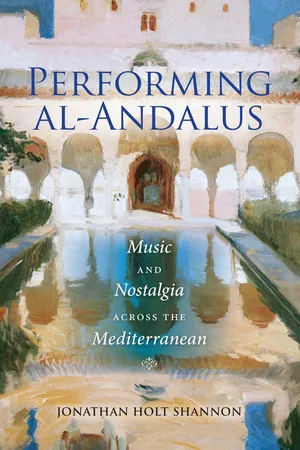
Performing al-Andalus explores three musical cultures that claim a connection to the music of medieval Iberia, the Islamic kingdom of al-Andalus, known for its complex mix of Arab, North African, Christian, and Jewish influences. Jonathan Holt Shannon shows that the idea of a shared Andalusian heritage animates performers and aficionados in modern-day Syria, Morocco, and Spain, but with varying and sometimes contradictory meanings in different social and political contexts. As he traces the movements of musicians, songs, histories, and memories circulating around the Mediterranean, he argues that attention to such flows offers new insights into the complexities of culture and the nuances of selfhood.
- 253 pages
- English
- ePUB (mobile friendly)
- Available on iOS & Android
eBook - ePub
About this book
Information
ONE
In the Shadows of Ziryab

Narratives of al-Andalus and
Andalusian Music
OVERTURE: WE ARE ALL SONS OF ZIRYAB
One afternoon in Granada I join a friend in Plaza Nueva, located at the foot of the old “Moorish” quarter of the Albaicín. He manages a little tourist shop that specializes in artesanía (arts and crafts), mostly imported wooden boxes and glassware from his native Algeria, as well as trinkets from Morocco and elsewhere. We had met the day before when, walking around the Calle Calderería Nueva, I heard the voice of the great Egyptian singer Umm Kulthum issuing from his shop. It was too much to resist, so I went in, and we began talking about music and life in Granada. After half an hour or so we agreed to meet in the main square the next day. At the appointed hour I find him in front of a news kiosk. Because he finds the Albaicín to be “sinister” he prefers for us to head today to the newer side of town. Not only is it more pleasant to sit there, he claims, but he wants to introduce me to a friend who runs a music store nearby where I am sure to find all sorts of CDs for my project on Andalusian music. Not long after we finish our freshly squeezed orange juices at a pleasant café near the Fuente de las Batallas, we walk over to the store, a small shop stacked high with recordings. The proprietor welcomes us both warmly, and we get to discussing the ins and outs of Andalusian music. She has a large collection of what she considers to be “Andalusian music,” including many of the recordings from Eduardo Paniagua’s Pneuma label dealing with one or another aspect of the Andalusian musical heritage, some Syrian and other Levantine recordings, and stacks of recordings of flamenco puro, nuevo flamenco, fusions of Arab and flamenco music, and so on.1 “The whole nine yards!” I think. I imagine that she must have understood that I am interested in musics from the Spanish region of Andalucía—a common confusion—so I tell her that I am mostly interested in the Arab-Andalusian music, not flamenco, which is closely associated with this region in Spain and especially with the city of Granada. “They are the same!” she replies. “They are all sons of Ziryab! Paco de Lucía, Tomatito, these guys [indicating a local group of Arab performers]. ¡Son todos hijos de Ziryab!” With that she puts a disc in the CD player, and, motioning for me to sit down on a stool near the cash register, we proceed to listen to the many sons of Ziryab.
The idea that all these musical cultures—from Levantine to North African to Spanish, from Arab-Ottoman to “Gypsy” to fusion—have their origins in the person of Ziryab is a popular one. The Ziryab origin story is shared, to one degree or another, by many musicians, audiences, and even scholars not only in Spain but across the span of the Mediterranean circuits I explore in this volume, and beyond. It constitutes a key or charter myth of the Andalusian musical legacies. This chapter provides an overview of the mythologies and histories of al-Andalus that inform our present reimaginings of this past time and place. I focus on the standard narrative that structures representations of Andalusian culture today across the Mediterranean region, especially the tale of Ziryab as a musical progenitor and the spread and development of Andalusian musics in the aftermath of the fall of Granada in 1492.2 While this book focuses on the Andalusian and Andalusian-inspired musics of Syria, Morocco, and Spain, I also discuss Andalusian performance practices and cultural memory in Algeria, Tunisia, and Libya, as well as among Sephardic Jews around the Mediterranean. My aim in doing so is both to review the histories and musics of the Andalusian Mediterranean and to highlight the ways in which the mythological character of the present understandings of the past promote the complex imaginaries and rhetorics of al-Andalus. “Andalusian music” per se does not exist, that is, as a unified musical practice with a fixed repertoire and a traceable genealogy. Rather, to borrow from Claude Lévi-Strauss (1964, 1966), it is “good to think”; that is, for musicians, audiences, cultural programmers, and scholars in and of the Middle East, North Africa, Mediterranean regions, and beyond, the very idea of an Andalusian heritage retrievable through musical performance subscribes to a logic of nostalgic consumption that makes cultural (and often financial) sense. This provocative assertion will be borne out through analysis of the varied histories of al-Andalus and the musics called “Andalusian” that form part of a broader trans-Mediterranean, indeed global, circulation of ideas and practices associated with medieval Spain. The label “Andalusian” was largely a colonial artifact but one that, like so many labels (think of jazz or any other style of music), has been very productive. As we shall see, labeling a musical culture “Andalusian” has the potential to reinforce secular pan-Arab ideologies or Islamist ideologies, just as it may shore up notions of ethnic and cultural distinction by asserting multiple and contradictory claims to the past, the present, and the future.
Confronting these multiple meanings of al-Andalus leads me to ask: What depths of cultural memory and other affective resources do these networks and circuits access and empower? In other words, what is the work of al-Andalus and Andalusian music in the contemporary Mediterranean? Why are these musical and imaginative circulations important today? And what is it about the contemporary Mediterranean that allows for the development, spread, and power of the idea of a shared Andalusian heritage to effect change? To answer these questions requires an itinerant, “nomadic” approach (Deleuze and Guattari [1980] 1987) to the histories and mythologies of al-Andalus. To understand how the musical legacies of al-Andalus, including the legend of Ziryab, contribute to the rhetorical work of al-Andalus in the modern era requires attention to the narratives of rise and decline, ebb and flow, conquest and return voyage that not only these musics but the story of al-Andalus trace for Syrian, Moroccan, Spanish, and increasingly global communities of musicians, artists, intellectuals, and tourists.
AL-ANDALUS BETWEEN HISTORY AND MYTHOLOGY: THE STANDARD NARRATIVE
The story of al-Andalus is eminently one of exile, conquest, and movement: if not rise and decline, then ebbing and flowing, like the sea that partially forms its boundaries, defines its points of access, and sets its limits. “Al-Andalus” is the Arabic name for those areas of the Iberian Peninsula that came under Muslim rule beginning in the early eighth century and, in the aftermath of the Christian conquest (in Spanish known as la reconquista), ending with the fall of the Kingdom of Granada in 1492 and the subsequent expulsion of Muslims and Jews from Spain as late as 1610 (in Spanish referred to as la partida).3 It is important to note that al-Andalus does not refer to a fixed place or time but rather to a fluid and shifting geographical, historical, political, and cultural cartography. As an object of nostalgic consumption in music, literature, cinema, popular culture, and scholarship, al-Andalus serves as a chronotope of authenticity (Bakhtin 1981; Shannon 2005). That is, al-Andalus constitutes a time-place endowed with an aura of the authentic, yet one with an ambiguous referent: sometimes the whole of Spain; sometimes the southern Iberian and Moroccan sides of what Fernand Braudel called a Euro-African “bi-continent”; sometimes the Spanish autonomous region of Andalucía, including the modern Spanish cities that bear the names of the medieval city-states (or ta’ifa kingdoms) of Córdoba, Granada, Málaga, Sevilla, Valencia, and so on (Braudel [1972] 1995, 117, 164, cited in Gilmore 1982, 178). For this reason we must acknowledge from the outset the coexistence of multiple, overlapping, and at times contradictory imaginings of al-Andalus, yet the multiplicity of these imaginings attests to the power of the concept, the very idea of al-Andalus, to animate projects of collective memorializing and myth making.4
We can identify these contradictions from the very beginning both in al-Andalus’s history and in its modern historiography. While most Occidental sources refer to the coming of the Muslims (Arabs, Berbers, and others) as the conquest of Iberia, medieval Arabic chronicles usually refer to their arrival as a fath, or “opening.” The idea of an opening rather than an invasion, conquest, or colonization carries very different connotations and invokes a different, more teleological narrative. Though the date of this opening is usually given as 711 CE, it actually began a little earlier, in 710, when Berber generals crossed from Morocco to Tarifa to intervene in the Visigoth civil war.5 The full-scale “opening” continued in April 711 with the landing of the Berber general Tariq Ibn Ziyad on Gibraltar. This latter crossing is what led to the defeat of King Roderic (Rodrigo), the capitulation or flight of the Visigoth forces, and the subsequent settling of much of Iberia in the ensuing eight years by Berber and Arab colonists—what we now know as the “Moorish Conquest of Iberia,” an Arab-Muslim conquest that was also a Berber, Arab, Muslim, and Christian opening. Another aspect of the standard narrative states that the opening of al-Andalus was also a liberation of Iberian Jewry, who suffered under Visigoth oppression but found more tolerant rulers in the Muslim colonizers.
The earliest political and cultural entity we know of as al-Andalus was the Umayyad Emirate, founded in Córdoba by the Syrian Umayyad prince ‘Abd al-Rahman al-Dakhil, “The Immigrant.” In 750 ‘Abd al-Rahman escaped the massacre of his family at the hands of ‘Abbasid partisans in his palace in Rusafa, Syria, and made his way across North Africa to Iberia, settling in Córdoba. By then al-Andalus was already in the process of becoming a land not only of Syrian-Arab princes but also of North African Berbers and Arabs, as well as Jews and Christians, some coming from the Arab lands and North Africa, others having been present in Iberia from before its opening to Islam. The ethnic, religious, and class composition of al-Andalus and its political fortunes varied dramatically from one era to another as waves of migrants, armies, settlers, and vanquished ebbed and flowed through the Iberian Peninsula and across the Pyrenees, the Strait of Gibraltar, and even the Sahara for more than eight centuries. This fluidity cannot be captured by the term invasion or conquest or, for that matter, opening.
As the standard narrative would have it, the Islamic opening of Christian Iberia prepared the ground for the development of a cultural and scientific efflorescence rivaling and even surpassing the achievements of the storied ‘Abbasid Dynasty based in Baghdad. Baghdad, seat of the famous caliph Harun al-Rashid (763–809) and then the center of the Muslim world, was famous for the Bayt al-Hikma (House of Wisdom), at the time the most important library and center of learning in the Islamic world, if not the whole world. We also know it today as a setting for some of the tales of The Book of a Thousand and One Nights. Yet Córdoba in its brief period of splendor (ca. 756–1031) would outshine even Baghdad.6 As the late scholar of al-Andalus María Rosa Menocal notes in her best-selling The Ornament of the World (2002b, 33), one example of the cultural dynamism of al-Andalus was Córdoba’s library, which by the eleventh century was thought to have contained over four hundred thousand manuscripts at a time when the largest library in Europe beyond the Pyrenees held fewer than four hundred. The extent of this library’s collection serves as a metaphor for the broad scientific, philosophical, literary, culinary, architectural, musical, and other advances that characterized this period of life in al-Andalus, especially during the Caliphate of Córdoba (929–1031); the metonymy between Córdoba the city and seat of the caliphate and the entirety of al-Andalus as a cultural and political entity dates to this period. Córdoba was also the adopted home of Ziryab, so in the standard narrative the music finds its origins and apotheosis here as well. Even if later periods were not to see an equivalent efflorescence, and indeed the time and place of its apogee remain ambiguous, cultural developments in such cities as Toledo, Sevilla, and Granada have led generations of Arabs, Muslims, scholars, poets, and others to think of al-Andalus as representing an historical golden age.
Continuing with the standard narrative, after the fall of the caliphate in 1031 after a devastating civil war, there developed in its shadow what are called the ta’ifa kingdoms, independent but militarily weak city-states that included many of the regional capitals of the former caliphate: Granada, Toledo, Sevilla, Valencia, Badajoz, Saragossa (Zaragoza), Málaga, Tortosa, and, much weakened, Córdoba itself. In the words of the thirteenth-century Andalusian poet al-Shaqundi, the fall of the Caliphate of Córdoba resulted in “the breaking of the necklace and the scattering of its pearls” (quoted in Fletcher 1989, 27).7 These scattered pearls were to develop their own rich cultural traditions. Given their political weakness—disunited politically, separated geographically, and often besieged militarily—the ta’ifa kingdoms often survived by allying themselves with Christian states, often in opposition to their Muslim neighbors, in return for peaceful coexistence and military security. In some way, the relative weakness of the ta’ifa kingdoms encouraged their cultural development, as rivalries among the various rulers meant that patronage was spread more widely than in the more centralized Córdoba, which stood as a (tarnished) model of cultural development. Thus the various ta’ifa courts hosted a menagerie of poets, statesmen, craftsmen, scholars, and jurists who added significantly to the cultural legacy of al-Andalus (Dodds, Menocal, and Balbale 2008; Fletcher 2006; Wasserstein 1985). It is important to note that this efflorescence occurred in the absence of a central authority and in the context of cooperation and complicity among Muslim and Christian leaders, often employing the services of Jewish intermediaries.
Indeed, one of the best-advertised features of life in medieval al-Andalus is what is now known as convivencia (coexistence or living together; in Arabic, al-ta’ayyush).8 This now well-known concept—featured in everything from academic symposia and trans-Mediterranean political and cultural projects to Spanish tourist brochures—describes the ability of the Muslims, Jews, and Christians of al-Andalus to live together peacefully from the early Umayyad period, through the Caliphate of Córdoba and ta’ifa kingdoms, up to the fall of Granada. Along with its architectural and literary splendors, the sociopolitical legacy of convivencia supports the idea of al-Andalus as a lost paradise.9 In a time when Jewish sages such as Maimonides wrote their masterpieces in Arabic, Christian princes decorated their homes and even tombs in the Mozarabic style (Spanish mozárabe, from the Arabic must‘arab, “Arabized”), and Muslim translators conveyed the wisdom of the ancient world to medieval Europe, it is tempting for more than one community to look back on this period with a mixture of mourning and even nostalgia, especially given the modern legacy of intercommunal hatred and violence.
Some scholars cast doubt on the extent of convivencia in al-Andalus, claiming that contemporary projects impose their own beliefs in multicultural tolerance on a world where the modalities of subjectivity were very different; medieval Iberia was not without its share of pogroms, massacres, and institutionalized discrimination in the form of dhimmi, or “protected status” populations (Catlos 2001; Cohen 1994; Fanjul García 2004; Fernández-Morera 2006; Fletcher 2006; Harvey 2005). Others argue that al-Andalus was, for its time, a model of relative harmony, if not interfaith coexistence. Andalusian convivencia remains one of the enduring cultural legacies of al-Andalus, relevant not only for narratives of the past but for a variety of contemporary projects of multiculturalism that draw on it—indeed, that have helped to construct it as a modern phenomenon. For many, the idea or even promise of convivencia, like the story of al-Andalus itself, is good to think as well.
THE LOSS OF AL-ANDALUS AND HYPERNOSTALGIA
Doors open and close, inviting or preventing access and movement, creating passages or erecting barriers. Indeed, the Muslim fath, or opening, was destined to last nearly eight centuries, though not without numerous closings, reopenings, and a (not entirely) final closure. Not surprisingly, the Arabic sources use a somewhat less poetic term to refer to this closure: suqut (fall), which refers both to the fall of individual cities and to the end of al-Andalus as a political entity.10 Yet even the fall of al-Andalus (suqut al-andalus) refers to different and shifting places and times: for example, Córdoba in 1236, Valencia in 1238, Seville in 1248, and, most famous of all, the fall of Granada in 1492, by which time Muslim sovereignty was limited to this city and some surrounding territories. Moreove...
Table of contents
- Cover
- Half title
- Title
- Copyright
- Dedication
- Contents
- Prelude
- Acknowledgments
- A Note on Transliteration
- Overture: Performance, Nostalgia, and the Rhetoric of al-Andalus: Mediterranean Soundings
- 1 In the Shadows of Ziryab: Narratives of al-Andalus and Andalusian Music
- 2 The Rhetoric of al-Andalus in Modern Syria, or, There and Back Again
- 3 The Rhetoric of al-Andalus in Morocco: Genealogical Imagination and Authenticity
- 4 The Rhetoric of al-Andalus in Spain: Nostalgic Dwelling among the Children of Ziryab
- Finalis: The Project of al-Andalus and Nostalgic Dwelling in the Twenty-First Century
- Glossary
- Notes
- References
- Index
Trusted by 375,005 students
Access to over 1.5 million titles for a fair monthly price.
Study more efficiently using our study tools.
Frequently asked questions
Yes, you can cancel anytime from the Subscription tab in your account settings on the Perlego website. Your subscription will stay active until the end of your current billing period. Learn how to cancel your subscription
No, books cannot be downloaded as external files, such as PDFs, for use outside of Perlego. However, you can download books within the Perlego app for offline reading on mobile or tablet. Learn how to download books offline
We are an online textbook subscription service, where you can get access to an entire online library for less than the price of a single book per month. With over 1.5 million books across 990+ topics, we’ve got you covered! Learn about our mission
Look out for the read-aloud symbol on your next book to see if you can listen to it. The read-aloud tool reads text aloud for you, highlighting the text as it is being read. You can pause it, speed it up and slow it down. Learn more about Read Aloud
Yes! You can use the Perlego app on both iOS and Android devices to read anytime, anywhere — even offline. Perfect for commutes or when you’re on the go.
Please note we cannot support devices running on iOS 13 and Android 7 or earlier. Learn more about using the app
Please note we cannot support devices running on iOS 13 and Android 7 or earlier. Learn more about using the app
Yes, you can access Performing al-Andalus by Jonathan Holt Shannon in PDF and/or ePUB format, as well as other popular books in History & European History. We have over 1.5 million books available in our catalogue for you to explore.