"Goscilo and Norris' innovative anthology provides Slavic scholars with a panoramic view of the city's literary, pictorial and social manifestations." —
Europe-Asia Studies
For more than three centuries, St. Petersburg, founded in 1703 by Peter the Great as Russia's westward-oriented capital and as a visually stunning showcase of Russia's imperial ambitions, has been the country's most mythologized city. Like a museum piece, it has functioned as a site for preservation, a literal and imaginative place where Russians can commune with idealized pasts.
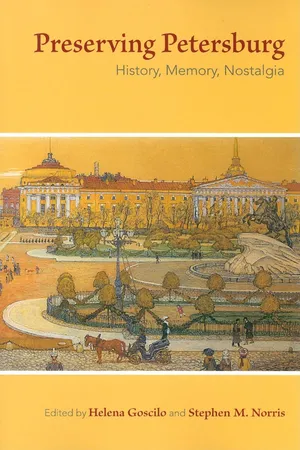
Preserving Petersburg represents a significant departure from traditional representations. By moving beyond the "Petersburg text" created by canonized writers and artists, the contributors to this engrossing volume trace the ways in which St. Petersburg has become a "museum piece," embodying history, nostalgia, and recourse to memories of the past. The essays in this attractively illustrated volume trace a process of preservation that stretches back nearly three centuries, as manifest in the works of noted historians, poets, novelists, artists, architects, filmmakers, and dramatists.
"The collection truly sparkles as the contributors each in turn take up this snuff box of a city . . . and breathe movement and life into the idealized Petersburg museum." —Gregory Stroud, Bennington College
"This collection brings together history, literature, architecture, and the politics of memory." —
Choice
"An interesting and important contribution to existing scholarship on St. Petersburg's myth, cult, and text . . . this volume is distinctive." —Catharine Theimer Nepomnyashchy, Columbia University
"A truly innovative contribution to the scholarship on Petersburg . . . The volume should be read by all serious Slavic scholars." —Emily Johnson, University of Oklahoma
eBook - ePub
Preserving Petersburg
History, Memory, Nostalgia
- 264 pages
- English
- ePUB (mobile friendly)
- Available on iOS & Android
eBook - ePub
Preserving Petersburg
History, Memory, Nostalgia
About this book
Information
Five
Petersburg in the Poetry of the Russian Emigration
__________________________________
Petersburg is one of the recurrent and most extensive themes in Russian émigré literature, including poetry. In the artistic consciousness of those who found themselves outside of their native country after the October 1917 Revolution, the former capital of the Russian empire represented an important artistic space. Understandably, sociopolitical and cultural factors played a primary role here: Petersburg was customarily associated with state power, military glory, the flourishing of sciences and the arts (including, of course, the city’s unique characteristic of being itself a work of art), but there was also something else, less subject to rational logic and which, perhaps, can be conveyed only by the metaphysical language of poetry.1
This can be seen in an example that, at first glance, seems rather amusing, but is most graphic and significant. The Muscovite Ia. N. Gorbov, who after Moscow University studied in the Petersburg Nikolaev military academy, wrote the following in a review of the book of poetry Blue World (Sinii mir; New York, 1961) by an émigré poetess, N. Belavina, who not only had never lived in Petersburg but also, apparently, had never even been there (at age five she was taken from the Crimea to Constantinople, then to Yugoslavia and from there to the West):
In St. Petersburg, whether on Ekaterininskii or Morskaia, on Kamennoostrovskii or on Nevsky or on the Moika, or someplace else, on some evenings, one could see from the window, or from the depths of the room, some kind of blue light, amazing but not strange, lightly glimmering, come right up to the glass, of a kind that one wanted to ask it some unspoken question and receive an unspoken answer, or exchange glances or a smile ... St. Petersburg was a unique city. The blue evening light, probably, even now remains there as something unique ... The title Blue World, written in blue letters on Nonna Belavina’s poetry collection, reminds those who saw the St. Petersburg blue light of its magic. Or perhaps an eternal promise of a better future, the elusive Bluebird?2
It is curious that in the review, Belavina, who never saw Petersburg with her own eyes, is almost transformed into the inveterate Petersburg author. The closeness between the title of her collection and the luminous effects of the Petersburg air are based on the reviewer’s sensory “aberrations” and are deeply associative in their origin. The last sentence about Maeterlinck’s Blue Bird somewhat clarifies the nature of these associations but it does not entirely dispel the sensation that Belavina’s verse is permeated with the Petersburg atmosphere with which she was not familiar!
Nostalgia, Exile, and the Petersburg Syndrome
At the heart of this curiosity, however, lies a very important and serious problem. The “Petersburg syndrome” does not necessarily testify to the fact that a poet was born in the city on the Neva. Rather, it is a matter of the profound intentions of Russian poetic culture in general, gravitating in its moral and spiritual insights toward the Pushkinian artistic heritage and therefore inseparably linked to the “Petersburg period” of Russian literature understood in the broad historical perspective.
Indisputably, the former residents of Petersburg were the ones who felt the greatest nostalgia for Petersburg. “You have to be a ‘Peterburzhets’ [resident of Petersburg] in order to understand the longing for Petersburg,” someone wrote under the pseudonym Petronius in the sketch “Petersburg.” “You have to be thoroughly soaked by the miasmas of the Marquisan Meadow, smoked by the Petersburg fogs, in order to dream of Petersburg amid the glitter and comfort of European centers. Berlin and Paris are now seething with such dreamers; and we dream about our foggy swamp as ardently as mountaineers thrust into the valleys dream about their azure heights.”3
In emigration, however, even those who had never been there and knew the city only from books or oral tales also wrote poems about Petersburg (or about the adjacent cultural-geographical areas). One example is A. Shteiger, who wrote the two-part cycle Tsarskoe Selo, whose interest in Petersburg was purely literary in origin. Georgii Adamovich, who knew Shteiger well, recalled that he “was capable of asking endlessly about Petersburg, about the Poets’ Guild (Tsekh poetov), about the evenings in the Stray Dog [café], even about the Petersburg ballet. For him this was some kind of paradise lost, incidentally, not even lost but unfamiliar because he had never been in Petersburg.”4 It is worth comparing this with the remark of Iurii Terapiano about the kind of “Petersburg syndrome” that developed among the émigré intelligentsia dreaming about the city “which they had not seen in their lifetime.”5 This syndrome, in which not only Petersburg residents but even people who had never been in the Russian capital found themselves “captives of its magnificent granite” (an image from the poetry of O. Annenkova, who never left Russia but remained there as an “internal émigré”), was so widespread among the emigrant community that it cannot but attract attention to itself.
Petersburg was a symbol of paradise lost, exile from which became a turning point in Russian history. The most potent symbol—the horseman on the rearing steed—receded into historical oblivion and gave way to new idols.6 The fall of one state order and its replacement by another was accompanied, as is usual and happens in times of stormy revolutionary cataclysms, by active myth creation in society. On one side of the border, in the USSR, Petersburg, which became Leningrad, in Soviet mythology was turned into the “cradle of three revolutions.” This version presented the legendary location sanctified by semi-official Soviet historiography and linked it with the name of “the leader of the worldwide proletariat.” It is quite clear that Petersburg/Leningrad images in Russian literature of the Soviet age did not reproduce in the automatic form these ideological clichés (it should be sufficient to recall such texts as “Satyr Chorus” (Kozlinaia pesri) by K. Vaginov, “Crazy Ship” (Sumasshedshii korabl’) by O. Forsh, “Poem without a Hero” (Poema bez geroia) by A. Akhmatova, etc.). But in the official Soviet history, Leningrad had been highlighted as the revolutionary myth. This did not, however, hinder the city’s provincialization, economic decline, and gradual loss of its former greatness. On the other side of the border, in emigration, Petersburg personified the lost state power, the Utopian dream of rebuilding the collapsed state.7 Forced to live in a phantom sociopolitical reality, the emigrants naturally dreamed of their own state, capable of uniting them not virtually or metaphysically but as full-fledged citizens with equal rights.8 This is the source for the émigré longing for Petersburg as a city that once played the role of a unifying center for a Russia of diverse peoples.
The Petersburg Image
This characteristic leads us to a very essential point for an understanding of the “Petersburg myth” in general and its frequent occurrence in emigration in particular. It boils down to the fact that the image of Petersburg, the center of the national-cultural cosmos, more so than any other Russian city, is inseparable from Russian literature. It is in equal measure the creation of Peter and Pushkin, as can be seen, for example, in the lines from the poem of Ivan Bunin, “The Day in Peter’s Memory” (Den’ pamiati Petra): “Great and sacred City, / Created by Peter and Pushkin.” The Russian émigré poet A. Topol’skii, who lived in Warsaw, went even further in his notion of the true founder of Petersburg: “You were created / Not by Peter but by Dostoevsky.” In this context, it is worth mentioning the mocking epistle of the satirical poet Don-Aminado (A. P. Shpolianskii) to Igor’ Severianin. While striving for a parody, at the same time the poet established a certain truth that was difficult to refute when he wrote in one of his verse feuilletons called “The Reason of all Reasons” (Prichina vsekh prichin):
Well, is this Petersburg fruitA peach or a pear?!How we lived! How we ate!What did we read, what did we listen toNear the Neva’s granite wat...
Table of contents
- Cover
- Half Title
- Title Page
- Copyright Page
- Table of Contents
- Acknowledgements
- Introduction
- One St. Petersburg and the Art of Survival
- Two The City’s Memory: Texts of Preservation and Loss in Imperial St. Petersburg
- Three Unsaintly St. Petersburg? Visions and Visuals
- Four A Tale of Two Cities: Ancient Rome and St. Petersburg in Mandelstam’s Poetry
- Five Petersburg in the Poetry of the Russian Emigration
- Six Multiethnic St. Petersburg: The Late Imperial Period
- Seven Leningrad Culture under Siege (1941–1944)
- Eight Cultural Capital and Cultural Heritage: St. Petersburg and the Arts of Imperial Russia
- Nine Strolls Through Postmodern Petersburg: Celebrating the City in 2003
- List of Contributors
- Index
Trusted by 375,005 students
Access to over 1.5 million titles for a fair monthly price.
Study more efficiently using our study tools.
Frequently asked questions
Yes, you can cancel anytime from the Subscription tab in your account settings on the Perlego website. Your subscription will stay active until the end of your current billing period. Learn how to cancel your subscription
No, books cannot be downloaded as external files, such as PDFs, for use outside of Perlego. However, you can download books within the Perlego app for offline reading on mobile or tablet. Learn how to download books offline
Perlego offers two plans: Essential and Complete
- Essential is ideal for learners and professionals who enjoy exploring a wide range of subjects. Access the Essential Library with 800,000+ trusted titles and best-sellers across business, personal growth, and the humanities. Includes unlimited reading time and Standard Read Aloud voice.
- Complete: Perfect for advanced learners and researchers needing full, unrestricted access. Unlock 1.5M+ books across hundreds of subjects, including academic and specialized titles. The Complete Plan also includes advanced features like Premium Read Aloud and Research Assistant.
We are an online textbook subscription service, where you can get access to an entire online library for less than the price of a single book per month. With over 1.5 million books across 990+ topics, we’ve got you covered! Learn about our mission
Look out for the read-aloud symbol on your next book to see if you can listen to it. The read-aloud tool reads text aloud for you, highlighting the text as it is being read. You can pause it, speed it up and slow it down. Learn more about Read Aloud
Yes! You can use the Perlego app on both iOS and Android devices to read anytime, anywhere — even offline. Perfect for commutes or when you’re on the go.
Please note we cannot support devices running on iOS 13 and Android 7 or earlier. Learn more about using the app
Please note we cannot support devices running on iOS 13 and Android 7 or earlier. Learn more about using the app
Yes, you can access Preserving Petersburg by Helena Goscilo, Stephen M. Norris, Helena Goscilo,Stephen M. Norris in PDF and/or ePUB format, as well as other popular books in History & Russian History. We have over 1.5 million books available in our catalogue for you to explore.