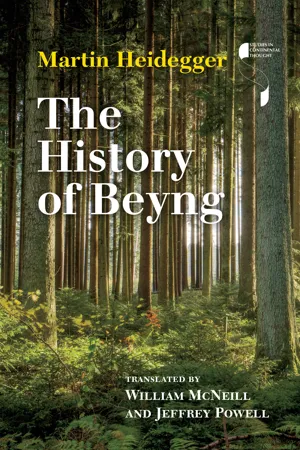
"[This] updated translation showcases what is a central and often-overlooked text in Heidegger's oeuvre" and essential to understanding his later work (Phenomenological Reviews).
The History of Beyng belongs to a series of Martin Heidegger's reflections from the 1930s that concern how to think about being not merely as a series of occurrences, but as essentially historical or fundamentally as an event. It builds directly on an earlier work in the series, Contributions to Philosophy (Of the Event), and provides a pathway to the later text,
Mindfulness.
Together, these texts are important for their meditations on the oblivion and abandonment of being, politics, and race, and for their incisive critique of power, force, and violence. Originally published in 1998, this English translation opens new avenues for understanding the trajectory of Heidegger's thinking during this crucial time.
- 226 pages
- English
- ePUB (mobile friendly)
- Available on iOS & Android
eBook - ePub
The History of Beyng
About this book
Information
Topic
PhilosophySubtopic
Existentialism in Philosophy
THE HISTORY OF BEYNG
(1938–40)
THE HISTORY OF BEYNG. PART I
I. The History of Beyng
1. “The History of Beyng” Is the Name . . .
“The History of Beyng” is the name for the attempt to place the truth of beyng as event back into the word of thinking, and thereby to entrust it to an essential ground of historical human beings—to the word and its sayability. Whether the attempted saying itself belongs to the event and thereby participates in the stillness of that which is without having an effect or requiring an effectiveness can never be discerned by calculation. But the attempt would necessarily remain entirely outside of its realm, if it were not to know that it would more appropriately be named: “To the very threshold.” And yet this hint once more diverts us away from the issue and toward the attempt to approach it.
The simple, mature conjoining of the Contributions1 and Mindfulness;2 the Contributions remain a framework, yet without structural articulation; Mindfulness is a middle, but not the source.
2. The History of Beyng
to be told only in the simple word, as told by the in-between which, transforming all relation to being, bears abyssally the sustainment in a way that humans are in general able to sustain within this inceptual realm.
World.
Earth.
Strife.
Humans.
God.
Countering.
Clearing.
Sustainment.
History.
Opening of appropriation.
Appropriative event.
3. Western Philosophya
Why is Western “philosophy” in its essence metaphysics?
Because in the ground of its essence it is “physics.”
And to what extent, and why, is Western philosophy “physics”?
“Physics” here means knowledge (preservation of the truth) of φύσις. Φύσις is the determination of being found at the commencement,3 and that therefore reigns throughout the entire history of Western philosophy.
Yet, being is that which philosophy thinks.
Yet why does physics come to be meta-physics?
What type of variation and entrenchment of physics is that?
Above all else: what does φύσις mean?
And is it the interpretation of the being of beings as a whole found at the commencement?
Is it even determinative for this interpretation?
And why?
Or is the why-question prohibited here, because it is profoundly inappropriate?
The history of beyng.
Is all this only the “philosophy of philosophy” and thus the degenerative outcome of an excess, which is the sign of an uprooting? Or, is something else imminent?
What speaks here is neither a “philosophy of philosophy” nor indeed a philosophy at all. Presumably, however, a readiness for philosophy enjoins its essence, a readiness that goes deep into its ground; and this is the grounding of a belonging to beyng. A rootedness opens up the path into the ground, an event propriated out of the refusal of beyng, neither fabricated nor thought up, yet thoughtfully attentive to the gentleness of the free, given over to the stillness that dwells supreme in the coming of that most in coming.
We appear to be inquiring about philosophy, yet in truth inquire only of beyng, for which philosophy remains the history of an essential belonging, one to which a thinker is from time to time admitted.
Philosophy as something contrived does not lie within the sphere of this reflection.4
4. The Truth of Beyng
hitherto never yet recognized, even though it had to come to the fore within the open realm belonging to the commencement of Western philosophy itself, albeit not as the truth of beyng, and therefore it also never entered its questioning. Rather even its first, still entirely veiled apparition was henceforth buried—and yet it could not and cannot be eliminated.
Only from out of the need of beyng, however, can we first inquire after it.
Compare the interpretation of Aristotle’s Physics B, 1 (first trimester 1940), p. 22ff.;5 a hint of the truth of beyng proceeding from Parmenides’ τò γὰρ αὐτò . . . ; cf. its revised interpretation from summer 1940.
5. Are We?
Who are we?
Where are we?
In what moment are we?
Who are we?
A configuration of questions in which one question arises—never with regard to “us,” but “after” beyng. A disconcerting state of affairs in which beyng propriates.
But never “dialectical,” never as the play of opposites—entirely as propriative event, something singular.
6. “We Are”
Who are we?
And indeed, are we?
What does “being” mean? “Are” we, because and insofar as we come across ourselves, and do so in the way that we come across a tree or house? And do we come across ourselves in this way? And even if we do, do we thereby hit upon the way in which we are?
Who decides about “being”?
Or does being decide about every “who” and all questioning? And how does it do so? What is being? How should being be unveiled and be brought into its truth? What is truth?
We stand in the most extreme region of these questions.

Propriation and the gentleness of supreme sovereignty, which does not require power or “struggle,” but originary critical setting apart. Power-less holding sway.
7. Da-sein
Who could say it!
The clearing of being. To be the grounding ground of this clearing.
This itself does not = being human, rather the latter as guardianship and founding.
The There [Da].
A trace of the There in the ἀλήθεια of φύσις.
But the trace has long since been extinguished—it can never simply be followed again, but must be found from one’s own trail.
And what a jumble of misinterpretation the concept of Da-sein in Being and Time has assembled. Not least in Jaspers, the most desolate leveling-down. From where, then, can we still await an ear and an eye and—a heart?
8. Beyng
at its appointed hour will ward off human fabrication and take even the gods into its service, casting off the corruption of its ownmost essence—machination.
9. ἀλήθεια and Beyng
Because ἀλήθεια remained but a resonance, and ungrounded, even the question concerning the clearing already appears entirely disconcerting to us. The question of beyng can be unfolded solely from out of this question. Beyng thus remains still more concealed and yet—the turn!
10. That Truth . . .
That truth, in essence, is ungrounded and the human lays claim to truths without truth—will historical humankind ever comprehend this as the non-ground of all contemporary history?
1. Beiträge zur Philosophie (Vom Ereignis). Gesamtausgabe vol. 65. Edited by F.-W. von Herrmann. Frankfurt am Main: Vittorio Klostermann, 1989. Translated as Contributions to Philosophy (Of the Event) by Richard Rojcewicz and Daniela Vallega-Neu. Bloomington: Indiana University Press, 2012.
2. Besinnung. Gesamtausgabe vol. 66. Edited by F.-W. von Herrmann. Frankfurt am Main: Vittorio Klostermann, 1997. Translated as Mindfulness by Parvis Emad and Thomas Kalary. New York: Continuum, 2006.
a. Trs.: The Beyng-Historical Concept of the Western World [Abendland]. The land [Land] of evening [Abend]. Evening consummation of a day of history (F.) and the transition to night; time of transition and preparation for morning. Night and day.
3. The term “commencement” translates the German Anfang. Where the adjective anfänglich or the gerund anfangend is used, we have generally rendered these as “inceptual” and “inceptive,” respectively.—Trans.
4. The term “reflection” translates the German Besinnung throughout the present volume. Besinnung, however, does not carry the optical or reflexive connotation of reflection, such as one finds in German Idealism, and which Heidegger associates with the representational form of thinking that he criticizes. Besinnung, rather, implies a thoughtful or meditative pondering that follows the meaning or directional “sense” (Sinn) of something: in this context, the “essencing” of the truth of beyng, as Heidegger will indicate in §31 below. Besinnung is also the title of the 1938–39 text published as volume 66 of the Gesamtausgabe and translated under the title Mindfulness (see note 2 above for details). In his 1953 essay “Wissenschaft und Besinnung” (translated as “Science and Reflection”), Heidegger clarifies Besinnung as follows: “To follow a direction that is the way that something has, of itself, already taken, is called, in our language, sinnan, sinnen [to sense]. To venture after sense or meaning [Sinn] is the essence of reflecting [Besinnen]. This means more than a mere making conscious of something. We do not yet have reflection when we have only consciousness. Reflection is more. It is releasement [Gelassenheit] to what is worthy of question.” See Vorträge und Aufsätze. Gesamtausgabe vol. 7. Edited by F.-W. von Herrmann. Frankfurt am Main: Vittorio Klostermann, 2000. Translated by William Lovitt in The Question Concerning Technology and Other Essays. New York: Harper & Row, 1977, 180 (translation modified). See also the translator’...
Table of contents
- Cover
- Half title
- Title
- Copyright
- Contents
- Translators’ Introduction
- The History of Beyng (1938–40)
- The History of Beyng. Part II
- Appendix
- Editor’s Epilogue
- German–English Glossary
- English–German Glossary
Trusted by 375,005 students
Access to over 1.5 million titles for a fair monthly price.
Study more efficiently using our study tools.
Frequently asked questions
Yes, you can cancel anytime from the Subscription tab in your account settings on the Perlego website. Your subscription will stay active until the end of your current billing period. Learn how to cancel your subscription
No, books cannot be downloaded as external files, such as PDFs, for use outside of Perlego. However, you can download books within the Perlego app for offline reading on mobile or tablet. Learn how to download books offline
Perlego offers two plans: Essential and Complete
- Essential is ideal for learners and professionals who enjoy exploring a wide range of subjects. Access the Essential Library with 800,000+ trusted titles and best-sellers across business, personal growth, and the humanities. Includes unlimited reading time and Standard Read Aloud voice.
- Complete: Perfect for advanced learners and researchers needing full, unrestricted access. Unlock 1.5M+ books across hundreds of subjects, including academic and specialized titles. The Complete Plan also includes advanced features like Premium Read Aloud and Research Assistant.
We are an online textbook subscription service, where you can get access to an entire online library for less than the price of a single book per month. With over 1.5 million books across 990+ topics, we’ve got you covered! Learn about our mission
Look out for the read-aloud symbol on your next book to see if you can listen to it. The read-aloud tool reads text aloud for you, highlighting the text as it is being read. You can pause it, speed it up and slow it down. Learn more about Read Aloud
Yes! You can use the Perlego app on both iOS and Android devices to read anytime, anywhere — even offline. Perfect for commutes or when you’re on the go.
Please note we cannot support devices running on iOS 13 and Android 7 or earlier. Learn more about using the app
Please note we cannot support devices running on iOS 13 and Android 7 or earlier. Learn more about using the app
Yes, you can access The History of Beyng by Martin Heidegger, William McNeill,Jeffrey Powell in PDF and/or ePUB format, as well as other popular books in Philosophy & Existentialism in Philosophy. We have over 1.5 million books available in our catalogue for you to explore.