We all know the name. Martin Luther King Jr., the great American civil rights leader. But most people today know relatively little about King, the campaigner against militarism, materialism, and racism—what he called the "giant triplets." Jennifer J. Yanco takes steps to redress this imbalance. "My objective is to highlight the important aspects of Dr. King's work which have all but disappeared from popular memory, so that more of us can really 'see' King." After briefly telling the familiar story of King's civil rights campaigns and accomplishments, she considers the lesser-known concerns that are an essential part of his legacy. Yanco reminds us that King was a strong critic of militarism who argued that the United States should take the lead in promoting peaceful solutions rather than imposing its will through military might; that growing materialism and an ethos of greed was damaging the moral and spiritual health of the country; and that in a nation where racism continues unabated, white Americans need to educate themselves about racism and its history and take their part in the weighty task of dismantling it.
eBook - ePub
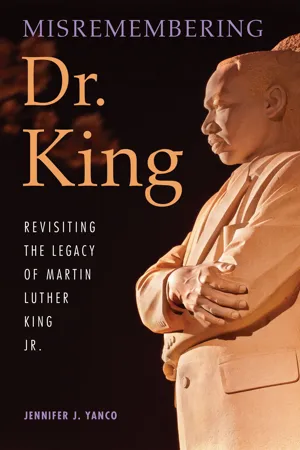
Misremembering Dr. King
Revisiting the Legacy of Martin Luther King Jr.
- 110 pages
- English
- ePUB (mobile friendly)
- Available on iOS & Android
eBook - ePub
About this book
Trusted by 375,005 students
Access to over 1.5 million titles for a fair monthly price.
Study more efficiently using our study tools.
Information
1

What We Remember
Martin Luther King Jr. was born into an exceptional family in Atlanta, Georgia, in 1929. His father, a Morehouse graduate, was a Baptist minister and civil rights leader active in the NAACP. His mother, Alberta Williams, was a graduate of Hampton University, where she trained as a teacher, although her teaching career was cut short by laws that precluded married women from teaching. Both of Dr. King’s parents had a long history with the Ebenezer Baptist Church. Alberta’s father (Dr. King’s maternal grandfather) was the minister there at the time that she married King Sr., who after the death of Alberta’s father in 1931 became Ebenezer’s minister, serving in this capacity for four decades.
Both of Dr. King’s parents were active in their community and in the fight to end segregation. Martin Luther King Sr. had an enormous influence on his son and on his “maladjustment” (as he would later call it) to a system that disenfranchised, marginalized, and humiliated African Americans.1 Dr. King’s father made certain that young Martin appreciated the challenges faced by those less fortunate; he often sent him to work in the fields to experience firsthand the kind of hard life that was the lot of so many.
From an early age, King was an exceptional student. At the age of fifteen, after skipping a couple of grades in his Atlanta high school, he followed in his father’s footsteps, enrolling at Morehouse College. He graduated in 1948 with a degree in sociology. In 1951, he earned another BA—this time in divinity—from Crozer Theological Seminary in Pennsylvania. In June 1955, just four years after completing his second BA, King received his PhD from the Boston University School of Theology. From his early years as the son of a minister to his advanced studies, Dr. King had a strong grounding in his faith. He was exceptionally well versed in Christian theology and the ethical precepts that he understood to be at the core of his religion and of all major world religions. Throughout all of his work, Dr. King drew inspiration from this faith and its emphasis on justice and compassion.
In 1953, Martin Luther King Jr. married Coretta Scott, an accomplished musician and activist. Coretta Scott had been one of the first black students to attend Antioch College, where she became active in the NAACP. She later transferred to the New England Conservatory of Music in Boston, where she graduated in 1954. It was during her time there that she met Martin, who was studying at Boston University. An exceptional woman who was fully committed to civil rights, she saw the civil rights movement as part of a larger campaign to liberate people worldwide from the bonds of poverty, violence, and discrimination. Ahead of her time on a woman’s role in marriage, she took the rather unusual step of removing from her wedding vows the passage promising obedience to her husband. In the fall of 1954, a little more than a year after their marriage, the couple moved to Montgomery, Alabama, where Dr. King became the pastor of the Dexter Avenue Baptist Church.
In the years that followed, Dr. King took on the leadership of the Montgomery Improvement Association and the bus boycott triggered in December 1955 by Rosa Parks’s refusal to give up her seat on a public bus (but actually set in motion long before that by committed activists in the NAACP and other groups). This year-long boycott led to the Supreme Court ruling in November 1956 that segregation of city buses was unconstitutional.
In 1963, Dr. King led the Birmingham Campaign, a prolonged campaign of resistance against widespread racial discrimination. It is most poignantly remembered in images of police aiming high-powered fire hoses at children—images that shocked the nation and the world. It was there that King was jailed and wrote his famous “Letter from Birmingham City Jail.” Later, in Why We Can’t Wait, he wrote of Birmingham that the “ultimate tragedy . . . was not the brutality of the bad people, but the silence of the good people.”2 This was a theme he would return to again and again.
Later that year, in August 1963, Washington, D.C., was the site of the March for Jobs and Freedom, which drew some 200,000 to 300,000 people—most of them African Americans—and where Dr. King delivered his “I Have a Dream” speech, parts of which form the core of our collective memory of Martin Luther King Jr.
In October 1964, Martin Luther King Jr. was awarded the prestigious Nobel Peace Prize.3 He was just thirty-five years old at the time, the youngest person to have ever received the Nobel Prize. This was a turning point and reflected his stature as an international figure to be reckoned with. In accepting the prize, he renewed his commitment to nonviolence, all the while acknowledging the extreme levels of violence to which civil rights demonstrators were being subjected and which continued to be the lot of African Americans throughout the nation.
In 1965, he worked with the Southern Christian Leadership Council and other groups to organize the Selma to Montgomery marches for voting rights. Images from these marches—of police charging protestors with billy clubs, firing teargas, and brutally attacking peaceful demonstrators—were televised around the world.
August 1965 saw the Los Angeles neighborhood of Watts go up in flames in a massive rebellion triggered, as were the 1992 uprisings some thirty years later, by police brutality directed at African Americans, and more generally by overcrowding, economic depression, and other expressions of societal racism. This was not the first, nor was it the last, of many such urban rebellions that rocked the nation’s cities over the next few years. Dr. King traveled to Watts, where he spoke about the conditions that led to the “riots” and urged that these be addressed through massive antipoverty programs to address the conditions in northern and western ghettos. This marked the move of the civil rights movement out of the South, where it had focused on challenging laws, to the rest of the country, where it focused on the economic consequences of racism. This is precisely where our memory of Dr. King grows weak.
In 1966, Dr. King moved his family north to Chicago, where he worked with others in the Chicago Freedom Movement. His civil rights concerns now emphasized economic equality; he could see that the legal gains of the civil rights movement had had no effect in alleviating the grinding poverty of the northern ghettos. He noted that in the Lawndale neighborhood of Chicago, the African American neighborhood where he settled, rents were higher than for modern apartments in the suburbs—and this for smaller apartments with fewer amenities. Yet, restrictive covenants forced African Americans into overcrowded, dilapidated areas of the city.
At the same time that Dr. King was turning his attention to the economic issues facing African Americans outside the South, our involvement in Vietnam was escalating. Over the next two years, Dr. King spoke out forcefully against economic inequality in the United States and worked closely with labor unions in opposing the war in Vietnam. His 1967 address at the Riverside Church in New York was a clear indictment of what he saw as a highly unjust war and misuse of national resources at a time when they were desperately needed to correct widespread poverty at home.
On April 1968, Dr. King was assassinated in Memphis, Tennessee, where he had gone to support striking sanitation workers. Joining with organized labor to support poor, black workers was controversial, and Dr. King was, as he had been for some time, under heavy government surveillance. He had become unpopular with the administration due to his outspoken opposition to the war in Vietnam, his support of labor, and his central role in the Poor People’s Campaign, which was planning a massive, multiracial march on Washington. The official version that he was assassinated by James Earl Ray was called into question by the 1999 wrongful death case filed by the King family. In this civil case, which received little notice by the media, a jury of six black and six white jurors found that the assassination of Dr. King was carried out by a conspiracy involving the U.S. government, as alleged by Loyd Jowers in 1993, and that James Earl Ray was a scapegoat. The full transcript of the trial is available in the archives of the King Center.4
DR. KING AND THE CIVIL RIGHTS MOVEMENT
In winning rights for ourselves we have produced substantial benefits for the whole nation.
Martin Luther King Jr., Where Do We Go from Here?
Dr. King is now best remembered as a leader of the civil rights movement in the United States, a movement that challenged racist laws that barred African Americans from full participation in civic and political life. We tend to forget that Dr. King was a very controversial figure whose tactics—nonviolent as they were—were nevertheless rejected as too radical by many African Americans as well as whites. Now, some fifty years later, it may be hard to imagine a world where black and white were legally required to drink from different drinking fountains and where the full force of the law came down on those who dared challenge such laws, but this was the situation in the southern United States of the 1950s, at the outset of Dr. King’s involvement in the movement. It is a tribute to the commitment, fearlessness, and hope of all those involved that the Civil Rights movement was able, against enormous odds, to effectively dismantle legal segregation and the laws that excluded African Americans from all sorts of public goods—restaurants, hotels, recreational facilities such as parks and swimming pools, transportation, and importantly, the ballot box.
At the end of 1955, King was named as the head of the Montgomery Improvement Association. It was in his capacity as leader of the Montgomery bus boycott that he captured the public’s attention and put the civil rights movement on the map. It was at this early stage of his work that Dr. King became an advocate of nonviolence, a philosophy and practice that would guide his life and work.
In the spring of 1963, in his position as the first president of the Southern Christian Leadership Conference, King joined with Fred Shuttlesworth of the Alabama Christian Movement for Human Rights to launch the Birmingham Campaign. This was a massive and sustained series of nonviolent direct actions aimed at dismantling the laws and customs that had made Birmingham the most segregated city in the South. Dr. King insisted that the campaign follow the precepts of nonviolence and gave a number of talks and training sessions on the practice of nonviolence. The use of nonviolent action was met with violent response from the city’s leadership, notably the police chief “Bull” O’Connor, whose officers unleashed dogs and high-power water hoses on protesters, including the high school and even younger students who were part of the campaign.
More than any prior event, the Birmingham Campaign brought to national and international attention the brutal reality of the Jim Crow South. (Jim Crow refers to state and local laws enacted between 1876 and 1965 that mandated racial segregation in all public facilities—schools, transportation, restaurants and hotels, libraries, public pools, and even drinking fountains.) There were boycotts of local businesses, sit-ins at libraries and lunch counters, voter registration drives, and other peaceful protests. When an injunction outlawing the protests passed, huge numbers of people were arrested, overwhelming the capacity of local jails. Dr. King was among those arrested; it was there that he penned his famous “Letter from Birmingham Jail.”5 Labor unions, which continued to support King in the years following, provided important support in raising bail funds. The Birmingham Campaign also engaged the Kennedy administration, which sent federal troops to the city. In June of that year, President John F. Kennedy delivered a civil rights address to the nation, an address that was certainly triggered by the events in Alabama. In it, Kennedy spoke in support of immediate desegregation of all facilities open to the public and of enhanced voter protections. Importantly, he also made a point of noting that racial injustice was an issue across the United States and not just in the South and urged all Americans to join the struggle for equal rights for African Americans.6
Dr. King could see, however, that success of the civil rights movement in eliminating racist laws did not necessarily lead to racial equality. He was clear that, beginning with the Emancipation Proclamation in 1863, legislation to protect the rights of African Americans had been passed with no eye to implementation. In Where Do We Go from Here: Chaos or Community?, the book King wrote in 1967, a year before his death, he described the period of 1956 to 1966 as “the first phase.” For most white Americans, this phase “had been a struggle to treat the Negro with a degree of decency, not of equality. White America,” he went on to say, “was ready to demand that the Negro should be spared the lash of brutality and coarse degradation, but it had never been truly committed to helping him out of poverty, exploitation or all forms of discrimination.”7
The civil rights movement triggered many changes in the legal structure of the United States:
• In 1956, following the Montgomery bus boycott, the Supreme Court ruled segregation on buses unconstitutional.
• In 1957, Congress passed the Civil Rights Act of 1957, the first civil rights legislation since Reconstruction. This was a voting rights act, ruling against poll taxes, literacy tests, and other local laws designed to exclude African Americans from voting. (In 1957, only about 20 percent of African Americans were registered to vote; fifty years later that figure was around 68 percent.)
• The 1960 Civil Rights Act increased the capacity to implement and enforce the 1957 act. Both the 1957 and the 1960 Civil Rights Acts were passed under the Eisenhower administration.
• In 1961, President Kennedy signed Executive Order 10925, which prohibited discrimination in government hiring and established the President’s Committee on Equal Employment Opportunity. This was later followed in 1965 by Executive Order 11246, signed into law by President Lyndon B. Johnson. These two executive orders established affirmative action as a way of ensuring equal opportunity in government employment.
• The 1964 Civil Rights Act, signed into law by President Johnson, outlawed discrimination in the workplace, in schools, and public accommodations (facilities serving the general public such as theaters, hotels, and restaurants) and led to the establishment in 1965 of the Equal Employment Opportunity Commission to enforce employment law. It also further strengthened voting rights by providing that rules and regulations governing voting be applied equally to all citizens.
• The 1965 Voting Rights Act, also signed by President Johnson, outlawed discriminatory practices such as literacy tests that were being used to keep African Americans from voting and established federal oversight of elections administration.
• In addition to these critical pieces of legislation, the civil rights movement, under Dr. King’s leadership, was instrumental in advancing President Johnson’s War on Poverty, which, although short-lived, did make significant differences in the nation. The overall ...
Table of contents
- Cover
- Title
- Copyright
- Dedication
- Contents
- Preface
- Acknowledgments
- Introduction: Memory and Forgetting
- 1. What We Remember
- 2. What We Forget: Dr. King’s Warning about the “Giant Triplets”
- 3. Why It Matters
- Notes
Frequently asked questions
Yes, you can cancel anytime from the Subscription tab in your account settings on the Perlego website. Your subscription will stay active until the end of your current billing period. Learn how to cancel your subscription
No, books cannot be downloaded as external files, such as PDFs, for use outside of Perlego. However, you can download books within the Perlego app for offline reading on mobile or tablet. Learn how to download books offline
Perlego offers two plans: Essential and Complete
- Essential is ideal for learners and professionals who enjoy exploring a wide range of subjects. Access the Essential Library with 800,000+ trusted titles and best-sellers across business, personal growth, and the humanities. Includes unlimited reading time and Standard Read Aloud voice.
- Complete: Perfect for advanced learners and researchers needing full, unrestricted access. Unlock 1.5M+ books across hundreds of subjects, including academic and specialized titles. The Complete Plan also includes advanced features like Premium Read Aloud and Research Assistant.
We are an online textbook subscription service, where you can get access to an entire online library for less than the price of a single book per month. With over 1.5 million books across 990+ topics, we’ve got you covered! Learn about our mission
Look out for the read-aloud symbol on your next book to see if you can listen to it. The read-aloud tool reads text aloud for you, highlighting the text as it is being read. You can pause it, speed it up and slow it down. Learn more about Read Aloud
Yes! You can use the Perlego app on both iOS and Android devices to read anytime, anywhere — even offline. Perfect for commutes or when you’re on the go.
Please note we cannot support devices running on iOS 13 and Android 7 or earlier. Learn more about using the app
Please note we cannot support devices running on iOS 13 and Android 7 or earlier. Learn more about using the app
Yes, you can access Misremembering Dr. King by Jennifer J. Yanco in PDF and/or ePUB format, as well as other popular books in History & Historical Biographies. We have over 1.5 million books available in our catalogue for you to explore.