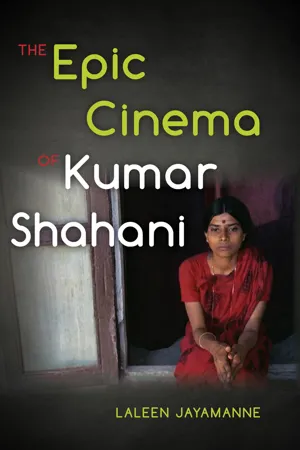
Laleen Jayamanne examines the major works of leading Indian film director, Kumar Shahani, and explores the reaches of modernist film aesthetics in its international form. More than an auteur study, Jayamanne approaches Shahani's films conceptually, as those that reveal cinema's synaesthetic capabilities, or "cinaesthesia." As the author shows, Shahani's cinematic project entails a modern reformulation of the ancient oral tradition of epic narration and performance in order to address the contemporary world, establishing a new cinematic expression, "an epic idiom." As evidenced by his films, constructing cinematic history becomes more than an archival project of retrieval, and is instead a living history of the present which can intervene in the current moment through sensory experiences, propelling thought.
- 316 pages
- English
- ePUB (mobile friendly)
- Available on iOS & Android
eBook - ePub
The Epic Cinema of Kumar Shahani
About this book
Information
Subtopic
Film & Video1

To Arrive at the Station
TRAINS OF THOUGHT
Ever since that fine day in 1895 when the Lumière brothers’ train arrived at the Salon Indien of the Grand Café in Paris and people got out and walked, walking hasn’t quite been the same.
Walking, our birthright as a species, frees our arms to swing in the air, relaxing the prehensile hand. Arms, freed from locomotion high up in trees, swing, creating a dynamic equilibrium as we raise one foot at a time to walk. The swinging arms harness kinetic energy in a cross-diagonal movement linking the latissimus dorsi muscle of the upper back with the pelvis. Banal movements, and yet we are astonished when we watch a child take her first steps (with arms held up for balance, as in an orant gesture of prayer). To the dear ones who scream in astonished delight, those first steps appear as nothing short of a miracle.1
As a film student, Kumar Shahani, with his guru, Ritwik Ghatak, would repeatedly screen the Lumière brothers’ Arrival of a Train at the Station at the Indian Film School in Pune. They would find themselves laughing each time in jubilation at the miraculous arrival of the train, signaling the mechanization of time, the regularization of movement, and the birth of an eye without an I; perception freed from the ego and hence from human prejudice, privilege, and social hierarchy. It would appear, then, that the arrival of the train at the station is also the greeting of one machine by another, the cinematograph greeting the train, recognizing their secret affinity in the creation of modern time. This rapport between these two machines of equalized movement and framed, mobile perception endows a strange visibility to spaces, objects, bodies, and rhythms without privileging the human. This nonanthropomorphic eye shows us the railway platform emptied of the people who have arrived and departed with as much care or indifference as it does the reflective surface of the train carriage on which the shadows of the people flicker as they walk past. An any-instant-whatever becomes perceptible and eventful, or not, making the spatiotemporal playing field level because of the mechanization of time, either at sixteen or twenty-four frames per second. Therefore, despite the effect of convergence built into the perspectival geometric bias of the optics of lensing, this mechanical nonorganic eye looks at the world in a manner foreign to our organic eye, attached to our body and its necessarily limited interests and prejudices. Shahani’s and Ghatak’s jubilation in the 1960s is remarkable in that the very first viewers of this pioneering film, scholars tell us, felt not only the thrill of the encounter (screaming in delightful terror) as the train came toward them but also the sinking feeling that it was “freighted with emptiness,” an instant enchantment and disenchantment, both in one long minute or so.2
And closer to home, at our workstations in cinema studies classes, the Arrival of a Train is also one of the essential first films screened each year (no longer on 16mm or video but on DVD) as a matter of academic routine to signal the beginnings of cinema both as technological invention and institution. New generations of Australian students who have grown up with CGI wonder what all the fuss is about, though some do go into slow motion and watch it again and even again, once the historical ramifications of the early films are elaborated with a theoretical orientation. But for the Indians Shahani and Ghatak, the cinematograph, a mechanical instrument with a metaphysical dimension, harbors a potential to reveal an epic facet of the world. Hence, as for Robert Bresson, Shahani’s other mentor, it is a machine with powers of divination, understood as revealing that which is unknown.3 To give this notion a South Asian ontological texture, the camera is a machine with powers of manifestation (avatār), which are those attributed to notions of divinity in many religious traditions, including paganism. The root of the word “manifest” is “hand.” Homo faber manifests powers of divination by creating gods, understood as incarnating dynamic forces. Icons and idols, crafted with the hand and eye, and mind, have tremendous materiality in all traditions, but what is specific to the Hindu tradition is that both creation and destruction are perceived as dynamic forces, neither good nor evil – beyond good and evil, one might say, thinking of Nietzsche.
As Godard says in his epic Histoire(s) du cinéma, the hand and the eye (once very intimate) are now very far apart, and he impels us, lures us, to think their distanced connection even as he sits at his desk hammering away at his typewriter (remember the typewriter? remember to remember the typewriter!), producing a machine-gun pulse in his history of cinema as also story/ies of the relationship between hand, eye, and brain.4 The cinematograph, an iconophiliac and iconoclastic, idolatrous machine harnessed to the power of capital, has both marked and exacerbated the growing distance between the hand and the eye while also offering a chance to think this process in excited reverie or in a flash at the movies or in the classroom. Certain films at least enable us to think this distance as an interval – might one say, as a synaptic gap of sorts? The Canadian neurosurgeon Wilder Penfield mapped the human brain by “drawing,” with electrodes, a little man, or the “sensory homunculus,” in whom the face, hand, and thumb occupy a disproportionately large share of the cortex. The cognitive neuroscientist V. S. Ramachandran says of this map that “the area involved with the lips or with the fingers take up as much space as the area involved with the trunk of the body. This is presumably because your lips and fingers are highly sensitive to touch and are capable of very fine discrimination, whereas your trunk is considerably less sensitive, requiring less cortical space.”5 In the Penfield map of the brain the area activating the hand is adjacent to the area of the face, evidence of an intimate rapport, in evolutionary terms, among Homo erectus, Homo faber, and Homo sapiens – a walking, talking, tool/weapon-making/wielding sensory thinker, a social animal. The operations of the human nervous system and those of the cinematic apparatus when thought through together (as Gilles Deleuze has suggested) may provide a manner of formulating productive problems.6 Such a move necessitates thinking cinema in relation to an idea of an ecology of the human senses within the technosphere that is our abode. This idea of a mental ecology that refuses the separation of aesthetics from an ethical sensibility (derived from Felix Guattari’s therapeutic work and writing) in turn necessitates the yoking together of two terms usually unrelated: cinema and civilization. This gesture refuses the familiar couple “cinema and modernity” the exclusive rights to determine terms of reference for thinking the human sensorium within the rapidly changing cinematic public sphere.7 The idea of civilization with attendant notions of technologies will be mobilized from a cinematic point of view by exploring Shahani’s conception of epic cinema, the epic itself being a civilizational legacy of human culture.
This book is an attempt to explore the historical and theoretical ramifications of the modern epic aesthetic idiom Shahani has invented on the basis of his perception of the cinematic apparatus (an orifice, as he calls and thinks it) as one with powers of epic manifestation and revelation. My inquiry will be guided by the question of how exactly he invests this magical mimetic apparatus of Western modernity with civilizational values. These values might schematically be signaled by the names of three ancient cities, Athens, Jerusalem, and Taxilā, sites of cohabitation of ideas of reason and revelation. Athens and Jerusalem are of course two cities at the heart of Western civilization based on both Judeo-Christian (the site of the three great monotheisms, including Islam) and Greco-Roman (Dionysus-Apollo, republicanism, and empire) legacies. Taxilā, less well known in the West except to archaeologists, was a city on the northwest frontier region of Gāndhāra, of ancient India, now in Pakistan’s western Punjab region, and is listed as a world heritage archaeological site by UNESCO. In ancient India it was the name of a famous city situated at the crossroads of three major trade routes, including the Silk Road, linking India to the Far East, Central Asia, Asia Minor, and farther west. It was a center of learning famed for its Buddhist scholarship and good governance where Hindu and other religious practices coexisted. Skepticism and debate, central to Buddhist notions of reason and enlightenment, flourished in Taxilā. It is also the region to which Alexander the Great brought his armies in 327 bc when it was still a part of the Persian Achaemenid Empire. Romila Thapar says that earlier this Indian province provided mercenaries for the Persian armies fighting against the Greeks in the years 486–465 bc and adds that Herodotus described them as dressed in cotton clothes. According to Thapar, “the movement of the Greek army starting from mainland Greece, across western Asia and Iran to India, opened up and reinforced a number of trade routes between north-western India via Afghanistan and Iran to Asia Minor and to the ports along the eastern Mediterranean. This accelerated east–west trade and no doubt the Greek population in India must have had a large part in it.”8 The subsequent Greek influence on the region is attested to by coins as well as the Gāndhāra Buddhist sculptures, the most spectacular of which were the giant Bamyan Buddhas recently destroyed by the fundamentalist Islamist Taliban. It is also said that the Mahābhārata, the Indian epic, was first recited at the court in Taxilā: “If the Mahābhārata is to be believed, Janamejaya sometimes held his court at Taxilā, and it was at Taxilā that Vaisampayana is said to have related to him the story of the great conflict between the Kurus and the Pandus.”9
This historical city with its pragmatic trade routes creating contact zones of diverse cultures (Persian and central Asian tribes too) offers an image with historical depth and mythic and epic resonances with which to situate the Indian Shahani’s epic oeuvre heuristically. I am not dreaming of what might have happened if Alexander stayed on in India (the possibility that incited Claude Lévi-Strauss to write his last two chapters of Tristes tropiques, one of which is called “Taxilā”); instead, I am trying to situate Shahani, for whom the permeability of the subcontinent to a multiplicity of cultural forces is the contested dynamic site of his filmmaking practice and will to art.10 And the distant memory of the cosmopolitanism of historical and mythical Taxilā, with its rich commercial, artistic, and intellectual life and diverse religious practices, still excites him as a “virtual” image might, “virtual” understood in the Bergsonian sense of a non-psychological, non-chronological past as such that subsists and insists, with great amplitude and potential.11 While Shahani’s films and his ideas will be the main generative focus of this book, he is surrounded in my mind by a “virtual community” of international filmmakers who may have a certain affinity, as I see it, with the ideas he articulates. This community, being a cinematic one, will not be homogeneous. And a ruse of this book is to invoke members of the community when necessary through the mediation of the idiom and optic Shahani has invented and the movement of thought his cinema provokes across filmic thresholds. It is my task to construct, make audible, visible, and sensible from time to time as the need arises, an international fraternity among visionary filmmakers through the mediation of Shahani’s thought. It is not a usual move in cinema studies to refract cinematic thought through the master filmmakers of Asia. This book is a contribution to such a project, which requires collective work. It is not an attempt at synthesizing the heterogeneous as a homogeneous theoretical brick to throw at an imaginary opponent. The source of the affinity among the filmmakers I call upon and invoke here, as I see it, is a fervent conviction of cinema’s synesthetic capabilities – cinesthesia, one might call it. This is a belief that requires an act of spirited faith conceived energetically as a leap between a rock and a hard place. This is so because the film image is lined with money, so much money for a minute of film – and yet, heroically, filmmakers resist this very equivalence with full awareness as they make the image catch fire with a collective labor of love. This book is also an attempt to work out why the cinesthetic means invented by Shahani and others might matter now, in the early twenty-first century (the century of digital cinema and thereby the vastly accelerated transnational circulation of film economies and new libidinal economies of the image), even as we are witnessing the obsolescence of celluloid cinema. By the historical ramifications of Shahani’s work I mean an “untimely” history of our senses as much as a certain history of the cinematic institution and its technology. He believes in an intimate rapport between cinema and the evolution and vicissitudes of human sense perception. The material Shahani works with to explore these concerns has a civilizational duration and a contemporary resonance within postcolonial Indian culture in particular. The other directors to whom I refer when necessary are also those invested in thinking with celluloid as perishable, textured, light-sensitive material, even as they may or may not operate within the newer regimes of image production.
Shahani was born in Larkana, Sind, in 1940, and his family moved to India as refugees with the partition of India after independence from Britain in 1947, when his natal province became part of the newly established state of Pakistan. The political frontier violently established between India and Pakistan cannot obliterate the cultural practices connecting this region, which according to historians of world trade such as Fernand Braudel constituted a major zone of trade (with links to the Silk Road) prior to European colonialism, entailing exchange of goods, skills, and technologies and the mingling of peoples and ideas over a long duration. Also, Larkana is the archaeological site of Mohenjo-daro, the ancient Indus Valley civilization of India circa 2000 bc. There is a fascinating link between the small bronze dancing-girl figurine found at this site (now in the National Museum in Delhi) and the “main character,” Tarān, in Māyā darpan, Shahani’s first film, which I will discuss later in terms of Shahani’s iconic conception of the actor’s body.12
THE EPIC MODE: AN EPIC IDIOM
What India does have in terms of its civilizational legacy are its epics, myths, and legends rather than chronicled history. One of Shahani’s mentors, the Marxist historian of ancient India D. D. Kosambi, has made him attuned to the sedimentations of time and human praxis in myth and the epics as well as in archaeological artifacts, even the most humble and mundane, such as microliths readily found beneath the earth in Pune. Shahani tells me that Kosambi’s decoding of myth and metaphysical expressions has had a lasting influence on him.13 Shahani’s cinematic project entails a modern reformulation of the ancient oral tradition of epic narration and performance in order to address the contemporary, and he says that his task is made easier by the fact that epic forms are still performed and therefore alive in India, unlike, say, Europe, where Bertolt Brecht, heroically diverging from avant-garde theatrical practice of the 1920s, developed an epic theatrical idiom in the absence of a living epic tradition. Walter Benjamin, who wrote eloquent commentaries supporting Brecht’s unfashionable formulation of epic theater, describes epic duration, albeit in a spatial image, in his essay “The Story Teller” thus:
One must imagine the transformation of epic forms occurring in rhythms comparable to those of the change that has come over the earth’s surface in the course of thousands of centuries. Hardly any other forms of human communications have taken shape more slowly, been lost more slowly.
Memory is the epic faculty par excellence.
Memory creates the chain of tradition which passes a happening on from generation to generation.14
Here, as elsewhere in his work, one of Benjamin’s most pressing concerns was the problem of the transmissibility of experience in modernity, where what he calls “the chain of tradition” has been brutally severed, perhaps lost irretrievably. Memory, both epic memory and that linked to storytelling, has been dismembered through the loss of the rich technicalaesthetic productive means for its sustenance in craft practices. For Shahani too, there is no pristine intact tradition after colonialism, nor is retrieval of a pure precolonial tradition an option. Invention on the basis of what remains, in a modern, decolonizing context, is his problematic. To further this end Shahani researched epic forms cross-culturally on a Homi Bhabha Fellowship (1976–78). He studied Indian theatrical forms, including Kutiyattam, Tamāsha, and Indian epics (the Mahābhārata in particular), Buddhist iconography, classical Ind...
Table of contents
- Cover
- Title
- Copyright
- Dedication
- Contents
- Preface and Acknowledgments
- 1. To Arrive at the Station: Trains of Thought
- 2. To Leave the Factory: With Cloth and Film
- 3. To Derail Thought: Of Infinity as Motif or Walking
- 4. In the Beginning Was Sound: Tarāng (Wave)
- 5. Lapidary Dynamisms: River, Stone, Icon
- 6. A Second Nervous System: Acting and Thinking
- 7. Shahani and Baz Luhrmann: Directing as Choreographic Act
- 8. Modulating Cinematic Avatārs: Shahani’s Unit
- 9. Memory of the World: Archive Fever
- Notes
- Bibliography
- Filmography
- Index
Trusted by 375,005 students
Access to over 1.5 million titles for a fair monthly price.
Study more efficiently using our study tools.
Frequently asked questions
Yes, you can cancel anytime from the Subscription tab in your account settings on the Perlego website. Your subscription will stay active until the end of your current billing period. Learn how to cancel your subscription
No, books cannot be downloaded as external files, such as PDFs, for use outside of Perlego. However, you can download books within the Perlego app for offline reading on mobile or tablet. Learn how to download books offline
Perlego offers two plans: Essential and Complete
- Essential is ideal for learners and professionals who enjoy exploring a wide range of subjects. Access the Essential Library with 800,000+ trusted titles and best-sellers across business, personal growth, and the humanities. Includes unlimited reading time and Standard Read Aloud voice.
- Complete: Perfect for advanced learners and researchers needing full, unrestricted access. Unlock 1.5M+ books across hundreds of subjects, including academic and specialized titles. The Complete Plan also includes advanced features like Premium Read Aloud and Research Assistant.
We are an online textbook subscription service, where you can get access to an entire online library for less than the price of a single book per month. With over 1.5 million books across 990+ topics, we’ve got you covered! Learn about our mission
Look out for the read-aloud symbol on your next book to see if you can listen to it. The read-aloud tool reads text aloud for you, highlighting the text as it is being read. You can pause it, speed it up and slow it down. Learn more about Read Aloud
Yes! You can use the Perlego app on both iOS and Android devices to read anytime, anywhere — even offline. Perfect for commutes or when you’re on the go.
Please note we cannot support devices running on iOS 13 and Android 7 or earlier. Learn more about using the app
Please note we cannot support devices running on iOS 13 and Android 7 or earlier. Learn more about using the app
Yes, you can access The Epic Cinema of Kumar Shahani by Laleen Jayamanne in PDF and/or ePUB format, as well as other popular books in Media & Performing Arts & Film & Video. We have over 1.5 million books available in our catalogue for you to explore.