"A ground-breaking study of the songs of the pied butcherbird . . . intellectually engaging and also very entertaining as a fieldwork memoir." —
The Music Trust
How and when does music become possible? Is it a matter of biology, or culture, or an interaction between the two? Revolutionizing the way we think about the core values of music and human exceptionalism, Hollis Taylor takes us on an outback road trip to meet the Australian pied butcherbird. Recognized for their distinct timbre, calls, and songs, both sexes of this songbird sing in duos, trios, and even larger choirs, transforming their flute-like songs annually.
While birdsong has long inspired artists, writers, musicians, and philosophers, and enthralled listeners from all walks of life, researchers from the sciences have dominated its study. As a field musicologist, Taylor spends months each year in the Australian outback recording the songs of the pied butcherbird and chronicling their musical activities. She argues persuasively in these pages that their inventiveness in song surpasses biological necessity, compelling us to question the foundations of music and confront the remarkably entangled relationship between human and animal worlds.
Equal parts nature essay, memoir, and scholarship,
Is Birdsong Music? offers vivid portraits of the extreme locations where these avian choristers are found, quirky stories from the field, and an in-depth exploration of the vocalizations of the pied butcherbird.
"Hollis Taylor has given us one of the most serious books ever written on animal music.
Is Birdsong Music? is so engaging that all who care about humanity's place on Earth should read it. We are certainly not the only musicians on this planet." —David Rothenberg, author of
Why Birds Sing
- 364 pages
- English
- ePUB (mobile friendly)
- Available on iOS & Android
eBook - ePub
About this book
Information

CHAPTER 1
An Outback Epiphany
WOGARNO STATION, Western Australia, 13 April 2001: Drought has set its oven on slow bake. This autumn, they must assign acres to a sheep rather than sheep to an acre. On our drive up the five-mile dirt track to Lizard Rock, a sacred Aboriginal site, we pass a cinnabar lakebed frosted with cracked salt. Round a bend, a nonsensical white pile on the left vies for our attention: “bone dry” made manifest in the stacked remains of starving sheep, shot during the last drought. I can’t take it in.
At noon, several hundred people crowd onto an ancient ironstone outcropping to hear my concert. I marvel that they could all find the place. The canopy erected to protect me and my violin from the sun barely manages. I’m a hostage to brightness and heat: head spinning, ears hissing, lights shooting in my eyes. The devil’s box suffers Dante’s Inferno.
Back at the homestead, the flash and rumble of a flock of galahs (Cacatua roseicapilla) cut across the sky. Wheeling in unison, they seem to say: “Look at us—we’re pink, we’re grey, we’re pink again. Look!” On landing, their metallic “chirrink-chirrink” mixes with the windmill’s creak and slurp. A few of the parrots ride it like a Ferris wheel. Others abseil down the stays of the homestead’s radio mast, beak on wire. The raucous squawking from these party animals intensifies when one galah ups the ante: a flapping of wings during descent produces several mad circles around the wire. Copy-galahs are quick to follow. Let’s twist and shout.
I wander about, collecting grass fishhooks in my socks. Haphazard tin sheds and aging fences, inventions of necessity encouraged to stand for yet another season, masquerade as one-of-a-kind designs. I’m photographing weathered wooden posts coifed with curls and tangles of charismatic wire when I feel a nudge on the back of my leg. It’s Macca, the border collie pack leader. Apparently, he intends to chaperone me on my investigations. I always appreciate local knowledge.
He’s quite attentive, but after a while I begin to wonder if Macca is just looking for a way to pass time, or if I am a personality so lacking in self-confidence as to appear sheepish. A border collie stare cannot be ignored, nor can it be appeased by tossing a stick or a snack. I feel object to his subject. When we arrive back where we began, he and the other dogs succeed in roping me into a game that takes three forms and switches from one to another for no obvious reason: kick the ball, stare at the ball, or stare at Marmalade, the cat. I’m trying to grasp the rules of the game, wondering whether Kick-and-Stare is all that happens for an hour and if I’m being a good sport or just a pushover, when out of the blue I hear a leisurely, rich-toned phrase. It’s a jazz flutist in a tree. An explosion of sound in another tree answers—a long, bold rattle descends sharply and swiftly, and a duet ensues—no, a trio. Twenty otherworldly seconds pass: low, slow, and enticingly familiar. I had no idea birds sang in trios.
“It’s the pied butcherbird,” Eva explains to me later. “They get their name from snatching other birds’ babies right out of a nest. Then they’ll wedge their prey into the fork of a tree or skewer it on a broken branch. And they attack people’s eyes,” she warns, “so some folks wear hats with eyes drawn on the back to confuse the birds.”
I notate several irresistible melodies, later writing in my travel journal devoted to this, my first trip to and across the Australian continent: Enchanted. Hard to put together this songster’s name and savage reputation with this angelic voice. Won over by blue notes, hip riffs, and syncopated chimes, I’ve fallen head over heels for a convict.1

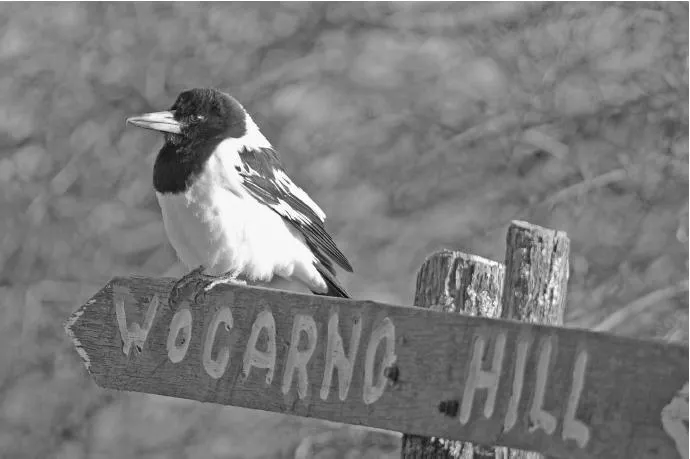
Figure 1.1. Pied butcherbird at Wogarno Station, Western Australia. Photograph by Chris Tate (2008). Used by permission.
Hearing these birds was an epiphany, but my partner, Jon, and I only heard one other pied butcherbird during our trip.2 When stopped at the Western Australia/Northern Territory border, we offered up our grapes to the quarantine officer, but he didn’t want them—officers only collect from traffic headed in the opposite direction. Just then, a pied butcherbird who was perched atop the welcome sign tilted back their head, opened their bill, and puffed out in song: a born performer who turns on for an audience—or so we told ourselves. Again, I grabbed my journal and notated some phrases.
When we arrived back in Sydney two months later, pied butcherbirds were still on my mind. Disappointingly, commercial recordings of them were scarcely available. On returning to Paris, I put my hasty notations away. After that, the few times I came across them, I bumped up against the same notion: while the birds’ phrases had inspired the composer in me, I was not so interested in “improving” them. I wanted to know more precisely what these birds were up to. It seemed that something extraordinary was transpiring in their songs, and though my memory of them was fading, the enchantment remained.
I followed my hunch four years later as a doctoral candidate researching pied butcherbird vocalizations. Since I had spent the previous thirty years of my career as a practicing musician and not an academic, I plunged into my research with the naive expectation that there would be no resistance from the natural sciences or musicology and that it would be a relatively simple task to bring them together in the course of my investigations—this in spite of scientist C. P. Snow’s influential lecture-cum-book The Two Cultures, which details what many assume to be a truism: a difference in methodologies and a notable absence of dialogue between the sciences and the humanities.3 I needed a home base from which I could, if not unite them, at least navigate between the two, a place where the musical, personal, anecdotal, scientific, philosophical, and environmental could sit beside one another and keep polite, even good, company … a place where I could ask what turns out for some to be an impolite question: Is birdsong music?
I initially thought the question, while good, failed to be the most pressing one. My newfound passion saw me probing how to best describe, illuminate, and celebrate pied butcherbird vocalizations. What did that bird sing? My enthusiasm also went to other questions: What can musicians tell us about birdsong that no one else could? What might birdsong tell us about the human capacity for music that nothing else could? I found a place where I could ask all of these questions and where the birds could guide me in determining both answers and further questions.
THE FIELD OF ZOÖMUSICOLOGY
Enter zoömusicology (which I pronounce “zoh-uh-musicology,” not “zoomusicology”), a rapprochement and partial remedy to this historical disciplinary tension—but also the source of new tensions. As the study of music in animal culture, zoömusicology allows for unapologetically bringing musicological tools and ways of knowing to the project, for honoring painstaking long-term field observation (well-known in ethnography and the natural sciences), for giving a place to thick description and the materiality of the experience of music, and for allowing the exceptional and mysterious to play a part in shaping a species’ depiction.4 With no standardized methodology or fixed research questions, work under this umbrella is best considered a mixed-methods, multiperspectival field rather than a discipline.5
Given my broad topic and readership, I will at times define terms that may seem self-evident. For instance, while for some, “animal” refers too narrowly to mammals only, others find the term too general for the wide variety of species under this label. Although “earth others,” “animal others,” “nonhuman” and “more-than-human” have currency, I find them unsatisfactory. I want a word that emphasizes kinship over difference, so “others” and “nonhumans” do not fit the bill. The meaning of “more-than-human” is not immediately apparent and only appeals to a handful of specialists. “Creature,” “kin,” and “critters” are fine but too awkward for regular use, while “wild community” omits the domestic contingent. This brings us back to “animal,” and although humans are of course animals in denotation if not connotation, I will employ the word (with respect and wonder) to signify what most of us assume it to mean: any member of the kingdom Animalia other than a human being. That said, I will spend most of my time dwelling not on generic animals but on individual birds and their achievements.
The musical properties of animal sounds have many champions. “It is probable that in the artistic hierarchy birds are the greatest musicians existing on our planet,” proclaimed composer Olivier Messiaen.6 His teacher Paul Dukas had advised students “to admire, analyze and notate” birdsong, and Messiaen passed this example on to his own students, most notably composer François-Bernard Mâche.7 Although Mâche is often credited with coining the word zoomusicologie in 1983, biologist and musicologist Péter Szőke apparently preceded him, writing in 1969 about Jesuit polymath Athanasius Kircher’s “zoomusicological representation of the cock-crow.” In addition, Szőke and Miroslav Filip used the term “ornithomusicology” in a 1977 article, following on the heels of an article Szőke wrote in Hungarian in 1963 in which he employed ornitomuzikológia.8 Nevertheless, it is Mâche who has eloquently and meticulously given zoömusicology its initial theoretical, and to some extent methodological, underpinnings.
Although he does not straightforwardly define zoömusicology, Mâche devotes a long chapter from his monograph Music, Myth and Nature to the subject. Several sentences could be read as, if not definitional, at least foundational. For instance, he writes, “If these manifestations from the animal sound world are presented to the ears of musicians, it is possible that they will hear them differently from ethological specialists,” drawing attention to the signal importance of a musical ear in the study of sound. He encourages us to regard animals’ sonic gestures beyond their assumed social functions and to drop the scare quotes around animal music that signal a metaphor rather than the real thing.9
Mâche opens a path of analysis among the songs of the sedge warbler (Acrocephalus schoenobaenus) and Blyth’s reed warbler (Acrocephalus dumetorum) and Stravinsky’s repetitive yet unpredictable rhythms in The Rite of Spring and Les noces, and he links the arithmetical procedures of the skylark (Alauda arvensis) to the “chromaticisms of durations” favored by Messiaen. A comprehensive grasp of the Western canon also allows Mâche to draw a comparison between the marsh warbler’s (Acrocephalus palustris) syntactical procedure of elimination and a Beethoven recapitulation, wherein the thematic material is typically reduced to its core, which he also compares to a Debussy theme left suspended in silence.10 In addition, Mâche understands avian deployments of repetition as essential tools of invention rather than as fill-ins due to a lapse of imagination.
While in this monograph he sometimes writes “musics” in the plural, in a later volume Mâche makes a case for music to be thought of as a singularity.11 He argues in both books for the linkage of all music and musical capacities. In tracing the musical archetypes and kinds of organization known in human music to birdsongs, he notes that the same solutions crop up, prompting him to conclude that the origins of music must have a fundamental basis in the biology of all living beings. Efforts to slow down a birdsong and speed up a whale song produce remarkably similar results and are just one example in support of his thesis.
Whenever I am in Paris, Mâche and I meet to pour over my latest batch of pied butcherbird recordings and to discuss my analytical results and challenges. His studio is filled with birdsong transcription notebooks—at least one for every letter of the alphabet, he tells me. Early in my research, upon hitting the roadblock of making “scientific” measurements on the one hand, and capturing the essence of a song on the other, I sought his advice. He urged me to first trust my ear, then measurements. Recalling that he used to make his transcriptions too precise, rendering them nearly illegible to other people, he tells me that these days, he simplifies.
Zoömusicology finds a kindred spirit in poet and ornithologist K. C. Halafoff, whose analysis of a superb lyrebird’s (Menura novaehollandiae) song divides avian sounds into three categories: tonality items (those of definitive pitch); percussion items; and indefinite sounds. In his view, the lyrebird’s vocalizations qualify as essentially tonal and are therefore a suitable candidate for conventional notation. Halafoff’s side-by-side comparison of Stravinsky’s Symphonies of Wind Instruments (1920) and a portion of lyrebird song stands out for the use of analytical terms like “introduction,” “main theme,” “exposition,” “recapitulation,” “bridge,” and “coda” that identify a close structural resemblance of music by Stravinsky and the lyrebird.12
While analogies with Western classical music give birdsong credibility in some corners, zoösemiotician, composer, and musicologist Dario Martinelli underlines the importance for zoömusicology of crafting a definition of music without a Euro-, ethno-, or anthropocentric bias.13 Like him, I am suspicious of definitions, given their cultural constructedness. The inescapable challenge for zoömusicology, however, is that it depends on the human analysis and valorization ...
Table of contents
- Cover
- Title Page
- Copyright
- Dedication
- Contents
- Foreword
- 1. An Outback Epiphany
- 2. Songbird Studies
- 3. The Nature of Transcription and the Transcription of Nature
- 4. Notes and Calls: A Taste for Diversity
- 5. Song Development: A Taste for Complexity
- 6. Musicality and the Art of Song: A Taste for Beauty
- 7. Border Conflicts at Music’s Definition
- 8. Facts to Suit Theories
- 9. Too Many Theories and Not Enough Birdsong
- 10. Songbirds as Colleagues and Contemporaries
- Acknowledgments
- Notation and Supplement Conventions
- List of Audio Tracks
- List of Abbreviations
- Glossary
- Bibliography
- Index
Trusted by 375,005 students
Access to over 1.5 million titles for a fair monthly price.
Study more efficiently using our study tools.
Frequently asked questions
Yes, you can cancel anytime from the Subscription tab in your account settings on the Perlego website. Your subscription will stay active until the end of your current billing period. Learn how to cancel your subscription
No, books cannot be downloaded as external files, such as PDFs, for use outside of Perlego. However, you can download books within the Perlego app for offline reading on mobile or tablet. Learn how to download books offline
Perlego offers two plans: Essential and Complete
- Essential is ideal for learners and professionals who enjoy exploring a wide range of subjects. Access the Essential Library with 800,000+ trusted titles and best-sellers across business, personal growth, and the humanities. Includes unlimited reading time and Standard Read Aloud voice.
- Complete: Perfect for advanced learners and researchers needing full, unrestricted access. Unlock 1.5M+ books across hundreds of subjects, including academic and specialized titles. The Complete Plan also includes advanced features like Premium Read Aloud and Research Assistant.
We are an online textbook subscription service, where you can get access to an entire online library for less than the price of a single book per month. With over 1.5 million books across 990+ topics, we’ve got you covered! Learn about our mission
Look out for the read-aloud symbol on your next book to see if you can listen to it. The read-aloud tool reads text aloud for you, highlighting the text as it is being read. You can pause it, speed it up and slow it down. Learn more about Read Aloud
Yes! You can use the Perlego app on both iOS and Android devices to read anytime, anywhere — even offline. Perfect for commutes or when you’re on the go.
Please note we cannot support devices running on iOS 13 and Android 7 or earlier. Learn more about using the app
Please note we cannot support devices running on iOS 13 and Android 7 or earlier. Learn more about using the app
Yes, you can access Is Birdsong Music? by Hollis Taylor in PDF and/or ePUB format, as well as other popular books in Biological Sciences & Music. We have over 1.5 million books available in our catalogue for you to explore.