Abdi Ismail Samatar provides a clear and foundational history of Somalia at the dawn of the country's independence when Africa's first democrats appeared. While many African countries were dominated by authoritarian rulers when they entered the postcolonial era—and scholars have assumed this as a standard feature of political leadership on the continent—Somalia had an authentic democratic leadership. Samatar's political biography of Aden A. Osman and Abdirazak H. Hussen breaks the stereotype of brutal African tyranny. Samatar discusses the framing of democracy in Somalia following the years of control by fascist Italy, the formation of democratic organizations during the political struggle, and the establishment of democratic foundations in the new nation. Even though this early state of affairs did not last, these leaders left behind a strong democratic legacy that may provide a model of good governance for the rest of the continent.
eBook - ePub
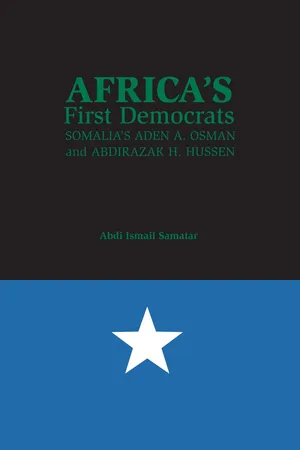
Africa's First Democrats
Somalia's Aden A. Osman and Abdirazak H. Hussen
- 307 pages
- English
- ePUB (mobile friendly)
- Available on iOS & Android
eBook - ePub
About this book
Information
1Leadership in Africa
TWO INTERTWINED SPECTERS are haunting the African continent, and most particularly the Somali people.1 They are the debilitating absence of leadership2 fit to meet the complex imperatives of citizenship and national development and the dearth of accountable and effective state institutions that can sustain civic life where leadership is lacking. Inspiring and capable leadership and functioning state institutions are the two critical instruments necessary for development, but each one alone is insufficient to successfully confront the challenges of development and national identity formation.3 Most of Africa labored under cruel and authoritarian colonial rule for nearly a century, and this in part laid the foundation for dictatorial rule in the immediate aftermath. Subsequently, authoritarian leaders dominated Africa’s postcolonial political order for the first thirty years of independence. They directed state operations to maintain their hold on power and in the process subverted the dream of freedom. Because of the predominance of this type of political leadership on the continent, many scholars and practitioners have assumed that postcolonial Africa lacked democratic culture and governance experience that was worthy of emulation. This assumption led them to prefer importation of governance models and practices from outside the continent. This book provides a unique African fable of democratic leadership and practice during the first two decades of African independence that remains untold. This story is worthy to tell for two reasons: (1) the systematic democratic practice of Somali leaders was like no other on the continent during those decades and therefore provides political and scholarly insights into the ways we think about African leadership and democracy, and (2) it demonstrates a political reality in Somalia that contrasts with today’s Somalia, an experience that could have significant bearing on the future of that country given the political catastrophe of the last three decades.
Somali leaders confronted challenges from two quarters: factions of the political elite who considered the postcolonial state apparatus as their vehicle for rent seeking and perpetuating their reign. The other test came from cold warriors who were not interested in accountable African governments but who instead favored local allies that served their respective interests rather than those of African people.4 The tussle between the democrats and the sectarian political camps, in the context of the Cold War, is a vital African story that has not been told before and that has valuable lessons for others. This book tells the story of Africa’s first democrats.
Debating African Leadership
Nearly sixty years after independence the promise of Africa’s liberation, for the most part, is stuck in the quicksands of dictatorial leaders, dysfunctional administrative systems, and a cold-blooded international order.5 Much of the literature on African leadership is deeply invested in the diagnosis of authoritarian leaders but pays scant attention to democratic alternatives whose experiences could provide positive guides for those dreaming and struggling for a fully democratic Africa. Successful local projects, rather than imported ones, are most relevant in incubating development and democracy in Africa and elsewhere in the Third World.6
Over the last quarter century much energy has been devoted to the nature of the African political crisis and the need for democratic governments.7 I posit that the place to advance this discussion is the examination of the nature and the role of the state8 and leadership.9 Broadly defined, the state encompasses four key pillars: leader, regime, administrative apparatus, and collective consciousness. My argument is that collective belonging in the form of citizenship is at the heart of state making and the most precarious and difficult to create; nonetheless, leadership is the piston that can transform a nation’s potential into real progress.10 Indeed, such might be more so the case in a transitional context, when revival of a civic spirit and national mobilization are a sine qua non for renewal. In transitions such as from colonialism to independence, in which the national question,11 the nature of the postcolonial development,12 and the structure and the role of government have to be oriented, I suggest that political leadership is where central history making is most critical.13
Two groups of scholars have dealt with African leadership since the early 1980s, but neither of them focused on democratic leaders and the state in a detailed and methodical manner.14 The most systematic scholarly treatment of postcolonial African leadership is the book by Robert Jackson and Carl Rosberg titled Personal Rule in Black Africa. It provides a fine blend of theoretical concepts and much empirical flesh. In this seminal study, Jackson and Rosberg identify four types of postcolonial African leaders who have dominated the continent’s political landscape: Prince, Autocrat, Prophet, and Tyrant.15 The four types of leaders described in the book are differentiated by the degree to which each dominates the state and by the nature of their relations to other members of the elite and society. Some “personal rulers,” who ignore laws in favor of their personal and political needs, turn the state into their private preserve, while others command it in order to realize national ambitions such as development. Style difference among personal rulers notwithstanding, all of the four leadership types permit minimal democratic inputs from the societies they rule. Accordingly, Tyrants are the most brutal and least democratic, while political Prophets are driven by ambitious goals they have for their societies. The latter think that their agenda can be achieved only if they tightly direct it. The Prince and the Autocrat fit somewhere in the middle of this leadership spectrum.
Tyrants rule ruthlessly and without regard for any public norms. Jackson and Rosberg underscore the fundamental qualities of African tyrannical rulers:
Tyrants have ruled without any pretense to legitimacy or authority, and tyranny is therefore conceived as fundamentally illegitimate and unjust government in violation of any norms or rules or understandings. . . . [I]t is a mistake to consider that Tyrants enjoy “privileges” or exercise “responsibilities” or that subjects enjoy “rights” or exercise “obligation.”16
Among the tyrants identified by Jackson and Rosberg were Uganda’s Idi Amin, Jean-Bedel Bokassa of Central African Republic, and Francisco Macias Nguema of Equatorial Guinea.
While tyrants occupy the extreme end of the political spectrum, autocrats are not far behind in terms of their control of the state and society. Although the Autocrat is slightly more mindful of his political obligation than a Tyrant, nevertheless he has tight rein over his political associates. Accordingly,
the African Autocrat dominates the state to a greater extent than the African Prince. Lieutenants remain far more dependent on him and are prevented by him from acquiring an independent power base. It is only a slight exaggeration to suggest that the “state” under autocracy of the African type is more the ruler’s private domain than the public realm; he conducts himself and is treated like the proprietor of the state.17
Jackson and Rosberg name Felix Houphouet-Boigny (Ivory Coast), Kamuzu Banda (Malawi), Ahmed Ahidjo (Cameroon), and Omar Bongo (Gabon) as major African Autocrats.
Less brutal and dominating than the Autocrat is the African political Prince. Unlike the Tyrant and the Autocrat, the Prince rules through private agreement with elements of the elite. Political Princes have
royalist characteristics akin to those of a traditional monarchy, where the ruler is the personification of the state and the custodian of its political values and practices. But the new African Prince is obliged to conduct the affairs of state without the supporting normative framework of a political tradition. . . . [T]he legitimacy of the modern African Prince depends upon his respect for the private understandings and agreements he has made with other members of the oligarchy over whom he presides and with whom he rules. It is not only their power he respects, but also his informal contracts with them.18
Among the African Princes noted are Jomo Kenyatta (Kenya), Leopold Senghor (Senegal), William Tubman and William Tolbert (Liberia), and Haile Selassie (Ethiopia).19 Despite important variation between the governance style of these powerful men and the private arrangements they had with other key members of the elite, all amassed state power in their offices and marginalized whatever constitutional process that existed in their countries.
The final nondemocratic African leader is the political Prophet. A political Prophet is distinguished from other personal rulers by remaining in power not being his final preoccupation.20 Instead prophets hang on to power to chase the promised land for their societies:
Prophetic leadership does not function through adjudication and political compromise, as does princely rule, nor through control and management, as does autocratic rule. Neither has it the amoral characteristics of pure power-hunger distinctive of tyranny. Quite the opposite: it is founded on morality, but the morality of ultimate ends. . . . It is autocracy with a mission. The leader himself must be a moral exemplar: an inspiration to his disciples and followers and yet a severely demanding taskmaster.21
According to Jackson and Rosberg, African political Prophets are few, and the most prominent were Kwame Nkrumah of Ghana22 and Julius Nyerere of Tanzania.
Personal Rule in Black Africa has made pioneering contributions to the way we study African leadership. However, the scope of Jackson and Rosberg’s book is limited to the study of only one type of leadership, “personal rule.” Alternative forms of political leadership existed in Africa during the period under review, even in places like Botswana, but they did not attract the attention of scholars.23
Unlike Personal Rule in Black Africa, the limited scholarly works that have focused on Africa’s new leaders in the 1990s offered little in the way of sustained theoretical exploration or significant historically grounded empirical evidence that speaks to democratic leadership on the continent. The most significant contribution to this line of thinking is Marina Ottaway’s book on the new leadership of Uganda, Ethiopia, Eritrea, and Rwanda. Ottaway’s thesis is that the Ugandan, Ethiopian, Rwandan, and Eritrean leaders have received much credit for reconstructing war-devastated economies. However, she categorically declares, these leaders could not be cajoled by the international community to transition to democratic rule.24 Political developments in the region have confirmed the prognosis of the book despite the efforts of some of these regimes to stage fraudulent elections that have consistently reconfirmed their total hold on power.25 Thus, Ottaway’s new leaders of Africa by and large fit into one of the four leadership types Jackson and Rosberg identify.
The contributions of Jackson and Rosberg as well as Ottaway demonstrate that Africa’s personal rulers shaped the orientation and structures of the state to different degrees such that the states functioned in ways that significantly reflected the rulers’ imprint. More particularly, Personal Rule in Black Africa has much explanatory merit as evidenced by the poor quality of leadership accelerated by unvarnished personal and militaristic dictatorship, which has directly contributed to the demise of civic life and autonomous public institutions in several parts of the continent. Further, the present interregnum in Somalia, Sudan, South Sudan, Libya,26 Central African Republic, Democratic Republic of the Congo, and elsewhere where dictatorship is the norm, as in Algeria, Ethiopia, and Egypt, registers either a recycling of spent yet still ambitious failures or throws up relative newcomers hungry for power but Lilliputian in the attributes that count: legitimacy, accountability, competence, integrity, and promise. If postcolonial times in Africa have been hostage to these categories of aspirants, have there been African leaders who have valued legitimacy, good governance, ethical behavior, and most certainly the will to leave office when their tenure ended? I suggest Somali leaders in the 1960s offered a different model of leader.27
Theoretically speaking, the antithesis of the personal ruler is the democratic statesperson. By definition, a statesperson is distinguishable from ordinary politicians, personal rulers or otherwise. The politician, though capable of occasional acts of collective value, is primarily energized by myopic self-interest, at times instrumentally linked to the promotion of a sectarian group interest, and in the end, satisfied and even exhausted by playing the game of fortune to collect the personal spoils it delivers to the victors. While politicians could possibly repent and transmute themselves, statespeople define themselves as quintessentially trustees. More concretely, there are, among others, four additional organic characteristics that separate the latter from the former. First, a statesperson is characteristically self-confident. This trait is different from concentrated egocentricity in that it is a fusion of healthy but rigorous self-minding to improve one’s life chances and an early awareness of civic obligations. Moving into large arenas, preoccupation with inclusive well-being begins to dominate priorities. Second, a statesperson exudes a strong moral code. While there are, probably, precognitive sentiments of goodwill to others that are the bequest of primary socializing agents such as the family and school, the potential statesperson sculpts a personal identity by cultivating a deep sense of righteousness. Here, necessary properties include wakefulness, probity and duty, respect for the rights of others, overall emotional intelligence, and a strict adherence to the constitution of the land. Third, a statesperson has a vision of where the nation must go and how it can get there. The rudiments of an appealing, if not moving, conception of the task at hand requires a cluster of abilities. These include an evolving knowledge of the relevant past, thoughtful engagement with the perplexities of the age, an eye for the possible future or a workable utopia that identifies hope within the hard contradictions worth striving for, and a modicum of public eloquence to inspire others to embrace the vision. ...
Table of contents
- Cover
- Half title
- Title
- Copyright
- Dedication
- Contents
- Preface and Acknowledgments
- Selected Dates
- 1 Leadership in Africa
- 2 Aden A. Osman: From Orphan to Nationalist Leader
- 3 Abdirazak H. Hussen: From Camel Boy to Freedom Fighter
- 4 The Somali Youth League and the Nationalist Project, 1943–1960
- 5 The First Republic: Institutional Foundations of Democracy, 1960–1964
- 6 The Second Republic: Democratic Trailblazing, 1964–1967
- 7 The March toward Dictatorship, 1967–1974
- 8 Conclusion
- Notes
- Bibliography
- Index
Trusted by 375,005 students
Access to over 1.5 million titles for a fair monthly price.
Study more efficiently using our study tools.
Frequently asked questions
Yes, you can cancel anytime from the Subscription tab in your account settings on the Perlego website. Your subscription will stay active until the end of your current billing period. Learn how to cancel your subscription
No, books cannot be downloaded as external files, such as PDFs, for use outside of Perlego. However, you can download books within the Perlego app for offline reading on mobile or tablet. Learn how to download books offline
Perlego offers two plans: Essential and Complete
- Essential is ideal for learners and professionals who enjoy exploring a wide range of subjects. Access the Essential Library with 800,000+ trusted titles and best-sellers across business, personal growth, and the humanities. Includes unlimited reading time and Standard Read Aloud voice.
- Complete: Perfect for advanced learners and researchers needing full, unrestricted access. Unlock 1.5M+ books across hundreds of subjects, including academic and specialized titles. The Complete Plan also includes advanced features like Premium Read Aloud and Research Assistant.
We are an online textbook subscription service, where you can get access to an entire online library for less than the price of a single book per month. With over 1.5 million books across 990+ topics, we’ve got you covered! Learn about our mission
Look out for the read-aloud symbol on your next book to see if you can listen to it. The read-aloud tool reads text aloud for you, highlighting the text as it is being read. You can pause it, speed it up and slow it down. Learn more about Read Aloud
Yes! You can use the Perlego app on both iOS and Android devices to read anytime, anywhere — even offline. Perfect for commutes or when you’re on the go.
Please note we cannot support devices running on iOS 13 and Android 7 or earlier. Learn more about using the app
Please note we cannot support devices running on iOS 13 and Android 7 or earlier. Learn more about using the app
Yes, you can access Africa's First Democrats by Abdi Ismail Samatar in PDF and/or ePUB format, as well as other popular books in History & African History. We have over 1.5 million books available in our catalogue for you to explore.