A new way to understand the human longing for stories, informed by both neuroscience and psychoanalytic theory.
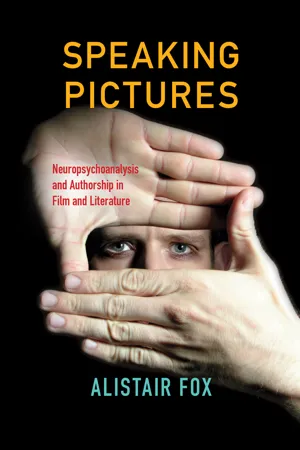
In this book, Alistair Fox presents a theory of literary and cinematic representation through the lens of neurological and cognitive science in order to understand the origins of storytelling and our desire for fictional worlds.
Fox contends that fiction is deeply shaped by emotions and the human capacity for metaphorical thought. Literary and moving images bridge emotional response with the cognitive side of the brain. In a radical move to link the neurosciences with psychoanalysis, Fox foregrounds the interpretive experience as a way to reach personal emotional equilibrium by working through autobiographical issues within a fictive form.
- 310 pages
- English
- ePUB (mobile friendly)
- Available on iOS & Android
eBook - ePub
About this book
Information
1

Changing Configurations in Theories of Fictive Representation
Charting a course through the waters of theoretical speculation on the nature and function of fictive representation from earliest times to the present requires one to tack and turn to avoid shifting sandbanks. The reason for this tortuous path is that, while almost everything that has been said about fiction has been around for some time, the ways in which different schools of thought inflect these insights vary greatly, depending on whatever intellectual and ideological currents are flowing most powerfully when a particular theory is formulated. In this chapter, I provide an overview of the evolving ways in which fictive representation has been conceived in theory throughout history.
EMBODIED FICTIONS, OR FICTIONS AS SIGN? CLASSICAL PERSPECTIVES
Writing about 335 BC, Aristotle claimed that “poetry” (from Greek poiesis, or “making”–that is, a work of fictive invention) derives from mimēsis–an instinct toward representation that is “innate in human beings from childhood,” through which we learn and in which we gain pleasure.1 With respect to tragedy, which was the specific genre he was discussing, Aristotle believed that the function of the representation was to effect “through pity and fear the catharsis of such emotions.”2 Earlier, Simonides of Ceos (556–468 BC), according to Plutarch in his essay “De gloria Atheniensium” (c. AD 100), had made the claim that “painting [is] inarticulate poetry and poetry articulate painting.”3
These suppositions–that fictive representations have an educative purpose–work through the delight they impart, have an emotional influence, and function like a speaking picture, were reiterated as commonplaces by subsequent classical authors, most notably Horace in his Ars Poetica (c. 19 BC), in which he asserted: “Aut prodesse volunt, aut delectare poetae, / Aut simul et jucunda et idonea dicere vitae” (Poets aim either to benefit, or to amuse, or to utter words at once both pleasing and helpful to life),4 and claimed: “Omne tulit punctum qui miscuit utile dulci, lectorem delectando pariterque monendo” (The writer who has combined the pleasant with the useful wins on all points by delighting the reader while he gives advice).5 Following Simonides, Horace added: “Ut pictura poesis” (As a painting, so is a poem).6
Plato, in his Republic (c. 380 BC), countered this comparatively appreciative view of “poetry” by banishing poets from his ideal state on the grounds that “the imitative art is an inferior who marries an inferior, and has inferior offspring.”7 Plato’s disapproval arose not only because poetry merely produces an imitation of an imitation, and hence has “an inferior degree of truth” in relation to reality, but also because the poet “awakens and nourishes and strengthens the feelings and impairs the reason.”8 Here, Plato, like Aristotle, identified the affective power of fictive representation, but disapproved of its influence. Because of his dualistic separation of reason and emotion, and his privileging of the former at the expense of the latter, he saw the emotion aroused by poetry as subverting reason rather than assisting or complementing it in a beneficial way.
In these early classical perspectives on poetic imitation, we can see the beginnings of a split between two conceptualizations: one, a view of fiction as embodied, integral, and operating instrumentally to achieve an emotional as well as cognitive end; the other, a sense that the literal surface of the fictive invention is illusory and therefore untrustworthy, which means that it needs to be penetrated to find the “truer” reality of which its literal sense is an imperfect manifestation achieved at several removes. Both of these perspectives persisted throughout the centuries to come. The embodied conceptualization found new life during the Renaissance, as reflected in the great works of Sir Thomas More, Sir Philip Sidney, William Shakespeare, and John Milton. The dualistic view informed much of the literary activity of the Middle Ages. Both views are still very much with us, the former finding expression, for example, in cognitive criticism (but deprived of the affective dimension so valued during the Renaissance); the latter, in certain types of modern myth criticism (such as that of Northrup Frye) and various forms of psychoanalytic and poststructuralist criticism (such as that of Jacques Lacan).
THE EFFECTS OF CHRISTIAN CONVERSION: A MEDIEVAL BIFURCATION
Following the conversion of the Emperor Constantine, who ruled the Roman Empire from AD 306 to 337, and the rapid spread of Christianity throughout Europe, the second of the two classical perspectives on fictive representation–that is, the Platonic notion of an ideal reality of which fiction presented an imperfect shadow–took root in a method for interpreting the proper meaning of the Christian scriptures. One of the prime theorists for this method was Saint Augustine of Hippo (AD 354–430), who elaborated his theory of biblical exegesis in De Doctrina Christiana (On Christian Doctrine). According to Augustine, the narratives of the Bible are composed of “things” and “signs.” A “thing” signifies “that which is never employed as a sign of anything else: for example, wood, stone, cattle, and other things of that kind.” There is also a second category of things, those that, “though they are things, are also signs of other things.” In addition, there is a third type: “those which are never employed except as signs.” Accordingly, although “every sign is also a thing,” the obverse is not true: “Every thing . . . is not also a sign.”9
This system of biblical exegesis, which was grounded in a fundamental Platonic dualistic view of the world in relation to a transcendent “reality,” was easily and quickly transferred to the interpretation of secular literature in order to present it as “Christianized.” By adopting an allegorical method of interpretation, pagan subject matter, and the sensibility that accompanied it, could be considered compatible with Christian doctrine. One example of this allegorizing predisposition can be found in the late-Medieval French work L’Ovide moralisé (written between 1317 and 1328), which reinterprets Ovid’s Metamorphoses by turning it into an exemplum of Christian morality. In the story of Jason and Medea (Book VII), for example, whereas Ovid did not judge Jason adversely for his desertion of Medea, in L’Ovide moralisé he is denounced as “li maus trichierres, / Li faus, li desloiaus, li lierres” (the evil trickster, the false, the disloyal one, the thief).10 A similar impulse can be found in De casibus virorum illustrium (On the Fall of Illustrious People), written between 1355 and 1360 by Giovanni Boccaccio, which recounts the calamities befalling famous historical figures apparently favored by Fortune, such as Priam, Hannibal, Dido, Cleopatra, Cicero, and King Arthur, to point up the moral that the only sure way of overcoming misfortune is to adhere to the Christian conception of virtue.
Counterpointing this highly didactic medieval approach to literature, which was designed to underline the teaching function of fiction, was a radically contrasting form of literature that aimed solely to entertain–the existence of which attested to the extent to which Horace’s mingling of utile dulci (profit and delight) had become unwound into two separate strands. The most colorful expression of this alternative mode of literature was the extremely scurrilous fabliau tradition that had arisen in France, Italy, and England, consisting of comic tales marked by sexual and scatological obscenity, anticlericalism, antifeminism, and anticourtliness. Examples of such fabliaux are Boccaccio’s Decameron (1353) and several of Geoffrey Chaucer’s Canterbury Tales (1387–1400)–for example, “The Reeve’s Tale” and “The Miller’s Tale”–which were themselves merely a fraction of a vast corpus of unrecorded popular forms forming a very vibrant tradition.11
THE RENAISSANCE HUMANIST SYNTHESIS AND ITS AFTERMATH
For about a century during the English literary renaissance, the idea of fictive representation as an embodied process working through the emotions and the view that through it one can gain access to transcendental truths were brought together again in the Christian-humanist synthesis of the later sixteenth and the early seventeenth century. This was a period in which writers sought ways of reconciling a revived classical learning inspired by ancient Greece and Rome, which privileged the pursuit of rational wisdom through the persuasive eloquence of rhetoric, with the Calvinist-inspired theology of the Reformation in England with its emphasis on spirituality.12
One can register the change wrought by the revival of classicism in the comments of Sir Thomas More, one of the early English humanists, on the function of images, especially in relation to interpretation of the Bible. Whereas for Saint Augustine and later medieval exegetes, the literal sense had been less important than the allegorical meaning that could be extrapolated from it, More laid much more importance on the literal meaning itself, especially as conveyed through visual imagery: “Ymages paynted / grauen / or carued / may be so well wrought and so nere to the quycke and to ye trouth / that they shall naturally / and moche more effectually represent the thynge then shall the name either spoken or wrytten.”13 To illustrate his point, More cited the visual impact of a crucifix: “There is no man I wene so good nor so well lerned / nor in medytacyon so well accustomyd / but that he fyndyth himself more mouyd to pyte and compassion / vpon the beholdynge of the holy crucyfyxe / than whan he lackyth it.”14 As Plato and Aristotle had centuries earlier, More here acknowledged the moving power of fictive representation, working through images of sight, to arouse the emotions. Unlike Plato, however, More approved of this affective influence as a good thing because of its very instrumentality; indeed, he went as far as to say, in an insight that foreshadows the invention of cinema nearly 400 years later, that “surely sauynge that men can not do it / els if it might commodiously be done / there were not in this worlde so effectuall wrytyng as were to expresse all thing in ymagery.”15
More transferred this belief in the innate connection of meaning to the literal sense, and the emotion it arouses through visualization, to the secular sphere in his practices as a writer of fiction. Rather than construct a fictive representation that was merely a pretext for delivering an allegorical significatio (i.e., decoded meaning), in which the fiction could be discarded like a husk once the kernel of signification had been extracted, he employed a fully dramatized, mimetic mode in writing Utopia (1516)–which Sir Philip Sidney recognized as the “most absolute [way of] patterning a commonwealth” because of how it exploits “the feigned image of poesy.”16 In defining “poesy” (i.e., fictive representation) as “an art of imitation . . . that is to say, a representing, counterfeiting, or figuring forth–to speak metaphorically, a speaking picture,”17 Sidney was drawing on what Stephen Halliwell has identified as “a second family of meanings” in the word mimēsis that is often ignored: the idea that fictive representation has to do with “model-building and imagination,” which signifies “a ‘world simulating’ or ‘world creating’ conception of artistic representation” rather than a “world reflecting” one.18 This mode of fiction-making was to be the lifeblood of poetic creativity in England for the next hundred years and was to eventuate in some of the greatest works ever written in the English language–or in any language, for that matter.
Sidney himself was the outstanding theoretician of this fusion of classical aesthetics with Christian spirituality in sixteenth-century England, elaborating a synthesis that survived in various forms until the twentieth century. Picking up on the classical theorists, Sidney, like More, alleged an affective power in the mimetic mode of fictive representation that is capable of moving the “poet” (and his readers) “into another nature”–with “no small argument to the incredulous of that first accursed fall of Adam: since our erected wit maketh us know what perfection is, and yet our infected will keepeth us from reaching unto it.”19 The difference between Sidney’s version of these ideas and the earlier formulations of Aristotle and Plato was that, for Sidney, as for More, poetry did not merely “move,” but delighted “to move men to take that goodness in hand, which without delight they would fly as from a stranger, and teach, to make them know that goodness whereunto they are moved.”20
Although he lacked the scientific evidence that neuroscience has now supplied, Sidney intuited the processes of mind that lend peculiar force to fictive representations. Comparing philosophy and history with “poesy” (the sixteenth-century term for fictive representation) in terms of their relative effectiveness in conveying insights into how life should best be lived, Sidney concluded that the former two are inferior to the latter because, whereas philosophy prioritizes “precept” and history focuses on “example,” “both, not having both, do both halt.”21 The writer of fiction, asserted Sidney, ...
Table of contents
- Cover
- Half title
- Title
- Copyright
- Dedication
- Acknowledgments
- Introduction
- 1. Changing Configurations in Theories of Fictive Representation
- 2. Why Does Fictive Representation Exist?
- 3. The Wellsprings of Fictive Creativity
- 4. The Materials of Fictive Invention
- 5. The Informing Role of Fantasy
- 6. The Shaping of Fictive Scenarios by the Author: Motivations, Strategies, and Outcomes
- 7. The Exploitation of Generic Templates and Intertexts as Vehicles for Affect Regulation
- 8. Theories of Reception in the Twentieth and Twenty-First Centuries
- 9. A Neuropsychoanalytic Theory of Reception
- 10. Intersubjective Attunement, Filiation, and the Re-creative Process: Jules and Jim–from Henri-Pierre Roché to François Truffaut
- 11. The Conversion of Autobiographical Emotion into Symbolic Figuration: William Shakespeare’s Hamlet
- 12. Tracking a Personal Myth through an Oeuvre: The Films of François Ozon
- Conclusion
- Notes
- Select Bibliography
- Filmography
- Index
Trusted by 375,005 students
Access to over 1.5 million titles for a fair monthly price.
Study more efficiently using our study tools.
Frequently asked questions
Yes, you can cancel anytime from the Subscription tab in your account settings on the Perlego website. Your subscription will stay active until the end of your current billing period. Learn how to cancel your subscription
No, books cannot be downloaded as external files, such as PDFs, for use outside of Perlego. However, you can download books within the Perlego app for offline reading on mobile or tablet. Learn how to download books offline
Perlego offers two plans: Essential and Complete
- Essential is ideal for learners and professionals who enjoy exploring a wide range of subjects. Access the Essential Library with 800,000+ trusted titles and best-sellers across business, personal growth, and the humanities. Includes unlimited reading time and Standard Read Aloud voice.
- Complete: Perfect for advanced learners and researchers needing full, unrestricted access. Unlock 1.5M+ books across hundreds of subjects, including academic and specialized titles. The Complete Plan also includes advanced features like Premium Read Aloud and Research Assistant.
We are an online textbook subscription service, where you can get access to an entire online library for less than the price of a single book per month. With over 1.5 million books across 990+ topics, we’ve got you covered! Learn about our mission
Look out for the read-aloud symbol on your next book to see if you can listen to it. The read-aloud tool reads text aloud for you, highlighting the text as it is being read. You can pause it, speed it up and slow it down. Learn more about Read Aloud
Yes! You can use the Perlego app on both iOS and Android devices to read anytime, anywhere — even offline. Perfect for commutes or when you’re on the go.
Please note we cannot support devices running on iOS 13 and Android 7 or earlier. Learn more about using the app
Please note we cannot support devices running on iOS 13 and Android 7 or earlier. Learn more about using the app
Yes, you can access Speaking Pictures by Alistair Fox in PDF and/or ePUB format, as well as other popular books in Literature & Literary Criticism Theory. We have over 1.5 million books available in our catalogue for you to explore.