The author of
Emerson & Self-Culture shares essays covering such themes as identity, experience, ethics, poetry, philosophy, history, and race.
John T. Lysaker works between and weaves together questions and replies in philosophical psychology, Emerson studies, and ethics in this book of deep existential questioning. Each essay in this atypical, philosophical book employs recurring terms, phrases, and questions that characterize our contemporary age. Setting out from the idea of where we are in an almost literal sense, Lysaker takes readers on an intellectual journey into thematic concerns and commitments of broad interest, such as the nature of self and self-experience, ethical life, poetry and philosophy, and history and race. In the manner of Emerson, Cavell, and Rorty, Lysaker's vibrant writing is certain to have a transformative effect on American philosophy today.
"An original and stimulating book, manifesting a level of reflection and existential concern of the highest order. It is intellectually and personally honest." —Robert E. Innis, author of
Susanne Langer in Focus
"There is something fresh and hence refreshing in the manner in which John T. Lysaker takes up familiar topics. He shows, with both arresting details and an evolving design, how the conduct of life (to use Emerson's expression) demands a form of thought frequently at odds with contemporary fashions and preoccupations, with institutionally entrenched approaches and all too rigidly policed discourses." —Vincent Colapietro, author of
Experience, Interpretation, and Community
"Acknowledged as one of his generations premier Emerson scholars, Lysaker goes beyond his earlier work,
Emerson & Self-Culture . . . [T]he writing is stimulating, vibrant, challenging, risky, and fecund. Recommended." —D. B. Boersma,
Choice
- 200 pages
- English
- ePUB (mobile friendly)
- Available on iOS & Android
eBook - ePub
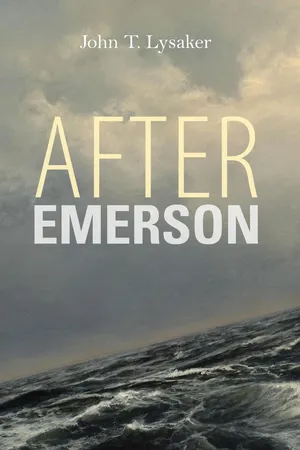
After Emerson
About this book
Information
Topic
PhilosophySubtopic
Modern PhilosophyEMERSON AND THE CASE OF PHILOSOPHY

I will have no covenants but proximities.
—Ralph Waldo Emerson
I have the ambition to be a practical preacher (of philosophy).
—Ralph Waldo Emerson
∼I. NO WORD OF WELCOME: Philosophy is an unsettled affair. Even after a century of professionalization, it houses and draws outsiders.1 Like Hume, some have worked beyond the confines of established academies, whereas others, say Nietzsche, also forsook established modes of writing. And if we expand the philosophical canon to include philosophers from historically marginalized groups, outsiders swell to an imposing rank, including the likes of Elizabeth of Bohemia, Sor Juana, and W. E. B. Du Bois.
Philosophy has also spawned heralds, even proponents of its own demise. Wittgenstein and Heidegger (insiders trying to work their way out) convinced themselves (and several others) that philosophy had reached its limits. Not that philosophy had realized itself. Rather, its radical reflexivity unleashed, philosophy found itself unable to complete the tasks that had settled into subdisciplines such as metaphysics, epistemology, and ethics. And yet, rather than close the book on philosophy, Wittgenstein and Heidegger gave rise to vital traditions of thought, from ordinary language philosophy to hermeneutics and deconstruction—the move outside turned out to be the swift currents of an inception.
Philosophy is thus an evolving, manifold affair, a constellation lit by multiple stars, rising or setting depending on the angle your satellite affords. Or, to work from a different metaphor, philosophy admits of many cases, as if it were a mutating virus, replicating in a string of hosts whose lineages reach back into several ancient cultures. However, even given this breadth (and turbulence), Emerson’s place remains marginal. He is rarely taught in Philosophy departments, and a dissertation on Emerson risks professional suicide. Interestingly, Nietzsche’s case has been affirmatively settled, but Emerson, despite his profound influence on Nietzsche, remains suspect.
Not that philosophers and scholars haven’t championed Emerson’s cause in various ways, particularly in recent years. Van Leer’s Emerson’s Epistemology (1986) and Van Cromphout’s Emerson’s Ethics (1999) locate Emerson within established philosophical fields. Is Emerson a philosopher? We will know, they say, when we test his contributions to philosophical subdisciplines. Similarly, Goodman’s American Philosophy and the Romantic Tradition (1990) ties Emerson’s case to philosophical topics, such as freedom and idealism, as does Lawrence Buell, whose Emerson (2003) explores, among other things, Emerson’s intersection with virtue ethics.
Another tack connects Emerson to figures/traditions whose philosophical standing is secure. West’s American Evasion of Philosophy (1989) sets Emerson at the origins of American pragmatism, whereas Cavell, across several essays (1981–2003), takes Emerson to inaugurate a line of moral perfectionism that includes Thoreau, Nietzsche, Heidegger, the later Wittgenstein, and Austin, and that contests the modernity of folk such as Descartes and Kant, often at the level of phrasing. Goodman, in his recent American Philosophy before Pragmatism (2015), takes a similar tack in reading Emerson relative to well and less established figures, namely Plato and Neoplatonism, Kant (in part through de Staël), as well as Hume and Montaigne, though not Hegel and Schelling.
In the wake of West and Cavell’s gestures of inclusion, some have debated which of these approaches should prevail. Anderson (2006) and Albrecht (2012) argue against Cavell’s historiography and for more continuity with pragmatism. Saito (2005) tries to weave together (rather than split) the difference, working between Emerson and Dewey in a Cavellian vein. No doubt Emerson also could and should be read for his readings of and relations to classical Indian and Greek philosophy, as was more common fifty years ago, for example, Dale Riepe’s “Emerson and Indian Philosophy” (1967) and Ray Benoit’s “Emerson on Plato: the Fire’s Center,” which begins: “The idealists dismiss Emerson as a pragmatist and the pragmatists dismiss him as an idealist. It is safe to say that one is wrong, but it is safer to say that both are right” (1963, 487).
And yet, throughout these apologia, (each, in its own way, of value), few mention how often Emerson explicitly distanced himself from philosophy. In discussing nature, for example, he insists: “It will not be dissected, nor unraveled, nor shown. Away profane philosopher! … Known it will not be, but gladly beloved and enjoyed” (CW1, 125). Similarly, in defending involuntary perceptions as the “last fact behind which analysis cannot go,” Emerson asserts, “If we ask whence this comes, if we seek to pry into the soul that causes, all philosophy is at fault” (CW2, 37). Finally, at the close of “Nominalist and Realist,” after refusing to resolve that dilemma, Emerson confesses that he has “no word of welcome for them,” namely, a pair of philosophers who had come to visit (CW3, 145).
Emerson’s relation to philosophy is thus an active one. More specifically, it is bound to an assessment of philosophy, which I now aim to examine. Where and why does Emerson contest philosophy, and with what terms? And is that contestation carried out in the name of philosophy, or is something else on offer, and if so, what is it?
∼II. THE POET IN PROSE: Writing to Lydian Jackson in 1835, Emerson declares: “I am a born poet, of a low class without doubt yet a poet. That is my nature & vocation. My singing be sure is very ‘husky,’ & is for the most part in prose” (CL1, 435). According to Emerson, a poet is a “perceiver” and “dear lover of the harmonies that are in the soul & in matter, & specially of the correspondences between these & those” (ibid.). The scene concerns self and world, how each is well ordered (harmonious rather than cacophonous or dissonant), and what their accord entails. Emerson’s perceptions thus concern not only how things are, but also how they are when they are as they should be. Not that his concern is prescriptive. He does not report a grasp of imperatives, normative principles, or regulative ideals, though such things might lie within the harmonies he hears. Rather, Emerson claims to apprehend moments when values are immanently evident within facts, that is, when self and world are in harmony with themselves and one another.
As a kind of shorthand, we might say that Emerson takes himself to perceive patterns of order or, more briefly still, thoughts. For example, he might identify elemental activities of the soul such as doing, thinking, and saying, as he does in “The Poet.” Or, he might realize how matter cooperates organically, for example, when trees generate hydrocarbons and discharge oxygen with the help of sunlight and ground water. Or, he might analogize matter and soul, finding common ground in how they “grow.” Or, focusing on soul harmonies, Emerson might perceive himself to be a poet in husky prose, that is, his soul has an order (his principal activity is a kind of saying) and a purpose (the conversion of experience into imagistic signification). And if we take that twofold realization as a whole, a vocation emerges, itself a pattern of order fit for a life.
What though is the character of such perceptions? Keeping to his letter, we find that Emerson aligns it with love, precisely what “The Method of Nature” demands from those who would fathom nature, its method, and no doubt the essay as well. The accords that Emerson perceives are thus not simply intellectual but affective and affirmative. Such perceptions claim him as the beloved claims the lover; he falls for them. I take this to mean that Emerson does not assemble the harmonies he perceives, say in synthetic judgments directed toward simpler parts analytically distinguished and convened. Rather, he is struck by the harmonies as harmonies, that is the prima facie character of their occurrence. One realizes one’s vocation and only later analyzes its call, as I did in the previous paragraph.
Emerson’s letter to Lydian indicates, at least in his case, how thought—that is, a pattern of order—occurs, namely, as an affective and semiotically rich reception. The case of Emerson thus partially comes to pass in the dative—his work is the indirect object of affective disclosures. He is a poet not simply because he has made himself one but because that is what he has been given to be, it is where he finds himself—called to a poetry in prose.
Affective reception is not the whole of the tale, however. In a letter to Henry Ware Jr., dated 1838, he says: “For I do not know, I confess, what arguments mean in reference to any expression of a thought. I delight in telling what I think but if you ask me how I dare say so or why it is so I am the most helpless of mortal men; I see not even that either of these questions admit of an answer” (CL2, 167). Here the activity concerns how a thought or pattern of order is expressed. And that provides us with something like a pattern within which to think of Emerson’s relation to philosophy. How does it stand with regard to reception on the one hand, expression on the other? As he writes in “Intellect,” “to genius must always go two gifts, the thought and the publication” (CW2, 198).
But “pattern” isn’t quite right. What is at stake is a kind (or kinds of action). Relying on an Emersonian term, I would rather say that being a poet or a philosopher is a question of “manner,” which involves an effort to “facilitate life, to get rid of impediments, and bring the man pure to energize” (CW3, 75).2 In terms of philosophy then (or poetry), energizing one or the other, at least in part, revolves around how one undergoes the event of thought in its occurrence and transmission.
But let us return to expression in particular and with regard to argumentation. After his Divinity School Address, Emerson defensively informs Ware that he eschews prototypical justification when expressing himself, remaining instead with the thought that has gripped him, concentrating on the what as opposed to the why. And this means that he is averse, as a rule (which means there will be exceptions), to demonstrating how his commitment follows inferentially from some other, distinct thought. Moreover, and this adds a new facet to argumentation (while reinforcing what I just mentioned), Emerson does not labor to “make-good his thesis against all comers” (ibid.). But this is already evident in the address itself. “Truly speaking,” he writes, “it is not instruction, but provocation, that I can receive from another soul. What he announces, I must find true in me, or wholly reject, and on his word, or as his second, be he who he may, I can accept nothing” (CW1, 80). While this passage iterates the common, Emersonian theme of self-reliance, it further suggests that “expression” also concerns how best to address another. “Expression” not only names a subjective labor, therefore, but also an intersubjective one, and as we explore it, we should keep both dimensions in mind.3
Emerson identifies as a poet in prose who aims to receive and express patterns of order without engaging in prototypical practices of justification or contestation. For many, this closes the case of his relation to philosophy. By expressing thoughts without establishing linear chains of inference, without affirming the conclusion after (and only after) an ordered presentation of premises, Emerson seems to set himself outside what most take philosophy to entail, at least as a necessary condition. Yes, Emerson might address issues also addressed by philosophers, such as freedom and knowledge, and his replies might echo, at the level of content, dominant philosophical positions, for example, idealism in metaphysics, but his path toward to these questions and views has a decisively unphilosophical manner. This is a cogent reading. No reliable reader of Emerson should find the preceding assessment simply false. And yet, I remain struck by the fact that Emerson doesn’t simply fall outside philosophy and into some other class, say literature. Instead, he sets himself outside what many take philosophy to entail and elects to tarry there, work there. And that setting is worth exploring.
∼III. A PHILOSOPHY OF CONSTANTS: Predictably, Emerson’s conception of philosophy evolves, but some generalizations are possible. Early on, Emerson aligns philosophy with a kind of corrosive skepticism. After declaring in 1825 that the “best good that is reaped, is the glorious congregation of final causes,” which “bring of obedience & honor to Deity,” he asserts, “the examination of a single idea with the eye of exact philosophy leads to atheism & to universal doubt” (JMN3, 54).4 Then in August of 1834, reflecting on “our mood of pyrrhonism,” he states, “If there were many philosophers, the world would go to pieces presently, all sand, no lime” (JMN4, 310). I find the image of limeless mortar quite exact, and it marks a concern to which we’ll return. The charge is that philosophy proves unable to fashion material that binds, that allows stacked stone to ascend and stand together. Keeping to the image (which recalls the lime mortar supporting the buildings of Greece and Rome), the charge is that philosophy is unable to secure livable structures. Something in either its reception or expression enables negation but not affirmation.
By 1836, however, Emerson also evidences a more affirmative stance toward philosophy. In particular, he aligns it with an idealizing vision not only more compatible with religious insight but even superior to its popular tenets. “Religion does for the uncultivated which philosophy does for Hume, Berkeley, & Viasa; —makes the mountain dance & smoke & disappear before the steadfast of Reason” (JMN5, 123).5 And it does so by apprehending the laws that underwrite and guide nature in its dynamic unfolding. Referring to Bacon in a lecture of 1835, he says, “No single mind since Plato has enriched his fellowmen with so many of those truths which by their dignity and extent of application we incline to call laws” (EL1, 187). And speaking a year later about history, Emerson finds “philosophy the announcement of its laws,” concluding, “Therefore is philosophy the only true historian, and the only true prophet” (EL2, 12).6
Emerson’s appreciation for philosophy grows as he increasingly appreciates the power of its idealizations. Idealizations enable us to settle the world with some basic terms. “Unity or Identity, & Variety,” jots Emerson in an entry from 1845. “The poles of philosophy. It makes haste to develop these two” (JMN9, 303–304). Returning to the language we drew from Emerson’s letter to Lydian, we might say that philosophical idealizing apprehends harmonies in the soul, in nature, and in their relation. As he remarks in a notebook from 1860: “The world, the galaxy, is a scrap before the metaphysical power” (TN3, 313). For example, ascertaining the reliance of persons on temperament (something Emerson consistently affirms), gives some unity to a diverse life of actions. Or, “Motion and Rest,” to pull terms from “Nature” (1844), allow us to think of particular objects as individuals (nature at rest), without thinking that their emergence and decomposition mark discontinuities in the whole; both are moments in a differentiating unity. “Compound it how she will,” Emerson insists, “star, sand, fire, water, tree, man, it is still one stuff, and betrays the same properties” (CW3, 105). Or, and most generally, the thought that Atman is Brahman binds mind to matter and matter to mind, part to whole, and gods to the morass they purport to rule. (This explains why Emerson places the fabled author of the Vedas, Viasa, among the philosophers.)
Philosophy does not simply find such patterns, however. It also specifies them, purifies them of accidental traits. Valorizing Plato in Representative Men (1850), Emerson says: “This defining is philosophy. Philosophy is the account which the human mind gives to itself of the constitution of the world. Two cardinal facts lie forever at the base; the One; and the two. 1. Unity or Identity; and, 2. Variety. We unite all things by perceiving the law that pervades them, by perceiving the superficial differences and the profound resemblances. But every mental act,—this very perception of identity or oneness, recognizes the difference of things. Oneness and Otherness. It is impossible to speak, or to think without embracing both” (CW4, 28). This is why Emerson favors philosophy over the anthropomorphic and miraculous tenets of popular Christian faith. They prove too particular, too attached to one variety, or in the case of the divine, one luminous example. And so they also incline toward dogmatism, at least in manner. But philosophy frees the idealizing trajectory already at work in all symbolization and drives it toward the limits of generalization, which has salutary effects. Lecturing in 1845, Emerson claims, “Philosophy overlooks no appearance as trifling” (LL1, 90).7 Its eye on the ideal, philosophy finds each occurrence the oblique facet of a larger crystalline structure—it indicates larger patterns and concretizes what would otherwise be an amorphous flurry. Moreover, “philosophy teaches how to be personal without being unparliamentary” (JMN7, 192). In its openness to all appearances, philosophy can prove parliamentary—everything has its say. And yet, it remains personal insofar as it takes its idealizations to be representative.8
I have been tarrying with passages primarily from the mid-to-late 1840s, though some from the turn of the decade. They convey, I think, something characteristic of Emerson’s affirmative sense of the task of philosophy—to inventory and thus order all appearances, hence the cosmos, through an ongoing, revisionist process of basic categorization.9 Set within nature’s diversity, categories disclose underlying patterns of order and thus prove akin to laws—they govern how things come to pass. And when set into an ordered system, these law-like categories provide a typography of the world in its diversity.
This conception of philosophy—call it surveying the cosmos—persists for the remainder of Emerson’s writing life. It recurs in the 1850s and 1860s, and is in full bloom in his lectures on the Natural Method of Mental Philosophy (1858) and across the pages of at least three topical notebooks: IT (middle 1850s), PH (1860–1870), and ML (1865–1869).10
In PH, Emerson states: “Philosophy seeks to find a foundation in thought for everything that exists in fact,” which entails a “true science of the mind” (TN2, 334, 339), And in IT, he ventures ju...
Table of contents
- Cover
- Title Page
- Copyright
- Dedication
- Contents
- Acknowledgments
- Where Do We Find Ourselves?
- Not with Syllables but Men
- Essaying America
- Living Multiplicity: A Matter of Course
- Emerson, Race, and the Conduct of Life
- Reforming Ethical Life
- Emerson and the Case of Philosophy
- Abbreviations for Emerson’s Works
- Bibliography
- Index
Trusted by 375,005 students
Access to over 1.5 million titles for a fair monthly price.
Study more efficiently using our study tools.
Frequently asked questions
Yes, you can cancel anytime from the Subscription tab in your account settings on the Perlego website. Your subscription will stay active until the end of your current billing period. Learn how to cancel your subscription
No, books cannot be downloaded as external files, such as PDFs, for use outside of Perlego. However, you can download books within the Perlego app for offline reading on mobile or tablet. Learn how to download books offline
We are an online textbook subscription service, where you can get access to an entire online library for less than the price of a single book per month. With over 1.5 million books across 990+ topics, we’ve got you covered! Learn about our mission
Look out for the read-aloud symbol on your next book to see if you can listen to it. The read-aloud tool reads text aloud for you, highlighting the text as it is being read. You can pause it, speed it up and slow it down. Learn more about Read Aloud
Yes! You can use the Perlego app on both iOS and Android devices to read anytime, anywhere — even offline. Perfect for commutes or when you’re on the go.
Please note we cannot support devices running on iOS 13 and Android 7 or earlier. Learn more about using the app
Please note we cannot support devices running on iOS 13 and Android 7 or earlier. Learn more about using the app
Yes, you can access After Emerson by John T. Lysaker in PDF and/or ePUB format, as well as other popular books in Philosophy & Modern Philosophy. We have over 1.5 million books available in our catalogue for you to explore.