"A learned and engaging collection of essays" on Israel's diverse, modern metropolis, established in 1909 (
Religious Studies Review).
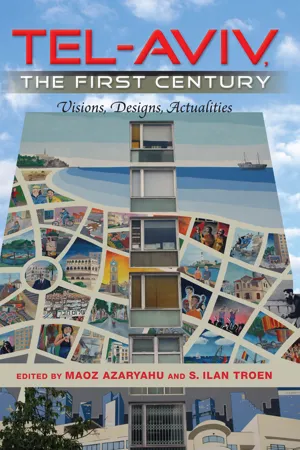
Tel-Aviv, the First Century brings together a broad range of scholars and cutting-edge research to trace the development and paradoxes of Tel-Aviv as an urban center and a national symbol. Through the lenses of history, literature, urban planning, gender studies, architecture, art, and other fields, these essays reveal the place of Tel-Aviv in the life and imagination of its diverse inhabitants. The careful and insightful tracing of the development of the city's landscape, the relationship of its varied architecture to its competing social cultures, and its evolving place in Israel's literary imagination come together to offer a vivid and complex picture of Tel-Aviv as a microcosm of Israeli life and a vibrant, modern, global city.
"Israel's main metropolis is scrutinized through the lens of history, geography, architecture, art, literature, and gender studies, presenting the many facets that have come to constitute the elaborate personality of a very complicated city and society."—
H-Judaic
- 480 pages
- English
- ePUB (mobile friendly)
- Available on iOS & Android
eBook - ePub
About this book
Information
Historical Issues
ONE
Telling the Story of a Hebrew City
Yaacov Shavit
Tel-Aviv Did Not Want to Be a City
Tel-Aviv did not want to be a city. In fact, it was afraid to be a city. The fear arose from the anti-urban trend and the negative image of the city—“the dark city”—in the nineteenth century, as well as the Zionist concern that the city would attract most of the new immigrants and would compete with the agricultural settlements for resources. Only in the 1930s did Tel-Aviv realize that it was becoming a city after all.
What it really meant to be was a suburb, or a modern small town, but certainly not something on the order of the average European city. Even today, Tel-Aviv, with 390,000 residents, is certainly not a large city.
Why Is Its Hundredth Anniversary Noteworthy?
From the perspective of the world outside Europe, there is nothing special about the founding of Tel-Aviv one hundred years ago. During the nineteenth century, outside the continent, and especially in the United States, many cities were established, and not as a result of government initiative. Within Europe, however, the situation was different; the only new city in the last 200 years is Odessa, which was founded by the Czarist government at the end of the eighteenth century.1 Within Eretz-Israel the situation was also different. Tel-Aviv is the only new city since Ramle was established in 717 BCE by the Umayyad caliph Sulayman ibn Abd al-Malik. It is the first so-called “Jewish city” since King Herod built Caesarea in 20–10 BCE and Tiberias was founded by King Herod Antipas in 22–17 BCE. Thus Tel-Aviv was the first city founded in Eretz-Israel in 1,200 years, and it was the first Jewish city founded there in some 2,000 years.
What Does Tel-Aviv Have in Common with Other Cities?
Although cities have much in common, each has its own history, character, and image. What does Tel-Aviv, with its brief history, have in common with other cities, and what makes it unique? Its uniqueness lies in its being the first city established by Jews for Jews, and more so, it was the first opportunity in general for Jews to found a city and to shape its character.
Meir Dizengoff, the head of the neighborhood committee and later the city’s first mayor, declared in 1921,
We are conducting the most important experiment in the entire period of our exile. We want to prove how we will behave in a new, modern city, that will be totally Jewish, that we will light by ourselves, guard by ourselves, improve by ourselves, and keep clean and wholesome [by ourselves].
He referred to a city in the urban-physical sense, as well as to the character of urban life.
The history of Tel-Aviv offers a unique opportunity to see how Jews built a city, what kind of city they wanted to build, and what kind of city grew from under their hands. If Tel-Aviv did not want to be a city, how does this statement fit with the declarations and texts that, already in the first decade of its existence, and certainly after that, seemed to predict the development of the Ahuzat Bayit neighborhood into a city?
These declarations were just rhetoric. A pamphlet dated 31 July 1906 raised the idea of establishing a Jewish neighborhood outside Jaffa. Its author, Akiva Arieh Weiss, who was the most important promoter of the neighborhood, wrote that it would be “the first Hebrew city” and that it would eventually become “Eretz-Israel’s New York.” He did not mean New York as a model for a city, but its role as the port of entry for immigrants. Weiss described this “modern” city:
In this city we will build the streets [so they have] roads and sidewalks [and] electric lights. Every house will have water from wells that will flow through pipes as in every modern European city, and also sewerage pipes will be installed for the health of the city and its residents.
Weiss’s vision still lacks many of the elements of a modern city, and certainly of a metropolis. S. Y. Agnon wrote in his novel Tmol Shilshom (Only Yesterday), “Sixty houses aren’t sixty cities, but we who do not aim too high, even smallness is great for us.”2 The widespread use of the word “city” (stadt) should not mislead us; Tel-Aviv had no intention of becoming New York, Odessa, Vienna, or Berlin.
Other urban visions were expressed. The writer A. A. Kabak, for example, wrote in 1914 that Tel-Aviv would become a large city in which “a rich culture will flourish, large shops [will have] splendid display windows, electric streetcars will pass by with a clatter, locomotives will shriek, [and] factory smokestacks will blast.” Meir Dizengoff, the first mayor, predicted in 1924 that Tel-Aviv would become a metropolis and a great Jewish cultural, commercial, industrial, and political center. However, as some of the city’s first residents stated,
In truth, no one foresaw the coming of Tel-Aviv, . . . when we drove the first stake in Kerem Jebali [“vineyard”—the first 85.5 dunams that were purchased by the first residents of Ahuzat Bayit] we never dreamed that our little neighborhood would grow into a big city and that the city would become the heart of the country, and if someone had predicted generations ago that within twenty-five years a big city would be built on the sandy desert north of Jaffa, [and] that [it] would have more than 100,000 residents, he would have been considered a dreamer.
In short, “Tel-Aviv was not built according to a predetermined plan, because its founders did not foresee its future.”
Even architect Patrick Geddes, in his 1926 outline plan for part of Tel-Aviv believed that Tel-Aviv would be “northern Jaffa.” His plan referred to a small town on just 3,000 dunams (750 acres), with small houses (residential buildings no more than three stories high), and commercial buildings, in commercial areas, of no more than four stories, as well as public parks and private gardens. This was a plan for a city of 100,000. Yet ten years after his plan Tel-Aviv numbered 150,000 inhabitants.3
The character of the city was not shaped in accordance with a vision or preconceived plan. Agnon wrote ironically about the first days of Tel-Aviv that naïve people who believed that their plans and their will had made Tel-Aviv were in error; the city had developed in a totally different manner from what they wanted, and that was God’s doing. In secular language, the city was shaped by the life force—that is, various forces that determined the rate of urban growth and the nature of that growth. Agnon wrote that Tel-Aviv became “the complete opposite of what the founders of Tel-Aviv wanted to make of Tel-Aviv.”4 Instead of becoming an autonomous and modern suburb, it became first a town and then a city, which was not the result of a vision or a plan.
It is true that various groups had a variety of models in mind for a city,5 but these models had only a slight influence on the course of Tel-Aviv’s development, at least in its first forty years. This is true not only in relation to its physical-urban character but also in relation to its social-urban and cultural-urban character.
“City Of Jews,” “Jewish City,” “Hebrew City,” “European City in the Orient”?
Tel-Aviv was a combination of all of these. It was undoubtedly a “city of Jews.” In 1909, the year that the Ahuzat Bayit neighborhood was established, more than a million Jews lived in New York (540,000 on less than one square mile),6 300,000 in Warsaw, and 150,000 in Odessa. Several cities not only had a demographic concentration of Jews but also a vibrant Jewish life. Numerous cities in Europe and in the New World had larger Jewish populations than Tel-Aviv during the British Mandate, and after. In some places, there were more Jews than in all of the Yishuv.
Jews have been portrayed as a quintessentially urban population who played an important role in the urban nineteenth-century revolution.7 However, Tel-Aviv was both a city of Jews and a Jewish city because all the residents within the municipal boundaries, until 1949, were Jews, and because only Tel-Aviv was a city established by Jews as a Jewish enterprise. It was a city whose urban character was shaped by Jews, a city that was run by Jews, and a city whose public space was controlled by Jews. Therefore, the urban challenge to its residents and its image-shapers was all encompassing. What shaped the character of Tel-Aviv was that at least some of the important decisions that determined the development of the urban space and of the urban society were under the control of the city’s residents and its leaders. It was the first and only place where Jews not only settled in a city, contributed to its growth, were an active element in it, were influenced by it, and at the same time established autonomous Jewish life, it was also a city in which they were the sole factor in its establishment, the sole moving force behind its development, and almost the sole shapers of its character.
Without the vision of the “Hebrew city,” without the desire to establish a modern Hebrew city, and without the ability to oversee urban processes at least partially, Tel-Aviv would have been just another city of immigrants and refugees, like all other cities.
However, urban visions do not portray the real city, but rather how the builders of Tel-Aviv and its residents imagined the ideal city. In fact, the city grew from the bottom up, and not all its layers developed according to preconceived ideas or in accordance with plans on paper, but rather as the result of a mostly uncontrolled dynamic.
The Life Force That Spurred the Urban Growth of Tel-Aviv
The main impetus for the establishment of the small Jewish neighborhoods that were built outside Jaffa starting in 1887 consisted of two factors: one was severe overcrowding in Jaffa, resulting from three kinds of increase: the urban growth of Arab Jaffa, an increase in the Jewish population of Jaffa as a result of internal migration (within the Yishuv), and Jewish immigration from outside the country. The second factor was the desire of some of Jaffa’s Jews to improve their housing conditions. In this respect, there was no difference between moving outside the walls of Jaffa and moving outside the walls of Jerusalem’s Old City, starting in the 1860s. Jaffa had ceased to be a bridge to Jerusalem and had become a favored destination. After 1909, and especially after World War I, Tel-Aviv became the favored destination of Jews from other cities in the Yishuv, and especially of many of the immigrants.
Dr. Arthur Ruppin, head of the Palestine office of the World Zionist Organization established in 1908, explained that
In no other place did they see the same degree of independent communal management, under a leadership that [the residents] themselves elected. In no other place was there such a feeling of total security; in no other place was it possible to educate the children to the...
Table of contents
- Cover
- Half title
- Title
- Copyright
- Dedication
- Contents
- Preface: Maoz Azaryahu and Ilan Troen
- Introduction: Tel-Aviv Imagined and Realized
- Part 1 Historical Issues
- Part 2 Language, Literature, and Art
- Part 3 Planning and Architecture
- Afterword: Tel-Aviv between Province and Metropolis
- Contributors
- Index
Trusted by 375,005 students
Access to over 1.5 million titles for a fair monthly price.
Study more efficiently using our study tools.
Frequently asked questions
Yes, you can cancel anytime from the Subscription tab in your account settings on the Perlego website. Your subscription will stay active until the end of your current billing period. Learn how to cancel your subscription
No, books cannot be downloaded as external files, such as PDFs, for use outside of Perlego. However, you can download books within the Perlego app for offline reading on mobile or tablet. Learn how to download books offline
Perlego offers two plans: Essential and Complete
- Essential is ideal for learners and professionals who enjoy exploring a wide range of subjects. Access the Essential Library with 800,000+ trusted titles and best-sellers across business, personal growth, and the humanities. Includes unlimited reading time and Standard Read Aloud voice.
- Complete: Perfect for advanced learners and researchers needing full, unrestricted access. Unlock 1.5M+ books across hundreds of subjects, including academic and specialized titles. The Complete Plan also includes advanced features like Premium Read Aloud and Research Assistant.
We are an online textbook subscription service, where you can get access to an entire online library for less than the price of a single book per month. With over 1.5 million books across 990+ topics, we’ve got you covered! Learn about our mission
Look out for the read-aloud symbol on your next book to see if you can listen to it. The read-aloud tool reads text aloud for you, highlighting the text as it is being read. You can pause it, speed it up and slow it down. Learn more about Read Aloud
Yes! You can use the Perlego app on both iOS and Android devices to read anytime, anywhere — even offline. Perfect for commutes or when you’re on the go.
Please note we cannot support devices running on iOS 13 and Android 7 or earlier. Learn more about using the app
Please note we cannot support devices running on iOS 13 and Android 7 or earlier. Learn more about using the app
Yes, you can access Tel-Aviv, the First Century by Maoz Azaryahu,S. Ilan Troen in PDF and/or ePUB format, as well as other popular books in History & Middle Eastern History. We have over 1.5 million books available in our catalogue for you to explore.