Paul Tillich (1886–1965) is widely regarded as one of the most influential theologians of the 20th century. By bringing his thought together with the theology and practices of an important contemporary Christian movement, Pentecostalism, this volume provokes active, productive, critical, and creative dialogue with a broad range of theological topics. These essays stimulate robust conversation, engage on common ground regarding the work of the Holy Spirit, and offer significant insights into the universal concerns of Christian theology and Paul Tillich and his legacy.
eBook - ePub
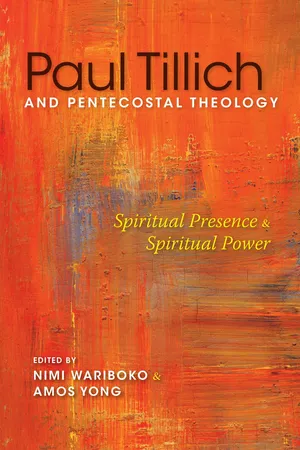
Paul Tillich and Pentecostal Theology
Spiritual Presence and Spiritual Power
- 266 pages
- English
- ePUB (mobile friendly)
- Available on iOS & Android
eBook - ePub
Paul Tillich and Pentecostal Theology
Spiritual Presence and Spiritual Power
About this book
Trusted by 375,005 students
Access to over 1.5 million titles for a fair monthly price.
Study more efficiently using our study tools.
Information
Topic
Theology & ReligionSubtopic
Christian DenominationsONE
Spiritual Power and Spiritual Presence
The Contemporary Renaissance in Pneumatology in Light of a Dialogue between Pentecostal Theology and Tillich
VELI-MATTI KÄRKKÄINEN
First Words: In Search of a New Theology of the Spirit
The American Benedictine pneumatologist Fr. Kilian McDonnell, O.S.B., made a critical and formative statement in his acclaimed 1982 state-of-the-current-pneumatology essay titled “The Determinative Doctrine of the Holy Spirit.” In this same essay, he commends Paul Tillich for his treatment of the doctrine of the Spirit—one that this current chapter considers pivotal among late twentieth-century pneumatologies and that merits engagement with pentecostal pneumatology, using the key terms presence and power. Although McDonnell’s 1982 essay, published three decades ago, may be outdated, it remains timelessly important. Fr. Kilian laments the limited, secondary role given to the Holy Spirit both in Catholic and Protestant theology:
In both Protestantism and Catholicism, the doctrine of the Holy Spirit, or pneumatology, has to do mostly with private, not public experience. In Protestantism, the interest in pneumatology has been largely in pietism where it is a function of interiority and inwardness. In Roman Catholicism, its dominant expression has been in books on spirituality or on the charismatic renewal, or when speaking of the structural elements of the church. In the West, we think essentially in Christological categories, with the Holy Spirit as an extra, an addendum, a “false” window to give symmetry and balance to theological design. We build up our large theological constructs in constitutive christological categories, and then, in a second, non-constitutive moment, we decorate the already constructed system with pneumatological baubles, a little Spirit tinsel.1
The main concern for Fr. Kilian in the way pneumatology has been conceived is its lack of connection with the rest of the world and life; in other words, “how could pneumatology be integral to the theology of history, liberation theology, the theology of hope, political theology, and transcendental anthropology?”2 With many contemporaries, the Benedictine theologian is searching for a more inclusive, life-affirming approach to the Spirit because “contemporary theology has turned from a theology of the Word to a theology of the World.”3 Thus the title of his more recent landmark work, The Other Hand of God: The Holy Spirit as the Universal Touch and Goal,4 through which he has established his place among leading Catholic theologians of the Spirit. Not surprisingly, Fr. Kilian finds in Paul Tillich’s pneumatology an ally in his search for a wider, inclusive, robust account of the Spirit. In stark contrast to Barth (to whom the Benedictine, however, gives credit for an effort to rediscover, particularly in the latter part of his life, the significance of pneumatology),
Tillich is one of the few Protestant (or Catholic) theologians who has handled the doctrine of the Spirit in its proper section instead of seeing it as part of ecclesiology, as Schleiermacher did, or as part of the doctrine of grace. Tillich attempted to do what Schleiermacher, Hegel, and nineteenth-century liberalism tried to do and never accomplished, that is, close the dangerous gap between culture and religion. His specific intent was to correlate culture, religion, philosophy, and theology.5
Indeed, the Catholic pneumatologist praises the Lutheran existentialist: “The role of the Spirit in Tillich’s theology is neither the churchy Spirit of ecclesiastical piety, nor the experiential Spirit of pietism, but the universalist Spirit who bridges all the gaps. And that is Tillich’s strength.”6 Unfortunately, Fr. Kilian’s engagement of Tillich in that programmatic essay is short, toward the end, and functions rather as an invitation for further discussion.7
How would Fr. Kilian’s call for a new theology of the Spirit relate to emerging pentecostal pneumatologies? In personal conversations—an informal part of my postdoctoral mentoring during a most memorable year-long stay at the Institute for Ecumenical and Cultural Research (St. John’s University, Collegeville, Minn.)—he often compared and contrasted Roman Catholic and pentecostal pneumatologies with the terms presence and power. While Catholics, he maintained, believe in all kinds of powerful manifestations of the Spirit of God (just consider the rich mystical and charismatic spiritual experiences among various religious orders throughout ages), for them the divine presence, not only in the sacramental life of the church but in all the world, is the heart of pneumatological belief. For Pentecostals, mere presence, without external and experience-driven manifestations, hardly suffices. It seems to me that this simple template may express well the difference in pneumatological intuitions between not only Catholics and Pentecostals but more widely, non-Pentecostals and Pentecostals. With that in mind I have selected the topic for my chapter, namely, “Spiritual Power and Spiritual Presence.“ With full justification it can be said that if any term faithfully and succinctly describes the Pentecostal experience of the Spirit, it is power. With equal justification it can be said—and is routinely noted—that for Tillich, the corresponding expression is (spiritual) presence.8
The purpose of this chapter is thus to locate Tillich’s vision of the Spirit in the wider matrix of evolving pneumatologies of the latter part of the twentieth century and then engage emerging pentecostal pneumatologies. It is hoped that this dialogue may yield some insights into how (what used to be called) “liberal” and “conservative” traditions may jointly enrich each other, collaborate, and continue discerning the ways of the Spirit in the contemporary world.
Tillich’s Pneumatology in the Context of the Contemporary Search for a New Theology of the Spirit
In recent years Tillich’s aspirations (and McDonnell’s hopes) for an inclusive, life-affirming, and robust pneumatology have been met in an unprecedented way in contemporary constructive theology. Just consider the Reformed Jürgen Moltmann’s groundbreaking The Spirit of Life: A Universal Affirmation (1992), whose agenda is guided by exactly the same kind of directions as Fr. Kilian’s:
In both Protestant and Catholic theology and devotion, there is a tendency to view the Holy Spirit solely as the Spirit of redemption. Its place is in the church, and it gives men and women the assurance of the eternal blessedness of their souls. This redemptive Spirit is cut off both from bodily life and from the life of nature. It makes people turn away from “this world” and hope for a better world beyond. They then seek and experience in the Spirit of Christ a power that is different from the divine energy of life, which according to the Old Testament ideas interpenetrates all the living. The theological textbooks therefore talk about the Holy Spirit in connection with God, faith, the Christian life, the church and prayer, but seldom in connection with the body and nature.9
Indeed, one doesn’t have to wait until the beginning of the 1990s to see Tillich’s dream begin to come true. Tillich’s contemporary the Dutch Hendrikus Berkhof attempted a powerful revision of traditional confessional Reformed theology in light of the heritage of classical liberalism and the new challenges of the twentieth-century context. In his 1964 The Doctrine of the Holy Spirit, Berkhof envisioned the Spirit as the “vitality” of God, “God’s inspiring breath by which he grants life in creation and re-creation.”10 Though strongly modalistic, Berkhof’s view of the Spirit is inclusive and universalistic—building on the Reformed tradition stemming from Jean Calvin and Abraham Kuyper, on the one hand, and anticipating the contemporary turn to a holistic doctrine of the Spirit, on the other hand. Rather than focusing on the church, his pneumatology discerned God’s acts through the Spirit in history, in creation and preservation, as well as in the human life. Echoing Kuyper,11 Berkhof concludes that “the Spirit of God also inspires man’s culture. The Old Testament connects him with agriculture, architecture, jurisdiction, and politics (Cyrus as God’s anointed one!). In general all human wisdom is the gift of God’s Spirit. This relation between the Spirit and creation is much neglected in Christian thinking.”12 In other words, “The Spirit is not locked up in the church.”13
The attempts to release the Spirit from the confines of inner piety and ecclesiastical—sacramental—life without in any way leaving behind these important domains of the Spirit’s ministry—abound in current times, including integrating the Spirit into the center of constructive theology and its “method,”14 christology (“spirit christology”15), creation/environment,16 public life, including sociopolitical liberation and equality,17 as well as other religions,18 among others. Without the space in this discussion to go into any further detail concerning this contemporary pneumatological renaissance, let it suffice to acknowledge and hail the dramatically widening domain of the Spirit of God in contemporary theology, in keeping with the hints provided by Tillich.
Tillich’s pointers toward an all-encompassing pneumatology are both aided and hindered by his placement of the discussion of the Spirit in his third volume. Tillich’s note, as he transitions from volume 2 to volume 3, illustrates the tension: “that the Christ is not the Christ without the church makes the doctrines of the Spirit and of the Kingdom of God integral parts of the christological work.” On the one hand, it certainly is a gain to link pneumatology with the kingdom of God rather than (merely) with the church. Notwithstanding the fact that for Tillich, so it seems to me, “kingdom of God” is a more limited category than “history,”19 this gain opens up a wider horizon for the discussion of the Spirit in the world; God’s rule is something “bigger” and “wider” than the church. On the other hand, Tillich’s note speaks of the doctrine of the Spirit as a part of christology. While in no way denying the mutual conditioning of the works of the Spirit and Son, in an authentic trinitarian grammar, it is not useful to make the Spirit’s work an extension or even fulfillment of Christ’s work. It smacks of subordination or, at least, making the Spirit’s work the second moment. The Spirit’s and Son’s works are mutually conditioned.
Nevertheless, Tillich forges the link between the Christ and the Spirit and hence points to an emerging spirit christology (ST 3:144–149). While not thematically trinitarian, Tillich is able to go beyond the modalistic pneumatologies of his contemporaries Berkhof and the Anglican Geoffrey Lampe.20 He rightly argues, on the basis of the synoptic gospels’ Spirit-christology, that “it is not the spirit of the man Jesus of Nazareth that makes him the Christ, but that it is the Spiritual Presence, God in him, that possesses and drives his individual spirit” (ST 3:146). That said, against the typical tendencies of pietism and, ironically, liberalism, Tillich also reminds us that “the divine Spirit which made Jesus into the Christ is creatively present in the whole history of revelation and salvation before and after his appearance. The event ‘Jesus as the Christ’ is unique but not isolated” (ST 3:147).21 That he was unable to construct an authentic trinitarian spirit christology is part of the bigger problem in his system, which is illustrated by the placement of the short discussion “The Trinitarian Symbols” after even the Spirit (the last section of part 4 in volume 3). At the end of the systematic discussion, not much can be done to make theology authentically trinitarian.
My suspicions of the secondary role given to the Spirit in Tillich’s system, as he likes to call it, are strengthened by two other, mutually related considerations, well known among Tillich students. First, going back to the placement of pneumatology in the third volume, it means—as this Lutheran theologian of course himself mentions and makes a theological theme—that the divine Spirit is the “answer” to the questions related to the ambiguities of life, “the conqueror of the ambiguities of life” (ST 2:80), or the “unity” of life (as he includes under the term “life” a “‘mixture’ of essential and existential elements,” ST 3:12). If so, it means that the “questions” are asked not only by philosophy (following the method of corre...
Table of contents
- Cover
- Half title
- Title
- Copyright
- Dedication
- Contents
- Preface
- Introduction: Why Is the “Correlation” between Paul Tillich and Pentecostal Theology Important, and Who Cares?
- 1. Spiritual Power and Spiritual Presence: The Contemporary Renaissance in Pneumatology in Light of a Dialogue between Pentecostal Theology and Tillich
- 2. Spirit and Nature: Pentecostal Pneumatology in Dialogue with Tillich’s Pneumatological Ontology
- 3. To the Ground of Being and Beyond: Toward a Pentecostal Engagement with Ontology
- 4. God as Being and Trinity: Pentecostal-Tillichian Interrogations
- 5. Tillich’s Picture of Jesus as the Christ: Toward a Theology of the Spirit’s Saving Presence
- 6. Spiritual Presence: The Role of Pneumatology in Paul Tillich’s Theology
- 7. Pneumatological Participation: Embodiment, Sacramentality, and the Multidimensional Unity of Life
- 8. Tillich’s Sacramental Spirituality in a New Key: A Feminist Pentecostal Proposal
- 9. Political Theology from Tillich to Pentecostalism in Africa
- 10. What Have Pentecostals to Do with “The Religion of the Concrete Spirit”? Tillich’s Theology of Religions in Twenty-First Century Global Renewal Context
- 11. The Demonic from the Protestant Era to the Pentecostal Era: An Intersection of Tillichian and Pentecostal Demonologies and Its Implications
- 12. Eschatology in the Theology of Paul Tillich and the Toronto Blessing: The Ontological and Relational Implications of Love
- 13. Paul Tillich, Pentecostalism, and the Early Frankfurt School: A Critical Constellation
- Responses
- List of Contributors
- Index
Frequently asked questions
Yes, you can cancel anytime from the Subscription tab in your account settings on the Perlego website. Your subscription will stay active until the end of your current billing period. Learn how to cancel your subscription
No, books cannot be downloaded as external files, such as PDFs, for use outside of Perlego. However, you can download books within the Perlego app for offline reading on mobile or tablet. Learn how to download books offline
Perlego offers two plans: Essential and Complete
- Essential is ideal for learners and professionals who enjoy exploring a wide range of subjects. Access the Essential Library with 800,000+ trusted titles and best-sellers across business, personal growth, and the humanities. Includes unlimited reading time and Standard Read Aloud voice.
- Complete: Perfect for advanced learners and researchers needing full, unrestricted access. Unlock 1.5M+ books across hundreds of subjects, including academic and specialized titles. The Complete Plan also includes advanced features like Premium Read Aloud and Research Assistant.
We are an online textbook subscription service, where you can get access to an entire online library for less than the price of a single book per month. With over 1.5 million books across 990+ topics, we’ve got you covered! Learn about our mission
Look out for the read-aloud symbol on your next book to see if you can listen to it. The read-aloud tool reads text aloud for you, highlighting the text as it is being read. You can pause it, speed it up and slow it down. Learn more about Read Aloud
Yes! You can use the Perlego app on both iOS and Android devices to read anytime, anywhere — even offline. Perfect for commutes or when you’re on the go.
Please note we cannot support devices running on iOS 13 and Android 7 or earlier. Learn more about using the app
Please note we cannot support devices running on iOS 13 and Android 7 or earlier. Learn more about using the app
Yes, you can access Paul Tillich and Pentecostal Theology by Nimi Wariboko, Amos Yong, Nimi Wariboko,Amos Yong in PDF and/or ePUB format, as well as other popular books in Theology & Religion & Christian Denominations. We have over 1.5 million books available in our catalogue for you to explore.