Now updated: An "eminently readable, highly engaging" anthology about the lives of ordinary citizens in India, Pakistan, Bangladesh, Nepal, and Sri Lanka (Margaret Mills, Ohio State University).
For the second edition of this popular textbook, readings have been updated and new essays added. The result is a timely collection that explores key themes in understanding the region, including gender, caste, class, religion, globalization, economic liberalization, nationalism, and emerging modernities.
New readings focus attention on the experiences of the middle classes, migrant workers, and IT professionals, and on media, consumerism, and youth culture. Clear and engaging writing makes this text particularly valuable for general and student readers, while the range of new and classic scholarship provides a useful resource for specialists.
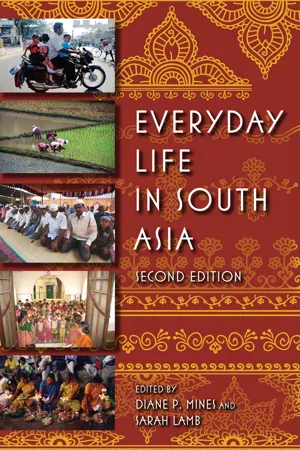
eBook - ePub
Everyday Life in South Asia
- 584 pages
- English
- ePUB (mobile friendly)
- Available on iOS & Android
eBook - ePub
Everyday Life in South Asia
About this book
Information
PART ONE

The Family and the Life Course
The family is a central site of everyday life in South Asia. It is an arena through which persons move through the life-course passages of birth, youth, marriage, parenthood, aging, and dying; it can be a place of love and conflict, material sustenance and want, companionship and painful separations. One term for family in several Indian languages is samsara, which means literally “that which flows together,” and also more broadly connotes worldly life in general. In its sense as family, samsara refers to the assembly of kin and household things that “flow with” persons as they move through their lives.
One common assumption held by many both within and outside South Asia is that South Asians live ideally in “joint families,” consisting of a married couple, their sons, sons’ wives and children, any unmarried daughters, and perhaps even grandsons’ wives and children. We see in the following selections that this assumption is both true and not true, and that family relationships and structures are richly complex and varied. In general, urbanites tend to live in smaller, more nuclear households than those in rural areas, and poorer people (with less land and smaller homes to their names) tend to live in smaller households than the wealthier. National and transnational migration also affects household structures, as many across South Asia are moving to cities or abroad for work, only sometimes bringing the rest of their families with them.
Children are highly valued and loved. The births of boys are often even more elaborately celebrated than the births of girls, but this is not because girls are not equally loved. Parents often worry about the burden of providing a dowry for a daughter’s marriage, and they know that a daughter will move away from them when she marries—unlike a son, who could remain with his parents for their lifetime. Most children in South Asia spend at least some time in school (although this school education can be very minimal, as Gold examines); many also play vital roles by helping their parents with work; and they also play with friends and receive affection and indulgence from seniors. Liechty explores how many urban youth (in this case in Kathmandu, Nepal) are participating in what is becoming a globalized, cosmopolitan youth culture, with shared forms of popular music, media, slang, dress, and sometimes drugs.
Although not all people get married (see, for instance, Seizer’s account of actresses’ lives and Reddy’s exploration of same-sex relationships in part 2), marriage is considered by most in South Asia a crucial part of a person’s and family’s life. Young people—rural and urban—spend much time thinking about their marriages and chatting among themselves about whether traditional arranged marriages or romantic “love marriages” are better. Arranged marriages have long been the most widely accepted marriage practice across South Asia, where the parents and other family members make the match, taking into consideration the background and character of not only the bride and the groom but also their families, considering matters such as caste endogamy, family status, community reputation, wealth, occupation, education, potential business alliances, physical attractiveness, and perceived compatibility. Even when a marriage is arranged by parents and other senior kin, the young person will usually face the event with, along with some trepidation, a degree of eager anticipation and romantic expectation, having perhaps met the future spouse on one or more occasions, or at least having seen and admired a photo. The distinction between “arranged” and “love” marriages is in fact becoming increasingly blurred, especially among the urban middle classes, where it is common for young people to participate in choosing their potential partners within the framework of parental approval in one of two ways: Parents or other kin may introduce the two, who then might spend some time getting to know each other by phone or email, in meetings in the parents’ homes, and even by dating a few times, before agreeing to a match. Or the couple might meet each other on their own in, say, college or the workplace, or by growing up in the same village, and then—if the family backgrounds seem compatible—broach the topic of a match to the parents, who may then assume the responsibility of arranging the marriage. Extensive socializing between the sexes before marriage is still widely discouraged, however, and single women employed in mixed-gender workplaces can be criticized for opposite-sex fraternizing, as the selections by Kapur (this part) and Lynch (part 5) explore. Divorce rates in India are among the lowest in the world, especially among Hindus (within Islam, divorce is accepted under appropriate circumstances), although divorce is on the rise within professional, cosmopolitan circles in India, as Kapur’s chapter examines.
Aging and dying tend to be accepted as natural parts of life and family flows for many South Asians. The expectation or ideal (one that is not always realized) is that intergenerational ties will be close and reciprocal throughout life and even after death, as parents care for their children when young, and children (especially sons and daughters-in-law) in turn support their parents in old age and as ancestors (Lamb). Much public discourse in India—in newspapers, television serials, gerontological texts, and everyday talk—is currently concerned with the decline of multigenerational family living for the aged, in the face of the growing prevalence of nuclear family households, living alone, old-age homes, and the transnational dispersal of families amidst global labor markets. Nonetheless, the vast majority of India’s elders continue to live in multigenerational family homes: of persons aged sixty or older, just 4 percent in 2000 lived in single-person households, for instance, and just 7 percent as an elderly couple.1 These figures present a stark contrast to those in the United States, where among those sixty-five and over, 30 percent live in single-person households and 53 percent with only their spouse, and where it is widely considered entirely normal and even desirable for people to live singly and especially with a spouse in late life.2
For the most part, older South Asians practice fewer attempts to fight the bodily changes of age—through the hair-dyeing, face-lifting, anti-aging exercise routines, life-prolonging medical technologies, and the like that are so dominant now in Europe and America. (Such techniques are, however, becoming popular among the cosmopolitan South Asian elite.) Hindus, as well as Buddhists, Jains, and Sikhs, view death as not an end but a passage on to new forms of life; the body is discarded and cremated, while the soul moves on to new births, deaths, and rebirths. Muslims bury their dead and imagine an afterlife with the possibility of suffering or bliss depending partly on how much merit or sin one has accumulated. Some Muslims believe that death should not be loudly mourned, for the timing and circumstances of death are in Allah’s hands, and one would not want to insult Allah.
One significant theme running throughout several of this part’s chapters is the idea that belonging to a family whole is more important than pursuing individual aspirations (see also Radhakrishnan, part 6). Susan Wadley quotes a Brahman man using the imagery of the broom to explain the value of a large, interdependent family: “Say there is a broom. If you have one straw separate, it can’t sweep. But when all are together, it can sweep.” Patricia and Roger Jeffery’s examination of a Muslim woman’s life in rural north India illustrates how the ideal of a harmonious joint family does not always work out neatly: Sabra’s marital family suffers bitter disagreements, separations, poverty, and death. Yet in significant respects Sabra’s interdependent extended family ties endure, and it is only through remaining part of her husband’s family that Sabra is able to survive as a widow with young children. Sabra’s story also demonstrates the importance of a woman’s natal ties. Although she moves to her husband’s home, her ties to her natal parents and brothers remain valuable lines of material support and affection.
Another theme that appears in these chapters surrounds the nature of modernity. Many in South Asia interpret problems in contemporary families, such as a youth drug culture (Liechty), divorce (Kapur), neglected elderly (Lamb), and a general decline in family values, as modern afflictions, stemming from forces such as consumerism, urbanization, individualism, colonialism, a globalizing political economy and media, and the back and forth of transnational migration. Some view such features of modernity as coming principally from the “West” and/or from “globalization.” In such discourses, the intimate extended family can stand as a sign of “tradition” and a morally superior national culture (see Chatterjee 1993; Lamb, Lynch, Radhakrishnan). Yet, the chapters in this part also highlight crucial dialectic processes of interchange between more local and global cultural forms, as people forge family lives while striving to maintain older needs, desires, and values, and also producing and fulfilling and sometimes resisting new ones, wrestling strategically with what they see as the conditions of their modern society.
* * *
The chapters in this section together aim to portray the richness and diversity of everyday experiences of the family and the life course in South Asia. Susan Wadley begins by examining the ideology and practice of the joint family in the largely Hindu community of Karimpur in rural north India. People of Karimpur express the idea that power comes through numbers and that those who wish to sustain a family’s honor and vitality should remain together as one whole under a unifying male head. Wadley further examines how, contrary to expectations, the joint family is more prevalent now in Karimpur than ever before, although the nature of some relationships within the family is changing.
Patricia and Roger Jeffery’s vivid account of the life of Sabra, a rural north Indian Muslim woman, portrays the phases of a woman’s life as she moves from girlhood, to marriage, to motherhood and widowhood; the quest for sons; and the afflictions and sustenance that derive from extended family ties.
Mark Liechty focuses on youth culture in urban Nepal. Middle-class youth, while waiting—often in vain—for white-collar employment, have the leisure time to join gangs, consort with foreign tourists, sell and take drugs, and consume foreign media—participating in the intermingling of global and local worlds, creating images and fantasies of foreignness and modernity.
Cari Costanzo Kapur explores the ways call center employees in India negotiate their sense of identity as young, income-earning professionals at a stage in life when both career growth and decisions about marriage and family are paramount. She asks how the intersection of global labor, gender ideologies, and class in contemporary India are shaping ideas about, and options for, courtship, marriage, and divorce, and enabling new ways of thinking about kinship.
Sarah Lamb moves on to examine the ways Bengalis think of aging as a time to loosen ties to family, things, and their own bodies, to prepare for the myriad leave-takings and journeys of dying. She explores the experiences and perspectives both of those living in families in a large West Bengali village and of those in the rapidly emerging old-age homes in India’s middleclass cosmopolitan centers, institutions that are replacing for those who live in them the more conventional multigenerational co-residential family that many have long viewed as central to a proper way of aging and society in India. To some, such old-age homes signify not merely a new form of aging and family, but also much broader social, cultural, and national transformations.
NOTES
1. See Census of India 2001: “Data Highlights: HH-5: Households with number of aged persons 60 years and above by sex and household size,” pp. 2–4, www.censusindia.gov.in/.
2. U.S. Census Bureau, www.census.gov: Single Person Households Age 65 and Older in 1999: 2000 Census, Tables No. 60 and 61; and “A Profile of Older Americans: 2003,” www.aoa.gov/prof/Statistics/profile/2003/6.asp#figure3.
1

One Straw from a Broom Cannot Sweep: The Ideology and Practice of the Joint Family in Rural North India
Susan S. Wadley
The Indian joint family is built upon the idea and reality that power comes through numbers, and that those who seek to be most powerful, especially in India’s village communities, should remain in joint families in order to successfully sustain a family’s honor and position. A second, but equally important, component of the success of joint families in practice is the training that children receive that marks their interdependence, their sense of belonging to a group that is more important than individual goals and aspirations. The ideal joint family is made up of a married couple, their married sons, their sons’ wives and children (and possibly grandsons’ wives and great-grandchildren), and unmarried daughters. In the community of Karimpur1 in rural Uttar Pradesh, some 150 miles southeast of New Delhi, some joint families extend to four generations and include more than thirty members. For Karimpur’s landowning families, which are more likely to be joint than are poor families, separating a joint family is traumatic, rupturing family ties, economic relationships, and workloads, as well as necessitating the division of all of the joint family’s material goods (land, ploughs, cattle, cooking utensils, stocks of grain and seed, courtyards, verandahs, rooms, cooking areas, etc.). Separation (nyare) is, in fact, most comparable to an American divorce. It also brings dishonor to one’s family.
The paradigm most frequently used to regulate social life in Karimpur is that of the ordered family, implying the authority of a male head, a number of adults working together under that authority, and respect for all of those higher in the family (or village) hierarchy. As in many north Indian communities, Karimpur residents use fictive kin terms toward all nonrelated village residents of whatever caste group; and traditionally, they have seen the village community as one family.2 As one elderly Brahman man put it in 1984:
Where there is cooperation (sangṭhan), there are various kinds of wealth and property. And where there is no cooperation, there is a shortage of each and every thing or there is an atmosphere of want. Where there is cooperation there is no need [of the ambition] to pile up wealth. “The minor streams or rivers go into the ocean but they do not have the ambition [to be big].” So, in the same way, property and comfort accrue without being sought after when there is cooperation: property comes to the properly regulated (kayda) man.
Hence the family is dependent upon a man who has himself, and his family, under his control. This control is attained through a variety of daily practices, as well as a clearly articulated ideology of male superiority. The same elderly Brahman male spoke of women in this way:
Q: How does the man *control* her?3
BM: *Control*? They [women] don’t have much knowledge (gyan). How is the lion locked in the cage? It lacks reason (vivek). Man protects her from everything.
Q: If a woman progresses, then she would be knowledgeable. Then how can you shut her in a cage?
BM: I say that if the sun begins to rise in the west, then what? It is a law of nature.
At another time, he added that “a woman cannot think as much as a man” (even though, he we...
Table of contents
- Cover
- Title
- Copyright
- Contents
- Acknowledgments
- Note on Transliteration
- Map
- Introduction
- Part One The Family and the Life Course
- Part Two Genders
- Part Three Caste, Class, and Community
- Part Four Practicing Religion
- Part Five Nation-Making
- Part Six Globalization, Public Culture, and the South Asian Diaspora
- List of References
- List of Contributors
- Index
Trusted by 375,005 students
Access to over 1.5 million titles for a fair monthly price.
Study more efficiently using our study tools.
Frequently asked questions
Yes, you can cancel anytime from the Subscription tab in your account settings on the Perlego website. Your subscription will stay active until the end of your current billing period. Learn how to cancel your subscription
No, books cannot be downloaded as external files, such as PDFs, for use outside of Perlego. However, you can download books within the Perlego app for offline reading on mobile or tablet. Learn how to download books offline
Perlego offers two plans: Essential and Complete
- Essential is ideal for learners and professionals who enjoy exploring a wide range of subjects. Access the Essential Library with 800,000+ trusted titles and best-sellers across business, personal growth, and the humanities. Includes unlimited reading time and Standard Read Aloud voice.
- Complete: Perfect for advanced learners and researchers needing full, unrestricted access. Unlock 1.5M+ books across hundreds of subjects, including academic and specialized titles. The Complete Plan also includes advanced features like Premium Read Aloud and Research Assistant.
We are an online textbook subscription service, where you can get access to an entire online library for less than the price of a single book per month. With over 1.5 million books across 990+ topics, we’ve got you covered! Learn about our mission
Look out for the read-aloud symbol on your next book to see if you can listen to it. The read-aloud tool reads text aloud for you, highlighting the text as it is being read. You can pause it, speed it up and slow it down. Learn more about Read Aloud
Yes! You can use the Perlego app on both iOS and Android devices to read anytime, anywhere — even offline. Perfect for commutes or when you’re on the go.
Please note we cannot support devices running on iOS 13 and Android 7 or earlier. Learn more about using the app
Please note we cannot support devices running on iOS 13 and Android 7 or earlier. Learn more about using the app
Yes, you can access Everyday Life in South Asia by Diane P. Mines, Sarah Lamb, Diane P. Mines,Sarah Lamb, Diane P. Mines, Sarah E. Lamb in PDF and/or ePUB format, as well as other popular books in Social Sciences & Cultural & Social Anthropology. We have over 1.5 million books available in our catalogue for you to explore.