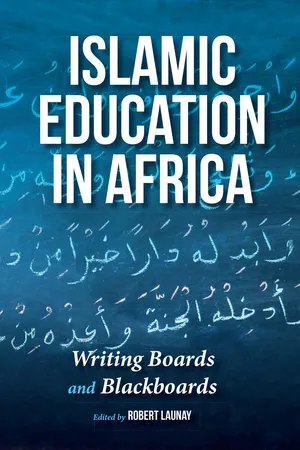
Writing boards and blackboards are emblematic of two radically different styles of education in Islam. The essays in this lively volume address various aspects of the expanding and evolving range of educational choices available to Muslims in sub-Saharan Africa. Contributors from the United States, Europe, and Africa evaluate classical Islamic education in Africa from colonial times to the present, including changes in pedagogical methods—from sitting to standing, from individual to collective learning, from recitation to analysis. Also discussed are the differences between British, French, Belgian, and Portuguese education in Africa and between mission schools and Qur'anic schools; changes to the classical Islamic curriculum; the changing intent of Islamic education; the modernization of pedagogical styles and tools; hybrid forms of religious and secular education; the inclusion of women in Qur'anic schools; and the changing notion of what it means to be an educated person in Africa. A new view of the role of Islamic education, especially its politics and controversies in today's age of terrorism, emerges from this broadly comparative volume.
- 336 pages
- English
- ePUB (mobile friendly)
- Available on iOS & Android
eBook - ePub
About this book
Information
Topic
Theology & ReligionSubtopic
Islamic Theology1.
INTRODUCTION: WRITING BOARDS AND BLACKBOARDS

WRITING BOARDS AND blackboards are emblematic of two radically different styles of education. Writing boards typify the centuries-old classical system of Qur’anic education. They are rectangular wooden planks on which a teacher or student writes a text, usually a passage from the Qur’an, in homemade black ink. The student then learns to recite, and sometimes memorize, the text in question. Blackboards, a nineteenth-century invention that marked the expansion of mass education in Europe and the United States, came to embody colonial institutions of education: state secular schools, of course, but also mission schools that proliferated in British, but also in Belgian and Portuguese, colonies. More recently, they have also been taken up by Muslim reformers who actively seek to “modernize” Islamic education.
The essays in this volume represent an attempt to take these different systems of education on their own terms and in historical context and to present a wide coverage of the continent—East, West, and, if to a lesser extent, Central and Southern; anglophone, francophone, and lusophone—to highlight critical similarities as well as differences. Indeed, the comparative dimensions of the subject have received relatively little attention. Bringing together the chapters in this volume constitutes a first step toward delineating the contours of the problem and of suggesting avenues for a more comprehensively comparative treatment. One of the aims of this volume is to call for a reevaluation of classical Islamic education in Africa in an attempt to understand it in its own right and on its own terms.1
Three important theoretical considerations underpin the collection of essays and can help to place them in a broader context. The rest of this introduction will develop these considerations in greater detail. First, writing boards and blackboards do not simply symbolize two different systems of education, but in a deeper sense literally embody them materially. Each of these supports called for different postures, different attitudes, and different behaviors, which served to inscribe different disciplinary projects on the bodies of pupils. These projects, in turn, correspond to different epistemic regimes, taken-for-granted ways of understanding the world and the word. Most if not all readers of this text take the episteme of the modern school system for granted. For this very reason, understanding the episteme of classical Islamic education on its own terms requires an effort of the theoretical imagination.
Second, as Comaroff and Comaroff (1991) and Mitchell (1988) among others have noted, the modern school system epitomized by blackboards was an intrinsic component of the colonization of Africa, in some cases even before or in the absence of direct imperial domination. This assertion comes as no surprise. However, analyses of colonial education, to the extent that they have tended to focus on one regime or another, have curiously underemphasized the very real differences between British, French, and indeed Belgian and Portuguese education in Africa, and most specifically the extent to which different colonial regimes relied on or alternatively avoided mission schools. It may seem counterintuitive to suggest that the involvement of missionaries in colonial schooling had an important impact on the attitudes of colonial administrations toward Islamic education—an impact that has often persisted after the independence of former African colonies. However, the British reliance on missionaries from multiple, and often rival, denominations opened a space for religious education in British colonies that did not exist in French, Belgian, or Portuguese territories.
Third, the centrality of mission schooling in the elaboration of different colonial policies toward Islamic education points to the importance of considering the constantly shifting field of educational alternatives, Islamic and otherwise, as a structured field. This is particularly relevant today, when neoliberal policies of structural adjustment have obliged African governments to scale down radically the public sector, and in particular public education. Brenner’s (2001) pioneering account of the growth of madrasas in Mali correctly links their success to the deterioration of Malian public education without explaining the causes of their failure. As a result of this failure, parents and pupils in Mali (and elsewhere) are reduced to shopping among educational alternatives in what appears, at least superficially, to be a free market. They are obliged to weigh the costs (sometimes very literally) against the benefits of different kinds of Islamic and secular educations. The unintended consequences of this shift include the reinforcement of educational stratification by class in an African context, but also the opening of new spaces for and new forms of Islamic leadership and Islamic education—especially, though hardly exclusively, for women.
I have avoided the temptation to title this volume “from writing boards to blackboards.” Obviously, in terms of a historical sequence, such a characterization is accurate.2 Writing boards were used in Africa before blackboards were invented, much less before they were introduced in African classrooms. Unfortunately, it is all too easy to provide a teleological slant to a chronological sequence of events, to suggest that writing boards are backwards and outdated and that their replacement by blackboards is not only inevitable but, more important, represents a pedagogical advance. This was certainly the attitude of colonial educators and administrators, for whom schools were a fundamental instrument for inculcating the values and the virtues of “civilization.” For the same reason, I have deliberately avoided labeling classical education as “traditional,” though I have no objection to calling colonial systems of education “modern.” In the first place, to label the classical mode of education as traditional implies that it is in some sense fundamentally African, a manifestation of a syncretic (and mythical) Islam noir, which deviated from a putatively pure Middle Eastern model. This is empirically false. The classical system has its roots throughout the Muslim world Chamberlain 1994, 1997; Eickelman 1994). Indeed, Ware (2014) has argued that classical education in Africa still perpetuates a system that once characterized the Muslim world as a whole. It is important to insist that the categorization and dichotomization of educational systems as traditional or modern is a feature of an ideology of modernity intrinsically tied to the kind of education that colonizers of whatever stripe tried to impose on their subjects. Colonial schooling was very self-consciously modern, especially in an Africa stigmatized as primitive and consequently radically backward. Muslims were (only sometimes) considered less primitive than others, though perhaps for that very reason more recalcitrant.
Educational Material, Material Education
The introduction of blackboards has, to my knowledge, largely escaped the attention of scholars of colonialism in Africa. Blackboards have been passed over in favor of clocks, looking glasses, and other sexier symbols of European technological modernity (Comaroff and Comaroff 1991, xi, 170–97). The homely blackboard, perhaps because so many of us take it for granted, has remained virtually invisible.3 Yet there are similarities as well as differences between writing boards and blackboards. They are, after all, similar pedagogical tools, on which texts are inscribed for the benefit of pupils, only to be erased and replaced with new and different texts. But the differences outnumber the similarities. One writes with pen and ink on a writing board, just as one writes on a sheet of paper. It is important to bear in mind that, before the advent of colonial rule, paper itself was a relatively precious commodity, which certainly would not have been wasted on the training of young pupils but kept for manuscripts intended to be preserved, especially in the absence of printed books.4 To the extent that writing boards were reserved for sacred texts, if not exclusively for passages from the Qur’an, the very act of writing on them partook of the domains of sacrality and even of (relative) permanence. Indeed Santerre (1973, 107), in his study of classical Islamic education in northern Cameroon, notes that writing boards were not to be taken home but were always left in the keeping of the teacher (see also Fortier, this volume). Santerre’s suggestion that this was a means by which teachers preserved their monopoly of pupils’ education by ensuring that no one else would copy passages on a pupil’s writing board is uncharitable. Such boards needed to be treated with some of the reverence accorded to manuscript copies of the Qur’an. By contrast, blackboards are an intrinsically impermanent medium. Unlike pen and ink, chalk is reserved exclusively for blackboards, where writing is destined to be erased, however sacred the text may be. The ink washed off writing boards was not infrequently drunk as “medicine,” its virtues depending on the text in question. It is hard to conceive of the chalk erased from a blackboard put to a similar use.
This difference, while it conveniently encapsulates and symbolizes the contrast between two radically different systems of education, also calls attention to the material supports essential to each system and the very different embodied dispositions they inculcate. Discussions of Islamic education, particularly those that have focused on explicitly modernizing projects of reform,5 have centered on the ideological dimensions, admittedly both real and pertinent, often to the exclusion of the material and embodied realm. In particular, Foucault’s (1975) analysis of modern disciplinary regimes treats schools as one institution (among others) committed to creating docile bodies.6 Foucault’s approach has been most notably employed by Mitchell (1988) in his analysis of the nineteenth-century colonizing of Egypt. Mitchell argues that the very concept of education as an autonomous domain reserved for youth is entirely a product of the disciplinary regime of the modern school. According to Mitchell, neither the scholarship dispensed by the lessons of learned doctors at al-Azhar nor the apprenticeship dispensed by village fiqi in the appropriate recitation and use of words from the Qur’an constituted education. Their misapprehension as such by European observers led to their characterization as simultaneously disorderly and ineffective.
Mitchell’s contrast is perhaps too stark, and not always helpful in African countries where both forms of instruction have coexisted and in many cases remain either complementary or in competition. Qur’anic instruction is, after all, also a disciplinary project, but the difference between writing boards and blackboards entails the different natures of the two projects. The disciplinary practices associated with writing boards are directed toward the text as an object. The way one holds the board and the rocking motion one makes with one’s whole body while psalmodying the text are geared to instilling a reverence for the exact words and intonations, either as recited or written. The practices associated with the blackboard are directed to a qualitatively different object: the lesson. Pupils are seated in orderly rows at their desks, not in an improvised circle on the ground. They are enjoined to silence unless called on to contribute to a lesson directed not specifically to them but to the entire class. Success is measured by examination, not recitation. For Gradgrind, the caricatural schoolmaster in Charles Dickens’s Hard Times, the goal of education was to instill “facts,” not “words.”
Writing boards are also a concrete token of the direct and personal link between master and pupil. Only the master, his delegate—an advanced student of the master, acting as his assistant—or the pupil himself (or, more rarely, herself) at the master’s instruction would write on the board. The pupil was responsible for mastering the text by reciting it correctly, aloud and melodically. Indeed, the proper recitation of the Qur’an is a fundamental Islamic discipline in and of itself (Nelson 1985). Only when a pupil had mastered a text was it washed off and replaced by another. Consequently, each pupil proceeded at his or her own pace. Lessons involved several pupils, simultaneously reciting different passages.
Blackboards, on the other hand, exemplified the relative depersonalization of the educational process. They belonged to neither the teacher nor the student but instead to the school, the institution. Their purpose was not to convey a text but rather a lesson. The lesson was not aimed at a particular student but to an entire class,7 who were generally responsible for writing down the lesson in their notebooks. It is the notebook that permitted the student to learn the lesson—perhaps by rote—at home, at her own leisure. Reciting the entire lesson aloud was generally beside the point and usually inappropriate. Students may have been called upon—in turn and not simultaneously—to provide appropriate answers rather than to recite the text as a whole. Success was measured by examinations rather than by recitations. There is nothing, of course, to prevent a blackboard from purveying religious education, Muslim or Christian. This is indeed frequently the case. But the same blackboard may convey a passage from the Qur’an at one moment, a problem of arithmetic at another. A blackboard is, after all, only a blackboard.
The Clash of Educations?
Nowhere is the antithesis between the classical Qur’anic and the modern colonial systems of education more powerfully expressed than in Cheikh Hamidou Kane’s novel, L’aventure ambiguë (1961). The novel opens as the central protagonist, Samba Diallo, is being beaten by his teacher Thierno for having inadvertently garbled the verse he was reciting. The brutality of the punishment is paradoxically a token of the master’s deep affection for his best pupil, from whom he demands and expects nothing less than perfection. But it is not Samba’s destiny to pursue his Qur’anic education. Scion of a princely family, he is selected by his family as a pioneer and leader, the first to attend colonial school and ultimately to pursue his studies in Paris. Such a portrayal of colonial schooling as a radical rupture with tradition is common to other African, especially francophone African, novels, most notably Camara Laye’s L’enfant noir (1953).8 However, in Kane’s novel, tradition is squarely situated in the context of Qur’anic education. These two types of schools embody the contest for Samba’s allegiance, and ultimately his very soul.
Of course, the notion that classical Islamic and colonial systems of education were, to some extent (if not radically), antithetical was hardly restricted to novelists. Modern education was central to the colonial project of winning over the minds (if not the hearts) of colonized subjects. Qur’anic education was, from such a perspective, an unwelcome alternative to colonial schools that lured away potential pupils while (from the point of view of the colonizers) serving no useful purpose. In the words of a colonial report on education in Zanzibar in 1925: “It cannot be seriously said that Koran schools make any real contribution to meet the educational needs of the Protectorate. They are in fact a hindrance to progress” (cited in Loimeier 2009, 47).
The education provided in Qur’anic schools was derisively characterized as “parrot talk”—the mechanical repetition of words not understood. Another colonial memorandum insisted that “It is difficult to imagine anything more deadening to potential intellect than to read aloud from morning till evening, for a period of two or three years, words of which nothing is understood…. It is indeed true that the intellectual development in the tropics, the vital importance of bringing children under proper control at the earliest possible age is obvious” (cited in Loimeier 2009, 244–45).
This combination of disdain for Qur’anic schools and distress at their resilience was hardly restricted to British colonizers. It is striking that in most sub-Saharan African colonies—and nowadays in most independent African nations—the ability to read and write Arabic was never counted as “literacy” in official statistics. French administrators were generally more apprehensive of Islam than were their British counterparts (Harrison 1988; Triaud 1974). The British, traumatized by the Indian Revolt of 1857, were haunted by the perspective of a “nativist” uprising against which Muslims constituted potential allies; ‘Abd al-Qadr’s resistance to the French in Algeria left them constantly apprehensive of the possibility of a pan-Islamic revolt. Seen in this light, Qur’anic schools constituted a potential menace, and the French kept files on all Qur’anic teachers as well as other ulama in their colonies.
In turn, Muslim parents could be just as apprehensive of colonial schools. For example, Dyula Muslims in the town of Korhogo, in Côte d’Ivoire, refused as long as they could to send their children to school. A friend of mine recounted how, in the early 1950s, soldiers came to the neighborhood to escort him and other boys his age, the first cohort to attend French school, by force. Such reluctance to send children to school was hardly exclusive to Muslims, nor were Muslim reactions to European education uniform. Nevertheless, the anxieties of many Muslim parents were far from irrational. They perceived the schools as purveyors of foreign ideologies, potentially if not actively hostile to Islam: Christianity and secularism.
However, it would be im...
Table of contents
- Cover
- Title Page
- Copyright
- Dedication
- Contents
- Preface
- 1 Introduction: Writing Boards and Blackboards
- The Classical Paradigm
- Institutional Transformations
- Innovations and Experiments
- Plural Possibilities?
- Contributors
- Index
Trusted by 375,005 students
Access to over 1.5 million titles for a fair monthly price.
Study more efficiently using our study tools.
Frequently asked questions
Yes, you can cancel anytime from the Subscription tab in your account settings on the Perlego website. Your subscription will stay active until the end of your current billing period. Learn how to cancel your subscription
No, books cannot be downloaded as external files, such as PDFs, for use outside of Perlego. However, you can download books within the Perlego app for offline reading on mobile or tablet. Learn how to download books offline
Perlego offers two plans: Essential and Complete
- Essential is ideal for learners and professionals who enjoy exploring a wide range of subjects. Access the Essential Library with 800,000+ trusted titles and best-sellers across business, personal growth, and the humanities. Includes unlimited reading time and Standard Read Aloud voice.
- Complete: Perfect for advanced learners and researchers needing full, unrestricted access. Unlock 1.5M+ books across hundreds of subjects, including academic and specialized titles. The Complete Plan also includes advanced features like Premium Read Aloud and Research Assistant.
We are an online textbook subscription service, where you can get access to an entire online library for less than the price of a single book per month. With over 1.5 million books across 990+ topics, we’ve got you covered! Learn about our mission
Look out for the read-aloud symbol on your next book to see if you can listen to it. The read-aloud tool reads text aloud for you, highlighting the text as it is being read. You can pause it, speed it up and slow it down. Learn more about Read Aloud
Yes! You can use the Perlego app on both iOS and Android devices to read anytime, anywhere — even offline. Perfect for commutes or when you’re on the go.
Please note we cannot support devices running on iOS 13 and Android 7 or earlier. Learn more about using the app
Please note we cannot support devices running on iOS 13 and Android 7 or earlier. Learn more about using the app
Yes, you can access Islamic Education in Africa by Robert Launay in PDF and/or ePUB format, as well as other popular books in Theology & Religion & Islamic Theology. We have over 1.5 million books available in our catalogue for you to explore.