First-person accounts by scholars and journalists of the Arab Spring and the revolution that ended Mubarak's presidency.
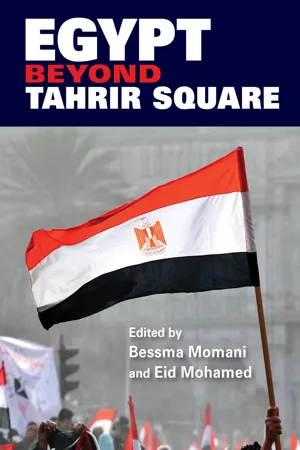
On January 25, 2011, the world's eyes were on Egypt's Tahrir Square as millions of people poured into the city center to call for the resignation of president Hosni Mubarak. Since then, few scholars or journalists have been given the opportunity to reflect on the nationwide moment of transformation and the hope that was embodied by the Egyptian Revolution.
In this important and necessary volume, leading Egyptian academics and writers share their eyewitness experiences. They examine how events unfolded in relation to key social groups and institutions such as the military, police, labor, intellectuals, Coptic Christians, and the media; share the mood of the nation; assess what happened when three recent regimes of Egyptian rule came to an end; and account for the dramatic rise and fall of the Muslim Brotherhood.
The contributors' deep engagement with politics and society in their country is evident and sets this volume apart from most of what has been published in English about the Arab Spring. The diversity of views brought together here is a testament to the contradictions and complexities of historical and political changes that affect Egypt and beyond.
- 196 pages
- English
- ePUB (mobile friendly)
- Available on iOS & Android
eBook - ePub
Egypt beyond Tahrir Square
About this book
Trusted by 375,005 students
Access to over 1.5 million titles for a fair monthly price.
Study more efficiently using our study tools.
Information
1 Egypt’s Revolutionary Spirit across Time
Belal Fadl and Maissaa Almustafa
All roads led into the mire in my time.
My tongue betrayed me to the butchers.
There was little I could do. But those in power
Sat safer without me: that was my hope.
So passed my time
Which had been given to me on earth
Our forces were slight. Our goal
Lay far in the distance
It was clearly visible, though I myself
Was unlikely to reach it.
So passed my time
Which had been given to me on earth….
—Bertolt Brecht (1898–1956)
THROUGHOUT MODERN EGYPTIAN history, the goals of justice, freedom, and dignity have inspired people to break out into the streets, protesting against those in power and demanding recognition of their own rights. The path to revolution is not always an easy one. However, with the goal of a better future in mind, many people have been able to continue their fight against repressive regimes. This chapter is an attempt to revive our memories of historical circumstances that have taken place in several societies that have witnessed political revolutions. It then compares the development of these revolutions to the revolution of January 25, 2011, in Egypt. An examination of the political, economic, and social crises in Egyptian history will also demonstrate that the Egyptian population currently faces similar challenges, and that the root causes of these crises remain the same.
Egyptian History Repeats Itself
Even before the emergence of the modern Arab state, the great Arab, Tunisian, and North African philosophical work of Ibn Khaldun in his book the Muqaddimah (“Introduction or Prolegomena”), written in the fourteenth century, presented concepts that can help to illuminate some of the contemporary political, economic, and social crises in Middle Eastern societies today. According to Ibn Khaldun, “A ruler can achieve power only with the help of his own people. They are his group and his helpers in his enterprise…. With the approach of the second stage, the ruler shows himself independent of his people, claims the glory for himself.”1 Ibn Khaldun also explains how rulers can either acquire people’s trust or generate anger: “Exaggerated harshness is harmful to royal authority and in most cases causes its destruction…. If the ruler continues to keep forceful grip on his subjects, group feeling will be destroyed. If the ruler is mild and overlooking the bad sides of his subject, they will trust him and take refuge with him. They love him heartily and are willing to die for him in battle against his enemies. Everything is then in order in the state.”2 According to Ibn Khaldun, “Injustice brings about the ruin of civilization.”3 He notes how people lose their interest in production when they become subjects of injustice: “Attacks on people’s property remove the incentive to acquire and gain property…. When people no longer do business in order to make a living, and when they cease all gainful activity, the business of civilization slumps and everything decays.”4 Ibn Khaldun’s explanation of the “dynasty’s senility” as the last stage of a state’s life is still valid and applies to contemporary political experiences. This phase attributes the split of a dynasty to its ruler’s arrogance and willingness to maintain his absolute individual authority:
When royal authority comes into its own and achieves the utmost luxury … and when the ruler controls all the glory and has it all for himself, he is too proud to let anyone share in it…. He eliminates all claims in this direction by destroying those of his relatives who are possible candidates for his position and whom he suspects. Those who participate with the ruler in this (activity) often fear for their own (safety) and take refuge in remote parts of the realm…. The refugee related (to the dynasty) gains control. His power grows continually, while the authority of the dynasty shrinks.5
Ibn Khaldun then confirms that when the stage of senility occurs, nothing can stop it: “Senility is a chronic disease that cannot be cured or made to disappear because it is something natural.” He interestingly adds, “At the end of a dynasty, there often also appears some power that gives the impression that senility of the dynasty has been made to disappear. It lights up brilliantly just before it is extinguished.”6 Considering the current upheavals in the Middle East, Ibn Khaldun’s words are relevant for many of Egypt’s past and current politicians, who face political unrest within their respective borders.
Modern Egyptian history witnessed several social and political crises, many of which were linked to state corruption and repression. Many of those crises involved social uprisings and riots. Critical analysis of these uprisings shows that most of their leaders lacked revolutionary vision and the movements failed to result in the improvement of the living conditions among Egyptian people. This section surveys Egyptian analysis of modern revolts to demonstrate how the themes of duplicity and failed leadership predicted revolutionary failure in the past. In his work The Social Crises in Egypt in the Seventeenth Century, Naser Ahmad Ibrahim draws a tragic picture of daily life in Egypt from 1678 to 1703. He examines the relationship between malnutrition and epidemic diseases and the economic crises caused by rapid price increases during the period. According to Ibrahim, such crises were not caused by food scarcity throughout Egypt, but rather by pricing policies and market monopolies imposed by wealthy merchants. At the same time, Egyptian rulers did not interfere or assist their people during the hardships of repeated starvation. In fact, research shows that the crises were the result of political and administrative policies adopted by Egyptian rulers, rather than disease or exogenous factors. For example, the illegal multiple taxes imposed on the people by the corrupt governors were high enough to absorb Egyptian farmers’ entire annual incomes, leaving them in a severe state of destitution and further damaging their already decaying agricultural infrastructure.7
Due to these devastating conditions, four public uprisings occurred when people broke out into the streets of Cairo to protest against inflation. Angry groups attacked shops, looted, and burned warehouses of grain. In studying the nature of the seventeenth-century uprisings and the reasons why they failed to improve the living conditions of average Egyptian people, Ibrahim notes that the main participants were temporary workers, peddlers, beggars, and porters. They were the most marginalized groups in Egyptian society, and the first to become victims in any crisis. Farmers, however, did not join the seventeenth-century riots, as they were engaged in domestic conflicts over water rations. At the time, scholars and religious figures—the educated class in Egypt—were used by the regime to mitigate people’s anger and to encourage the mob (as they were considered to be) to obey their rulers as good citizens and good Muslims. Instead of leading the uprisings, the educated were therefore used by authorities to control the people through religious teachings and social customs.8
For centuries, the continued lack of vision and the absence of inspired revolutionary leadership were behind the failure of many social uprisings in Egypt. The spirit of the Orabi Revolt (1879–1882) has been an inspiring symbol of success for many generations of Egyptians. However, in his book Orabi Revolt and the English Occupation, historian Abdul Rahman Al Rafie claims that the great charismatic leader Ahmed Orabi was defeated by his own arrogance and political inefficiency. Orabi, who was able to attract different classes of Egyptians to his revolutionary cause and gain their trust, was not politically qualified to be the supreme leader of a revolution. He refused to consult his qualified comrades to assist him in leading the country toward victory. In October 1901, Orabi even supported the British occupation in order to return from his exile.9 Historian Ahmad Amin presents a different perspective of the Orabi Revolt in his book Reform Leaders in the Modern Era, in which he talks about the well-known Egyptian reformer Mohamad Abdou (1849–1905). Abdou, who had an ambitious project of reforming Egypt, opposed Orabi’s revolution. He believed that Orabi would destroy the reform movement in Egypt and refused to join the revolution, until he realized that it was proving to be an attractive movement for many Egyptians. At that moment, he felt it was not a conflict between parties or leaders; rather, it was a battle between Egypt as a nation and the British-led occupation. He joined the revolution at a later stage, and was eventually imprisoned and exiled.10
The Egyptian Revolution of 1919, which was led by the revolutionary figure Saad Zaghlul and other members of the Wafd Party against the British occupation, is another inspiring revolutionary experience in Egyptian history, as it forced British authorities to recognize Egyptian independence in 1922. However, a careful reading of history will show that internal conflicts between revolutionary leaders actually damaged Egyptian national unity, thus allowing British authorities to maintain their forces in the strategic Suez Canal.
In his book The Events of May 1922: Unknown Chapter of 1919 History, historian Hamada Mahmoud Ismail discusses how two of the main figures of the revolution, Zaghlul and Adli Yakan, went from being close friends to enemies as they failed to unify the Egyptian people against the British occupational authorities. They both sought to maintain Egyptian unity, but their actions were in opposition to one another. The situation deteriorated as each figure accused and faulted the other in their public speeches, destroying what they had both worked hard to accomplish from the outset of the revolution. British authorities fueled the disagreement between the two leaders so that Egyptians would be perceived as incapable of governing themselves and protecting their own interests.11
This 1919 conflict led to a political deadlock, followed by waves of violence among Egyptians. Many national figures attempted to prevent the violence from spreading across the country. For example, Prince Omar Tousan issued a statement reminding Egyptians of their goals of independence and freedom. He argued that they should adopt the principles of civil coexistence, in which parties respect one another and avoid public marginalization and exclusion. Unfortunately, no one listened to Tousan’s call for calm, and the conflict between Zaghlul and Yakan continued to divide the nation, creating an environment of tremendous civil unrest. Waves of severe political and economic chaos followed, (mis)leading millions of Egyptians to believe that their struggles were the result of the revolution. In later years, they were ready to accept the abolishment of their parliament and political parties, and were cheering for a military ruler who seemed capable of resolving the turbulent security situation in the country. The people were willing to surrender their freedom for a certain degree of economic and political stability in Egypt.
Western Revolutions: Were There Any Changes?
Egyptian revolutions shared similar characteristics with Western revolutionary movements in places where chaos and unrest were common features. People often lose their confidence or appetite for change due to the economic and political disorders that accompany revolution, becoming disappointed once they realize that changes leading to a better life will not occur overnight. This was the case for many Egyptians who claimed that the January 25 Revolution did not bear fruit to produce a new Egypt. But has there ever been a revolution that was able to produce an entirely new society in a short span of time? History shows that many revolutions were in fact a series of revolutionary movements rather than a single radical step in the direction of change. For example, the French Revolution was a series of revolutionary waves that happened over a long period of time. In his book Anatomy of Revolution, Crane Brinton presents an analytical study of the life cycle of a revolution: “We shall regard revolutions … as a kind of fever…. In the society and during the generation or so before the outbreak of revolution, in the old regime, there will be found signs of the coming disturbance. Rigorously, these sings are not quite symptoms since when the symptoms are fully enough developed, the disease is already present…. Then comes a time when the full symptoms disclose themselves, and when we can say the fever of revolution.”12
Brinton explains that a revolution will subsequently witness a “Reign of Terror” but concludes that, “once the fever is over, and the patient is himself again, [he will] actually be strengthened by the experience, but certainly not wholly made over into a new man.” Brinton argues that such processes take place in the social sphere as well, a “parallel [that] goes through to the end, for the societies that undergo the full cycle of revolution are perhaps in some respect the stronger for it, but they [are] by no means entirely remade.”13
In his book, The Psychology of Revolution, Le Bon notes that during the French Revolution, the revolutionaries were preoccupied with executing the old regime’s figures through revolutionary courts controlled by fanatics, while crime prevailed in society in the absence of state institutions. The majority of the French Revolution’s leaders were neutral moderates who did not dare to challenge the radicals. Le Bon explains that the determined but narrow-minded radical minority dominated the majority of neutral moderates. He claims that the moderates damaged the revolution alongside the radicals. In fact, the radicals’ strength was derived from the moderates’ weakness. Le Bon also mentions a third group that was interested in participating in the revolution: an opportunistic group of unemployed lawyers, failed doctors, and retired priests who supported the radicals. Additionally, by examining the fatal conflict between two of the main figures of the French Revolution—Georges Danton and Maximilien Robespierre—Le Bon demonstrates how the damaging revolutionary fanaticism dragged France into chaos and instability. By the end, the French were ready to accept a tyrant like Napoleon as their savior, and he was said to at least have brought prosperity back to France.14
The eighteenth-century American Revolution gives another example of the gradual nature of the world’s major political revolutions. In his book Unruly Americans and the Origins of the Constitution, historian Woody Holton explains how the American people wer...
Table of contents
- Cover
- Title Page
- Copyright
- Contents
- Acknowledgments
- Introduction
- 1 Egypt’s Revolutionary Spirit across Time
- 2 Egyptian Revolutionaries’ Unrealistic Expectations
- 3 Egypt’s Revolutionary Moment Turned Uprising
- 4 The New Intellectual in Egypt’s Revolutions
- 5 The Muslim Brotherhood: Between Opposition and Power
- 6 Copts’ Role in Modern Egypt
- 7 Egyptian Media Capturing the Revolution
- 8 The Egyptian Military and the Presidency: Continuity and Change
- 9 Policing Egypt during Revolutionary Times
- Conclusion: Moving beyond Tahrir
- List of Contributors
- Index
Frequently asked questions
Yes, you can cancel anytime from the Subscription tab in your account settings on the Perlego website. Your subscription will stay active until the end of your current billing period. Learn how to cancel your subscription
No, books cannot be downloaded as external files, such as PDFs, for use outside of Perlego. However, you can download books within the Perlego app for offline reading on mobile or tablet. Learn how to download books offline
Perlego offers two plans: Essential and Complete
- Essential is ideal for learners and professionals who enjoy exploring a wide range of subjects. Access the Essential Library with 800,000+ trusted titles and best-sellers across business, personal growth, and the humanities. Includes unlimited reading time and Standard Read Aloud voice.
- Complete: Perfect for advanced learners and researchers needing full, unrestricted access. Unlock 1.5M+ books across hundreds of subjects, including academic and specialized titles. The Complete Plan also includes advanced features like Premium Read Aloud and Research Assistant.
We are an online textbook subscription service, where you can get access to an entire online library for less than the price of a single book per month. With over 1.5 million books across 990+ topics, we’ve got you covered! Learn about our mission
Look out for the read-aloud symbol on your next book to see if you can listen to it. The read-aloud tool reads text aloud for you, highlighting the text as it is being read. You can pause it, speed it up and slow it down. Learn more about Read Aloud
Yes! You can use the Perlego app on both iOS and Android devices to read anytime, anywhere — even offline. Perfect for commutes or when you’re on the go.
Please note we cannot support devices running on iOS 13 and Android 7 or earlier. Learn more about using the app
Please note we cannot support devices running on iOS 13 and Android 7 or earlier. Learn more about using the app
Yes, you can access Egypt beyond Tahrir Square by Bessma Momani, Eid Mohamed, Bessma Momani,Eid Mohamed in PDF and/or ePUB format, as well as other popular books in Politics & International Relations & Democracy. We have over 1.5 million books available in our catalogue for you to explore.