A critique of male-dominated modes of language use, their roots in higher education, their effects, and their spill over into popular culture.
David Bleich sees the human body, its affective life, social life, and political functions as belonging to the study of language. In
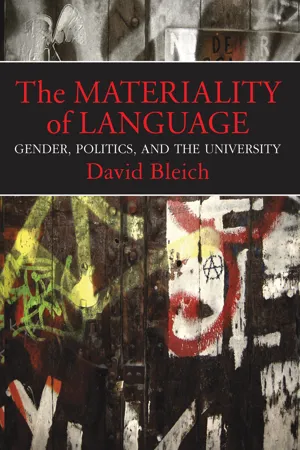
The Materiality of Language, Bleich addresses the need to end centuries of limiting access to language and its many contexts of use. To recognize language as material and treat it as such, argues Bleich, is to remove restrictions to language access due to historic patterns of academic censorship and unfair gender practices. Language is understood as a key path in the formation of all social and political relations, and becomes available for study by all speakers, who may regulate it, change it, and make it flexible like other material things.
"A potentially foundational text in an emergent field [of] language studies, whose work is to break up the monopoly Linguistics and Philosophy have had on the study of language. . . . The insight that the affective operation of language is elided in nearly all approaches to [language] acquisition is brilliant and astounding. . . . The analysis of subject creation as an affective process of recognizing and sharing the same affective state and language as the means for materializing affective states . . . is fascinating and persuasive. . . . One of the book's distinctive features is the use of gender as a key normative analytical lens throughout. It would be difficult to exaggerate how rare this is among language thinkers, and how productive it is for the arguments here." —Mary Louise Pratt, New York University
"A powerful, first-rate book on a crucial topic. It offers a great interpretation of the sacralization and ascendancy of Latin as a language supporting what Bleich calls 'an elite group of men.' . . . This is a brilliant codebook to academic language and its coercions." —Dale Bauer, University of Illinois</DESC>
literary theory;semiotics;literary criticism;philosophy;language philosophy;philosophy of language;gender studies;social science;language studies;communication studies;language arts;language disciplines;gender;sex;language;rhetoric;academic language;colloquial language;language political aspects;language sex differences;language and gender
LIT006000 LITERARY CRITICISM / Semiotics & Theory
PHI038000 PHILOSOPHY / Language
SOC032000 SOCIAL SCIENCE / Gender Studies
LAN004000 LANGUAGE ARTS & DISCIPLINES / Communication Studies
9780253016508
Well-Tempered Woodwinds: Friedrich von Huene and the Making of Early Music in a New World
Geoffrey Burgess
- 574 pages
- English
- ePUB (mobile friendly)
- Available on iOS & Android
eBook - ePub
About this book
Trusted by 375,005 students
Access to over 1.5 million titles for a fair monthly price.
Study more efficiently using our study tools.
Information
THE MATERIALITY OF LANGUAGE
CHAPTER ONE
Premises and Backgrounds
I. The Materiality of Language and the Sacralization of Texts
The premise that people exchange language and not meaning governs this study. The materiality of language1 is a description that follows from this premise.
Uses of language, oral or written, mark the growth and cultivation of language in any society. Different art forms, sciences, and professional interests have distinctive genres of discourse and dialects, which are collective practices—rather than concepts—that are eligible for public assimilation, for testing, and for appropriation toward social adaptation.
Genres in different subject matters are gestures of language use. “Gestures” includes reference to the bodily action of speech and writing. This reference contrasts with the common use of the term “language,” which usually implies that thought or ideas are prior, more fundamental, and more essential than words. The Platonic tradition, which the common use of the term “language” reflects, is sometimes identified as “realism.” According to this tradition, words are transient and mortal. Ideas (meanings), however, are the essence of language and are eternal; they are passed through generations and survive individual human mortality. Emerging from this tradition is the almost universal assumption that language is not bodily because its essence is “meaning”—ideas and thought, which reside in and emerge from an incorporeal zone of existence.
To stipulate the materiality of language is to move away from the Platonic tradition. In classical and medieval times, nominalists questioned the Platonic premise and opposed the tradition that was derived from it.2 They did not attribute to language use its function as a conduit of intangible meaning. They treated the uses of language as self-evident within their immediate contexts and experiences. Seeing language in this way enabled them to use “faith” as a belief in something not in evidence. Yet Church authorities who had custody of language uses and of their study opposed nominalism and maintained, instead, that there was indeed evidence for religious beliefs. If one held a language philosophy that accepted that there was no evidence for faith either within language or outside of it, religious authorities and institutions would be discredited and endangered. Nominalism held that language does not give evidence of anything beyond its living functions, nor does it predict future events.
My extended consideration of the materiality of language is founded on a tradition of language philosophy that had been on the record for (at least) two millennia but has remained a minority perspective. However, the twentieth century’s proliferation of popular literacy and greatly increased access to education has brought about a new collective recognition of the materiality of language. This development is due in part to the reduction of religious authority, to the increased respect for secularism, and to the rapid spread of technology and other material benefits such as medicines. In the twentieth century, materiality was urged and suggested by changes in society that brought tangible benefits to millions of people.
From one standpoint, the recognition by several thinkers of the materiality of language could be seen as part of a growing respect for and dependence on material things more generally. The increasing number of educated people willing to challenge the acceptance of transcendental spirituality and God led inevitably to the recognition that language itself—long held to be special, unique to humans, and immaterial—to be, in the final analysis, material like everything else. This view is plausible enough for me to take seriously, but it is not the principal focus of this book. Rather, this study does not seek any explanation of why, in a brief period during the twentieth century, fewer than a dozen figures paying attention to language and how it is conceived arrived at similar understandings of how it worked and how we might continue to view it. I try only to show that these figures are, finally, similar to one another in basic ways, and although they share no one common feature, their similarity may be described as an understanding that language is more usefully treated as a material entity than as an incorporeal, ineffable, intangible, or spiritual phenomenon. I try to show how the work of this group of thinkers shares the sense of the revolutionary role language would take on if consciously received, taught, used, and understood as a material entity.
I hope to show that because these figures came to similar conclusions at more or less the same point in history, those of us who value learning and teaching should pay attention to them—on the grounds that our searches for knowledge and understanding depend on how language is used, who is using it, and what circumstances of its authority are being established. No one locus of language use is more or less important than any other because there is no subject matter that does not finally depend on the use of language. The use of language is fundamental throughout the individual life cycle, and throughout history.
I describe the language practice that follows from the use of Platonic realism as the sacralization of texts. During times when only a minuscule fraction of the total population was literate, those who could write had the most access to language. Almost automatically, those who could produce texts were in position to proclaim the authority of these texts, as well as their value, to the total population. All cultures have received an array of sacred texts; today we view them as the oldest and most venerated in our possession, and as having the greatest value to our societies. We continue to refer to various bibles as sacred texts, which means that religious institutions have more authority to read, interpret, and use them than those who are not part of such institutions, or who are not religious themselves.
Emerging from this practical religious tradition has been the view that an author of a text has a special claim on our attention by virtue of having created that text. Texts created by authors carry a heightened status resembling that of sacred texts. Until recently the creation and production of texts has remained restricted to the most privileged members of society. During the medieval period, authoritative texts were considered valid only if they were written in the one official language, Latin. Those who knew Latin were church members or were trained in universities that were sponsored by the Church. The combination of literacy and the supremacy of the Latin language in the creation of texts lent any text written in Latin a near-sacred, if not altogether sacred, status. Furthermore, the long history of authoritative Latin writing helped to make it seem that anything written was sacred and that anything carrying a Latin name had greater value than something with a vernacular name. Gradually these perceptions took root, leading to the point where any text, even in modern times, could be sacralized.3
In practice, sacralization involves viewing a text as fixed, not changeable by those who have access to it. Alteration of sacred texts may be read as sacrilegious, but alteration of any text is understood to be irresponsible and disrespectful. For most received texts, great pains are taken to ascertain the so-called original authenticity of the text and to establish an authoritative version. There is scholarly discomfort when there are different versions of what is ostensibly the same text. There is a silent standard that there must be a final text given by an author, and that incomplete texts are less than satisfactory. In schools students are cautioned to “stick to the text”—that is, to read it in its presumably one and only authoritative form in order to find out its truest possible meaning. In the mid-twentieth century, the highly regarded essay “Heresy of Paraphrase” implied, perhaps in good humor, that paraphrasing a literary text was cause for alarm.4
Scientific texts are sacralized somewhat differently than humanistic ones. They formulate so-called laws of nature, and the figures who set down these laws are considered to have given an authoritative formulation that all texts must reproduce. Any reading of a sacralized text must begin with that text, and rephrasing of its language counts only as an interpretation of its language—an attempt at finding its meaning, and not as an improvement or an experiment or a revision for present purposes. Although oral texts, typically conceived of as folklore, have been subject to such socially and politically governed changes, once a text has been written, it is automatically sacralized.5 In Western culture, there has been a taboo regarding playing with texts, paraphrasing them, or changing them without reference to a fixed original.
The materiality of language is a ground for desacralizing texts. There is no reason automatically to consider written texts to be more permanent or more authoritative than oral texts. There are often occasions to declare the permanence of texts, but if such declarations are admissible, then other declarations revoking earlier declarations are equally admissible. The framers of the U.S. Constitution stated that the Constitution could be changed. But for changes to be enacted, 75 percent of the states had to approve the changes. This rule, however, has not been subject to change, so that the political decision to limit the ability to change the Constitution, made over two centuries ago, has remained in effect and can be viewed as having sacralized the Constitution. If political sentiments change, then that text may be desacralized subject to further social and political variation. Any desacralization is a political language gesture that is inhibited by the premise of the permanence of language, but is encouraged by the assumption of the materiality of language.
The nub of the matter is that official and authoritative texts and language remain sacralized by their dependence on established or hegemonic official mediators. While language changes and grows through an increasingly prominent popular culture as well as through a variety of widely read literary works, there are very few zones in which the materiality of language has any effect. For example, in legal contexts, the concept of “intent” remains viable: intent to kill. Assuming the materiality of language viewing such a case rules out consideration of intent. The crime is described differently if there is no need to specify what the intent was. In sting and entrapment cases, no crime was committed, but legal argument may claim that there was intent. Even in cases in which one person murdered another, one can describe what happened without saying what a person’s intent was. But if the law says that intent is part of the crime, juries are likely to be forced to stipulate an intent, something they are not likely to know with certainty. With different descriptions of crimes, the practices of punishment have a different value and a different function.
In science as well, it is hardly possible to contest sacralized phrases such as “the struggle for existence,” a carrier of commonly held values that envisions all forms of life in a competition—the outcome of which is the equally sacralized “survival of the fittest.” It is assumed that these terms, like “intent,” refer to something that exists. But they are abstractions that refer to indefinite, inferred entities that appear to us differently each time they are identified.6 More often sacralized abstractions are assumed to be causes of important patterns, as it is sometimes thought that an “aggression instinct” is the cause of male violence or war—or that a “maternal instinct” renders those women who decide not to become mothers as maladaptive or otherwise deficient, unable to meet an imaginary phylogenetic standard.
While important texts and familiar phrases are not to be censored, people to whom they matter are in a position to desacralize them, to change their usage and collective function, to make incremental changes of usage by virtue of their materiality. Under these circumstances, changes are tested by the contexts of use, by the political interests of readers and users of language. Whatever the field or zone of inquiry, the language is material in the sense that new uses always retest the received usage, and consensus and mutual comprehension are in position to fix usage—with the understanding that any such fixing is contingent and provisional, and not necessarily denoting the same thing all the time.
Therefore, if, within the study of language-dependent subject matters, there is a tradition of misunderstanding the roles and actions of language in society, it is important to consider the extent of this misunderstanding. The practical result of the present reconsideration is, on the one hand, to lengthen and strengthen the reach of the study of language, and, on the other hand, to extend this study to other semiotic genres—to find, perhaps in a more general way, what claims the use of language has on the way...
Table of contents
- Cover
- Half title
- Title
- Copyright
- Brief Contents
- Detailed Contents
- Acknowledgments
- Introduction: The Contested Subject
- Part One: The Materiality of Language
- Part Two: Language in the University
- Bibliography
- Index
Frequently asked questions
Yes, you can cancel anytime from the Subscription tab in your account settings on the Perlego website. Your subscription will stay active until the end of your current billing period. Learn how to cancel your subscription
No, books cannot be downloaded as external files, such as PDFs, for use outside of Perlego. However, you can download books within the Perlego app for offline reading on mobile or tablet. Learn how to download books offline
Perlego offers two plans: Essential and Complete
- Essential is ideal for learners and professionals who enjoy exploring a wide range of subjects. Access the Essential Library with 800,000+ trusted titles and best-sellers across business, personal growth, and the humanities. Includes unlimited reading time and Standard Read Aloud voice.
- Complete: Perfect for advanced learners and researchers needing full, unrestricted access. Unlock 1.5M+ books across hundreds of subjects, including academic and specialized titles. The Complete Plan also includes advanced features like Premium Read Aloud and Research Assistant.
We are an online textbook subscription service, where you can get access to an entire online library for less than the price of a single book per month. With over 1.5 million books across 990+ topics, we’ve got you covered! Learn about our mission
Look out for the read-aloud symbol on your next book to see if you can listen to it. The read-aloud tool reads text aloud for you, highlighting the text as it is being read. You can pause it, speed it up and slow it down. Learn more about Read Aloud
Yes! You can use the Perlego app on both iOS and Android devices to read anytime, anywhere — even offline. Perfect for commutes or when you’re on the go.
Please note we cannot support devices running on iOS 13 and Android 7 or earlier. Learn more about using the app
Please note we cannot support devices running on iOS 13 and Android 7 or earlier. Learn more about using the app
Yes, you can access The Materiality of Language by David Bleich in PDF and/or ePUB format, as well as other popular books in Literature & Communication Studies. We have over 1.5 million books available in our catalogue for you to explore.