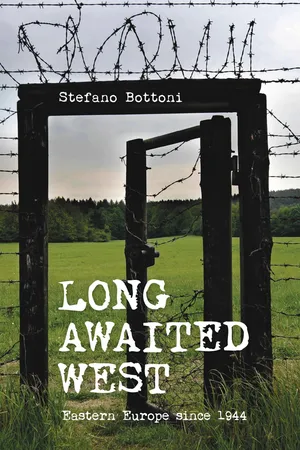
What is Eastern Europe and why is it so culturally and politically separate from the rest of Europe? In Long Awaited West, Stefano Bottoni considers what binds these countries together in an increasingly globalized world. Focusing on economic and social policies, Bottoni explores how Eastern Europe developed and, more importantly, why it remains so distant from the rest of the continent. He argues that this distance arises in part from psychological divides which have only deepened since the global economic crisis of 2008, and provides new insight into Eastern Europe's significance as it finds itself located - both politically and geographically - between a distracted European Union and Russia's increased aggressions.
- 352 pages
- English
- ePUB (mobile friendly)
- Available on iOS & Android
eBook - ePub
About this book
Trusted by 375,005 students
Access to over 1.5 million titles for a fair monthly price.
Study more efficiently using our study tools.
Information
Chapter 1
On Soviet Turf (1944–1948)
Eastern Europe in the Shadow of Genocidal War
The maid came in and began clearing the table, wearing white gloves, as she did when serving, because this was also one of the rules of the house. I went to my room and sat down at the old desk. Before the windows, the city was silent in the spring night. Only occasionally did a tank rumble on its way to Castle Hill, carrying members of the Gestapo to occupy the offices. I listened to the clattering tanks and smoked cigarettes. The room was pleasantly lukewarm. I looked absent-mindedly at the books lining the walls, the six thousand volumes I had gathered together in various places in the world. Here was that Marcus Aurelius I bought from a second-hand dealer on the banks of the Seine, Eckermann’s Conversations, and an old Hungarian edition of the Bible. And six thousand more books. From a wall my father, grandfather, and deceased relatives looked down at me.
—Sándor Márai, Memoir of Hungary, 1944–1948
The recent history of Eastern Europe is inseparable from the human, material, and moral devastation of the Second World War. The offensive launched by Nazi Germany and its allies against the Soviet Union in the summer of 1941 transformed the military conflict that began in 1939 into a total, genocidal war. The opening of the Eastern Front provided the idea of “New Europe,” which had long played a role in National Socialist public discourse, with a decisive push toward practical application. Over the following three and a half years, the effort to implement this concept led to the methodical genocide of Jews and Roma, as well as serial crimes committed against Poles, Ukrainians, and Russians.1 Ghettos were established in Germany in 1940 following the implementation of anti-Semitic policies throughout Eastern Europe that had been codified in the 1935 Nuremberg Laws; the establishment of mobile “deployment groups” (Einsatzgruppen) in 1941 represented the beginning of the next phase. These units followed Axis troops advancing along the Soviet front in order to carry out their nominal duty of cleansing occupied territory of presumed communist elements, which in practice turned out to be primarily Jews. These Einsatzgruppen, which included local auxiliary units, committed acts of genocide that in fewer than three years resulted in the deaths of 2 million people, primarily Jews in the Ukraine and the Baltic, who had inhabited the shtetl located in the former Pale of Settlement established in czarist Russia.2
Among the German allies, the Romanian occupational forces also cooperated in the massacres that occurred in Bessarabia, Bukovina, and the city of Odessa during the invasion of the Soviet Union. Romania contributed to the atrocities committed on the Eastern Front with death brigades of its own. The government of Romania, led by Marshal Ion Antonescu, independently planned and carried out the deportation and execution of 280,000 Jews from occupied territories beyond the Dniester River, as well as 10,000 Roma from Bessarabia and northern Bukovina.3 The diplomatic and armed struggle between Hungary and Romania for control of Transylvania provides a clear illustration of the ground that the concept of national exclusivity had gained in Europe at this time. Holly Case demonstrates that the collapse of the Versailles system and the outbreak of the Second World War placed Romania, the previous defender of the territorial status quo, and Hungary, one of the primary losers in the post–First World War peace agreements, in a new situation. Before the Second Vienna Award both countries endeavored to win the favor of the expanding Germany that had proclaimed the “new European order”; then after the pact they fought alongside the Germans on the Soviet front while making continual preparations to attack each other. The two allied countries joined the war not primarily to fight against the Soviet Union or Bolshevism but as a means of acquiring territory, above all Transylvania.4
The attempt to establish the New Europe assumed an extremely brutal character in large areas of the Soviet Union. The genocidal nature of the German invasion was reflected in the treatment of Soviet prisoners of war, above all in Ukraine, Belarus, and the Volga region. The mortality rate among prisoners held in concentration and internment camps was very high in the winter of 1942, and only 1.1 million of the nearly 4 million soldiers held captive in these camps survived. Famine and the brutality of the invading forces decimated the civilian population of major occupied cities.
Several authors have emphasized that by 1944 the cruelty of the Axis occupation of the Soviet Union had generated nearly universal hostility toward the local German administration, even among those such as the supporters of the Stepan Bandera–led militant wing of the Organization of Ukrainian Nationalists, which in 1941 had greeted Wehrmacht forces as liberators and launched the recruitment of an anti-Bolshevik national army that failed precisely because of initial opposition from the German military leadership. The Germans subsequently approved the Ukrainian request to form armed military units, though only in 1943. The resulting Kraków-based Ukrainian National Committee fought under German command as part of the 14th Galician SS-Volunteer Division in Ukraine, in anti-partisan operations in the Balkan Peninsula as well as in Slovakia at the time of the August 1944 Slovak National Uprising. Before the collapse of the Third Reich, this force grew to include more than 70,000 active personnel and was transformed into the First Division of the Ukrainian National Army.5
In the Baltics, the local civilian population largely supported collaboration with German authorities. This was not only because of the historically significant German presence in the region, but also due to the anti-Soviet attitudes that had permeated throughout nearly the entire population of Estonia, Latvia, and Lithuania following the Soviet occupation of 1940. The Germans incorporated these countries and part of Poland and Belarus into the Riga-based Reichskommissariat Ostland in 1941. The German occupation therefore provided the Baltic states with some degree, albeit largely formal, of autonomy. Moreover, the Germans partially reprivatized the economies of the Baltic region, but subordinated them to the war effort and permitted local farmers only to rent land that had been expropriated at the time of the Soviet occupation. Around 250,000 Jews were murdered in the Baltic states during the Second World War. Estonian and Latvian SS regiments committed the majority of these killings. The population of Lithuania, which also possessed a large Jewish community, regarded the occupational forces with a hostility that frequently evolved into active resistance.
German oppression appeared in its most violent form in Poland. In addition to the fact that the extermination of Jews assumed its most horrifying forms and dimensions in the annexed territories of Poland, the war that the Third Reich launched against the country’s entire population made no distinctions with regard to nationality or political affiliation. Hitler did not merely want to defeat Poland—he wanted to obliterate it. Because Poland was the home of the largest Jewish community in Europe, the German-occupied country was doomed to serve as the final destination of deportations and the primary site of the physical destruction of European Jewry. The residents of Jewish ghettos in major cities in Poland were deported to the country’s largest camp, Auschwitz-Birkenau (those from the Lwów/Lemberg Ghetto in March 1942, those from Warsaw Ghetto between July and September 1943, and those from Łódź Ghetto in the summer of 1944). Jews from the Netherlands, the Protectorate of Bohemia and Moravia, Slovakia, Austria, Hungary, and Greece were also deported to Auschwitz-Birkenau. Nearly 450,000 Hungarian Jews were the final significant transport to the extermination camp in the spring and early summer of 1944. Several hundred thousand Poles, Russians, and other Slavs, as well as Roma, homosexuals, and political prisoners, died at Nazi death camps as well.
In the Baltic states, Poland, Belarus, Ukraine, and western Russia, the “bloodlands” that suffered appalling devastation at the hands of both Hitler and Stalin from 1933 to 1945, around 14 million noncombatants were killed over this twelve-year period. In his recent and much-discussed books on the German and Soviet rule over that region, Timothy Snyder seeks to explain the extraordinary amount of physical violence perpetrated against ordinary people.6 Snyder challenges the “Auschwitz paradox” and claims that the mass killing camps of Eastern Europe should be regarded as the epistemological center of the tragedy; instead, it was not the lethality of modern bureaucracy—as previously claimed by standard historiography of the Holocaust, but rather the removal of bureaucracy or deportation of Jews to “bureaucracy-free zones in the East” that was fatal to the East European Jewry.7 According to Snyder, many Jews avoided deportation because dependent satellites of Nazi Germany (Slovakia and Croatia), conquered states (France, Netherlands, Belgium, Denmark, Norway, Yugoslavia, and Greece), and allied states (Italy, Hungary, Bulgaria, and Romania) all retained varying degrees of sovereignty that protected Jews to some extent from unrestrained German will. However, the domestically arranged mass killings carried out in 1941–42 by the Romanian state administration in occupied Transnistria and Bessarabia, the Roma and Serb Holocaust perpetrated by Croatian authorities during the war, or the involvement at all levels of the Hungarian bureaucracy in the mass deportations of 1944 demonstrate that local agency—that is to say, the role of national or regional bureaucracies—cannot be left out from the set of explanations for the genocidal war.
As mentioned, Nazi-occupied Poland suffered the highest number of casualties compared to its overall population. Tadeusz Piotrowski estimates that 5.6 million citizens of Poland—21 percent of the country’s total population—fell victim to the cruelties and depravations of war between 1939 and 1945. Three million of those who died as a result of war and genocide during this period were Jews (just 10 percent of Poland’s Jewish community survived the war), and 2.5 million were non-Jews—2 million Poles and around 500,000 Ukrainians and Belarusians.8 One-third of the population of Poland was either killed or wounded as the front rolled over the country. The Warsaw Ghetto and its inhabitants were liquidated following the 1943 ghetto uprising, and the Germans and allied Ukrainian volunteers completely destroyed the western half of Poland’s capital city after suppressing the Polish Home Army–led Warsaw Uprising in October 1944.
The Italian historian Antonio Ferrara believes that with the eradication of Jewish communities throughout Europe, the Nazis had delivered a definitive blow to the continent’s old bourgeois world and transnational network. According to Ferrara, the obliteration of European Jewry can be defined as “one of Nazi Germany’s most revolutionary acts” for its long-standing social and cultural consequences.9
Liberation or Occupation?
The political and social organization of Europe following the Second World War depended primarily on the balance of power that emerged on the battlefield. The two-pronged Soviet offensive launched in the late summer of 1944—into Poland from the north and into the Balkans and up toward Hungary from the south—ended with the Red Army’s occupation of Prague on May 9, 1945, following the Wehrmacht’s surrender the previous day. At the end of the war in Europe, Soviet troops occupied half of the continent, including Vienna and Trieste. Yugoslav forces had captured Trieste on May 1, 1945, with the approval of Soviet and Italian communist leaders and maintained control over the city for an entire month.10
Norman Davies contends that the Soviet advance through Central Europe represented one of the “largest and most terrible military operations in modern history,” which succeeded in ending the cataclysmic war despite almost immediately subjecting Eastern Europe to Stalinist political practices and Soviet geopolitical interests.11 The end of armed conflict and the beginning of the postwar period entailed a completely different set of circumstances in Red Army–controlled Eastern Europe than in Western Europe. To understand the conditions under which a given city, region, nationality, religious community, or social group reacted to the Soviet presence, one must examine the micro-level effects of the grand narrative of 1944–45 (see map 1.1).
The arrival of the Red Army delivered millions of people from the Nazi genocide, military occupation, and radical right-wing political systems. For the Jews who survived the deportations and camps, for the Slavic nations that Hitler had forced into a state of servitude, for the armed partisans and members of political resistance organizations, and, finally, for a significant portion of the exhausted civilian populations, the appearance of the Soviet army represented true liberation, and often the sole chance for survival. After six years of war, most people simply wanted peace regardless of the political system under which it emerged.
Thus, the paradox of hundreds of thousands of people expressing enthusiasm for the Soviet Union and communist ideology in countries where the end of the Second World War did not by any means signify the end of mass violence was not the sole result of fear and opportunism. The citizens of Czechoslovakia and Bulgaria regarded the Red Army as a liberation force, especially since it quickly withdrew from those countries. For the Germans and their allies, particularly the Hungarians, the arrival of the Soviet army represented not only military defeat and the collapse of a Weltanschauung, but the beginning phase of a more or less spontaneous terror that millions of physically and psychologically devastated soldiers inflicted upon the vanquished. The number of people who suffered injury and abuse with the arrival of Soviet troops, primarily in Germany, Poland, and Hungary, is inestimable. For the several million prisoners of war and defenseless civilians—above all women who for months lived in continual fear of violation and indignity—the year 1945 brought not liberation, but tragedy.12 According to Andrea Pető, the rapes committed by the soldiers of the Red Army in several Central and Eastern European countries represent a special case of social memory. On the one hand, everybody privately knew that the Soviet soldiers were committing rapes, but this fact became part of the canonized historical knowledge very late, in most cases only after the demise of socialism. Pető maintains that the silence around the Soviet soldiers’ mass rapes was not a case of amnesia, but rather a “conspiracy of silence” obtained though the formation of a psychological pattern: keeping silent...
Table of contents
- Cover
- Title Page
- Copyright
- Dedication
- Contents
- Acknowledgments
- Introduction: Reframing the Debated Concept of Eastern Europe
- 1 On Soviet Turf (1944–1948)
- 2 Terror and Thaw (1949–1955)
- 3 Political Crises and Social Consolidation (1956–1972)
- 4 The Decline and Fall of the Soviet Bloc (1973–1991)
- 5 Return to Europe? The Postcommunist Galaxy
- 6 Eastern Europe Today: Western Periphery or Buffer Zone?
- Epilogue: Unreflective Mimicry and National Egoism
- Bibliography
- Index
Frequently asked questions
Yes, you can cancel anytime from the Subscription tab in your account settings on the Perlego website. Your subscription will stay active until the end of your current billing period. Learn how to cancel your subscription
No, books cannot be downloaded as external files, such as PDFs, for use outside of Perlego. However, you can download books within the Perlego app for offline reading on mobile or tablet. Learn how to download books offline
We are an online textbook subscription service, where you can get access to an entire online library for less than the price of a single book per month. With over 1.5 million books across 990+ topics, we’ve got you covered! Learn about our mission
Look out for the read-aloud symbol on your next book to see if you can listen to it. The read-aloud tool reads text aloud for you, highlighting the text as it is being read. You can pause it, speed it up and slow it down. Learn more about Read Aloud
Yes! You can use the Perlego app on both iOS and Android devices to read anytime, anywhere — even offline. Perfect for commutes or when you’re on the go.
Please note we cannot support devices running on iOS 13 and Android 7 or earlier. Learn more about using the app
Please note we cannot support devices running on iOS 13 and Android 7 or earlier. Learn more about using the app
Yes, you can access Long Awaited West by Stefano Bottoni, Sean Lambert in PDF and/or ePUB format, as well as other popular books in History & Eastern European History. We have over 1.5 million books available in our catalogue for you to explore.