![]()
PART ONE
A FOLK HISTORY OF SLAVERY
![]()
BACKGROUND OF THE WPA INTERVIEWS
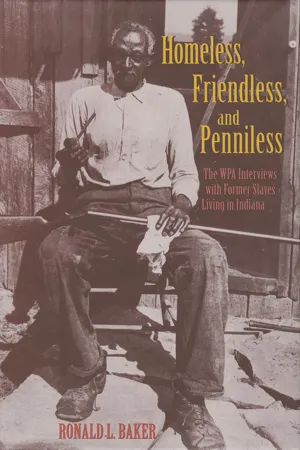
This book is based on a collection of interviews with former slaves who were living in Indiana in the late 1930s. The interviews were conducted as part of Indiana’s contribution to a federal project undertaken in seventeen states during the Great Depression. Over a three-year period, former slaves and, in some cases, descendants of former slaves shared their memories with field-workers of the Federal Writers’ Project (FWP) of the Works Progress Administration (WPA), renamed the Work Projects Administration in 1939. As a result of this early fieldwork in folklore and oral history, today we have an invaluable record of the lives and thoughts of former slaves who moved to Indiana after the Civil War and made significant contributions to the evolving patchwork of Hoosier culture. The Indiana interviews are especially notable because they were collected from freed slaves living in a state that was free during the Civil War. Most of the other former slaves interviewed for the national project still lived in the South. In fact, according to John W. Blassingame, most of the WPA informants interviewed in southern states “had spent all of their lives in the same locale as their former master’s plantation” (Blassingame 1985: 89).
The Indiana slave narratives provide a glimpse of slavery through the memories of those who experienced it; thus, they preserve insiders’ views of a deplorable chapter in American history. Though the former slaves represented in the Indiana collection lived in Indiana at the time of the interviews, they had, of course, been held in slavery in other states; therefore, the interviews reveal experiences of African Americans enslaved not in a single state but in eleven different states from the Carolinas to Louisiana, though most of them were slaves in Kentucky (see Appendix II). Just as important, the interviews reveal how former slaves fared in Indiana after the Civil War and during the Depression. Some became ministers, a few became educators, and one became a physician; but many lived in poverty and survived on Christian faith and small government pensions.
The interviews on which this book is based are located in the Cunningham Memorial Library at Indiana State University in Terre Haute, Indiana. Since the Department of Public Relations at Indiana State Teachers College, now Indiana State University, was the state sponsor of the Indiana Federal Writers’ Project, the manuscript files of the Indiana Federal Writers’ Project were deposited in the library at Indiana State, where they remain. The 36-cubic-foot collection, housed in the Department of Rare Books and Special Collections of the Cunningham Memorial Library, contains around 60,000 pages of material on, among other things, the oral history and folklore of all of Indiana’s ninety-two counties (see Carter and Vancil 1992). In addition to the interviews with former slaves living in Indiana at that time, the collection is a storehouse of traditional foodways, songs, beliefs, customs, sayings, cures, legends, jokes, and place-name anecdotes, as well as other accounts of Hoosier folklife and local history. Material related to the slave narrative project includes papers about the Underground Railroad in Indiana, a summary of slave laws in Indiana, records of indentures in Indiana, and an account of the Roberts Settlement, a black community in Hamilton County. The slave narrative project represented here was simply a small, albeit important, part of a larger project funded by the federal government during the Depression to provide jobs for unemployed white-collar workers. A major goal of the Federal Writers’ Project was the preparation and publication of a guidebook for each state; Indiana’s guide, Indiana: A Guide to the Hoosier State, was published in September 1941.
The WPA’s slave narrative collection project grew indirectly out of earlier efforts to preserve the personal-experience stories of former slaves. Even before the Civil War, slave autobiographies and epistolary slave testimonies were published, but probably the first systematic attempt to collect the dictated experiences of former slaves began around 1927. Andrew P. Watson, then a graduate student in anthropology at Fisk University, spent two years interviewing 100 older African Americans, mainly former slaves, and eventually, in 1945, the Social Sciences Institute at Fisk University published six autobiographical narratives and fifty accounts of conversion experiences in God Struck Me Dead: Religious Conversion Experiences and Autobiographies of Negro Ex-Slaves (Fisk University 1945a), later reprinted in part by Johnson (Johnson 1969) and in full by Rawick (Rawick 1972, vol. 19).
A year or two after Watson began his fieldwork, Charles S. Johnson, founder of the Social Science Institute at Fisk University, organized a community study, and in 1929 a member of his research staff, Ophelia Settle, interviewed a number of former slaves living near Fisk. Encouraged by Johnson, Settle broadened the scope of her project and began collecting the life histories of other former slaves then living in rural Tennessee and Kentucky (Yetman 1967: 540–541). In 1945, thirty-seven of her one hundred interviews were published as Unwritten History of Slavery: Autobiographical Account of Negro Ex-Slaves (Fisk University 1945b), also reprinted by Rawick (Rawick 1972, vol. 18).
Also in 1929, John B. Cade—who chaired the Extension Department of Southern University in Scotlandville, Louisiana—asked students in his U.S. history class to collect recollections of slavery from former slaveholders as well as from former slaves. During the 1929–1930 academic year, thirty-six of his students turned in eighty-two interviews as class assignments. In 1935 Cade published some of this material in “Out of the Mouths of Ex-Slaves,” an article in the Journal of Negro History. From 1935 to 1938, Cade directed a similar project at Prairie View State College, collecting more than four hundred additional unpublished interviews with former slaves (Yetman 1967: 540; Perdue, Barden, and Phillips 1980: xii).
Lawrence D. Reddick studied under Charles S. Johnson at Fisk University and interviewed former slaves as part of Johnson’s community study project (Yetman 1967: 541). Reddick later joined the faculty at Kentucky State University (then Kentucky State Industrial College) in Frankfort, and on June 14, 1934, he proposed a collection of testimonies of former slaves to Harry L. Hopkins, director of the Federal Emergency Relief Administration (Botkin 1944: 37). Since the Federal Emergency Relief Administration supported programs that put unemployed Americans to work, Reddick received federal funding to initiate the collecting project (Perdue, Barden, and Phillips 1980: xiii). Reddick first proposed a pilot study conducted by a dozen African American students who would interview former slaves in the Ohio River Valley, and then he planned a broader project that would put as many as five hundred white-collar African Americans to work interviewing surviving slaves throughout the South. Although nothing came of Reddick’s large-scale project, his pilot project resulted in nearly 250 interviews, which are apparently still unpublished, in Kentucky and Indiana from September 1934 through July 1935. What is more, Reddick was the first to get federal funding to support the collecting of interviews with former slaves (Yetman 1967: 542–543; Perdue, Barden, and Phillips 1980: xiii).
In April 1935, Congress passed the Emergency Relief Appropriations Act, which provided authority for the establishment of the Works Progress Administration, and Harry L. Hopkins, director of the Federal Emergency Relief Administration, was appointed to a similar position with the WPA. In August 1935, when the WPA announced that it would sponsor projects to employ out-of-work artists, musicians, dramatists, and writers, Hopkins created the Federal Writers’ Project, appointing Henry G. Alsberg—former newspaperman, writer, and theater director—to direct the WPA’s writing program. Among its significant accomplishments, the Federal Writers’ Project collected local folklore and oral history, including life histories of former slaves, and produced the American Guide Series (Mangione 1972: 53–56). In 1936 Alsberg had the foresight to appoint Sterling A. Brown to the Federal Writers’ Project’s Washington office as National Editor of Negro Affairs. Brown, a member of Howard University’s English Department, was a poet of some stature and a pioneer in the study of African American literature, so at the time he was the right person to oversee the development of the Writers’ Program’s projects dealing with African American culture (Yetman 1967: 546).
The first WPA testimonies of former slaves were collected in 1936 by the Georgia Writers’ Project under the direction of Carolyn P. Dillard (Perdue, Barden, and Phillips 1980: xv). Later in 1936, fieldworkers also began interviewing former slaves in South Carolina, Virginia, and Florida. Significantly, in the middle of the same year, folklorist John Lomax, already well known for his collections of American folksongs, was appointed National Advisor on Folklore and Folkways for the Federal Writers’ Project, a position he held for more than a year. Reviewing some of the Florida interviews with former slaves that had been sent to the national office, Lomax liked what he read and proposed a large-scale program directed by the national office to collect slave testimonies in other states; consequently, on April 1, 1937, instructions were sent to FWP directors in other southern and border states charging workers to begin collecting the experiences of former slaves living in their states (Yetman 1967: 549–550; Perdue, Barden, and Phillips 1980: xv–xvi). Though the Florida interviews were not the first, they persuaded Lomax, who apparently was unaware of the Georgia and Virginia interviews, to initiate a national slave narrative collecting project. As Yetman notes, “Lomax’s tenure with the Writers’ Project was relatively brief, but his impact upon its program and especially upon the formation of the Slave Narrative Collection was enduring” (Yetman 1967: 545).
On August 31, 1939, the states assumed control of the WPA, and the Federal Writers’ Program became simply the Writers’ Program. Earlier the same year, most of the interviewing of former slaves already had stopped, but from late 1936 through early 1939, seventeen states turned in around 2,300 interviews to the Washington office. Arkansas turned in the most interviews, 677, and Kansas submitted the fewest, only 3 (Perdue, Barden, and Phillips 1980: xvi).
State fieldworkers in the Slave Narrative Project followed a standard set of suggestions and questions provided by the national office, so the interviews share common textual and stylistic features. Although the fieldworkers’ questions do not appear in the edited texts, using the list as an interview guide enabled inexperienced fieldworkers to gather information on a variety of subjects. In many cases, however, following the list did not allow an informant the opportunity to “talk freely,” “to say what he pleases without reference to the questions,” as the instructions prescribed.
After the fieldworkers had interviewed their informants, their field notes usually went through several drafts to meet the guidelines of the Washington office. Sometimes the notes were rewritten to read as if they were in response to a fieldworker’s questions, and sometimes editors contributed their notions of African American dialect in their revisions. Once the interviews were reworked and typed with manual typewriters on 8½ × 11” paper, some of the them, at least, were forwarded to the national office (Baker and Baker 1996: 6, 9).
Today professional fieldworkers in folklore and oral history use portable audio and video tape recorders to preserve the words and behavior of their informants, but these electronic tools were not available to WPA fieldworkers in the 1930s. Although in some states some of the WPA interviews with former slaves were recorded on aluminum disks and then transcribed, the amateur fieldworkers in Indiana apparently took notes with pencil and paper, simply jotting down the main ideas at the time of the interview. Later, either the field-workers or their editors fleshed out the material in preparation for the federal Slave Narrative Project.
Although the WPA fieldworkers did not provide the contextual information that contemporary folklorists and oral historians prefer, what we know about the social and physical contexts of the interviews must be considered when reading the Indiana interviews with former slaves. First, although most of the texts were collected from African Americans who had experienced slavery firsthand and probably regularly told their children and grandchildren personal-experience tales, the informants were quite old in the 1930s when the tales were collected by the WPA fieldworkers, and over the years their memories had probably become selective. In addition, a good many of the informants had still been children at the end of the Civil War and had had limited experience with slave life. Adults who had spent long, hard lives in servitude before experiencing freedom probably would have told even grimmer stories of life on the plantations (Blassingame 1985: 88). Moreover, all but one (Anna Pritchett) of the eighteen fieldworkers who interviewed former slaves living in Indiana were white, which probably had some influence on the interviews. Blassingame points out, “Not only did most of the whites lack empathy with the former slaves, they often phrased their questions in ways that indicated the kinds of answers they wanted” (Blassingame 1985: 86); and Woodward observes, “The distinctiveness of interviews where the interviewer and the interviewed were of the same race is readily apparent. The whole atmosphere changes. The thick dialect diminishes and so do deference and evasiveness and tributes to planter benevolence” (Woodward 1985: 52).
Some of the informants were probably cautious about providing information because the fieldworkers were government workers, and they either did not trust or did not want to offend the WPA interviewers. White fieldworker Richard M. Dorson recalls how difficult it was for him to establish rapport with African American informants in Calvin, Michigan, in the 1950s. After several “strenuous unrewarding days in the field,” one black female resident finally confessed why they mistrusted him and had not given him any folktales: “We didn’t know what to make of you when you first came here; there had been two federal detectives around not long ago, to break up a marijuana ring, and some thought you were from the FBI” (Dorson 1967: 21–22).
On October 17, 1939, the WPA established the Writers’ Unit of the Library of Congress Project to edit and prepare the slave narrative collection for deposit in the Library of Congress. Another folklorist, Benjamin A. Botkin, who had joined the FWP as folklore editor in 1938, was appointed chief editor of the project. Organizing the interviews first by state and then alphabetically by informant within each state, Botkin had them bound in seventeen volumes and deposited in the Rare Book Room of the Library of Congress. The sixty-one Indiana typescripts are bound in Volume V, “Indiana Narratives” as “Prepared by the Federal Writers’ Project of the Works Progress Administration for the State of Indiana.” Botkin’s introduction to the collection stresses the value and limitations of the interviews with former slaves:
Set beside the work of formal historians, social scientists, and novelists, slave autobiographies, and contemporary records of abolitionists and planters, these life histories, taken down as far as possible in the narrators’ words, constitute an invaluable body of unconscious evidence or indirect source material, which scholars and writers dealing with the South, especially, social psychologists and cultural anthropologists, cannot afford to reckon without. For the first and last time, a large number of surviving slaves (many of whom have since died) have been permitted to tell their own story, in their own way. In spite of obvious limitations—bias and fallibility of both informants and interviewers, the use of leading questions, unskilled techniques, and insufficient controls and checks—this saga must remain the most authentic and colorful source of our knowledge of the lives and thoughts of thousands of slaves, of their attitudes toward one another, toward their masters, mistresses, and overseers, toward poor whites, North and South, the Civil War, Emancipation, Reconstruction, religion, education, and virtually every phase of Negro life in the South. (Reprinted in Rawick 1972: I, 171)
In 1945 Botkin introduced scholars as well as general readers to the slave narrative collection when he published a one-volume selection of edited excerpts and some complete narratives from the collection as Lay My Burden Down: A Folk History of Slavery. Botkin viewed the book “not as a collection of source material for the scholar but as a finished product for the general reader” (Botkin 1989: xxxiii). That meant using mainly edited excerpts rather than whole narratives, abandoning the original attempts at dialect writing, and focusing on narratives that reflected broad “human and imaginative aspects” as well as “on those oral, literary, and narrative folk values for which in 1928 I coined the word ‘folk-say’” (Botkin 1989: xxxiii). To give the book unity and coherence, Botkin organized the material in five sections, dealing with folklore, life histories, the slave’s world, the Civil War, and Reconstruction; so the book generally moves from antebellum slavery through the war and Reconstruction to the 1930s.
In 1970, Norman R. Yetman published another work based on the WPA slave narratives, Voices from Slavery: Selections from the Slave Narrative Collection of the Library of Congress, which consists of an introduction and around a hundred texts. Like Botkin, Yetman edited the texts. As Rawick points out,
Professor Yetman’s selections in this volume of 100 of the WPA narratives, while excellent, also have been edited. At times, in order “to improve readability and continuity,” he has rewritten sentences and deleted others; he has eliminated the different “dialect” spellings in “an attempt to achieve some uniformity”; he has eliminated “those comments ... that concerned the informant’s situation when interviewed”; and he has usually deleted all the material included in the interviews that deal with events that occurred after the Civil War. (Rawick 1972: I, xvii)
In 1972 George P. Rawick published photographic reproductions of all of the interviews in the seventeen bound volumes in the Library of Congress as the first part of The American Slave: A Composite Autobiography, accompanied by an introductory volume, From Sundown to Sunup: The Making of the Black Community As volumes 18, Unwritten History of Slavery and 19, God Struck Me Dead, he also included the slave narratives recorded in the 1920s and 1930s by fieldworkers from Fisk University. The sixty-one Indiana narratives, along with the Alabama narratives, appear in volume 6.
Subsequently, in state depositories Rawick uncovered many other WPA interviews with ex-slaves that ...