A history and analysis of how women worked for the French Army from 1914 to 1940.
How did women contribute to the French Army in the World Wars? Drawing on myriad sources, historian Andrew Orr examines the roles and value of the many French women who have been overlooked by historians—those who worked as civilians supporting the military. During the First World War, most officers expected that the end of the war would see a return to prewar conditions, so they tolerated women in supporting roles. But soon after the November 1918 armistice, the French Army fired more than half its female employees. Demobilization created unexpected administrative demands that led to the next rehiring of many women. The army's female workforce grew slowly and unevenly until 1938 when preparations for war led to another hiring wave; however, officers resisted all efforts to allow women to enlist as soldiers and alternately opposed and ignored proposals to recognize them as long-term employees. Orr's work offers a critical look at the indispensable wartime roles filled by women behind the lines.
"Orr has successfully made the leap into what we have needed for decades: a truly modern and mainstream study of the complex interplay of women and the military in modern society that also takes into account the complex interplay of race and class." —
American Historical Review
"
Women and the French Army is well researched and provides an engaging read." —
Women in French Studies
"What is especially noteworthy about Orr's book is not the gender history, however, but the military history. Orr's research provides an excellent reminder that militaries are so much more than their front-facing services. In focusing on the civilian employees of the French army, Orr is able to tease out some of the nuances of this history that would otherwise be obscured." —
French History
"This is a fascinating study of intended and unintended consequences, well researched, well-written, and a pleasure to read." —H-France Review
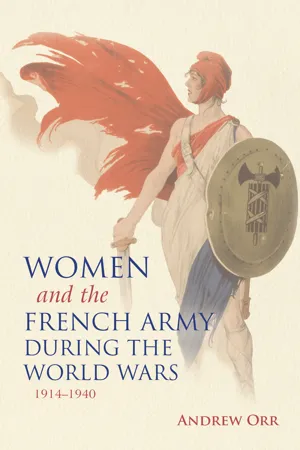
- 222 pages
- English
- ePUB (mobile friendly)
- Available on iOS & Android
eBook - ePub
Women and the French Army during the World Wars, 1914–1940
About this book
Trusted by 375,005 students
Access to over 1.5 million titles for a fair monthly price.
Study more efficiently using our study tools.
Information
1

Weapons of Total War, 1914–1918
The First World War had a profound effect on the French Army and led to changes in how officers defined military identity and whom they accepted as being part of the military community. Those changes revered a long-term process of masculinizing the military community that originated with the French Revolution and accelerated during the early Third Republic. Just as the crisis of 1914 and the advent of modern total war during World War I forced French commanders to change their combat tactics and adapt their force structure, it also led them to change the army’s relationship to women. Unlike many other belligerent powers such as Russia, the United Kingdom, and the United States, France did not recruit women as soldiers or sailors. Instead, the French Army hired women as temporary civilian employees to take over rear-area functions and free men for combat duty.
These women were not recognized as soldiers, but they performed a wide variety of vital functions, and senior military leaders devoted a considerable amount of time and resources to recruiting them and debating their futures within the army. Their arrival in the military community was unexpected, and it challenged established assumptions that self-discipline was a uniquely male trait and the cornerstone of military professionalism. Many officers objected to women’s sudden return to the military community, but senior generals and most ministers of war strongly supported hiring women to deal with the army’s critical personnel shortage during the war. This pressure from the top led to the creation of a set of hiring preferences that favored the widows and orphans of fallen soldiers, but otherwise hiring was decentralized to allow officers to respond to changes in their workload quickly. Despite significant opposition to women being part of the military community, by the end of the war there were nearly 200,000 women working inside the French Army.
THE MASCULINIZATION OF THE ARMY
The fact that women as a group were not permitted to be warriors did not mean that they played no role in France’s many wars before 1914. As John Lynn has shown, women played important roles in early modern European armies as essential members of seventeenth- and eighteenth-century mixed military-civilian “campaign communities.” When King Gustavus Adolphus of Sweden led a campaign in Germany during the Thirty Years War, he had more civilians than soldiers in his forces.1
Civilians were crucial to the period’s aggregate contract armies’ ability to feed and supply themselves. Merchants recognized a campaigning army as a lucrative market. The French Army tolerated the presence of regular merchants, but it also institutionalized specific civilians’ roles in providing soldiers with supplies. Some civilians worked for the army as sutlers, or vivandiers.2
Many of the sutlers were women (vivandières), and other women also followed the armies and worked as laundresses, seamstresses, and cooks. During the period of aggregate contract armies, the wives and children of the soldiers traveled and served with the forces. Indeed, soldiers’ sons were the French Army’s main source of voluntary recruits before the French Revolution. Although most enlisted men were single, and aristocratic officers almost never brought their wives or young children with them, French armies still contained thousands of civilians. Many wives and children added to the army’s labor pool, but they drained its supplies and slowed it down because it was effectively impossible for a commander to order his soldiers to abandon the slower-moving civilians or deny them a share of the army’s food when so many of them were from the soldiers’ families. While hampering an army’s mobility, women helped to feed the army through a combination of foraging, trading, and food preparation.3
As Thomas Cardoza has shown, in the late 1600s the French state began to officially license certain individual soldiers to be vivandiers. These soldiers continued to fulfill their normal military obligations, but had a special license to sell supplies to their comrades. In theory they were expected to run their businesses themselves, but in practice they could not fulfill their contracts without help because they also remained soldiers. Among other things, they could not leave camp or depart from the column, which meant it would have been almost impossible for them to procure new supplies while on campaign. As a result, vivandiers were always allowed to marry. Vivandiers’ wives were called vivandières and did most of the work, but the contracts technically belonged to their husbands. Because vivandières were not soldiers, they were permitted to depart from the army while it was campaigning to scavenge for extra food or to purchase alcohol and tobacco. Women’s ability to go places their husbands could not meant that they, and not their husbands who held the contacts, were the people actually providing the additional supplies the army needed and individual soldiers demanded. Some women even sold their wares, especially alcohol, to soldiers on the battlefield.4
Although vivandières were vital to the French Army’s functioning and morale, they were not initially given much control over their own destinies. Because the contracts were officially held by their husbands, if a vivandière’s husband died, whether of natural causes or in battle, she lost the right to sell her goods. In practice, most vivandières were allowed to immediately remarry another soldier to continue to act as a vivandière, but that still left them with a choice between an immediate remarriage or losing their livelihood and community. Between the late seventeenth and early twentieth centuries, vivandières were a constant presence in the French Army. They marched with the king’s armies in the cabinet wars of the eighteenth century, and became a normal and expected source of supplies.5
During the French Revolution, military and political leaders feared that women were naturally dangerous to military discipline and tried, often unsuccessfully, to minimize their military roles. This fit with the French Revolution’s gendered ideology, which recognized men alone as true citizens. The masculinization of the revolutionary state affected the vivandières, but military commanders found that they could not do without the women. Despite the new regime’s success in expanding the power of the state and the resources available to the armed forces, vivandières continued to provide vitally needed supplies, and officers recognized their important role in maintaining solders’ morale. During the revolutionary era vivandières also gained important new rights, including the legal right to hold their government contracts in their own names instead of through their husbands. The new national army depended on living off the land to allow it to move quickly, which placed a premium on foraging and local trade. Vivandières took the lead in both activities and contributed to Napoleon’s armies’ ability to move rapidly around Europe and repeatedly surprise opposing armies.6
Vivandières, who became increasingly known as cantinières over the course of the nineteenth century, continued to serve with the army after the Bourbon Restoration. Cantinières followed their units to Algeria in 1830 and stayed on with the French forces in North Africa. Starting in 1830 they were permitted to wear a modified form of the French Army’s uniform that included both a skirt and pants. Over time, uniformed cantinières became central to the public’s image of the army. Cantinières experienced their golden age during the Second Empire; much like the Zouaves, they were widely depicted in advertising and became romantic symbols of Napoleon III’s exotic foreign campaigns. They served, and sometimes died, in Napoleon III’s war in Italy and in the Franco-Prussian War that saw the end of the emperor’s reign and the fall of the Second Empire.7
Despite being the face of the Napoleon III’s army, cantinières were not officially recognized as soldiers. They worked for and lived with the army, and they were vital to its ability to operate, but legally they remained civilians. As such, their position was often vague, even to themselves. Many honestly believed that they were in the army and would be entitled to a pension when they retired. The Ministry of War’s regulations clearly stated that they were not entitled to pensions of their own, though they might be entitled to a widow’s pension through their husbands. Their confusion was not unique: most civilians seem to also have assumed that cantinières were soldiers.8
The fall of Napoleon III and his Second Empire in September 1870 marked the beginning of the end for the cantinières, though that was far from obvious at the time. Cantinières followed their units into battle, and many were trapped with Marshal Achilles Bazaine’s force in the besieged city of Metz after the French defeats at the battles of Mars-la-Tour and Gravelotte–St. Privat in August 1870. Others were captured along with Marshal Patrice MacMahon and their emperor when the rest of the Imperial Army was surrounded at Sedan in September. Although they were not legally recognized as soldiers, many cantinières shared the same experiences that soldiers did: they fought with their units, were killed or wounded by enemy fire and, in some cases, endured captivity when their units surrendered to the invading Germans. Cantinières also served units raised by the Government of National Defense. Despite their sometimes heroic service during the war, the postwar government began a forty-year process of removing women from the military community.9
The 1872 Army Organization Law established a conscription system in which a minority of men who drew bad draft numbers served five years while others served only one. This created a gross inequity that was controversial from the time it was adopted by the monarchist-dominated assembly. The division of the conscript class into long- and short-service conscripts meant that most of the men in the peacetime infantry companies would be long-service troops and a large proportion of reservists would be former short-service conscripts. This system limited the French Army’s available manpower in peacetime because up to half of all short-service conscripts were being trained at any given time. Such a shortage meant that military leaders continued to rely on civilians to staff support services. In addition, the law banned all members of the armed forces from voting.10 By excluding soldiers, who were all men and almost all of voting age, the National Assembly added them to the list of citizens deemed unable to exercise universal suffrage responsibly, a list that included minors, convicted criminals, and women.11
The Third Republic’s leaders believed women and male minors lacked the maturity, independence, and faculties of reason required to vote responsibly, and criminals had forfeited their political rights through antisocial behavior, but soldiers and sailors were different. A military man was an otherwise qualified voter, whom parliamentarians judged to be too dangerous to be allowed to exercise the basic right of his citizenship because of his profession. The Paris Commune had begun when politicized national guardsmen had revolted when the government tried to disarm them, which reinforced military and political leaders’ fears that politics could infect the military. Many political leaders also feared that officers could use their control over their men to control their votes (much as priests had used their influence to influence villagers’ votes in the 1848 parliamentary elections), and this would give the military too much control over the political system.12 The ban included career officers and noncommissioned officers, conscripts, and even recalled reservists. The Ministry of War claimed to be sensitive to the potential conflicts this provision created between civil and military power and promised to avoid scheduling reserve convocations during elections.13
At the end of the Franco-Prussian War, cantinières performed the same duties they had before the war, but in the late nineteenth century, republican politicians and reformist military leaders increasingly questioned the need to tolerate them. After wresting control of the government away from the monarchists in the late 1870s, moderate republican leaders maintained the monarchists’ prohibition on women and soldiers voting and emphasized a gendered conception of citizenship that privileged men’s alleged superiority in self-discipline and emotional control to justify excluding women from voting rights.14
The presence of many quasi-uniformed women with the army challenged anti-suffrage politicians’ claims that women lacked the capacity to exercise full citizenship. The fact that cantinières were not legally soldiers did not change the fact that they were uniformed and integrated into the army’s structure and contributed to its combat effectiveness. From the outside they looked a lot like soldiers and as such were a living challenge to the gendered construction of citizenship under the Third Republic. The expansion in the size of the army that resulted from the 1872 Amy Organization Law allowed commanders to use conscripts to displace civilian service personnel. In 1875 and 1879, new laws reduced the number of cantinières in the service by restricting new hiring so that attrition would slowly shrink their numbers. In addition, the legislation allowed men to serve as cantiniers, which created a form of competition that further reduced the number of new cantinières in the lat...
Table of contents
- Cover
- Title Page
- Copyright
- Contents
- Acknowledgments
- Introduction
- 1. Weapons of Total War, 1914–1918
- 2. The Failure of the Demobilization Purge, 1919–1923
- 3. The 1927 and 1928 Army Laws
- 4. War Clouds, 1929–1938
- 5. “She Remained at Her Post until the Very End”: Women and the Second World War
- Conclusion
- Selected Bibliography
- Index
Frequently asked questions
Yes, you can cancel anytime from the Subscription tab in your account settings on the Perlego website. Your subscription will stay active until the end of your current billing period. Learn how to cancel your subscription
No, books cannot be downloaded as external files, such as PDFs, for use outside of Perlego. However, you can download books within the Perlego app for offline reading on mobile or tablet. Learn how to download books offline
We are an online textbook subscription service, where you can get access to an entire online library for less than the price of a single book per month. With over 1.5 million books across 990+ topics, we’ve got you covered! Learn about our mission
Look out for the read-aloud symbol on your next book to see if you can listen to it. The read-aloud tool reads text aloud for you, highlighting the text as it is being read. You can pause it, speed it up and slow it down. Learn more about Read Aloud
Yes! You can use the Perlego app on both iOS and Android devices to read anytime, anywhere — even offline. Perfect for commutes or when you’re on the go.
Please note we cannot support devices running on iOS 13 and Android 7 or earlier. Learn more about using the app
Please note we cannot support devices running on iOS 13 and Android 7 or earlier. Learn more about using the app
Yes, you can access Women and the French Army during the World Wars, 1914–1940 by Andrew Orr in PDF and/or ePUB format, as well as other popular books in History & French History. We have over 1.5 million books available in our catalogue for you to explore.