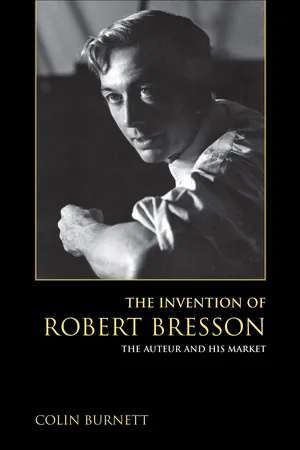
Challenging the prevailing notion among cinephiles that the auteur is an isolated genius interested primarily in individualism, Colin Burnett positions Robert Bresson as one whose life's work confronts the cultural forces that helped shape it. Regarded as one of film history's most elusive figures, Bresson (1901–1999) carried himself as an auteur long before cultural magazines, like the famed Cahiers du cinéma, advanced the term to describe such directors as Jacques Tati, Alfred Hitchcock, and Jean-Luc Godard. In this groundbreaking study, Burnett combines biography with cultural history to uncover the roots of the auteur in the alternative cultural marketplace of midcentury France.
- 288 pages
- English
- ePUB (mobile friendly)
- Available on iOS & Android
eBook - ePub
About this book
Trusted by 375,005 students
Access to over 1.5 million titles for a fair monthly price.
Study more efficiently using our study tools.
Information
Subtopic
Film & VideoPART I
ALTERNATIVE INSTITUTIONS
1 | Under the Aegis of Surrealism: |
How a Publicity Artist Became the Manager of an Independent Film Company |
He spoke to me about his film. He began by declaring that the title is Les Affaires publiques, and that it is an extraordinary film, based on a premise never before seen in France [that] will revolutionize French production.
—critic Henriette Janne1
SUCH WAS ROBERT Bresson’s ambition when he made his directorial debut, the comique fou short Les affaires publiques (1934).2 Only in his midthirties, he set out to challenge an entire industry and launch a revolution in film practice. What factors put him in a position to do so?
For decades, commentators have had very little to say about Bresson’s early art and film career. Some have even dismissed the period of the 1930s as irrelevant to his emergence as one of cinema’s most revered auteurs. This chapter reveals otherwise.
In what follows, I uncover the social and institutional factors that permitted Bresson’s entry into the world of filmmaking in the early 1930s. In ways that have yet to be fully appreciated by scholars, his first opportunities to pick up a movie camera came as a result of his ties to the Parisian avant-garde. This avant-garde, to a certain extent in decline, nevertheless remained a tight-knit group that allowed Bresson to come into contact with photographers, painters, sculptors, publicity artists, and patrons of the arts, who protected and nurtured his art, and ultimately afforded him something that is essential to any vanguard auteur: the opportunity to refine a distinctive artistic voice and thereby begin to gain a foothold in the cultural market.
This chapter and the next explore two contexts—the interwar and postwar avant-gardes—that are crucial to our reassessment of Bresson, backgrounds that make it vital to dispense with the convenient assumption that auteurs are mere individualists. Bresson did not discover his unique artistic commitments or establish himself within the cultural market through a strategy of extreme isolation and self-reliance, but through a combination of his own creativity and perseverance and intimate relationships with artistic fellow travelers, supporters, and patrons who sponsored and influenced both his art and the institutions needed to produce it. Bresson first showed an awareness of the importance of partnerships and alliances in the earliest phase of his professional life, as a publicity artist in the late 1920s and early 1930s, when he circulated in Surrealist circles. He then parlayed these experiences into a shift to filmmaking.
Many of our current misunderstandings about the sources of his cinema, dependent on the notion that he was a filmmaker apart with few connections to the cultures that directly or indirectly animated French film style, come from the fact that we have yet to appreciate this early phase, when Bresson relied upon the aesthetic, intellectual, and institutional resources provided by an interwar avant-garde that moved fluidly between media (painting, illustration, sculpture, photography, cinema, and fashion). Through an engagement with the avant-garde world around him—his work for the photography magazine L’illustration and in the publicity film business; his ties with Surrealists Max Ernst, Howard Hare “Pete” Powel, and Sir Roland Penrose; his partnership with the vanguard musician Jean Wiéner; and connections to the director René Clair—he was able to develop a personal style, launch and manage his own film production firm, Arc-Films, complete and promote a short film, and plan his first features. Bresson’s ambition to launch a revolution in French cinema of the 1930s—an ambition that sheds light on the vanguard auteur he later became—has a social history, unrecorded and unacknowledged until now.
Faint Traces of a Motley Milieu
Only faint traces survive of the milieu Bresson circulated in when he made his first known works of art in the late 1920s and early 1930s. Firsthand accounts are admittedly scarce and difficult to substantiate. Nevertheless, these traces are worth recording, for they suggest a great deal about the mobility this milieu afforded figures like him within the cultural market. If Bresson gravitated toward Surrealists, he was also not really a part of the movement. Rather, he linked up with a loose network of vanguard artists who crossed “high” and “low” media, created a conduit between vanguard forms and creative industries, and stimulated interest in filmmaking of offbeat sorts. Bresson made the most of this fluid culture, moving on its fringes and dabbling, it would appear, wherever it benefited his artistic development.
While it may defy assumptions, one of his earliest creative partnerships was with film director, writer, and producer Jean Aurenche.3 Today, in cinephilic circles, Aurenche is viewed as a pariah, a notorious scénariste best known for his collaborations with fellow Tradition de la qualité scribe Pierre Bost and with commercial directors like Claude Autant-Lara, for whom he penned Le mariage de chiffon (1942) and L’auberge rouge (1951), and René Clément, who worked with Aurenche on Jeux interdits (1952) and Gervaise (1956). In his 1954 Cahiers du cinéma polemic, “Une certaine tendance du cinéma français,” François Truffaut all but sealed Aurenche’s fate as a retrograde figure to be reviled by auteurists, symbolic of a commercial industry that saw little value in the films of visionary auteurs like Bresson.4 But in Bresson’s early professional history, an entirely different picture of Aurenche emerges. In the 1930s, he operated at the edges of a Parisian avant-garde that had been largely shut out of film production and distribution after “The Âge d’or Affair,” when Luis Buñuel’s 1930 Surrealist film (in which Aurenche played the part of a bandit) was censored, far-right groups associated with L’Action française trashed Studio 28, the Parisian theater where the film premiered, and exhibitors and financiers became reluctant to back avant-garde films as a result.5 Forming an independent production company of his own in 1931, and relying on his connections (he was brother-in-law to the Surrealist painter Max Ernst and mixed socially with Cocteau, Jacques Prévert, and Jean Anouilh, not to mention two of Bresson’s friends and future artistic collaborators, composer Jean Wiéner and painter Pierre Charbonnier), Aurenche sought on some level to revive the cinematic avant-garde in Paris and created new opportunities for young artists like Bresson.
Aurenche attributed many of the ties that he and other young artists had to the avant-garde to Cocteau, who provided them with opportunities to rub shoulders with their more celebrated peers, with painters, fashion designers, filmmakers, and musicians, throughout the 1920s. An eccentric and beloved filmmaker, poet, and playwright, Cocteau became a mentor to this generation, exposing them to the works of Apollinaire, Braque, Picasso, and the ceramic artist Josep Llorens Artigas, who also appeared in L’âge d’or. Of Cocteau, Aurenche wrote: “To educate us, he had us attend rehearsals of his plays. He introduced me to Picasso, and took me to visit him in his studio. There, I met musicians—[Georges] Auric and [Francis] Poulenc, who later composed scores for some of my films.”6 Cocteau had connections high in French society and the art world: “He introduced me to important people who liked to mingle with artists…. Chanel was a close friend, to whom he gave advice…. he created the artistic and intellectual climate that she needed. The truth is that Cocteau was a popularizer of genius. He introduced a small group of very rich and influential people … to painters, writers, musicians and filmmakers who, without him, would never have met.”7
This context also shaped a generation’s taste in film. Aurenche recalls that Cocteau “initiated me into the cinema. He brought a group of us to see movies, mainly American films, comedies, westerns. He also liked Russian films a great deal, the Eisensteins and the Pudovkins. I saw Expressionist films like The Cabinet of Doctor Caligari, The Testament of Doctor Mabuse, and Nosferatu.” Though a prominent member of the French avant-garde, Cocteau found the “Impressionists” of the 1920s lacking: “He was unimpressed by Gance or the avant-garde. It was his opinion that, literarily speaking, Gance was little more than a serial novelist. Of L’Herbier, the less said the better. ‘He picked up Oscar Wilde’s pen without noticing that it was broken,’ Cocteau said to me.”8
The time Aurenche and other up-and-comers spent in Cocteau’s company in the 1920s was effectively a crash course in art, literature, cinema, and making connections with patrons. One of the effects Cocteau had on the group was to inspire them with a passion for popular cinema, especially comedies. “In those days my ambition was to be a gagman for Keaton!” Aurenche confesses.9
This was a world Bresson surely knew on some level, although it is difficult to draw any definitive conclusions about his connections to the group. Perhaps Bresson’s friendship with Cocteau, whose role as dialoguiste on Les dames du bois de Boulogne (1945) allowed the film to be made, reaches back to the 1920s. Additional facts suggest the tantalizing possibility of a Cocteau influence on the young Bresson: Bresson’s personal taste for Keaton (whose “mathematical precision” and “elegance” he admired),10 and his liking for other 1920s and early 1930s popular and comic fare, including Chaplin’s Gold Rush (1925) and City Lights (1931) and for Eisenstein’s Battleship Potemkin (1925).11 A Cocteau link could also shed light on three aspects of Bresson’s social and professional life in the 1930s—namely, his employment by Coco Chanel in the early 1930s; his collaboration with Jean Wiéner, who was a colleague of Poulenc and Auric, members of the Groupe des Six (or “les Six”);12 and his early interest, shared with Aurenche, in making comedies. Unfortunately, the threads linking these figures and ideas are rather thin.
Aurenche’s recollections of the period have more direct relevance to Bresson in providing traces of his relationship with Max Ernst, the prominent Surrealist, and Coco Chanel, the icon of French fashion and design. Aurenche also had strong ties to the avant-garde through his sister Marie-Berthe. In 1927, Max Ernst—described by Aurenche as a “Surrealist, atheist, revolutionary and provocateur”13—married Aurenche’s seventeen-year-old sibling. She soon befriended the father of Surrealism André Breton, the poet and screenwriter Jacques Prévert, and Cocteau himself, who recommended her as a model to Chanel. Ernst remained with Marie-Berthe until 1936–1937 when he began to court the British painter Leonora Carrington. His marriage to Marie-Berthe came to a de facto end in 1936 during a public confrontation14 while Ernst was in London for the Surrealist International Exhibition organized by the British Surrealist poet and painter Roland Penrose.15 Bresson, explains Aurenche, had close ties with this group:
What few people know today is that Bresson began his professional life as a photographer. But not as a reporter of the Paris-Match variety, a kind of thuggish scrapper, oh no! Coco Chanel, to whom he was more or less related, built a whole studio for him and made him the photographer of her collections. She did all of this without taking into consideration that Bresson was born a perfectionist. Alteration after alteration, reprint after reprint followed, months passed and Chanel, who was amused (and who, between us, had long since hired an experienced ...
Table of contents
- Cover
- Title Page
- Copyright
- Dedication
- Contents
- Acknowledgments
- Introduction
- Part I. Alternative Institutions
- Part II. Vanguard Forms
- Afterword
- Selected Bibliography
- Index
Frequently asked questions
Yes, you can cancel anytime from the Subscription tab in your account settings on the Perlego website. Your subscription will stay active until the end of your current billing period. Learn how to cancel your subscription
No, books cannot be downloaded as external files, such as PDFs, for use outside of Perlego. However, you can download books within the Perlego app for offline reading on mobile or tablet. Learn how to download books offline
Perlego offers two plans: Essential and Complete
- Essential is ideal for learners and professionals who enjoy exploring a wide range of subjects. Access the Essential Library with 800,000+ trusted titles and best-sellers across business, personal growth, and the humanities. Includes unlimited reading time and Standard Read Aloud voice.
- Complete: Perfect for advanced learners and researchers needing full, unrestricted access. Unlock 1.5M+ books across hundreds of subjects, including academic and specialized titles. The Complete Plan also includes advanced features like Premium Read Aloud and Research Assistant.
We are an online textbook subscription service, where you can get access to an entire online library for less than the price of a single book per month. With over 1.5 million books across 990+ topics, we’ve got you covered! Learn about our mission
Look out for the read-aloud symbol on your next book to see if you can listen to it. The read-aloud tool reads text aloud for you, highlighting the text as it is being read. You can pause it, speed it up and slow it down. Learn more about Read Aloud
Yes! You can use the Perlego app on both iOS and Android devices to read anytime, anywhere — even offline. Perfect for commutes or when you’re on the go.
Please note we cannot support devices running on iOS 13 and Android 7 or earlier. Learn more about using the app
Please note we cannot support devices running on iOS 13 and Android 7 or earlier. Learn more about using the app
Yes, you can access The Invention of Robert Bresson by Colin Burnett in PDF and/or ePUB format, as well as other popular books in Media & Performing Arts & Film & Video. We have over 1.5 million books available in our catalogue for you to explore.