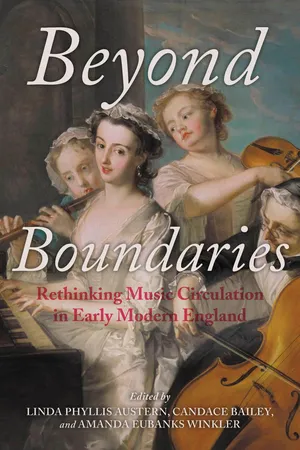
English music studies often apply rigid classifications to musical materials, their uses, their consumers, and performers. The contributors to this volume argue that some performers and manuscripts from the early modern era defy conventional categorization as "amateur" or "professional," "native" or "foreign." These leading scholars explore the circulation of music and performers in early modern England, reconsidering previously held ideas about the boundaries between locations of musical performance and practice.
eBook - ePub
Beyond Boundaries
Rethinking Music Circulation in Early Modern England
- 334 pages
- English
- ePUB (mobile friendly)
- Available on iOS & Android
eBook - ePub
Beyond Boundaries
Rethinking Music Circulation in Early Modern England
About this book
Trusted by 375,005 students
Access to over 1.5 million titles for a fair monthly price.
Study more efficiently using our study tools.
Information
Subtopic
Music1.
Tudor Musical Theater: Sounds of Religious Change in Ralph Roister Doister
When she acceded to the throne in July 1553, the Catholic Mary Tudor hoped to reverse the damage her reformist brother Edward VI had done to church music in his preceding six-year reign.1 Contemporary records indicate that upon the reading of the proclamation that Mary was Queen,
suddenly a great number of bells was heard ringing. . . . And shortly after the proclamation, various Lords of the Council went to St. Paul’s . . . and had there sung the “Te Deum laudamus,” playing organs and thanking the Almighty, which displays were not customary with them and had altogether been put aside of late.2
There are multiple accounts of nationwide singing, bell ringing, and organ playing to celebrate the proclamation and procession of Mary I, and a “Vox Patris Caelestis” for six voices was composed for her October coronation.3 In 1553, such music had not been heard publicly in England for several years, as Edward VI’s administration had drastically changed the sounds of English religious experience in official churches. In the early months of her reign, Mary was still deciding what form England’s newly revived Catholicism would take, and in particular the sound of its musical rituals.
In the months after Mary’s coronation, Nicholas Udall presented at least two plays for her at court: Respublica, a political morality play, and Ralph Roister Doister, an English play in the style of Roman comedies.4 Ralph Roister Doister, performed by boys from a London choir school, represents and parodies the kinds of religious music that were being debated at the time, while appealing variously to a range of confessional dispositions.5 I argue that the music of Roister Doister petitions the new queen to adapt a hybridized musical liturgy, combining elements of Roman Catholic ritual and Edward’s evangelical reforms.6 Such a petition was only possible in the early months of Mary’s rule, and only a playwright as canny and adaptable as Udall could have suggested such a musical-religious compromise in this historical moment.
In December 1553, a few months after her coronation, Mary issued a proclamation that forbade the playing of “interludes . . . ballads, rhymes, and other false treatises in the English tongue concerning doctrine in matters now in question and controversy touching the high points and mysteries of Christian religion.”7 Udall—a favorite playwright of Mary’s—thus needed to avoid overt reference to “mysteries of Christian religion” and the surrounding “controversy.”8 Roister Doister uses music to create a multivalent play that presents itself as entertainment while obliquely commenting on the “matters now in question.” The musical play’s interpretive complexity comes from a number of factors: that it was performed by choirboy actors during the period of the most complex and dynamic religious changes of the sixteenth century; that music was central to this religious dynamism; and that early Tudor dramas took on charged political and religious meanings because of the varying sacred, secular, and pedagogical spaces in which they were performed.
Udall’s extant writings sketch out some of the complexities of navigating rapid religious changes while keeping favor with royal patrons, religious powers, and academic administrations. When Mary became queen, the most zealous reformers were forced into exile to save their heads and stay faithful to their beliefs.9 Udall, however, adapted to the new religious, dramatic, and musical contexts of Marian England.10 In the 1530s and 1540s, he had been a reformist playwright and educator: his plays were performed for Henry VIII’s evangelical adviser Thomas Cromwell. In 1541, Udall had been fired from his post at Eton on charges of “buggery” (sodomy) with an older male student. However, his disgrace was surprisingly short lived; soon afterward, he had a steady stream of commissions by the likes of Catherine Parr (Henry VIII’s final wife, a reformer) and then-princess Mary Tudor to write and translate, and he was given a lucrative rectorship in Calborne under Edward. He translated humanist texts written by the moderate Catholic Erasmus and by the zealous Italian reformer Peter Martyr Vermigli; and he was patronized and employed by the Henrican reformer Thomas Cromwell and Edward VI in addition to Parr and Mary.11 Spanning four Tudor reigns, Udall’s work and life transcended categories of sacred and secular, Catholic and reformist.12 Critics have therefore viewed him as a timeserver or a moderate, but his slippery religious identity is consistent with early Tudor religious politics, and demonstrates the way Tudor subjects often elided categories of religious confession.13
The audience for Udall’s plays was similarly complex. Several historians warn against thinking of members of Mary’s court, and of England as a whole, in terms of categorical Catholics who supported the Queen and reformers who opposed her.14 In the early years of Mary’s reign, the continued presence of reformist members of Edward’s government in her court meant that the audience for Udall’s plays was doctrinally diverse. Ahistorical categories like “Catholic” and “Protestant” are inadequate to describe the audience members of Mary’s court, and they are also inadequate descriptors of sixteenth-century religious music.
The same music was often used interchangeably in traditional and reformist services.15 Since Henry’s dissolution of the monasteries and many choir schools, traditional Catholic musical liturgy had been in decline. Edward’s 1552 Book of Common Prayer and a series of injunctions banned organs and reduced parish church music to unaccompanied psalms sung by the congregation in English.16 While Mary was eager to return to the Latin musical polyphony of the pre-Reformation church, official change to doctrine came more slowly. Nicholas Temperley explains that “there was a period of more than eighteen months at the beginning of Mary’s reign in which it was possible to conduct worship according to the [Edwardian] 1552 prayer book, and even to hope for some compromise in the future.”17 One cannot assume that the religious music this queen heard early, or at any point, in her reign was strictly “Catholic.” The fact that a play like Roister Doister includes sacred music within a context of courtly and pedagogical entertainments, and that the play includes popular music alongside parodies of religious music, makes categories like “sacred” and “secular” insufficient to describe this music.
Although these religious and musical historical contexts complicate the interpretive possibilities of Roister Doister’s music, its particular performance context for Mary—in the space of the court and with choirboy performers—defies tidy categories. As Greg Walker explains, we cannot speak of “theater history” in discussing these Tudor plays, which were “precisely not theatrical, in the sense of taking place in a building designed for drama.”18 Early Tudor choirboy actors performed in their schools and at court, as well as in cathedrals, churches, and chapels; the playwrights’ careers as educators, courtiers, scholars, and priests overlapped in these spaces.19 Such drama, therefore, “lived in the spaces in which the real events which they allegorized also took place, and it drew rhetorical and symbolic strength from that fact.”20 The choirboy performers, in moving from school to ecclesiastic spaces, demonstrate the problems of categorizing drama and musical performance according to performance space. And as young performers who were still in training, the choirboy performers of Roister Doister and similar plays also defy neat categories of recreational or occupational.
It is for this multivalent performance context and climate of religious and political uncertainty that the once-avowedly reformist Udall wrote Roister Doister for the boys of a local choir school.21 These performers inhabited the domains of religion, music, drama, and education, thus helping to expose how the controversies regarding each subject are related and mutually constitutive. And performance in a household, even when that household was the court, blurs the distinction between private and public. These performers of Roister Doister were given audience by the most powerful decision makers in the land.22 And that audience heard them sing the very kinds of music that were the source of much contention.
Music is sung or discussed at length in nine scenes in Roister Doister; it is integral to the play’s structure, its plot, and the characterizations of everyone from Ralph (as a “roister” he is a loud braggart) to the servants. The (mock) hero Ralph spends the play unsuccessfully trying to woo the widow Christian Custance, often by means of music. Custance finds Ralph despicable and is also engaged to one Gawayn Goodluck. Ralph is described by his servant Dobinet Doughtie as one who keeps everyone awake with his musical practice, who plays several instruments as well as composes, and who coerces his servants into joining him in song. For Ralph, music is an emotional experience, tied to several failed attempts at courtship:
With every woman is he in some loves pang,
Then up to our lute at midnight, twangledome twang . . .
Of Songs and Balades also he is a maker,
And that can he as finely doe as Jacke Raker . . .
Then when aunswere is made that it may not bee,
O death why commest thou not? By and by (saith he) (2.1.19–20, 27–28, 35–36)...
Table of contents
- Cover
- Half title
- Title
- Copyright
- Dedication
- Contents
- Acknowledgments
- Note on Transcription
- List of Abbreviations and Library Sigla
- Introduction: Rethinking Boundaries in Musical Practice and Circulation
- 1. Tudor Musical Theater: Sounds of Religious Change in Ralph Roister Doister
- 2. English Jesuit Missionaries, Music Education, and the Musical Participation of Women in Devotional Life in Recusant Households from ca. 1580 to ca. 1630
- 3. The Transmission of Lute Music and the Culture of Aurality in Early Modern England
- 4. Thomas Campion’s “Superfluous Blossomes of His Deeper Studies”: The Public Realm of His English Ayres
- 5. Oyez! Fresh Thoughts about the “Cries of London” Repertory
- 6. “Locks, Bolts, Barres, and Barricados”: Song Performance, Gender, and Spatial Production in Richard Brome’s The Northern Lass
- 7. “Lasting-Pasted Monuments”: Memory, Music, Theater, and the Seventeenth-Century English Broadside Ballad
- 8. The Challenge of Domesticity in Men’s Manuscripts in Restoration England
- 9. A Midcentury Musical Friendship: Silas Taylor and Matthew Locke
- 10. Music and Merchants in Restoration London
- 11. Daniel Henstridge and the Aural Transmission of Music in Restoration England
- 12. Courtly Connections: Queen Anne, Music, and the Public Stage
- 13. Disseminating and Domesticating Handel in Mid-Eighteenth-Century Britain
- 14. From London’s Opera House to the Salon? The Favourite (and Not So “Favourite”) Songs from the King’s Theatre
- 15. Education, Entertainment, Embellishment: Music Publication in the Lady’s Magazine
- Selected Bibliography
- List of Contributors
- Index
Frequently asked questions
Yes, you can cancel anytime from the Subscription tab in your account settings on the Perlego website. Your subscription will stay active until the end of your current billing period. Learn how to cancel your subscription
No, books cannot be downloaded as external files, such as PDFs, for use outside of Perlego. However, you can download books within the Perlego app for offline reading on mobile or tablet. Learn how to download books offline
Perlego offers two plans: Essential and Complete
- Essential is ideal for learners and professionals who enjoy exploring a wide range of subjects. Access the Essential Library with 800,000+ trusted titles and best-sellers across business, personal growth, and the humanities. Includes unlimited reading time and Standard Read Aloud voice.
- Complete: Perfect for advanced learners and researchers needing full, unrestricted access. Unlock 1.5M+ books across hundreds of subjects, including academic and specialized titles. The Complete Plan also includes advanced features like Premium Read Aloud and Research Assistant.
We are an online textbook subscription service, where you can get access to an entire online library for less than the price of a single book per month. With over 1.5 million books across 990+ topics, we’ve got you covered! Learn about our mission
Look out for the read-aloud symbol on your next book to see if you can listen to it. The read-aloud tool reads text aloud for you, highlighting the text as it is being read. You can pause it, speed it up and slow it down. Learn more about Read Aloud
Yes! You can use the Perlego app on both iOS and Android devices to read anytime, anywhere — even offline. Perfect for commutes or when you’re on the go.
Please note we cannot support devices running on iOS 13 and Android 7 or earlier. Learn more about using the app
Please note we cannot support devices running on iOS 13 and Android 7 or earlier. Learn more about using the app
Yes, you can access Beyond Boundaries by Linda Phyllis Austern,Candace Bailey,Amanda Eubanks Winkler in PDF and/or ePUB format, as well as other popular books in Media & Performing Arts & Music. We have over 1.5 million books available in our catalogue for you to explore.