Passed in 1965 during the height of the Civil Rights movement, the Voting Rights Act (VRA) changed the face of the American electorate, dramatically increasing minority voting, especially in the South. While portions of the Act are permanent, certain provisions were set to expire in 2007. Reauthorization of these provisions passed by a wide margin in the House, and unanimously in the Senate, but the lopsided tally hid a deep and growing conflict. The Most Fundamental Right is an effort to understand the debate over the Act and its role in contemporary American democracy. Is the VRA the cornerstone of civil rights law that prevents unfair voting practices, or is it an anachronism that no longer serves American democracy? Divided into three sections, the book utilizes a point/counterpoint approach. Section 1 explains the legal and political context of the Act, providing important background for what follows; Section 2 pairs three debates concerning specific provisions or applications of the Act; while Section 3 offers commentaries on the previous chapters from attorneys with widely divergent viewpoints.
eBook - ePub
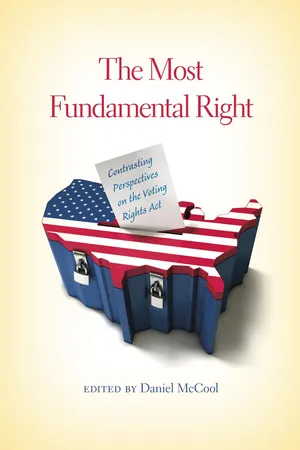
The Most Fundamental Right
Contrasting Perspectives on the Voting Rights Act
- 418 pages
- English
- ePUB (mobile friendly)
- Available on iOS & Android
eBook - ePub
About this book
Information
PART ONE
The Political and Legal Context
of the Voting Rights Act
ONE
Meaningful Votes
DANIEL MCCOOL
A BRIEF HISTORY
The debate over minority voting rights began in earnest the night of April 11, 1865. General Robert E. Lee had surrendered the Army of Northern Virginia two days earlier, and the end of the Civil War was in sight. Washington, D. C., was in a state of exultation, and a boisterous crowd of citizens gathered below a window of the White House, demanding that the president say a few words. Lincoln came to the window and, reading by candlelight, explained his vision for a postwar nation. Among his ideas was a proposal to give some blacks, especially those who had fought in the war, the right to vote. Among the listeners in the crowd was John Wilkes Booth. He muttered to his friend, “That means nigger citizenship. That’s the last speech he’ll ever make.”1
In the aftermath of the Civil War and Lincoln’s assassination, the Thirteenth, Fourteenth and Fifteenth Amendments to the Constitution were adopted. The Fifteenth Amendment, which became part of the Constitution in 1870, reads, “The right of citizens of the United States to vote shall not be denied or abridged by the United States or by any State on account of race, color, or previous condition of servitude. The Congress shall have power to enforce this article by appropriate legislation.” The debate over the Fifteenth Amendment was contentious; southern states argued that it interfered with states rights. But after the amendment was adopted, the New York Times editorialized that the amendment would “put an end to further agitation of the subject.”2
The Times was wrong; bills to give teeth to the Fifteenth Amendment were introduced repeatedly in the U.S. Congress in the latter half of the nineteenth century. The most innovative bill, the Federal Elections bill of 1891, failed to become law due to opposition from southern Democrats. At that point, the Congress gave up on passing a meaningful voting rights bill.3 It was not until 1965, one hundred years and three months after Lincoln’s window speech, that Congress passed the Voting Rights Act (VRA). The Congress was responding to President Johnson’s demand that in the wake of “Bloody Sunday” at the Edmund Pettus Bridge in Selma, Alabama, Congress pass the “goddamnest toughest” voting bill possible.4 The act was passed with broad bipartisan support, but there was stiff opposition from southerners who claimed the act was a “yoke of shame,” “very unjust,” and an “extreme measure.”5
Thus began the long odyssey of the Voting Rights Act, amended and renewed four times, most recently in 2006, making it what one congressman called “arguably the most carefully reviewed civil rights measure in our Nation’s history.”6 The adoption and the extensions of the VRA have always passed with support from both parties, in spite of opposition, and all the extensions were signed into law by Republican presidents.
Although there is currently a lively debate, featured in this book, over the merits of the current law, nearly everyone describes the original VRA in superlatives:
· “Many characterize the Voting Rights Act as the most important and effective civil rights legislation Congress ever adopted.”7
· The VRA is “the crowning achievement of social justice and equality for all Americans.”8
· “The Act is rightly lauded as the crown jewel of our civil rights laws.”9
· “The Voting Rights Act can be characterized accurately as one of the most successful pieces of civil rights legislation ever adopted by the Congress.”10
· “The Voting Rights Act of 1965 has arguably been the most successful legislation to have come out of the Great Society reforms of the 1960s.”11
· “The Voting Rights Act is a sacred symbol of American Democracy.”12
· “The Voting Rights Act of 1965 has been widely hailed as the single most important achievement of our civil rights laws.”13
· “The historic accomplishments of the Voting Rights Act are undeniable.”14
The VRA is a unique piece of legislation, divided into permanent and temporary sections. Section 2 is permanent, i.e., it does not sunset on a specific date. It outlaws election procedures that “result in the denial or abridgment of the right of any citizen of the U.S. to vote on account of race or color.” The act also permanently outlaws literacy and moral requirements and other such “test or device” that denies or abridges the voting rights of racial minorities.15
Sections 4 through 9 and 203 are temporary, and thus have to be periodically renewed. Of these, Section 5 requires “preclearance” of all changes in voting laws or procedures in certain states and political subdivisions – “covered jurisdictions” – that meet criteria specified in Section 4 (see chapter 2). The objective of Section 5 was, in the words of the U.S. Supreme Court, to “shift the benefit of time and inertia from the perpetrators of evil to the victim.”16 Sections 6 through 9 authorize the U.S. government to deploy federal examiners to oversee voter registration and federal observers to oversee polling places.17 Another temporary provision, Section 203, was added in 1975. It requires that voting materials be provided in languages other than English and assistance be provided to individuals with limited English proficiency in certain areas of the country.18
The 1965 act only authorized the temporary provisions for five years, so the first reauthorization was in 1970, which reauthorized the provisions for another five years, extended the coverage of Section 5, and made the prohibition of tests and devices applicable to the entire nation. The next reauthorization, in 1975, renewed the provisions for seven years, added Section 203, and made the ban on tests and devices permanent. In 1982, Congress once again renewed the expiring provisions, this time for twenty-five years. Congress also amended Section 2 in response to an adverse Supreme Court ruling.19 The new language prohibited voting practices that result in discrimination, and made it unnecessary to prove discriminatory intent, which is very difficult to document. The Congress also changed the “bailout” procedure – the process by which political jurisdictions covered under Sections 4 and 5 can remove themselves from coverage.20
Each of the four reauthorizations has provided an opportunity to expand the law’s coverage against what supporters describe as “the great degree of human ingenuity that has gone into devising methods to abridge or deny” the rights of minority voters.21 Conversely, each renewal has presented opportunities for opponents of the VRA to terminate or modify the renewable sections. Media attention has tended to focus on the bipartisan support for the act and has often downplayed the opposition. But in fact there has always been resistance, especially to the renewable sections. When the act was up for renewal in 1970, Governor Lester Maddox of Georgia declared that the law was “illegal, unconstitutional and ungodly and un-American and wrong against the good people of this country.”22 President Nixon expressed opposition to the renewal of Section 5, but signed the reauthorization anyway.23
In 1975, there were again voices of opposition, especially against the new language provisions.24 A group of southern senators argued that “the Southern States covered by the 1965 act have made significant gains that deserve recognition and encouragement rather than 10 more years of punitive sanctions. More minority citizens are registered, voting, and holding office in these States than at any time in American history. Congress should recognize this. . . . Sections 4 and 5 should be allowed to expire.”25
By 1982 the opposition was much more diverse. Many of the old southern segregationists were gone, and new opposition arose from conservative legislators from other parts of the country. Senator Orrin Hatch of Utah was a critic of Section 2.26 Congressman Henry Hyde of Illinois argued that the South had “been in the penalty box long enough,” and should not be subject to Section 5.27 One of the witnesses, a Texas lawyer, who appeared before the House committee proposed amending Section 2 to outlaw voting discrimination unless it was “reasonably necessary to protect a legitimate and concrete public interest.”28 The attorney general for the state of South Carolina argued that “[t]he Voting Rights Act has, in my opinion, served its purpose and it should be allowed to expire. . . . It is now time to remove the state of South Carolina from its state of vassalage.”29 Some people within the Reagan administration resisted renewal, and some opposed the Section 2 results test, but in the end President Reagan chose to sign the bill.30 And in another sign of changing political realities, Senator Strom Thurmond of South Carolina – once a symbol of ardent segregation – voted in favor of the extension.31 In short, the politics of the VRA were getting much more complicated.
The most recent authorization also encountered significant opposition. Although it passed both houses by huge margins, it did not “sail through Congress . . . without any major turbulence.”32 Rather, there was a spirited contest between differing visions of the renewable sections of the act and its role in American democracy. This lively debate, and the larger issue of the future impact of the entirety of the VRA, are the focus of this book.
IMPACT
The statistics regarding increases in minority voting and political participation since the first VRA was passed are stunning. Many of them occurred within the first five years after the act’s passage in 1965.33 According to one study, “there was a substantial jump in black voter registration in a relatively short period” following the passage of the VRA.34 Other data support this. African American voter registration in the eleven states of the former Confederacy increased from 43.1 percent in 1964 to 62 percent in 1968. In Mississippi, the gap between white and black voter registration rates went from 63.2 percent in 1965 to 6.3 percent in 1988.35 Of course, not all of these increases are wholly attributable to the VRA, but the act is clearly responsible for an “immediate and breathtaking transformation.”36
As a result, the forty years following the passage of the act have been “marked by major g...
Table of contents
- Cover
- Half title
- Title
- Copyright
- Dedication
- Contents
- Preface
- Part 1 The Political And Legal Context Of The Voting Rights Act
- Part 2 The Debate
- Part 3 Commentary
- Contributors
- Index
Trusted by 375,005 students
Access to over 1.5 million titles for a fair monthly price.
Study more efficiently using our study tools.
Frequently asked questions
Yes, you can cancel anytime from the Subscription tab in your account settings on the Perlego website. Your subscription will stay active until the end of your current billing period. Learn how to cancel your subscription
No, books cannot be downloaded as external files, such as PDFs, for use outside of Perlego. However, you can download books within the Perlego app for offline reading on mobile or tablet. Learn how to download books offline
Perlego offers two plans: Essential and Complete
- Essential is ideal for learners and professionals who enjoy exploring a wide range of subjects. Access the Essential Library with 800,000+ trusted titles and best-sellers across business, personal growth, and the humanities. Includes unlimited reading time and Standard Read Aloud voice.
- Complete: Perfect for advanced learners and researchers needing full, unrestricted access. Unlock 1.5M+ books across hundreds of subjects, including academic and specialized titles. The Complete Plan also includes advanced features like Premium Read Aloud and Research Assistant.
We are an online textbook subscription service, where you can get access to an entire online library for less than the price of a single book per month. With over 1.5 million books across 990+ topics, we’ve got you covered! Learn about our mission
Look out for the read-aloud symbol on your next book to see if you can listen to it. The read-aloud tool reads text aloud for you, highlighting the text as it is being read. You can pause it, speed it up and slow it down. Learn more about Read Aloud
Yes! You can use the Perlego app on both iOS and Android devices to read anytime, anywhere — even offline. Perfect for commutes or when you’re on the go.
Please note we cannot support devices running on iOS 13 and Android 7 or earlier. Learn more about using the app
Please note we cannot support devices running on iOS 13 and Android 7 or earlier. Learn more about using the app
Yes, you can access The Most Fundamental Right by Daniel McCool in PDF and/or ePUB format, as well as other popular books in Law & Public Law. We have over 1.5 million books available in our catalogue for you to explore.