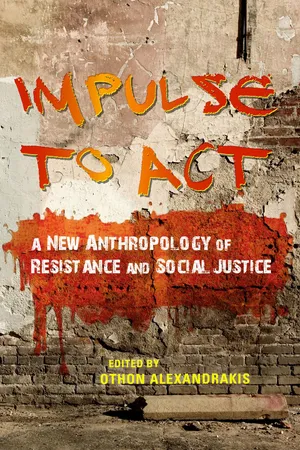
What drives people to take to the streets in protest? What is their connection to other activists and how does that change over time? How do seemingly spontaneous activist movements emerge, endure, and evolve, especially when they lack a leader and concrete agenda? How does one analyze a changing political movement immersed in contingency? Impulse to Act addresses these questions incisively, examining a wide range of activist movements from the December 2008 protests in Greece to the recent chto delat in Russia. Contributors in the first section of this volume highlight the affective dimensions of political movements, charting the various ways in which participants coalesce around and belong to collectives of resistance. The potent agency of movements is highlighted in the second section, where scholars show how the emerging actions and critiques of protesters help disrupt authoritative political structures. Responding to the demands of the field today, the novel approaches to protest movements in Impulse to Act offer new ways to reengage with the traditional cornerstones of political anthropology.
- 284 pages
- English
- ePUB (mobile friendly)
- Available on iOS & Android
eBook - ePub
About this book
Trusted by 375,005 students
Access to over 1.5 million titles for a fair monthly price.
Study more efficiently using our study tools.
Information
PART I
AFFECT AS POLITICAL CONDITION
1 Being and Doing Politics
Moral Ontologies and Ethical Ways of Knowing at the End of the Cold War
Jessica Greenberg
At a debate in Southern California in 2007, the French philosopher Alain Badiou informed the French philosopher Étienne Balibar that he, Balibar, was a reformist. “And you, monsieur,” Balibar replied, “are a theologian.”
—Bruce Robbins, “Balibarism!,” N+1 (2013)
IN THIS CHAPTER, I want to address three questions with methodological import for the analysis of political practice in contemporary Europe. First, how is it that we are still at a point in political thought where it makes sense to pose a choice between political theology and reform? Second, how are our categories of analysis denatured and flattened when we map the world of political possibility around these two opposing poles? And third, what has been the toll on activists who live and work in the shadow of such binaries? At issue is whether it is possible to imagine a progressive politics outside the terms that have dominated the European left for much of the twentieth (and apparently the early twenty-first) century. Is reform antithetical to an affectively rich and hopeful vision of a just world? Does pragmatism, and its ugly stepchild disappointment, truly spell the death of a utopian politics?
In approaching these questions, I hope to move beyond the binaries of revolution and reform, utopia and apologia, moral purity and compromise, as fixed starting points in defining political possibility. The remainder of Robbins’s (2013) article cited in the epigraph to this chapter is a spirited defense of Étienne Balibar’s reformism and a refusal that it is less politically pure than utopianism. In this spirit, I examine the ideological and affective structure of what I call elsewhere “a politics of disappointment” (Greenberg 2014). I argue that pragmatism, so often negatively understood as the absence of sentiment, is in fact a form of aspirational political desire, best understood through the lens of disappointment. Such disappointment engenders a particular relationship to human agency in the face of (im)possible change. Disappointment is thus the beginning, rather than the end, of a practical political engagement. Pragmatism (and relatedly, reformism) is thus not merely an effect of seeing the world “as it really is.” Neither is it a cynical response motivated by the absence of hope. It is a space of desire that emerges in dialogic relation with totalizing visions of political and moral transformation. In the attempt to rethink the experience of pragmatism as itself a form of affective intensity, I hope to show that the categories of “reformist” and “theologian,” “pragmatist” and “idealist,” are not opposites. Rather they are co-constituting and historically emergent categories that entail very different theories of human agency and thus call forth different approaches to activism.
On Hope and Disappointment
In part, this chapter is a response to recent scholarship on what might be called the post-hope generations of late liberalism. For young people, caught between their parents’ modernist ideals and the stark economic and social realities of the contemporary world, boredom (Mains 2007), shame (Jeffrey 2010), and disconnectedness (Allison 2009) emerge as effects of stalled expectations and deferred dreams. For many young people, such states are mapped along the progressive space of a life cycle (Durham 2008; Johnson-Hanks 2002) that intersects with broader geopolitical configurations of development and modernity (Koselleck 2004; Ferguson 1999). This contemporary scholarship is important in highlighting new features of coming of age in an insecure world. Yet at times, it runs the risk of reinscribing a binary of hope and disappointment that defines the “negative” affective experience as a form of loss.
At the same time that we are lamenting the absence of hope, we are also increasingly invested in the project of finding it in new places. We look to globalizing forms of protest, what Hardt and Negri (2011) have termed a “cycle of struggles,” or the reconfiguration of old domains of capital into sites of concentrated political possibility (Harvey 2000). Hope has become an aspirational horizon in which scholars are increasingly invested: if the world gives us disappointment, we might anecdotally (or ethnographically) locate hope in unlikely places. In such an intellectual and political context, disappointment is a starting point for inquiry. But it is rarely an enduring focus of analysis. In the attempt to take new democratic spaces seriously—both politically and analytically—we lose sight of disappointment as a social form in its own right.
Yet disappointment is neither loss—of hope or possibility—nor the aftereffect of “real” politics having taken place at another time or in another place. Indeed, it appears that disappointment is the dominant experiential frame of many contemporary political movements. We apprehend such disappointment in the narratives of frustrated activists and citizens. We experience it in the painful compromises and gripes of former revolutionaries turned technocrats, politicians, or nongovernmental organization workers. Scholars and activists alike often frame disappointment in the same terms as those that opened this article—those of the theologian versus the reformist, the revolutionary versus the pragmatist. Yet such binaries do not capture the complexities of practice. Increasingly, disappointment is the ruling ethos of many new (and not-so-new) democracies. It is a condition of democratic practice, not its failure.
In my 2014 book, I develop the frame of a politics of disappointment by tracking how student activists in Serbia after the democratic revolution of 2000 manage the contradictions of democratic practice as they play out in real time (Greenberg 2014). Here disappointment emerged not only as people compared the expectations of revolution to the realities of democracy in an impoverished country marked by war, state violence, and corruption. It also emerged as people contended with the murkiness and contingency of political agency under such conditions. Student activists were often at the center of these processes. They were charged objects of disappointment given long-standing ideological investment in youth revolutionary politics. And they were well poised to confront the contingencies of activism as they moved between street protest and institutionally based democratic reform.
I elaborate on student activists’ negotiation of changing meanings of youth politics in the postrevolutionary, postsocialist democratic period. I argue that they engaged in a “politics of disappointment” defined by a subtle awareness and negotiation of the contingency of action. They were, to put it plainly, well aware that their democratic practices would inevitably be contradictory and disappointing to others. In showing how such action unfolded and was made meaningful, I sought to show “the conditions under which the coherence of practice is impossible, and yet action takes place nonetheless” (Greenberg 2014, 8). To this extent, student activists were both shadowed by and able to move beyond the burden of the defining whether or not they were truly (and still are) revolutionary subjects.
Was There, or Was There Not?
For many activists in newly emerging democracies, the absolutisms of twentieth-century politics are no longer convincing ways of authorizing political engagement. Indeed, the investment in twentieth-century notions of revolutionary transformation has come under fire not only from scholars but also from many activist circles (see Graeber 2009). Certainly, in formerly socialist Eastern Europe, the collapse of state socialism has called into question the totalizing nature of revolutionary politics. On the one hand, the actually lived experience of “permanent revolution,” with its ongoing ideological and social contradictions, disabused socialist citizens of the idea that revolution could ever be a coherent or fully finished project. On the other hand, the disappointments of Western leftists in actually-existing socialism, from 1956 to 1968 and finally 1989, slowly eroded the belief that socialist utopia was at hand.
This terrain of post–Cold War politics is perfectly captured in the popular 2006 Romanian movie 12:08 East of Bucharest. I begin with an analysis of this film because it captures the affective experience and ethical stakes of living in the shadow of a revolution. In working between the space of “was there, or was there not?” the film points to how our assumptions about human political agency emerge in relationship to the knowability (and unknowability) of historical truth.
The farcical film—its Romanian title is A fost sau n-a fost? (Was There or Was There Not)—takes place over the course of a day in a small town east of the Romanian capital of Bucharest on the sixteenth anniversary of the Romanian Revolution. The film’s English title refers to the precise moment when Romanian dictator Nicolae Ceaușescu and his wife, Elena, fled the Presidential Palace in Bucharest by helicopter. They were later arrested and executed by firing squad. In the movie, a local television host, well connected and shadowed by corruption, hosts an anniversary program to determine whether there was or was not a revolution in their town. At stake is whether the small town participated in Romania’s democratic transformation. The integrity of those who claimed authority based on their resistance to the communist regime is also in question.
The host invites two citizens: an elderly man best known for dressing up as Santa Claus for the local children and a schoolteacher and intellectual whose moral authority is compromised by his heavy drinking. What follows is an hour of bickering, accusation, and counteraccusation. The spirit of revolution is reduced to a “he said, she said” tale of whether the schoolteacher was really in the square protesting before the 12:08 flight of Ceaușescu. In the process, the revolution becomes terrain for petty grievances and minor cruelties. The film itself deserves more elaboration than I have room for here. What is important is the way the film focuses on the importance of establishing historical timelines in order to pinpoint moral and political integrity. Establishing whether it did or did not happen is inseparable from establishing whether the town was complicit or courageous. Revolutionaries were present in the square. Petty liars and drunks were not. At stake is not just what happened but people’s essential moral being.
The film is funny and tragic because it reduces world-historical transformations to small-town disputes over meaningless details. The meaning of revolution and the status of the revolutionary are contingent on a mundane sequencing of events. This sequence forms the architecture of moral possibility through a process of post hoc reckoning. At the beginning of the film, the host and guests are certain they can get to the bottom of things. By the end, the beleaguered participants confront the limits of knowledge, and thus the limits of their own moral authority and political integrity. Not only does the film throw into question the possibility that revolution might be a knowable historical event. It also questions the very relevance of revolution as a metric of human value and political agency.
What, then, is left for a disappointed, backward-looking town, mired in the irrelevance of its own postsocialist disappointment? And to what extent is it the burden of revolution itself that stymies new imaginaries for the future? One particular moment in the film throws these questions into stark relief. It also suggests alternatives to fighting over control of historical memory and political significance. Toward the end of the film, the host turns to outside callers with questions for the panelists. Up to this point, the callers have engaged in accusations and counteraccusations to attempt to fix the exact timeline of events in the town’s main square. One caller has a different memory to share. Just before the show within the movie ends, the host asks if there is another call. There is a pause, and a woman’s voice fills the void. The following exchange occurs:
CALLER: My name is Tina. My son died on December 23 in Otopeni, Bucharest.
HOST: I’m very sorry, ma’am, but we want to know what happened in our town.
CALLER: I’m not about to reproach you, Mr. Jdersecu. I’m just calling to let you know that it’s snowing outside.
HOST: It’s snowing?
CALLER: Yes, it’s snowing big white flakes. Enjoy it now. Tomorrow it will be mud … Merry Christmas, everybody.
The panelists are momentarily stunned into awkward silence, and they are only able to wish her a Merry Christmas in the moments after she has hung up.
We know nothing about Tina, or her motivations for calling: only that she lost her son (likely one of the many killed in the protests in 1989). What is significant in this moment is that the entire enterprise of “was there, or was there not” that defines postsocialist political accountability is made utterly irrelevant. Instead, the woman’s recollection takes places along a different timeline, that of a human connectedness that eschews the temporal logic of political change. When the definitional becomes the terrain of politics, then everyday lived experience is lost. For the woman caller, what is significant about that day was not the inexorable march of historical change, but the interweaving of revolutionary time with affective intensities of memory and loss. For Tina, life’s meaning unfolded unexpectedly, not according to a fixed timeline based on rupture and hindsight. Her revolution was a different kind of transformation. Its significance could never be apprehended through a perfect and knowable sequencing of events. Time and distance (the bird’s-eye view of history), makes the revolution no less knowable. Yes, snow indeed turns to mud. But in the moment, one must experience and enjoy it—to do so is to be present in, rather than haunted by, time.
In this moment, 12:08 East of Bucharest proposes another way of understanding historicity. One’s essential relationship to political possibility in the future need not be determined by one’s position within the official histories of the past. Moving beyond “did it or did it not” happen is a key condition of possibility for post–Cold War politics. The very logic that structures our ability to distinguish revolution from reform—a temporal sequencing of events in which a moment of pure transformation might be apprehended, let alone made meaningful—is upended. For Tina the ability to define historical truth takes a backseat to a present-focused affective intensity that resists definition. It is in this space—and not the project of definitive knowledge—that ethics is grounded.
And yet the stakes of simply walking away from modernist frameworks for defining and apprehending change are high. Indeed, the problem is that “did it” or “did it not happen” is not merely the animating question of modernist ideologies of political transformation. The question of defining, naming, and knowing historical events has its roots in other political crises of twentieth-century Europe. To this extent, one cannot decenter the binary of revolution and reform without understanding the particular significance of “knowing” (did it happen or didn’t it?) in European political imaginaries. In turn, defining history becomes the basis for producing ethical subjectivity (whether one was or was not really a revolutionary).
The act of defining history is central to twentieth-century revolutionary politics and to modern European moral commitments. The stakes of “knowing historical truth” have been shaped by two intersecting failures. The first was the failure of the European left to anticipate or counter the totalizing crimes of fascism. The second was the failure of 1968 to reshape the conditions of political and social possibility in the name of humanist socialism: to effect a true revolution not only of state but also of society. In both cases, a totalizing vision gave way to a moral reckoning that forced a shattered left to try to pick up the pieces of history. There was an urgency to making sense of what really happened and why. The ability to set the record straight requires that one have temporal and spatial perspective: the moral capacities enabled by the twentieth-century bird’s-eye view of a complex, secular world. Bearing witness is at its heart an ethics of producing historical truth. The project of leftist politics in modern Europe was inextricably bound to such a project of history. The proper sequencing of events might encompass memory without reproducing the violence of rupture.
In such a context, politics of continuity (reform) became necessarily suspect. How could there be a moral basis for the pragmatic? Didn’t practical engagement imply at best acquiescence and at worst complicity? These moral and political stakes are necessary to understanding the weight of the distinction between revolution and reform. These are not merely different approaches to political change. They are different orientations to the past that dictate one’s ethical position in the present and the future.
Human Rights and Postutopian (Un)certainties
These dilemmas—the ethics of bearing witness and the confrontation with the contingency of historical knowledge and truth—come together in the modern history of human rights. Speaking of the international human rights movement, Samuel Moyn (2010, 213) notes:
The international human rights movement became so significant, then, neither because it offered a rights-based doctrine alone nor because it forged a truly global vision for the first time. Rather, it was the crisis of other utopias that allowed the very neutrality that had made “human rights” wholly peripheral to the aftermath of World War II … to become the condition of their success. Human rights could break through in that era because the ideological climate was ripe for claims to make a difference not through political vision but by transcending politics.
Moyn argues that the antipolitics of the human rights era opened up space for new, moralizing utopian horizons in the wake of revolutionary, anticolonial, and communist disappointments (see also Fassin 2011; Ticktin 2011). What links these dilemmas to those that open this chapter is a broader context in which twentieth-centu...
Table of contents
- Cover
- Title Page
- Copyright
- Dedication
- Contents
- Acknowledgments
- Introduction: Resistance Reconsidered
- Part I. Affect as Political Condition
- Part II. Agency as Ethical Condition
- Conclusion: On an Emergent Politics and Ethics of Resistance
- List of Contributors
- Index
Frequently asked questions
Yes, you can cancel anytime from the Subscription tab in your account settings on the Perlego website. Your subscription will stay active until the end of your current billing period. Learn how to cancel your subscription
No, books cannot be downloaded as external files, such as PDFs, for use outside of Perlego. However, you can download books within the Perlego app for offline reading on mobile or tablet. Learn how to download books offline
Perlego offers two plans: Essential and Complete
- Essential is ideal for learners and professionals who enjoy exploring a wide range of subjects. Access the Essential Library with 800,000+ trusted titles and best-sellers across business, personal growth, and the humanities. Includes unlimited reading time and Standard Read Aloud voice.
- Complete: Perfect for advanced learners and researchers needing full, unrestricted access. Unlock 1.5M+ books across hundreds of subjects, including academic and specialized titles. The Complete Plan also includes advanced features like Premium Read Aloud and Research Assistant.
We are an online textbook subscription service, where you can get access to an entire online library for less than the price of a single book per month. With over 1.5 million books across 990+ topics, we’ve got you covered! Learn about our mission
Look out for the read-aloud symbol on your next book to see if you can listen to it. The read-aloud tool reads text aloud for you, highlighting the text as it is being read. You can pause it, speed it up and slow it down. Learn more about Read Aloud
Yes! You can use the Perlego app on both iOS and Android devices to read anytime, anywhere — even offline. Perfect for commutes or when you’re on the go.
Please note we cannot support devices running on iOS 13 and Android 7 or earlier. Learn more about using the app
Please note we cannot support devices running on iOS 13 and Android 7 or earlier. Learn more about using the app
Yes, you can access Impulse to Act by Othon Alexandrakis in PDF and/or ePUB format, as well as other popular books in History & World History. We have over 1.5 million books available in our catalogue for you to explore.