"[A] scholarly overview of military technology throughout history—starting roughly in the 15th century and extending into the future . . . insightful."—
Publishers Weekly
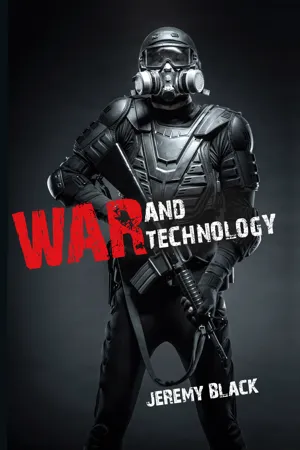
In this engaging book, Jeremy Black argues that technology neither acts as an independent variable nor operates without major limitations. This includes its capacity to obtain end results, as technology's impact is far from simple and its pathways are by no means clear. After considering such key conceptual points, Black discusses important technological advances in weaponry and power projection from sailing warships to aircraft carriers, muskets to tanks, balloons to unmanned drones—in each case, taking into account what difference these advances made. He addresses not only firepower but also power projection and technologies of logistics, command, and control. Examining military technologies in their historical context and the present centered on the Revolution in Military Affairs and Military Transformation, Black then forecasts possible future trends.
"Clear, concise, and thoughtful. An eminently readable synthesis of historical literature on technology and war."—John France, author of
Perilous Glory: The Rise of Western Military Power
"An interesting, thought provoking work by a major military historian . . . whose depth and wide range of knowledge across the entire sweep of world military history is without parallel.... Those who read this book closely will be richly rewarded for it is a mine of useful information and grist for discussion."—Spencer C. Tucker, author of
The European Powers in the First World War
"A most useful introduction to a very complex subject, and particularly valuable for its notes and references to other works. Provocative and vigorously argued . . . Highly recommended."—
Choice
- 344 pages
- English
- ePUB (mobile friendly)
- Available on iOS & Android
eBook - ePub
War and Technology
About this book
Information
1
EARLY MODERN WESTERN WARSHIPS
Technologies of Power Projection and Lethality
Killing and the ability to kill are key aspects of military history. In popular works, they also tend to crowd out other types and characteristics of technology. In particular, there is a tendency to downplay those facets that do not relate directly to conflict or to discuss them only when they are involved in battle. This contrast is less marked when considering naval history because ships serve both to project power and to provide the fighting platform. As a result, improvements in the specifications of warships serve to offer an all-round enhancement of capability, although, in detailed terms, as with other branches of military technology, an improvement in a particular specification can compromise other advantages. For example, increasing weight in order to provide greater protection can limit speed and maneuverability, a trade-off that became of major significance as armor developed in the nineteenth century in response to the increased power of naval ordnance.
Western expansion from 1450 to 1700, in what was subsequently described in the West as the early modern period,1 provides an important instance of the linkage between military technology and key changes in world power. The extent to which global naval strength and world history altered as a result of Western warship technology is a central issue. In turn, this question relates to a number of technologies, specifically ship construction, navigation, and firepower, and these technologies have to be considered in both conceptual and instrumental terms.
A classic means of demonstrating the significance of technological change is to assess the earlier situation, notably the weapons and systems, and then to attribute developments to changes in technology. That approach, however, risks not only crowding out other reasons for developments but also treating the earlier weapons system as inherently static and, therefore, readily supplanted. As far as naval warfare is concerned, this approach, nevertheless, appears self-evident. Western cannon-carrying ocean-going warships won a series of battles in the Indian Ocean in the early sixteenth century, notably off Diu in 1509, an area where there had been no Western warships in the Middle Ages. These victories both apparently demonstrated their superiority and helped secure a new world order dominated by Western powers.2 In turn, this order attracts attention thanks to modern interest in globalization and the development of long-distance trade links.
As with many popular concepts, there is a considerable basis for this interpretation, but it also faces limitations. First, it is necessary to give due attention to earlier changes in shipping and weaponry. The longstanding tendency to distinguish the Middle Ages from the conditions and processes of modernity and modernization has led to a repeated failure among historians who are not specialists in the period to note the dynamic character of medieval warfare. Secondly, there is a related failure to devote due attention to non-Western developments, although there are some important exceptions.3
SHIPS AND CANNON
Initially, the key Western developments in naval capability were made by the Portuguese, who, thanks to their location on the Atlantic edge of Europe, had an unprecedented opportunity to project power. Drawing on late fourteenth- and fifteenth-century Western changes in ship construction and navigation, specifically the fusion of Atlantic and Mediterranean techniques of hull construction and lateen and square-rigging, as well as on advances in location-finding at sea, Portuguese warships enjoyed advantages over other vessels, whether the latter carried cannon or not.
These varied advantages were a reminder of the extent to which technology was not a simple process involving changes only in one element. For example, developments in rigging permitted the Portuguese greater speed, improved maneuverability, and a better ability to sail close to the wind and thus maneuver more effectively in deep water combat, although the significance attributed to the lateen sail has been queried.4 The ability to sail close to the wind was greater than in the case of Chinese ships.
Developments interacted. Thus, carvel building, the edge-joining of hull-planks over frames, replaced the clinker system of shipbuilding using overlapping planks. This change contributed significantly to the development of hulls that were stronger and better able to carry the heavy guns that challenged stability and seaworthiness by needing to be carried high in the hull so that they could fire above the waterline.5
As with other important technological changes, there was no single leap forward but instead a process of development in which there were a number of stages. The Portuguese initially relied on the caravel, a swift and seaworthy but relatively small ship, ideal for coastal exploration and navigation, as well as the nau or great ship, a very large carrack-type vessel that could carry a larger cargo and thus support a crew in lengthy voyages. The nao was the Spanish equivalent to the nau. However, the Portuguese subsequently developed the galleon as a vessel able to sail great distances. It was longer and narrower than earlier carracks, with a reduced hull width-to-length ratio, and was faster, more maneuverable, and capable of carrying a heavier armament. Royal support for shipbuilding also became important in Spain.6
Developments in ship construction were linked to changes in firepower, namely the spread of cannon. However, underlining the extent to which technological changes did not simply combine but also operated on different chronologies, it was not necessary to have a large sailing ship in order to carry cannon, because galleys were also altered in order to carry them. Indeed by the mid-fifteenth century, galleys were being built to carry cannon, and in 1513 French galleys showed their ship-killing capability at the expense of the English fleet off the French naval base at Brest. In the sixteenth century, the emphasis on firepower in galley warfare increased. These cannon were carried forward and supplemented the focus on forward axial attack already expressed by the presence of a metal spur in their bow.7
Yet, as a reminder of the dependence of weapons effectiveness on the platforms available, galleys could not mount the armament of sailing ships because of the requirements linked to their being rowed by large numbers of men. In contrast, in sailing ships, cannon could be fired not only from bow and stern but also from the side of the vessel. Moreover, as a sign of the process of accretional change, this ability owed much to the development around 1500 of gun-ports just above the waterline and of waterproof covers for them. These covers ensured that guns could be carried near the waterline as well as higher up, thus reducing top-heaviness and increasing firepower.8 Such cannon, moreover, could inflict serious damage near the waterline, and, thereby, hole opposing warships. Indeed, it has been suggested that the development of more powerful “ship-killing” warships constituted a revolution in naval warfare.9
The cannon themselves reflected a process of accretional development, and one in which effectiveness was considered in a number of lights and was capable of a range of definitions, including that of cost. The introduction of cannon was certainly a difficult process at sea, and not only there. There was no pattern of rapid change. Wrought-iron cannon remained in use on ships until into the nineteenth century.10 The manufacture of large cast-iron weapons was initially beyond the technological scope of the period, but, from the mid-fifteenth century, firepower was increased by the development of large cannon cast, instead, from lighter, more durable, and workable “brass,” which was actually a form of bronze. Whereas brass is an alloy of copper and zinc, bronze is an alloy of copper and tin that can also include lead or zinc. Gunmetal is a form of bronze, as it includes zinc. These cannon were thick enough to withstand the high pressure from large powder charges and were able to fire iron shot with a high muzzle velocity and great penetrative force. The stone shot used in early cannon were phased out.11
In turn, cast-iron cannon were produced from the mid-sixteenth century. They were relatively inexpensive but were not preferred for warships as they were liable to fractures during casting and could burst when overheated through rapid firing. Cast-iron cannon did not become the leading naval cannon until after 1650, when the growth of big battle fleets was eased by the availability of cheap large-caliber cast-iron guns. Demand from purchasers interacted with the development of cast-iron technology, offering a good example of the relationship between goals and capability. Investment was encouraged by other aspects of enhanced capability, notably significant earlier improvements in gunpowder that increased the range of cannon.12
The impression that is created is that of a technologically driven and enabled revolution in naval power and capability, with developments in ship construction, rigging, navigation, muzzle-loaded cast-metal cannon, and heavy cannon on the broadside, all giving the West a key advantage. The latter advantage is seen in particular episodes, especially Portuguese victories in the Indian Ocean in the early sixteenth century. The arrival of Dutch and English sailing ships in the Mediterranean from the late sixteenth century, and the copying of this technology by Mediterranean powers, first the North African Barbary states and, later, Venice and the Ottoman Turks, is treated as further evidence of this process. The rise of the large specialized warship, in place of ships used for both trade and war, is also seen as a key aspect of specialization.
There are, however, significant problems with this account of a technologically driven shift in naval strength and world power. Other factors were also highly significant, notably the international context. The Chinese abandonment of long-range naval expeditions after the 1430s took a potential opponent out of the equation. In addition, alongside the strength of Portuguese warships, the success of their operations in Indian waters owed much to political factors, not least eventual Gujarati hostility to the Ottomans. The amphibious character of many Portuguese operations accentuated this point. Moreover, there was also, notably from the 1520s, willingness on the part of the Portuguese to rely on warships based on local designs and also to focus on boarding enemy ships and using armored soldiers, rather than destroying ships by cannon fire.13 The preponderance of short-range pieces in English inventories in the 1540s supports a similar interpretation but, by 1569, the English emphasis had changed to heavy guns capable of both long ranges and devastating short-range fire.14
As far as technology is concerned, it is necessary, first, to consider the process of development in the West and, secondly, its impact on the world scale. It is important to avoid the teleological assumption that development was a matter simply of sinking ships through gunfire and, therefore, that the arrival of more powerful ship-killing warships (and the appropriate guns) represented a revolution. Instead, it is necessary to note the difficulties of the process. The introduction of large numbers of cannon on individual ships was a challenge for ship design, made maritime technology more complex, and greatly increased the operational and fighting demands on crews.
Furthermore, it has been argued that, as with land warfare, earlier, fifteenth-century changes were also significant. Such a shift of emphasis entails a focus on a different chronology, specifically looking at a longer-term process of development and thereby reducing the supposedly revolutionary impact of any particular stage. Kelly DeVries has written that it is necessary to focus on a “process of technological and tactical evolution which began with the advent of gunpowder weapons on land, and then progressed through the placement of these guns on board ships, their use in naval engagements as anti-personnel weapons, their increase in size and numbers, and, finally, their changes in technology, separate from similar weapons used on land, in order to produce weaponry that was effective by contemporary criteria.”15
The progression suggested, however, is not entirely plausible, as it implies a relatively simple, sequential process. In practice, such things rarely occur in the real world. While it is clear that some developments depend upon the existence of certain others, and hence a chronological progression can be discerned as innovations are made, that does not constitute a clear lineage. Rather it is often pattern-spotting after the event, and a pattern-spotting that tends to neglect the failures and dead-end developments that add up to a non-linear progression.
In this case, a progression from anti-personnel to anti-material weaponry was probably less obvious than might be implied, as the size of weapons was not merely a question of what was technically feasible to make but a question of perception about how such weapons might be employed. The two are interlinked, but it is unwise to project small to large as a process because often it was the other way round, as with small arms ammunition.
If the focus is on shipping, the process of change was also a long one. Developments in the fourteenth and fifteenth century, particularly the increase in the number of masts, the number of sails per mast, the variety of sail shapes, and the spread of the sternpost rudder, were each of significance. The relationship between firepower and other developments was less clear-cut than has sometimes subsequently been suggested. Thus, changes in rigging, and the arrival both of cast-metal cannon and of heavy cannon on the broadside, did not all occur at once, nor were they mutually dependent. The respective significance of particular changes is difficult to assess, and this difficulty has implications for the attempt to analyze the nature and consequences of technological development.
ORGANIZATIONAL SUPPORT
There is the additional factor of the need to consider other criteria of naval capability, crit...
Table of contents
- Cover
- Half title
- Title
- Copyright
- Dedication
- Contents
- Preface
- Acknowledgments
- List of Abbreviations
- Introduction: The Key Themes
- 1 Early Modern Western Warships: Technologies of Power Projection and Lethality
- 2 Gunpowder Technology, 1490–1800
- 3 Firepower, Steamships, Railways, Telegraphs, Radio: Technologies of Killing, Logistics, Command, and Control, 1775–1945
- 4 The Internal Combustion Engine: The Technology of Decentralized Power, 1910–2013
- 5 A New Sphere: Air Power, 1903–2013
- 6 Revolution, Transformation, and the Present
- 7 Into the Future
- Conclusions
- Postscript
- Notes
- Selected Further Reading
- Index
Trusted by 375,005 students
Access to over 1.5 million titles for a fair monthly price.
Study more efficiently using our study tools.
Frequently asked questions
Yes, you can cancel anytime from the Subscription tab in your account settings on the Perlego website. Your subscription will stay active until the end of your current billing period. Learn how to cancel your subscription
No, books cannot be downloaded as external files, such as PDFs, for use outside of Perlego. However, you can download books within the Perlego app for offline reading on mobile or tablet. Learn how to download books offline
Perlego offers two plans: Essential and Complete
- Essential is ideal for learners and professionals who enjoy exploring a wide range of subjects. Access the Essential Library with 800,000+ trusted titles and best-sellers across business, personal growth, and the humanities. Includes unlimited reading time and Standard Read Aloud voice.
- Complete: Perfect for advanced learners and researchers needing full, unrestricted access. Unlock 1.5M+ books across hundreds of subjects, including academic and specialized titles. The Complete Plan also includes advanced features like Premium Read Aloud and Research Assistant.
We are an online textbook subscription service, where you can get access to an entire online library for less than the price of a single book per month. With over 1.5 million books across 990+ topics, we’ve got you covered! Learn about our mission
Look out for the read-aloud symbol on your next book to see if you can listen to it. The read-aloud tool reads text aloud for you, highlighting the text as it is being read. You can pause it, speed it up and slow it down. Learn more about Read Aloud
Yes! You can use the Perlego app on both iOS and Android devices to read anytime, anywhere — even offline. Perfect for commutes or when you’re on the go.
Please note we cannot support devices running on iOS 13 and Android 7 or earlier. Learn more about using the app
Please note we cannot support devices running on iOS 13 and Android 7 or earlier. Learn more about using the app
Yes, you can access War and Technology by Jeremy Black in PDF and/or ePUB format, as well as other popular books in History & Military & Maritime History. We have over 1.5 million books available in our catalogue for you to explore.