An analysis of the relationship between the internet and queer cinema.
In an era of digitally mediated cropping, remixing, extracting, and pirating, a second life for traditional media appears via the internet and emerging platforms.
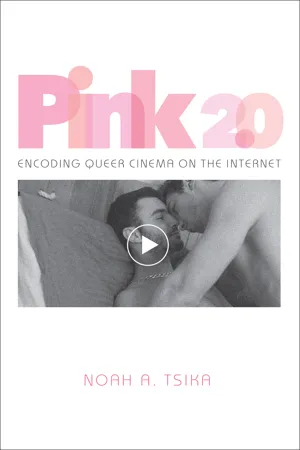
Pink 2.0 examines the mechanisms through which the internet and associated technologies both produce and limit the intelligibility of contemporary queer cinema. Challenging conventional conceptions of the internet as an exceptionally queer medium, Noah A. Tsika explores the constraints that publishers, advertisers, and content farms place on queer cinema as a category of production, distribution, and reception. He shows how the commercial internet is increasingly characterized by the algorithmic reduction of diverse queer films to the dimensions of a highly valued white, middle-class gay masculinity?a phenomenon that he terms "Pink 2.0." Excavating a rich set of online materials through the practice of media archaeology, he demonstrates how the internet's early and intense associations with gay male consumers (and vice versa) have not only survived the medium's dramatic global expansion but have also shaped a series of strategies for producing and consuming queer cinema. Identifying alternatives to such corporate and technological constraints, Tsika uncovers the vibrant lives of queer cinema in the complex, contentious, and libidinous pockets of the internet where resistant forms of queer fandom thrive.
"A rich, thought-provoking study at the cutting edge of media evolution. We certainly need more work like this: writing that expands the field of film and media studies into digitally without throwing the field-as-it-was completely overboard." —B. Ruby Rich, author of
New Queer Cinema: The Director's Cut
"Offers a most important contribution to scholarship in both queer studies and new media studies, and among its most significant accomplishments is its ability to imagine and explicate the crucial connections between these two disciplines in ways that I have not seen previously attempted . . .
Pink 2.0 is impeccably researched." —Michael DeAngelis, author of
Gay Fandom and Crossover Stardom
- 290 pages
- English
- ePUB (mobile friendly)
- Available on iOS & Android
eBook - ePub
About this book
Trusted by 375,005 students
Access to over 1.5 million titles for a fair monthly price.
Study more efficiently using our study tools.
Information
1 Digitizing Gay Fandom
Corporate Encounters with Queer Cinema on the Internet
To simply charge visibility politics with a restrictive sexual conformity or complicity with consumerism has its own limits. First, it cannot explain how it is or what it means, for example, that commercial representations have acquired political functions. And second, it cannot progress very far beyond a simplistic calculus of ideological purity and contamination: the mistaken idea, for example, that one can simply choose to be outside capital. Reducing analysis in this way to a game of paintball—once you’re stained, the game is over—can only bemoan, rather than fully understand, the conditions it evokes.
Eric O. Clarke, Virtuous Vice
Digital media do not refer. They communicate.
Sean Cubitt, The Cinema Effect
THERE IS A moment in Darren Stein’s 2013 film G.B.F., a high school comedy about three straight girls who compete to claim a token “gay best friend,” when everything hinges on an iPhone app. Dubbed GuyDar, the app is a satirically unsubtle facsimile of Grindr, the wildly popular mechanism through which millions of male-identified users may “find gay, bi, curious guys nearby, for free.”1 In G.B.F., the Grindr so commonly associated with “sleaze”—with easy sex made easier through advanced geolocation technology—is transformed into something a bit less salacious, though no less likely to link gay men to a limited, libidinous conception of networked activity.2 (One character, self-consciously mimicking the language of advertising, describes GuyDar as “the new app that lets gay guys find other gay guys through state-of-the-art globally positioned technology”; another simply calls it “a slutty gay hook-up app.”) When the three female competitors—all aspirants to the throne of prom queen—catch wind of GuyDar, their immediate impulse is to use its geolocation capabilities to “out” one of its active subscribers, who happens to be a high school student still struggling to define his sexuality. One girl even inspires the president of the school’s Gay-Straight Alliance, which is being dissolved due to the conspicuous absence of a single out gay student, to set up a fake GuyDar account—using images of allegedly gay-friendly male media stars, of course—in order to “locate a gay.” All of these appsavvy girls seem distinctly ignorant of the fact that GuyDar, like Grindr, openly invites and even cultivates “curious” users—men who may not self-identify as gay or even as bisexual—and they fail to understand that a technologically facilitated tracking of sexual minorities smacks of the most punitive of pursuits, the type of “witch hunt” that is well documented in David K. Johnson’s The Lavender Scare (and to which a concerned teacher, played by Natasha Lyonne, alludes). In their zealous quest for a cachet-conferring “gay best friend,” the girls take GuyDar to be a diagnostic tool of the highest caliber: a digital, mobile means of making clear who’s queer—and, moreover, of shaping such queerness into an exclusive and thus “manageable” homosexuality.
Free to operate, the actual app on which GuyDar is based—Grindr—relies on advertising revenue, thus raising key questions about the kinds of ads that it carries, and about their capacity to complicate conventional sexual taxonomies. In April 2014, ads for the Christian group GodLife began appearing on Grindr—much to the dismay of users familiar with the group’s stance against pornography and “sexual immorality.”3 Widely believed to offer “conversion therapy”—a process intended to transform a person’s sexual orientation from gay to straight—GodLife in fact refuses mention of homosexuality in its Grindr ads, all of which employ vague language, obligatory references to Jesus Christ, and images of Mt. Sinai. Inveighing against “sex perversions” without identifying homosexuality by name, the ads are symptomatic of the way that gayness is both everywhere and nowhere on Grindr—and both everywhere and nowhere on digital platforms more generally. Despite the assumptions of the vapid girls of G.B.F., an app like Grindr cannot “prove” that its users are all gay men. Indeed, Grindr guards against such limitations in a familiar capitalist manner: by invoking a sexual inclusiveness that rejects “restrictive” labels, Grindr cultivates a relatively broad base of users—“from gay to bi to curious.” At the same time, however, cultural commentators consistently position the app as an emphatically and exclusively gay one, even as, in other contexts, they uphold the dubious notion that the United States has at last earned its “post-gay” as well as “post-racial” credentials, preferring in social, cultural, and juridical terms to see Americans as “just people,” rather than as racialized and sexualized citizens.4 However, as Jasbir Puar points out, institutionalized racism and queerphobia persist, intertwine, and diverge in startling ways, even amid the accretion of “inclusive” legislative measures: “Don’t Ask, Don’t Tell, Don’t Pursue” (1994), which notoriously banned all manner of “gay identifications” within the United States military, was repealed on the very same day that Congress defeated the DREAM Act, which was designed to offer a “path to citizenship” for those who had immigrated to the United States as children.5 In Terrorist Assemblages, Puar suggests that what is widely understood as a landmark gay-rights victory—the 2003 Supreme Court decision that struck down longstanding anti-sodomy laws—has in fact enabled new forms of discrimination and surveillance. More recently, the 2015 Supreme Court ruling that made same-sex marriage a nationwide right guaranteed by the Constitution—and that has been hailed as yet another, universally beneficial gay-rights landmark—has similarly upstaged some sobering, newly strengthened discriminatory measures, particularly those that target transgender immigrants of color. Instructively, President Barack Obama’s much-praised declaration that the 2015 Supreme Court decision represented a “victory for America” was preceded, by just two days, by his public—and also widely praised—shaming of a transgender “heckler,” Jennicet Gutiérrez, concerned about the abusive detainment and deportation of transgender immigrants. “You’re in my house,” Obama told Gutiérrez, adding ominously (and all too tellingly), “you can either stay and be quiet or we’ll have to take you out.”6 That Obama spoke those words at a White House event celebrating Pride Month only underscores the painful reality that gay-rights gains often coincide with—even arrive at the expense of—manifold losses for queers of color. Unsurprisingly, a number of prominent, gay-identified blogs, including Queerty, responded to Gutiérrez’s “disruptive” remarks by producing a “rude houseguest” meme, positioning Gutiérrez’s “heckling” as “no way to celebrate Pride” and offering hyperlinks to “the right way”: urban consumerism as sanctioned and structured by GayCities, a website tied to an American gay and lesbian tourism industry with its own, overtly homonationalist agendas to uphold.7 This classist presentation of Pride as a profoundly exclusionary, even gentrifying tradition was, around this time, codified in a new iPhone app—Atari’s Pridefest, an interactive social-simulation game that exhorts its player to demolish “old and decrepit” buildings in order to make way for “fun and rainbows” (in the form of big, “gay-friendly” businesses, of course). The App Store’s official description of Pridefest may highlight the game’s “customizable avatar” (“Personalize with different body types, skin tones, clothes and accessories!”), but the player (required to simulate the activities of a big-city mayor) will encounter no transgender characters while literally pinkwashing the metropolis. As Zachary Small points out, Pridefest, despite its claims to queer inclusivity, is clearly aimed at gay men: its chat function (complete with geolocation technology) appears to have been patterned on Grindr, and erecting a state-of-the-art gym (and thereby activating representations of heavily muscled men) enables the player to access a special Pride float.8
More than simply “locked in” by monotonous software, corporate constructions of gay masculinity are also key components of what A. Aneesh calls “algocratic governance,” or “the rule of code”—a condition of bureaucratic control in which programming languages determine the limits of inclusion and the contours of interaction, preempting dissent whenever and wherever possible.9 Monitoring, reflecting, and rewarding what is “best” about the gay male consumer, software applications also confirm and reproduce the exclusion of such “unfamiliar,” “suspicious,” or otherwise “disruptive” subjects as the “undocumented” Gutiérrez, ensuring their censure. On the internet, optimization and surveillance thus routinely function at the expense of queer subjects who experience similar forms of discrimination in other aspects of their daily lives. Indeed, as Aneesh’s concept of the algocratic suggests, the lines between “user-friendliness” and governmentality—between online encounters and offline realities—blur as the rule of code reigns supreme. Predictably, Gutiérrez’s White House “outburst” was captured by multiple cameras—not merely the fixed, official cameras of the presidential event but also those of various smartphones wielded by the event’s participants. Disseminated online, clips of Gutiérrez were invariably ported through celebrations of Pride that proffered white, normatively bodied gay men as upstanding neoliberal subjects, eminently capable of embracing free market principles as reflections of their agency within new state formations. But they also tended to confirm Sherry Turkle’s reflections on the way that information and communication technologies inhibit empathy, cultivating suspicion of spontaneity and difference.10 “Surprisingly,” even “unnaturally” critical of Obama, Gutiérrez threatened to “ruin” Pride. Negative, downright viral responses to her ordeal evoke what Eric Herhuth refers to as the “general diminution of negotiability” characteristic of the algocratic turn, a decline in the capacity of digital systems and their users to accommodate debate, ambivalence, and ambiguity.11
Individual Facebook users may have posted their support for Gutiérrez—or at least for her broad, anti-transphobic, anti-racist, and anti-imperialist message—but Facebook is itself responsible, through its pronounced surveillance capabilities and drone-assisted, neocolonialist incursions into the global South, for some of the very conditions of inequality to which Gutiérrez was responding.12 As Queerty so vividly demonstrated, even purportedly queer-friendly websites were unable to extricate their accounts of Gutiérrez from the manufacturing of support for the particular forms of discrimination and imperialism that “gay pride” is so often used to conceal. When Gutiérrez took to the website Washington Blade (tellingly dubbed “America’s Leading Gay News Source”) in order to recount her experiences and elaborate her political position, the sponsor-supported site surrounded her words with advertisements for Roland Emmerich’s notoriously racist, transphobic, gay-focused film Stonewall (2015), the men’s clothing store Universal Gear (featuring heavily muscled white men modeling underwear), and the website’s own “Best of Gay DC” section, which regularly sustains the very homology—between white male power brokers and homonormative political formations—that Gutiérrez, in her remarks at the White House, was critiquing in the first place.13 That most of these advertisements were designed by various ad agencies and delivered by diverse intermediaries hardly mitigates the harsh irony at work here: a website like Washington Blade prides itself on publishing exclusive, “alternative” queer content like Gutiérrez’s essay while simultaneously hosting ads that contradict Gutiérrez’s point. Gutiérrez may argue that considerations of “equality” must encompass more than just the white gay man, but her words are necessarily surrounded by images that restrict queerness to that very figure, and that, given the crudeness of certain digital surveillance strategies, are supplied to all users suspected of being “non-straight,” regardless of their actual practices. Low-income, transgender women of color like Gutiérrez may be deemed “waste” and thus ignored by advertising firms and other agencies that engage in online surveillance, but that does not mean that they will be spared, say, Dustin Lance Black’s Tylenol commercial, which features two white, well-dressed gay men enjoying fatherhood in their impossibly plush suburban home.14 In some cases, the demonstrably “non-straight” associations of such queer users as Gutiérrez will simply be read as “gay,” and publishers, advertisers, and content farms will respond to these users accordingly. My point is not to suggest that they should be targeted as specifically transgender and given their own trans-identified ads, as if digital surveillance were somehow in need of expansion and improvement; it is simply to question the logic of inclusion that characterizes those queer websites that must rely on advertising revenue, and to highlight how a hegemonic gayness colonizes all manner of online territories. In other words, Jennicet Gutiérrez is produced as abject even—perhaps especially—when she articulates her political position on the internet. Despite her authorship of an online op-ed, Gutiérrez does not, in Judith Butler’s terms, “enjoy the status of subject,” and her “living under the sign of ‘unlivable’ ” would seem a necessary condition of production of a “queer” internet.15 Far from “unrepresentable” online, Gutiérrez becomes the abject figure against which the gay consumer is defined, as on Queerty and other websites where native advertising aligns male homosexuality not simply with purchase power but also with political clout and an uncritical support for a “queer-friendly” American president.
Even as it cooperates with targeted advertising strategies, joining other websites that pursue what David J. Phillips calls “a top-down, panoptic structure of visibility and classification,” Washington Blade features almost no alternatives to white, normatively bodied gay men in its prominently placed ads, reflecting the continued impoverishment of “queer” as a marketing concept—and perhaps sustaining, in its own way, the alterity of the transgender user of color.16 Using “cookies” to differentiate its visitors and, via targeted ads, interpellate them accordingly, Washington Blade nevertheless relies on sponsors whose understanding of “queer” is extremely limited. Viewed through the prism of queer theory, targeted advertising thus suggests both a confirmation and an extension of a Foucauldian conception of panopticism, in which “the observer, the operator and coordinator of the panoptic system, is invisible to the observed.”17 What happens, then, when the non-white, non-male, non-gay queer subject remains equally invisible even amid widespread strategies of surveillance and differentiation, whereby “different advertisements are served to members of different classes”?18 Washington Blade—the one queer commercial publication to provide a platform for Gutiérrez during the widespread social-media campaign to shame her—offers a useful example of the persistence, the normalization, of Pink 2.0, which, whatever the discrepant revelations of “cookies,” here divides visitors into a series of indistinguishable “queer” (i.e., gay male) categories. The visitor with a “verifiable” interest in cinema gets an ad for a major studio production like Stonewall, a film with a “marketable” gay male protagonist and its own semiotic contributions to U.S. nationalism and transphobia; the visitor with “political interests” gets a reminder of the “Best of Gay DC” (and thus images of cute, white, “baby-gay” clerks in expensive suits); and everyone, it seems, gets an underwear ad featuring a white man’s eight-pack abs. These, apparently, are the only options, and they remain semiotically significant—not to mention cruelly ironic counterpoints to Gutiérrez’s specific concerns. To read her words on Washington Blade is, in a sense—and through no fault of her own—to support some of the objects of her critique, including the ongoing production, commodification, and politicized celebration of a certain queer constituency capable of crowding out alternative subjects and political formations. The sponsor-supported interface of Washington Blade, like that of countless other “queer” websites, provides a striking reminder of some of the operations of homonationalism, even as it seeks to accommodate the concerns of a transgender immigrant of color—someone openly, even “rudely” critical of Obama. That is because, in Jasbir Puar’s terms, homonationalism is an assemblage—of global capitalism, information and communication technologies, political systems, and cultural practices—that, in conditioning access to the internet, is impossible to completely avoid online (or, for that matter...
Table of contents
- Cover
- Title Page
- Copyright
- Contents
- Acknowledgments
- A Note on Scope and Terminology
- Introduction: Questioning the “Queer Internet”
- 1 Digitizing Gay Fandom: Corporate Encounters with Queer Cinema on the Internet
- 2 Epistemology of the Blogosphere: Queer Cinema on Gay Porn Sites
- 3 Franco, Ginsberg, Kerouac & Co.: Constructing a Beat Topos with Digital Networked Technologies
- 4 Liberating Gayness: Selling the Sexual Candor of I Love You Phillip Morris
- 5 “Nollywood Goes Homo”: Gay Identifications on the Nigerian Internet
- Conclusion: Antiviral
- Notes
- Bibliography
- Index
Frequently asked questions
Yes, you can cancel anytime from the Subscription tab in your account settings on the Perlego website. Your subscription will stay active until the end of your current billing period. Learn how to cancel your subscription
No, books cannot be downloaded as external files, such as PDFs, for use outside of Perlego. However, you can download books within the Perlego app for offline reading on mobile or tablet. Learn how to download books offline
Perlego offers two plans: Essential and Complete
- Essential is ideal for learners and professionals who enjoy exploring a wide range of subjects. Access the Essential Library with 800,000+ trusted titles and best-sellers across business, personal growth, and the humanities. Includes unlimited reading time and Standard Read Aloud voice.
- Complete: Perfect for advanced learners and researchers needing full, unrestricted access. Unlock 1.5M+ books across hundreds of subjects, including academic and specialized titles. The Complete Plan also includes advanced features like Premium Read Aloud and Research Assistant.
We are an online textbook subscription service, where you can get access to an entire online library for less than the price of a single book per month. With over 1.5 million books across 990+ topics, we’ve got you covered! Learn about our mission
Look out for the read-aloud symbol on your next book to see if you can listen to it. The read-aloud tool reads text aloud for you, highlighting the text as it is being read. You can pause it, speed it up and slow it down. Learn more about Read Aloud
Yes! You can use the Perlego app on both iOS and Android devices to read anytime, anywhere — even offline. Perfect for commutes or when you’re on the go.
Please note we cannot support devices running on iOS 13 and Android 7 or earlier. Learn more about using the app
Please note we cannot support devices running on iOS 13 and Android 7 or earlier. Learn more about using the app
Yes, you can access Pink 2.0 by Noah A. Tsika in PDF and/or ePUB format, as well as other popular books in Social Sciences & Film History & Criticism. We have over 1.5 million books available in our catalogue for you to explore.