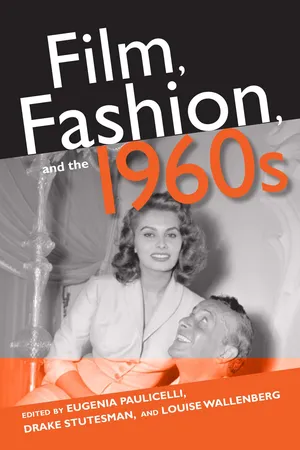
A fascinating look at one of the most experimental, volatile, and influential decades, Film, Fashion, and the 1960s, examines the numerous ways in which film and fashion intersected and affected identity expression during the era. From A Hard Day's Night to Breakfast at Tiffany's, from the works of Ingmar Bergman to Blake Edwards, the groundbreaking cinema of the 1960s often used fashion as the ultimate expression for urbanity, youth, and political (un)awareness. Crumbling hierarchies brought together previously separate cultural domains, and these blurred boundaries could be seen in unisex fashions and roles played out on the silver screen. As this volume amply demonstrates, fashion in films from Italy, France, England, Sweden, India, and the United States helped portray the rapidly changing faces of this cultural avant-gardism. This blending of fashion and film ultimately created a new aesthetic that continues to influence the fashion and media of today.
eBook - ePub
Film, Fashion, and the 1960s
- English
- ePUB (mobile friendly)
- Available on iOS & Android
eBook - ePub
Film, Fashion, and the 1960s
About this book
Trusted by 375,005 students
Access to over 1.5 million titles for a fair monthly price.
Study more efficiently using our study tools.
Information
Subtopic
Fashion DesignPART I
THE 1960S: YOUTH, CULTURE, AND SEXUAL LIBERATION
1 Sanitizing the Beatles for Revolution: Music, Film, and Fashion in the 1960s and A Hard Day’s Night
THE BEATLES’ HIGHLY acclaimed and financially successful first feature film A Hard Day’s Night (Richard Lester, 1964) went into production following the group’s emergence as rock stars not only in their home country of Great Britain but in the United States as well. Beatlemania arrived in the United States in February 1964 with tremendously successful live performances on television’s The Ed Sullivan Show and sold-out concerts at the Washington Coliseum in Washington, DC, and New York City’s Carnegie Hall. The production company United Artists had been primarily interested in using the film to sell the soundtrack, but with the Beatles incredible success in the United States, all parties involved realized that the film would receive more attention than initially envisioned. As film scholar Stephen Glynn recounts, “While the film was still in its frantic post-production phase, United Artists informed the media that, during August and September of 1964, A Hard Day’s Night would be shown on a saturation basis in every available market around the world, with ‘more prints in circulation than for any other pic in history.’”1 The Beatles had become mega rock stars almost overnight and were poised to be film superstars as well.
In the making of the film, the Beatles were surrounded by a creative team, including their manager Brian Epstein, music producer George Martin, the film’s producer Walter Shenson, director Richard Lester, screenwriter Alun Owen, and clothing designer Dougie Millings. The film turned out to be more than the conventional “pop” commodity, and the artful, amusing results pleasantly surprised critics. For instance, Arthur Knight, film critic for the Saturday Review, expressed his unexpected pleasure at the time:
The Beatles are, of course, England’s most controversial export since tea, and in the normal course of events such phenomena are generally “packaged” in a sleazy, indifferently made exploitation picture that goes into hundreds of theaters simultaneously, on what is known as a saturation booking, so that the producers can get their money out of it before the public learns that it is being robbed. Since everything about A Hard Day’s Night—posters, advertising, mass bookings—suggested just such a picture, I skipped the press screening. I was wrong. On the advice of friends and breaking the critics’ protocol, I went to a local theater, bought a ticket, and thoroughly enjoyed every minute of my first exposure to John, Paul, George, and Ringo.2
Most critics agreed with Knight in commending the film and likewise found the Beatles to be witty, playful, and talented lads.
Beatles scholars applaud the abundance of original, innovative songs by John Lennon and Paul McCartney for the soundtrack, which captured a new direction for both the group and pop music. Film scholars have praised the film equally for its documentary-like structure, active camerawork and editing, slapstick elements, “music video” interludes, and for capturing the band’s youthful energy and polite rebellion against their elders that signaled the rise of a 1960s youth-based counterculture. In his detailed, thorough study of the production and reception of the film, Glynn exemplifies this admiration, writing, “The enduring appeal of A Hard Day’s Night lies predominantly in the ageless charm of its protagonists, four lads from Liverpool who changed forever the style, the content, and the significance of popular music around the world.”3 Neil Sinyard agrees, boldly claiming, “Rather than the Citizen Kane of the juke-box musical, I would call Hard Day’s Night its Battleship Potemkin. The message is in the montage and the music, and the message is one of social revolution.”4
On the other hand, with a hindsight that Knight did not possess, many Beatles experts disparage the group’s polished image at this time, which was used to sell not only record albums, but also schlocky merchandise. While the film’s form and style and the Beatles’ music encapsulate their transition to a more creative future, such critiques view the fashion and performance style as devices that papered over the quartet’s more rebellious rock ’n’ roll past. The standardized performance and chic dress of the film present the Beatles as a safe brand to merchandize soap, charm bracelets, dolls, wigs, and other products.
Glynn attributes the repackaging from rough to nice to the band’s manager Brian Epstein, pointing out that fashion was a significant part of this shift. Glynn writes, “Before signing with Epstein the group wore rock’n’roll leather jackets and blue jeans…. Conscious of the associations of such dress with juvenile delinquency—with sexual and violent excess—Epstein had persuaded the boys to wear the newly designed Beatle suit, the epitome of ‘smart casual.’”5 Ian Inglis points out that Epstein also cleaned up the boys’ behavior: “[He] prohibited certain forms of behavior, including smoking, drinking, eating, and swearing on stage.”6 Media scholar Michael R. Frontani sees Epstein as the major force behind “sanitizing” their image:
He exerted great control over the image of the band throughout the touring years, particularly during the years of the band’s rise first to national prominence in England and then to international stardom. He “cleaned them up, sanitizing the rougher, more rebellious image that had been developed in Liverpool’s Cavern Club and on Hamburg’s Reeperbahn…. Rather, Epstein marketed the Beatles as clean, wholesome entertainment. Well-coifed and donning suits and ties, the new Beatles were cheeky and at time irreverent, but never vulgar.7
These accounts suggest a dominant narrative in Beatles scholarship that blames Epstein for taming and cleaning up the more unruly and authentic group through acceptable, tailored fashion and a good-mannered, robotic performance style for the entertainment and commercial industries. Since Epstein had a taste in smart menswear, fashion became a weapon for criticizing how he suppressed the Beatles’ individuality and taste. Clearly, Epstein fostered a new dressed up look and professional performance style for the band, but they were also ready to expand their audience and, so, actively participated in developing the new image. Labeling this simply as a “sanitizing” process erases the possibilities of creative transition offered by this new image. “Cleaned up” implicitly marks the new image as conventional, conformist, and commercial. In The Conquest of Cool, a study of how the cultural revolution in the 1960s impacted American business, Thomas Frank challenges this facile dismissal of fashion and commercial culture:
Advertising and men’s wear … were deeply caught up in both the corporate and cultural change that defined the sixties…. Both industries underwent “revolutions” in their own right during the 1960s, with vast changes in corporate practice, in productive flexibility, and especially in that intangible phenomenon known as “creativity”—and in both cases well before the counterculture appeared on the mass-media scene…. Seeking a single metaphor by which to characterize the accelerated obsolescence and enhanced consumer friendliness to change which were their goals, leaders in both fields had already settled on “youth” and “youthfulness” several years before saturation TV and print coverage of the “Summer of Love” introduced middle America to the fabulous new lifestyles of the young generation.8
Could it be that, along with A Hard Day’s Night’s loose narrative structure, film style, and musical track, the Beatles’ haircuts and stylish suits influenced a broader cultural revolution—that this new look was actually a modern turn through which not only the Beatles but also corporate culture, and individuals could embody and announce change?
A few possible reasons stand out for this critical dismissal and implicit demonization of Epstein’s taste and impact on the Beatles. One is that fashion is implicitly understood as a frivolous, less creative space. As fashion theorist Gilles Lipovetsky notes: “The question of fashion is not a fashionable one among intellectuals…. Seen as an ontologically and socially inferior domain, it is unproblematic and underserving of investigation; seen as a superficial issue, it discourages conceptual approaches. The topic of fashion arouses critical reflexes even before it is examined objectively: critics invoke it chiefly in order to castigate it, to set it apart, to deplore human stupidity and the corrupt nature of business.”9 Beatles scholars seem to venerate the rebellious and self-fashioned pre-Epstein Beatles, asserting connections with the iconoclastic images of Marlon Brando in The Wild One (1953) and James Dean in Rebel Without a Cause (1955), as well as with the self-made fashions of the “teddy boys.” Thus, they implicitly dismiss the shift into sleeker, suited attire and the more androgynous “moptop” haircut.
Many ignore this “cleaned up” look and make little or no attempt to historicize the new styles in men’s fashion that mark the Beatles’ look at the time of A Hard Day’s Night. To critics unversed in fashion, jeans and leather jackets emblematize the rebellious, independent aspects of rock ’n’ roll music, while the casual, tailored suits suggests a clone-like pop style, selling out to commercial music, and the marketing of junk. But as Glynn notes, the rebel look was also associated with troubled, often dangerous, juvenile delinquents as seen in the 1950s films The Wild One and The Blackboard Jungle (Richard Brooks, 1955). The new styles embraced by the Beatles, under the tutelage of Epstein, moved them away from the cultural references of youthful volatility suggested by “delinquent” fashion and toward the evolving, innovative space of coolness and cutting-edge taste associated with the new men’s fashions. These new fashions were not the conformist suits worn in The Man in the Grey Flannel Suit. They suggested, rather, rebellion against conformity and an embrace of youth, as suggested by Frank.
Moreover, Epstein’s refashioning of the Beatles is implicitly read as a queer action, moving them out of their rebellious, masculine image in Liverpool and Hamburg and into dressier, effeminate couture as they broke into the mainstream. As Paolo Hewitt notes, “many American males sneered at The Beatles. The band wore long hair and pretty suits. American fashion was much more masculine, based on jeans, Chino trousers, Bass Weejun shoes, button-down shirts and Harrington-style jackets. This was the all-American preppy look, and no way was a bunch of prissy Brits going to change that which was sacred in the US.”10 Many scholars seem to sympathize with this contemporary young male response, regretting the loss of the more rebellious roots, and are implicitly troubled by this effeminization. Drawing attention to and confronting this implicit dismissal of Epstein and his makeover of the Beatles, Steven D. Stark, in his revisionist history Meet the Beatles, argues, “The Beatles also challenged the definition that existed during their time of what it meant to be a man. This ultimately allowed them to help change the way men feel, the way men look, and the way men think about the way they look. Brian Epstein, their gay manager, influenced the group in many ways, but his most lasting contribution was to help design an image for the group that explored the fluidity of gender.”11 As Frank and Stark suggest, Epstein’s remaking may have begun (and certainly at least abetted), a revolutionary transition for both the Beatles and the large culture to the later more outrageous, colorful, androgynous men’s styles associated with the release of the band’s 1967 album Sgt. Pepper’s Lonely Hearts Club Band and to the youth-based countercultural phenomenon known as the “summer of love.” Both the album and the phenomenon made a total break from rock ’n’ roll’s tougher, juvenile delinquent image.
The Beatles in Transition: Original Compositions, Studio Recording, and the New Sound in A Hard Day’s Night
Elvis Presley is credited with unleashing repressed desires and physical energy through his style of singing and performing, but he did not write his own songs, and by the beginning of the 1960s, he was less of a spokesperson for the youth-driven market. The original music composed and arranged for A Hard Day’s Night signals a new direction for rock ’n’ roll performers, which is immediately announced by the film’s opening theme song. As the Beatles flee a group of hysterical fans in the opening montage, the soundtrack begins with a single guitar strum, followed by a beat of silence, and then Lennon’s voice exu...
Table of contents
- Cover
- Title Page
- Copyright
- Dedication
- Contents
- Acknowledgments
- Introduction
- Part I: The 1960s: Youth, Culture, and Sexual Liberation
- Part II: Cities, Nations, and Fashion
- Part III: Gender: Modernity and Tradition
- Part IV: Epilogue
- Index
Frequently asked questions
Yes, you can cancel anytime from the Subscription tab in your account settings on the Perlego website. Your subscription will stay active until the end of your current billing period. Learn how to cancel your subscription
No, books cannot be downloaded as external files, such as PDFs, for use outside of Perlego. However, you can download books within the Perlego app for offline reading on mobile or tablet. Learn how to download books offline
Perlego offers two plans: Essential and Complete
- Essential is ideal for learners and professionals who enjoy exploring a wide range of subjects. Access the Essential Library with 800,000+ trusted titles and best-sellers across business, personal growth, and the humanities. Includes unlimited reading time and Standard Read Aloud voice.
- Complete: Perfect for advanced learners and researchers needing full, unrestricted access. Unlock 1.5M+ books across hundreds of subjects, including academic and specialized titles. The Complete Plan also includes advanced features like Premium Read Aloud and Research Assistant.
We are an online textbook subscription service, where you can get access to an entire online library for less than the price of a single book per month. With over 1.5 million books across 990+ topics, we’ve got you covered! Learn about our mission
Look out for the read-aloud symbol on your next book to see if you can listen to it. The read-aloud tool reads text aloud for you, highlighting the text as it is being read. You can pause it, speed it up and slow it down. Learn more about Read Aloud
Yes! You can use the Perlego app on both iOS and Android devices to read anytime, anywhere — even offline. Perfect for commutes or when you’re on the go.
Please note we cannot support devices running on iOS 13 and Android 7 or earlier. Learn more about using the app
Please note we cannot support devices running on iOS 13 and Android 7 or earlier. Learn more about using the app
Yes, you can access Film, Fashion, and the 1960s by Eugenia Paulicelli, Drake Stutesman, Louise Wallenberg, Eugenia Paulicelli,Drake Stutesman,Louise Wallenberg in PDF and/or ePUB format, as well as other popular books in Media & Performing Arts & Fashion Design. We have over 1.5 million books available in our catalogue for you to explore.