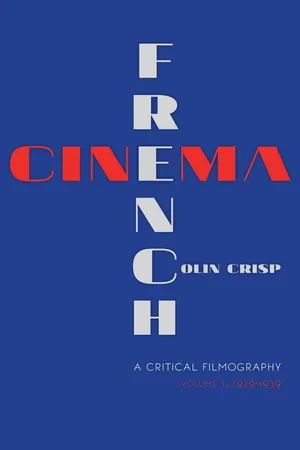
This invaluable resource by one of the world's leading experts in French cinema presents a coherent overview of French cinema in the 20th century and its place and function in French society. Each filmography includes 101 films listed chronologically (Volume 1: 1929–1939 and Volume 2: 1940–1958) and provides accessible points of entry into the remarkable world of 20th-century French cinema. All entries contain a list of cast members and characters, production details, an overview of the film's cultural and historical significance, and a critical summary of the film's plot and narrative structure. Each volume includes an appendix listing rewards earned and an extensive reference list for further reading and research. A third volume, covering the period 1958–1974, is forthcoming.
- 342 pages
- English
- ePUB (mobile friendly)
- Available on iOS & Android
eBook - ePub
About this book
Trusted by 375,005 students
Access to over 1.5 million titles for a fair monthly price.
Study more efficiently using our study tools.
Information
Subtopic
Film & VideoPART I
The Introduction of Sound
1. Prix de beauté
Miss Europe
France-Germany-Italy, 1930, 92 min, b&w
Dir Augusto Genina; Asst dir Edmond Gréville, André d’Ollivier, and Fernand Lefebvre; Prod SOFAR (Société des Films Artistiques); Scr Augusto Genina, René Clair, Bernard Zimmer, and Alessandro de Stefani, from an idea of Georg-Wilhelm Pabst; Cinematog Rudolph Maté; Music Wolfgang Zeller, René Sylviano, and H. Shephard; Art dir Robert Gys; Edit Edmond Gréville; Act Louise Brooks (Lucienne Garnier), Jean Bradin (Prince Grabovsky), Georges Charlia (André), H. Bandini (Antonin), André Nicolle (secretary), Yves Glad (Maharaja), Gaston Jacquet (Duc de la Tour Chalgrin), Alex Bernard (photographer), and Marc Ziboulsky (manager).
The bewildering list of credits for direction and script above give some idea of the complicated origins of this film, but the reality is even more astonishing. The film was begun in 1929 as a silent film. Most sources say the scenario was primarily René Clair’s, from an idea by Georg-Wilhelm Pabst, and that Clair intended to direct it himself, but the final scenario departed significantly from the original proposal and was rejected by the producer. Meanwhile, Clair had seen the first talkies and had revised the script to include sound. It was still rejected, however, perhaps for financial reasons, and was finally allocated to the experienced Italian director Augusto Genina. SOFAR was an Italian-German-French production company, so it decided for tactical reasons to shoot the film silent, then postsynch it in four languages, dubbing with different actors. Louise Brooks’s voice, for example, was dubbed in the French version by Hélène Regelly. It is astounding that such a multi-sourced film should be so coherent and so powerful, and no less astounding in that sound seems integral to the design of the film as it now stands. The climactic final scene, which had been central to Clair’s scenario, must nevertheless have been conceived in its present form after the decision to sonorize.
The story is simple: Lucienne becomes a star, and it proves fatal to her. At first she and André are a humble working-class couple; she works as a typist in a pressroom but dreams of a more glamorous life. Thanks to a beauty contest, she is able to achieve it; we follow her from office girl to Miss France and finally to her crowning in Spain as Miss Europe. She is courted by a prince, a duke, and a maharajah, and invited to do a screen test. The high life turns her head, and André issues an ultimatum: return to Paris and marry him, or it is all over. She is torn but accepts, and we see her trying to reconcile herself to a meager living in a sordid apartment with André. Finally, unable to endure it, she slips away to do the screen test. While she is watching the rushes with the producer, André sneaks into the projection room and shoots her dead.
The film is, then, clearly reflexive: its focus is on the making of a film, and more generally on the corrupting effect of the media. It constitutes a critique of the myth of the star, which was clearly, along with the beauty contest, the “idea” suggested to Clair by Pabst. This makes the presence of Louise Brooks in the central role particularly appropriate, since her abrupt rise to fame in the preceding three years had made of her just such a star, notably in two Pabst films (Pandora’s Box and The Diary of a Lost Girl). Prix de beauté picks up on several of her previous roles as a basically good-hearted girl whose intense sexuality almost accidentally entrains fatal consequences. From our first meeting with the couple, André is intensely jealous of the admiring glances she attracts, and she attempts to defuse the situation by putting on a record of the song “Ne sois pas jaloux” (“Don’t be jealous this evening, I only have one love, and it’s you. . . . You must forgive me,” etc.). It becomes their theme song, and what outrages André in the final scene is that, in the rushes of the film, she is singing “their” song. As she collapses dead, her giant recorded image continues above the scene of the murder, singing gaily on. Here already in the form “reality versus representation” we find the contrast of recorded versus real, and public gaiety versus private grief, which were to become regular motifs of 1930s films. The final images are of the flickering light of the screen illuminating fitfully their two faces—André somber, her dead.
Although this critique of the star is central to the film, what is no less fascinating is the exploration of sonorization techniques used in what had begun as a silent film. The sound-track is omnipresent, but only rarely are there moments of diegetic conversation or diegetically sourced sound and music (that is, sound for which the source is either visible on the screen or implied by the actions on the screen). The early beach and street scenes are accompanied by a babble of bathers and of traffic, out of which occasional identifiable voices arise. The pressroom scene that follows celebrates the futurist dynamism of the machines with bustling music, a player piano, the typewriters joining in a quasi-symphonic sound-mix, and a loud-speaker announcing the beauty competition.
All of this is accompanied by a montage of images, including documentary-style “hidden camera” images of the street scene. Lucienne’s fashion magazines inspire her with apparently unrealizable yearnings, and these dreams are forcefully contrasted with her actual existence, both when we see André returning from work with grubby hands and broken fingernails, and again when she and friends visit a fairground. There, grotesque images of “the people” aggress her until she wonders what she is doing amid this crush of unlovely individuals.
Throughout her ascent to Miss Europe, this montage of sounds and images accompanies and comments on her aspirations and fears, but also (once she has decided to marry André) on his jealousy and frustrations. In the bleaker central section, in their unhappy flat, her moment of fame cannot be forgotten: her image intrudes in newspapers used as wrapping, and fans inundate her with mail and photos to sign. André rips them all up and wanders disconsolate through the streets, finally spying on her encounter with the prince/producer of her film. Technically, then, this is an enormously ambitious film, including location shooting, a series of rapid camera movements, and several long tracking shots, all of which were shot with a silent camera and the likes of which were to become well-nigh impossible for the next few years, as the heavily blimped camera (that is, enclosed in soundproof casing) lumbered around the confined spaces of the studio.
Genina was to direct another five films in France in the next few years, one of which, interestingly, was called Ne sois pas jalouse, while another, Paris béguin (Paris Infatuation), with Jean Gabin, likewise dealt with the preparation of a performance and ended with his murder beneath a giant poster of the star who loves him, and who has to perform smiling through her tears. Pabst was also to make five more films in French versions, two of which are included here (#7 and 16), while even as this film came out, René Clair was putting the finishing touches to his first sound film, Sous les toits de Paris, which we examine next.
2. Sous les toits de Paris
Under the Rooftops of Paris
France-Germany, 1930, 96 min (but most current copies are approximately 80 min), b&w
Dir and Scr René Clair; Asst dir Georges Lacombe, Marcel Carné, and Jacques Houssin; Prod Tobis; Cinematog Georges Périnal; Music René Clair, in conjunction with the conductor Armand Bernard; Songs Raoul Moretti, René Nazelles, and André Gailhard; Art dir Lazare Meerson; Sound Hermann Storr and W. Morhenn; Edit René Le Hénaff; Act Pola Illéry (Pola), Albert Préjean (Albert), Gaston Modot (Fred), Edmond Gréville (Louis), Bill Bocket (Émile the thief), Aimos (a crook), Paul Olivier (drunken café client), and Jane Pierson.
René Clair has become by far the best-known of early sound directors, which is a little surprising given that more than any other, he spoke out against the introduction of sound. He had been a journalist, writer, and film actor before making his name as a director, notably with two art films (Paris qui dort, 1923, and Entr’acte, 1924) and two adaptations of popular comedies by Eugène Labiche (Un chapeau de paille d’Italie, 1927, and Les Deux timides, 1928). Clair was responsible for both the script and direction of his first five sound films, all made in France, of which this was the first. Both here and later in Le Million (1931, #9) and Quatorze juillet (1933, #22), he appealed to a particular mythic view of Paris and of “the little people” who are seen as essential to its vitality—not professionals or the rich, who are consistently mocked and ridiculed, but working-class people whose hardships are never dwelt on and whose joie de vivre is irrepressible. Clair’s art director, Lazare Meerson, produced an unforgettable representation of the poorer quarters of Paris, featuring narrow streets and tall apartment buildings with steep stairwells and austere but well-lit rooms, aesthetically worn and stained, looking out over endless tiled rooftops. The male characters tend toward the artistic (street singers, accordionists, sculptors) or the mechanical (taxi drivers), while the females are usually associated with flowers or with laundering—purity or nature. Sous les toits de Paris and its “sequels” follow the entanglements of such characters from bedrooms to bars to dance halls. There is always one exotic, capricious girl (often Eastern European) who plays male friends off against each other, and this behavior invariably leads the narrative toward the margins of the law, where amiable crooks and colorful fences, casually accepted as mates, confuse the borderline between the poor and the underworld. No stigma attaches to criminality, only to wealth, and no stigma attaches to sexuality or inconstancy: the characters’ entanglements are presented as moves in an elaborate game, with momentary winners and losers, where moralizing is irrelevant.
In Sous les toits de Paris, Albert is a street-singer who sees Pepe the pickpocket at work on the rich among his circle of listeners and gets paid off for holding his tongue.1 Fred is a beggar who pretends blindness to con the wealthy. Albert introduces himself to the flirtatious Pola by “finding” her purse, and from then on, she gives the narrative such direction as it has by being the object of desire of Albert, of Fred, and of Albert’s mate Louis. In Albert’s absence, Louis wins her; when they break up, however, she goes off with Fred. Consolation is never far away for the “losers.” Toward the end, she attempts to play them all off against each other, but in a Clair film, the women can never be taken too seriously: their main function is to clarify and ratify the relationships among the men. Friendship will always triumph over desire. Here the men finally throw dice for Pola, and Albert cheats to allow her to go off with Fred. This foregrounding of the game-like patterning of relationships is confirmed in the final circular sequence in which Albert is back singing in the street and flirting with someone else: another day, another girl, and so it goes.
If the film is, then, sentimental about the settings and atmosphere, it is far from sentimental about the characters and their relationships. No real attempt is made to exploit identification mechanisms that might invite the viewer to take seriously the characters’ losses, confusions, and infidelities. For Clair at this time, individuals were clearly less important than atmosphere and milieu. This disavowal of drama in favor of a sort of ballet-like set of advances and retreats is only heightened by the foregrounding of sound-image relationships. Much of the action is patterned on the verses of the songs or a record-player or the dance-hall orchestra. Elsewhere, non-diegetic music comments comically on the action, with a death march for instance, or with raindrops or with “cat-like tread.” Conversations that risk turning dramatic are totally drowned in orchestral sound, leaving nothing but frenetic gestures, and any threatening intimacy is distanced by being unheard—witnessed, for instance, through a glass door. There is, in fact, little synchronized dialogue. The first example is well into the film. Partly this is because sound mixing was not yet available, and the soundtrack had to be recorded integrally. But also Clair professed nostalgia (already!) for the silent film, and such was his dislike of the constant chatter that had resulted from the introduction of sound that h...
Table of contents
- Cover
- Half title
- Title
- Copyright
- Contents
- Acknowledgments
- Introduction: The French Cinema in the 1930s
- Part I. The Introduction of Sound
- Part II. The Great Depression
- Part III. The Rise of Poetic Realism
- Appendix: Prizes and Awards
- Bibliography
- Index
Frequently asked questions
Yes, you can cancel anytime from the Subscription tab in your account settings on the Perlego website. Your subscription will stay active until the end of your current billing period. Learn how to cancel your subscription
No, books cannot be downloaded as external files, such as PDFs, for use outside of Perlego. However, you can download books within the Perlego app for offline reading on mobile or tablet. Learn how to download books offline
Perlego offers two plans: Essential and Complete
- Essential is ideal for learners and professionals who enjoy exploring a wide range of subjects. Access the Essential Library with 800,000+ trusted titles and best-sellers across business, personal growth, and the humanities. Includes unlimited reading time and Standard Read Aloud voice.
- Complete: Perfect for advanced learners and researchers needing full, unrestricted access. Unlock 1.5M+ books across hundreds of subjects, including academic and specialized titles. The Complete Plan also includes advanced features like Premium Read Aloud and Research Assistant.
We are an online textbook subscription service, where you can get access to an entire online library for less than the price of a single book per month. With over 1.5 million books across 990+ topics, we’ve got you covered! Learn about our mission
Look out for the read-aloud symbol on your next book to see if you can listen to it. The read-aloud tool reads text aloud for you, highlighting the text as it is being read. You can pause it, speed it up and slow it down. Learn more about Read Aloud
Yes! You can use the Perlego app on both iOS and Android devices to read anytime, anywhere — even offline. Perfect for commutes or when you’re on the go.
Please note we cannot support devices running on iOS 13 and Android 7 or earlier. Learn more about using the app
Please note we cannot support devices running on iOS 13 and Android 7 or earlier. Learn more about using the app
Yes, you can access French Cinema—A Critical Filmography by Colin Crisp in PDF and/or ePUB format, as well as other popular books in Media & Performing Arts & Film & Video. We have over 1.5 million books available in our catalogue for you to explore.