"Deals masterfully with a neglected crisis, how climate change is driving migration . . . The work broaches solutions both practical . . . and political."—Christopher E. Goldthwait, former US Ambassador
With global climate change upon us, it is imperative to start thinking about the massive numbers of people who will be displaced by environmental crises. The rise in sea levels alone will account for hundreds of millions of refugees around the globe.
In
Rising Tides, John R. Wennersten and Denise Robbins face the difficult questions that will have to be answered: How will people be relocated and settled? Is it possible to offer environmental refugees temporary or permanent asylum? Will these refugees have any collective rights in the new areas they inhabit? And lastly, who will pay the costs of all the affected countries during the process of resettlement?
Offering an essential, continent-by-continent look at these dangers,
Rising Tides is "a passionately argued, well-documented wake-up call on the dire, current and undeniable human fallout from climate change. Looking behind the headlines, it connects the dots in a way that will inform and should alarm us all" (Eugene L. Meyer, author of
Five for Freedom).
"This chilling and urgent call to action spares no detail in its mission to present the facts on a looming humanitarian disaster. Climate-change warning messages too often focus on the environment without going into specifics of how humans will be hurt by global warming.
Rising Tides singlehandedly rectifies this issue."—
Foreword Reviews
"A must read for policymakers and those in positions of power, especially the ones who remain in a state of denial about climate change and refuse to do enough to address the crisis."—
The Hindu
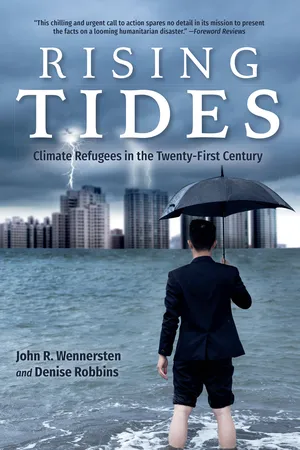
eBook - ePub
Rising Tides
Climate Refugees in the Twenty-First Century
- 272 pages
- English
- ePUB (mobile friendly)
- Available on iOS & Android
eBook - ePub
Rising Tides
Climate Refugees in the Twenty-First Century
About this book
Information
Subtopic
Global Warming & Climate ChangeIndex
Biological SciencesPART ONE
Climate Refugees in the Twenty-First Century
Introduction
The issue of environmental refugees is fast becoming prominent in the global arena. Indeed it promises to rank as one of the foremost human crises of our times.
Norman Myers, “Environmental Exodus”
THE MAN IN THE TUNNEL
On August 6, 2015, a misty gray day, an illegal migrant was arrested in Britain after he had walked the entire thirty-one-mile length of the English Channel Tunnel. His name was Abdul Tahman Haroun, a forty-year-old Sudanese illegal immigrant who walked the tunnel to Britain from Calais, France. He was charged with malicious obstruction to a railroad carriageway. The fact that he succeeded in walking under the channel to Folkstone, England, underscores the desperation of people like him fleeing the impoverished dry lands of Sudan. On that same date there were at least five hundred other attempts to reach Britain from Calais through the tunnel. The net effect of this development has been that Britain has posted one hundred more guards in the Eurotunnel terminal and announced new measures to deter asylum seekers, with possible prison sentences of up to five years.1
The tunnel is part of a larger issue of the number of people illegally trying to get into Europe from the Middle East and North Africa. Because of war and worsening environmental conditions, a constant flow of humanity is coming across into Europe, and there is no sign that it will be slowing down. Whether attempted by tunnel entry or in boats, which frequently capsize in the Mediterranean, this migration is part of humanity’s distress call.
Climate change is with us and we need to think about the next big, disturbing idea—the potentially disastrous consequences of massive numbers of environmental refugees at large on the planet. As early as 1990 the Intergovernmental Panel on Climate Change reported that “the greatest single impact of climate change could be on human migration with millions of people displaced by shoreline erosion, coastal flooding, and agricultural disruption,” writes the United Nations Development Program in its 2015 Human Development Report.2 These people will be left to seek new homes in an era where “asylum” has increasingly become an unwelcome term. In a recent book entitled Constant Battles, Steven LeBlanc of the Peabody Museum of Archeology argues that environmental changes such as population growth, droughts, and crop failures in the ancient Middle East resulted in higher levels of warfare. Anthropologist Jared Diamond describes similar developments among the ancient Mayans of Mexico and the Anasazi culture of New Mexico in Collapse: How Societies Choose to Fail or Succeed.3 In addition, as Michael Klare observes, “Many experts believe that the fighting in Darfur and other war-ravaged areas of North Africa has been driven, at least in part, by competition among desert tribes for scarce water supplies, exacerbated in some cases by rising population levels.”4
THE RESEARCH OF CAMILO MORA
University of Hawaii biogeographer Camilo Mora and colleagues have recently published a disturbing analysis of what lies in the global future.5 They call it the era of “climate departure,” a point at which, as Diane Toomey of Yale’s Environment 360 puts it, “the earth’s climate begins to cease resembling what has come before and moves into a new state, one where heat records are routinely shattered and what was once considered extreme will become the norm.”6 Mora and his coauthors examined millions of data points from various regions to determine what climate departure will mean for our planet. Interviewed by Toomey, Mora pegs the date of climate departure as 2047: “At the broadest scale, we calculate that year, under a business as usual scenario, is going to be 2047. Basically, by the year 2047 the climate is going to move beyond something we’ve never seen in the last 150 years.”7 The scientific models cover 200-year periods from sixty thousand locations around the world. The biggest climate changes, Mora’s team predicts, will actually occur sooner in the tropics, where species have long adapted to a stable climate and will suffer dramatically if the average temperature increases by just one or two degrees Celsius. This is already happening in some places in the world’s oceans, with massive bleaching of coral reefs.8
What scares Mora as a scientist and as an earth dweller is that changes are already happening around the world and that “people can’t appreciate the magnitude of these changes until it is too late,” but “when we start damaging physical systems and the carrying capacity of physical systems to produce food, people will react to this in a terrible way.”9 Climate departure will take place in a world of limited food. People need about two hectares each to provide the food to sustain them. Since there are some seven billion people on earth at present, and Mora’s team has estimated that the planet has only eleven billion hectares that can be sustainably harvested, “every year we consume three billion hectares.” The only remedy for the future, Mora notes, is to alert the public consciousness and embark on a concerted effort at reducing population growth.10
Most potential climate change consequences are described are in terms of weather extremes such as heat waves, floods, and severe storms. If we can extrapolate Mora’s data well into the future, we can anticipate greater and more damaging tropical storms and extreme heat waves that will transform moderate climate zones in the hemispheres into tropical environments or deserts. According to a data analysis published by the US Climate Change Science Program, there have been three distinct periods in the twentieth century in which the average number of tropical storms increased and then continued at “elevated levels.” The level of tropical storms globewide remained relatively stable until the close of the century, but in the ten-year period from 1995 to 2005, the number of extreme cyclones and hurricanes increased from an average of ten to fifteen: eight hurricanes and seven tropical storms.11 And as the Climate Institute notes, “It is important to consider that two of the driving forces behind hurricane formation (sea surface temperature and humidity levels) have been influenced by climate change.”12 Heat waves are another extreme weather event that will increase in number as greenhouse gas emissions continue, driving global temperatures caused by climate change increasingly higher. India and a number of other countries have seen their summer temperatures increase to over one hundred degrees Fahrenheit. The summer of 2003 saw one of the highest weather-related death tolls in European history as fifty-two thousand people died as a result of heat extremes.13
With increased temperatures comes increased capacity of the atmosphere to hold moisture, resulting in heavier rainstorms. An increase in the intensity of floods in low-lying areas would be catastrophic around the world. In Bangladesh, for example, over seventeen million people live in elevations of less than three feet above sea level, and millions inhabit the flood plains and flat banks in the subcontinent along the Ganges and Brahmaputra rivers.14
Environmental factors are almost invariably linked with economic factors in the push and pull of everyday existence. In developing countries it is the impoverished who often bear the brunt of the most environmental damage, which in turn sets off migration events. Because people often become climate refugees as the result of multi-causal factors, it is not easy to quantify their displacement as a social science problem. But it should also be recognized that sometimes environmental decline has nothing to do with political economy. As Norman Myers has pointed out, “Not all factors can be quantified in comprehensive detail, nor can all analyses be supported with across-the-board documentation.”15 As we have seen, however, the links between climate and human migration are not new. The droughts of the 1930s in the plains of the American Dust Bowl forced hundreds of thousands of migrants toward California, and those that struck the Sahel region of Africa between 1969 and 1974 displaced millions of farmers and nomads toward the cities.16 If future changes in the climate continue to force mass levels of migration, it raises the question of when these victims will be granted rights to a form of protection.
FROM “REFUGIE” TO “REFUGEE”
The world has seen massive influxes of refugees before. The term “refugee” was first applied to Protestant Huguenots of France who were forced to leave the country by edict of King Louis XIV in 1685. (Revocation of the Edict of Nantes allowing religious toleration.) It was adopted from the French word “refugie,” originally meaning someone seeking religious asylum. Today, the term applies to those who flee to safety in a foreign country away from political upheaval.17 Neither the term “refugee” nor “migrant” seemed at all popular then or now, as it seems to confer a stigma on the persons involved. There is an intriguing body of literature on past refugee problems from the eighteenth through the twentieth centuries. In the past, refugees were often by-products of statebuilding processes. Nation-states excluded unwanted minorities much as the newly unified German state after 1864 excluded Poles. Turks excluded Armenians, and Balkan countries excluded Muslims. Relocation of refugees was seen as a preemptive measure to deal with problems of overcrowding and resource scarcity.
World War I created the first refugee crisis. The victorious nations at the Paris Peace Conference created the League of Nations, part of whose task was to deal with the repatriation and resettlement of 9.5 million refugees. The League of Nations was scarcely prepared to deal with the situation. The victors as well as the vanquished were in dire financial straits. The League of Nations’ High Commission for Refugees (1921) did meritorious work in repatriating prisoners of war, and under Commissioner Fridjhof Nansen the league was able to initiate identification papers for homeless or stateless refugees. But as historian Michael Marrus has pointed out, dealing with the refugee problem in the 1920s and 1930s was like “using bedroom sheets to block a hurricane.”18
Like the previous world war, World War II produced a tsunami of refugees. Allied military officials in 1945 quickly divided the vast hordes of people, over nine million, who had been either prisoners of war or enslaved by Nazi Germany, into two groups: refugees, who could be repatriated to their home countries, and “displaced persons,” who had no homeland. As Marrus describes it: “Millions of refugees moved through the wreckage of Eastern Europe: Germans expelled by the Russians and various governments, thousands of forced laborers released by the Nazi collapse, some 2.5 million Poles and Czechs returning from the Soviet Union . . . cast out of their homes by the conflagration of war.” Late in the war the International Refugee Or...
Table of contents
- Cover
- Half title
- Title
- Copyright
- Dedication
- Contents
- Preface
- Part One Climate Refugees in the Twenty-First Century
- Part Two Pressure Points and Regional Analysis
- Part Three Policy Implications and Conclusions
Trusted by 375,005 students
Access to over 1.5 million titles for a fair monthly price.
Study more efficiently using our study tools.
Frequently asked questions
Yes, you can cancel anytime from the Subscription tab in your account settings on the Perlego website. Your subscription will stay active until the end of your current billing period. Learn how to cancel your subscription
No, books cannot be downloaded as external files, such as PDFs, for use outside of Perlego. However, you can download books within the Perlego app for offline reading on mobile or tablet. Learn how to download books offline
Perlego offers two plans: Essential and Complete
- Essential is ideal for learners and professionals who enjoy exploring a wide range of subjects. Access the Essential Library with 800,000+ trusted titles and best-sellers across business, personal growth, and the humanities. Includes unlimited reading time and Standard Read Aloud voice.
- Complete: Perfect for advanced learners and researchers needing full, unrestricted access. Unlock 1.5M+ books across hundreds of subjects, including academic and specialized titles. The Complete Plan also includes advanced features like Premium Read Aloud and Research Assistant.
We are an online textbook subscription service, where you can get access to an entire online library for less than the price of a single book per month. With over 1.5 million books across 990+ topics, we’ve got you covered! Learn about our mission
Look out for the read-aloud symbol on your next book to see if you can listen to it. The read-aloud tool reads text aloud for you, highlighting the text as it is being read. You can pause it, speed it up and slow it down. Learn more about Read Aloud
Yes! You can use the Perlego app on both iOS and Android devices to read anytime, anywhere — even offline. Perfect for commutes or when you’re on the go.
Please note we cannot support devices running on iOS 13 and Android 7 or earlier. Learn more about using the app
Please note we cannot support devices running on iOS 13 and Android 7 or earlier. Learn more about using the app
Yes, you can access Rising Tides by John R. Wennersten, Denise Robbins, John R. Wennersten,Denise Robbins in PDF and/or ePUB format, as well as other popular books in Biological Sciences & Global Warming & Climate Change. We have over 1.5 million books available in our catalogue for you to explore.