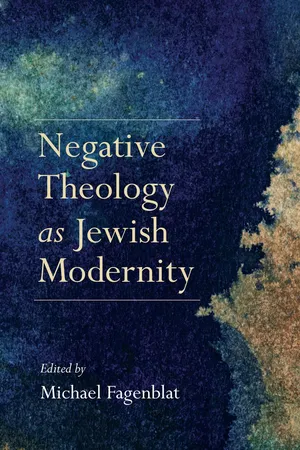
Negative theology is the attempt to describe God by speaking in terms of what God is not. Historical affinities between Jewish modernity and negative theology indicate new directions for thematizing the modern Jewish experience. Questions such as, What are the limits of Jewish modernity in terms of negativity? Has this creative tradition exhausted itself? and How might Jewish thought go forward? anchor these original essays. Taken together they explore the roots and legacies of negative theology in Jewish thought, examine the viability and limits of theorizing the modern Jewish experience as negative theology, and offer a fresh perspective from which to approach Jewish intellectual history.
- 388 pages
- English
- ePUB (mobile friendly)
- Available on iOS & Android
eBook - ePub
Negative Theology as Jewish Modernity
About this book
Information
Topic
PhilosophySubtopic
Philosophy of ReligionONE
The Limits of Negative Theology in Medieval Kabbalah and Jewish Philosophy
“Nothing!” would be the ineluctable answer to the question: “what can be said of God?” For whatever God is—it is beyond the scope of human knowledge. Indeed, such a statement is very common not only in medieval Jewish philosophy but in medieval Kabbalah as well. However beyond that shared consensus, hide different conceptions of negative theology; this and more, alternative conceptions present at times a real challenge to the very definition of negative theology. To better understand what kind of negation is at stake in a given theological system, one needs to understand what kind of limits, as well as what is off-limits, the work of negative theology comes to set. What is the meaning of that “nothing” will indeed broadly depend on the role given to the delimitation of knowledge.
This essay offers a general overview of the different role played by negative theology in medieval Jewish philosophy and Kabbalah, in light of their different degree of commitment to negative theology. It is my intention to downplay the hegemonic tendency of negative theology and propose instead new ways to think about the interaction between negative and positive theologies. To my view, negative theology as a system that considers negation as the only possible approach is, as a matter of fact, marginal not only in Kabbalah but in Jewish philosophy as well. The main problem we encounter when attempting to assess the role of negative theology comes from its own paradoxical thinking and its hegemonic nature which, at face value, seems to leave no place for an alternative. It is nevertheless very rare to see negative theology eradicate all positive theology, for most of the time, it opens up or gives place to alternative theology. Whereas the role of what I propose to call “comprehensive negative theology” is better known, that of restrictive negative theology has not yet been properly assessed. However, even in the case of Maimonides, the main advocate of comprehensive negative theology, the extent of his negative theology is still an open question and scholarship offers a wide range of interpretations.
The role of negative theology in medieval Kabbalah is even the more problematic for, contrary to the comprehensive Maimonidean theology, it develops a restrictive use of negative theology. In Jewish philosophy and even the more so in Jewish mysticism, the rational/theological inquiry is usually challenged by the performative and contemplative relation to God opening up to nonspeculative approaches. In Jewish mysticism, Gershom Scholem’s understanding of the Kabbalistic theological structure is articulated on an ontological distinction between revealed God and concealed God.1 The problem raised by such a distinction is that it presupposes a theological system articulated on negative theology before we even get a chance to study the role of negative theology in a given system. Moshe Idel has pointed out the importance of thinking about theological conceptions in their diversity. This is not merely a call for pluralism, but also a revision of what is understood as the abstract and ineffable God.2 In the same vein but in a different perspective, in his pioneering article, Elliot Wolfson has also greatly unsettled our understanding of Kabbalah by challenging its negative theology in light of its positive assertions.3
In what follows I wish to push further that inquiry into the role of negative theology in medieval thought and describe in large strokes the limits themselves of negative theology. To that purpose I will address the question by inverting the formula of Elliot Wolfson and discussing positive theologies in light of negative assertions. This change of perspective will help us to understand aspects of negative theology and its relation to positive theology in a more fundamental way beyond their apparent contradictions. To that task it is crucial to distinguish between theological systems dedicated to negative theology and theological system where negative theology has a place but not necessarily a dominant one. To better understand the role of negative theology, I therefore propose to distinguish restrictive uses of negative theology from comprehensive negative theology. Restrictive because it cohabits with alternative positive conceptions that are not coming from within the work of negation. After a general overview of negative theology in philosophy and in Jewish philosophy, I will present the place of negative theology in medieval Kabbalah. The nature of the corpora discussed dictates that Jewish philosophy will be presented chronologically, whereas the Kabbalistic material will be organized thematically. While philosophical texts and authors present an organized corpus, this is not the case with Kabbalistic literature which is a much more fragmented and eclectic corpus.
In Jewish traditions, expression of negative theology goes back to Philo of Alexandria in the first century. Philo discusses the conception of God’s unknowability on the basis of Exodus 33:20 and its twofold Glory conception.4 However, the remote status of God does not disqualify every relation, since for Philo nonknowledge is the acknowledgment of human nothingness and as such presents a gateway to an encounter with God: “for then is the time for the creature to encounter the creator when it has recognized its own nothingness.”5 This mixture of total inaccessibility and the possibility of access nevertheless through negation is the very mark of the comprehensive approach of negative theology.
At face value, however, Philo’s negative theology became the legacy of the Christian church and the extent of his influence on Jewish thought has not yet been properly evaluated. Following a renewed interest in Neoplatonic and Aristotelian philosophies, the unknowability of God will become a motto among the medieval philosophical traditions both Muslim and Jewish. The Middle Ages, with the renewal of philosophy in Islam and consecutively in Judaism, sees the question of the divine attributes at the center of the debate. In the Islamic tradition, Al Kindi,6 Al Farabi, Avicenna, Al-Gazali, and Averroes will all exacerbate the unknowability of God. The exaltation of the ignorance has also been at the heart of medieval texts such as in the Theology of Aristotle and those of Muslims thinkers.7
In the spirit of their time, Jewish philosophers adhere as well to the idea of unknowability. Following the philosophy of Kalam, David ibn Merwan al-Mukammas, Saadia Gaon, and Joseph ibn Zaddik reject the semantic validity of divine attributes; nevertheless, they would accept predication only if it truly reflects God’s essence.8 A common use of negation aims to establish what He is not. For Al-Mukammas, for example, when we affirm that God is alive, we are in fact denying that He is dead.9 However, this approach should be seen as a partial negative theological approach, for Al-Mukammas nevertheless follows the view of the Mu‘tazilites, whom accept terms that are equivalent to God’s essence. This view stands in contrast to the more comprehensive and exclusive negative theology of the Book of Causes, in which nothing not even an attribute of essence can be predicated: “This is because description only comes to be by means of discourse, and discourse by means of intelligence, and intelligence by means of reasoning, and reasoning by means of imagination, and imagination by means of sense. However; the First Cause is above all things, since it is their cause; as a result then, it comes to be that it does not itself fall under sense or imagination or reasoning or intelligence or discourse; consequently, it is not describable.”10
For Saadya Gaon, rational knowledge and prophecy are equivalent, prophecy being superior only in virtue of its divine origin. Even though the epistemological dimension of the limit of knowledge is an important aspect of Saadya’s philosophy, the central point is still the divine unity in conformity with the philosophy of Kalam. In the controversy of his time between those who believe in attributes and those denying them, Saadya opt for a position that put forth the inner divine unity. Promoting the simplicity of God’s unity is meant to resolve the problem of attributes by refraining to resort to predication. Even though God cannot be known, the specific aspects of the divine unity are reflected in a formulation that offers some solution to important semantic problems. For example, the notion of divine simplicity excludes any differentiation in God and consequently gives an account of God’s essence but not by means of real attributes, modes, or attributes of essence. How can something partial be said about God without implying multiplicity in the Divine? For the problem of human-limited semantics lies in its equivalent partial approach to God. Simple, undifferentiated unity is the best testimony of His wholeness, since by denying multiplicity and attribution it affirms indivisible unity.11
Accordingly to his Neoplatonic heritage, Bachya ibn Paquda will also profess the unknowability of God. In the Duties of the Heart, the existence, unity, and eternity of God as essential attributes are opposed to attributes of action, distinguishing therefore attributes of God before and after the creation: “For He is exceedingly close to you in His activities, but infinitely remote in any representation of His essence or comparison with it. As already stated, we will never find Him in this way.”12 Through acknowledgment of God in the world, that is, of His actions, one can nevertheless experience God. Negative assertions have therefore a limited action, even if they are part of a process of purification of the soul and reason, worshiping God can only come from another way. Apparently, God’s revelation in His actions is a sufficient source of knowledge where the creature meets His creator, knows Him intimately and worships Him: “With the knowledge of God that is in their hearts; they serve Him as if they were with the holy angels in the highest heavens.”13
Shlomo ibn Gabirol, another central Neoplatonic philosopher, argues that “direct knowledge of the primary Existent is impossible why . . . because it is above and beyond all things and is illimitable.”14 Such a view can be tracked back to Isaac Israeli and his disciple Dunash ibn Tamim.15 For Gabirol, God is pure essence, and we only perceive his essence through a composite of form and matter such as it is reflected in God’s actions. Along with a notion of God’s essence as being above of everything, Gabirol promotes a view that will influence Kabbalah notably through its nachleben with Moshe ibn Ezra’s Arugat ha-Bosem. In Fons Vitae, the Master declares that “because the knowledge of any knower requires him to encompass what is known the illimitable cannot be encompassed by knowledge.”16
Even though apophatic approaches can be traced back very early in the Middle Ages, only with Maimonides can one find a comprehensive system of negative theology. According to his view, predication on God’s essence is strictly impossible, and the only knowledge possible is that of His actions. Maimonides’s negative theology rejects the ontological approach of his predecessors who while adhering to negative theology would...
Table of contents
- Cover
- Half title
- Title
- Copyright
- Contents
- Introduction. Delineations: Negative Theology as Jewish Modernity
- 1. The Limits of Negative Theology in Medieval Kabbalah and Jewish Philosophy
- 2. “No One Can See My Face and Live”
- 3. What Is Positive in Negative Theology?
- 4. Negative Theology as Illuminating and/or Therapeutic Falsehood
- 5. “My Aid Will Come from Nothingness”: The Practice of Negative Theology in Maggid Devarav Le-Ya’akov
- 6. Secrecy, Apophasis, and Atheistic Faith in the Teachings of Rav Kook
- 7. Two Types of Negative Theology; Or, What Does Negative Theology Negate?
- 8. Khoric Apophasis: Matter and Messianicity in Islamo-Judeo-Greek Neoplatonism
- 9. Negative Dialectics, Sive Secular Jewish Theology: Adorno on the Prohibition on Graven Images and Imperative of Historical Critique
- 10. The Passion of Nonknowing True Oneness: Derrida and Maimonides on God—and Jew, Perhaps
- 11. Jewish Negative Theology: A Phenomenological Perspective
- 12. Mysteries of the Promise: Negative Theology in Benjamin and Scholem
- 13. Can Halakhah Survive Negative Theology?
- 14. The Stylus and the Almond: Negative Literary Theologies in Paul Celan
- 15. “Gods Change”: The Deconstruction of the Transcendent God and the Reconstruction of the Mythical Godhead in Yehuda Amichai’s Open Closed Open
- 16. The Politics of Negative Theology
- Contributors
- Index
- Citation Index
Trusted by 375,005 students
Access to over 1.5 million titles for a fair monthly price.
Study more efficiently using our study tools.
Frequently asked questions
Yes, you can cancel anytime from the Subscription tab in your account settings on the Perlego website. Your subscription will stay active until the end of your current billing period. Learn how to cancel your subscription
No, books cannot be downloaded as external files, such as PDFs, for use outside of Perlego. However, you can download books within the Perlego app for offline reading on mobile or tablet. Learn how to download books offline
Perlego offers two plans: Essential and Complete
- Essential is ideal for learners and professionals who enjoy exploring a wide range of subjects. Access the Essential Library with 800,000+ trusted titles and best-sellers across business, personal growth, and the humanities. Includes unlimited reading time and Standard Read Aloud voice.
- Complete: Perfect for advanced learners and researchers needing full, unrestricted access. Unlock 1.5M+ books across hundreds of subjects, including academic and specialized titles. The Complete Plan also includes advanced features like Premium Read Aloud and Research Assistant.
We are an online textbook subscription service, where you can get access to an entire online library for less than the price of a single book per month. With over 1.5 million books across 990+ topics, we’ve got you covered! Learn about our mission
Look out for the read-aloud symbol on your next book to see if you can listen to it. The read-aloud tool reads text aloud for you, highlighting the text as it is being read. You can pause it, speed it up and slow it down. Learn more about Read Aloud
Yes! You can use the Perlego app on both iOS and Android devices to read anytime, anywhere — even offline. Perfect for commutes or when you’re on the go.
Please note we cannot support devices running on iOS 13 and Android 7 or earlier. Learn more about using the app
Please note we cannot support devices running on iOS 13 and Android 7 or earlier. Learn more about using the app
Yes, you can access Negative Theology as Jewish Modernity by Michael Fagenblat in PDF and/or ePUB format, as well as other popular books in Philosophy & Philosophy of Religion. We have over 1.5 million books available in our catalogue for you to explore.