Often disguised in public discourse by terms like "gay," "homoerotic," "homosocial," or "queer," bisexuality is strangely absent from queer studies and virtually untreated in film and media criticism. Maria San Filippo aims to explore the central role bisexuality plays in contemporary screen culture, establishing its importance in representation, marketing, and spectatorship. By examining a variety of media genres including art cinema, sexploitation cinema and vampire films, "bromances," and series television, San Filippo discovers "missed moments" where bisexual readings of these texts reveal a more malleable notion of subjectivity and eroticism. San Filippo's work moves beyond the subject of heteronormativity and responds to "compulsory monosexuality," where it's not necessarily a couple's gender that is at issue, but rather that an individual chooses one or the other. The B Word transcends dominant relational formation (gay, straight, or otherwise) and brings a discursive voice to the field of queer and film studies.
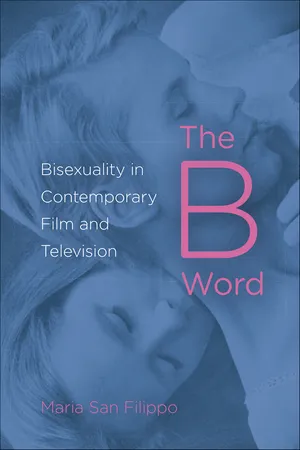
- 283 pages
- English
- ePUB (mobile friendly)
- Available on iOS & Android
eBook - ePub
About this book
Information
Subtopic
Film History & CriticismAmerican movies are based on the assumption that life presents you with problems, while European films are based on the conviction that life confronts you with dilemmas – and while problems are something you solve, dilemmas cannot be solved, they’re merely probed.
PAUL SCHRADER
ONE
Unthinking Monosexuality: Bisexual Representability in Art Cinema
Though schrader’s remark, clearly intended to provoke, may go too far in consigning popular commercial cinema and art cinema to opposing sides of the Atlantic, it offers a useful starting point for thinking about the expectations that filmmakers and audiences bring to different forms of filmmaking. For the majority of popular films classifiable as “mainstream” or “Hollywood” productions (both terms require troubling), it remains anathema to offer downbeat or ambiguous resolutions, longtime staples of art cinema. Conventional Hollywood narrative closure endorses compulsory monosexuality by reestablishing heterosexuality as the natural order and opposite-sex coupling as the ultimate goal. Characters who fail to conform to Hollywood’s boy-gets-girl dictate are typically homosocialized (female friends, male buddies) or fetishized into spectacles either hypersexualized (lesbian vampires) or romanticized (gay cowboys). Since the 1980s, homonormative same-sex coupling is increasingly tolerated in across-the-aisle crowd-pleasers such as 1993’s The Wedding Banquet, the low-budget romantic comedy that launched the career of its then-unknown director Ang Lee. Such films are made palatable for straight consumption through their downplaying of eroticism, and of the threat to social order represented by same-sex desire. Their feel-good tastefulness is a far cry from the 1990s New Queer Cinema, which featured films so defiantly nonassimilatory that they did not uniformly find favor even with the gay audience they targeted. In the sea of “positive images” and “gay role models” that has come to dominate the BGLQT film marketplace and media rhetoric since that brief moment of edgy irreverence, art cinema can still be counted on for a degree of narrative and erotic realism, daring, or complexity with regard to queer sexuality.
Whereas commercial cinema generally relies on clearly motivated, rational characters and Manichaean divisions between protagonists and antagonists to secure spectatorial identification, art cinema embraces ambiguity and illogicality as truthful rather than obfuscating. According to Robert Self, art cinema
perceives the social subject as a site of contestation and contradiction that is constantly in the process of construction and crisis under pressure from forces in the cultural formation. The subject is a process not yet fixed but open to difference and transformation. . . . The art cinema demands a reading strategy that looks not for resolution but for multiplicity, not for linear causality but for indeterminacy. The art cinema asks to be read in its ambiguity.1
By preventing any complete, coherent understanding of narrative meaning and character psychology, art cinema undermines and frustrates the Cartesian ideal of rational self-knowledge. Notwithstanding the commercial incentive of “having it both ways,” in its reluctance to resolve character identity or to desire monosexually, art cinema looks beyond Western modernity’s division between heterosexual and homosexual, and between homosexual and homosocial. Art cinema’s audiences respond in kind, adapting their modes of identification and perception to engage with enigmatic characters and to eroticize more freely. Previously I suggested that a primary way of gauging bisexual representability is to assess whether a film keeps open the possibility of bisexuality or relegates potentially bisexual characters and desires to fixed monosexual positions. In contrast to most popular cinema as well as “indie” films (a description more of a film’s sensibility than of its actual financing model), art cinema historically and cumulatively has mounted a substantial critique of compulsory monosexuality with its willingness to probe the dilemmas of desire.
Clearly the financial stakes are lower for art films – smaller budgets, less risk – than for studio-produced films, a factor that encourages experimentation, bisexual and otherwise. And, of course, featuring sexual titillation is a proven strategy for art films seeking American distribution. Overall, however, there seems to be a saturation point in terms of fiscal risk on an explicitly bi-suggestive film. Consider Hollywood’s experiments with relatively big-budget bisexuality: Gigli (Martin Brest, 2003), a film that despite going to great pains to disavow the sexual transgressions of its female lead (played by Jennifer Lopez) by having her fall for Ben Affleck’s character, performed abysmally at the box office. As did Domino (Tony Scott, 2005), a high-octane adaptation of the life of Domino Harvey, Hollywood royalty turned bisexual bounty hunter, starring Keira Knightley. Other studio-produced and/or -distributed films that ventured into explicit representations of queer identity and succeeded have either, as in the much-awarded Philadelphia (Jonathan Demme, 1993), played their sensitivity and sentimentality to the hilt, or, as in the cases of Boys Don’t Cry (Kimberly Peirce, 1999) and Brokeback Mountain, have hedged their bets with high publicity-to-production budget ratios and by avoiding significant formal disruptions. Despite the MPAA flap over Boys Don’t Cry’s depiction of oral sex, all three of these films kept the display of sexual activity muted.2 More recently, the bisexual female rebel-heroine Lisbeth Salander of Stieg Larsson’s Millennium Trilogy survived her Hollywood importation with bisexuality intact, in David Fincher’s 2011 adaptation; as I discuss in my conclusion, this recent remake could challenge industry thinking on big-budget bisexuality (if not the characteristic representation of it). I will explore this topic of Hollywood-financed queer representation more fully in chapter 3’s discussion of the bromance, but the pertinent point here is that the relative affordability of art cinema production fosters bisexual representability, as does the embrace of narrative ambiguity and complex characterization that art cinema’s specialized market niche allows. To represent sexualities and stories outside of the norm and in nonprescriptive, open-ended ways is a risky venture that violates studio productions’ preference for the proven and the palatable. Art cinema’s sexual frankness and associations with decadence (or deviance) enable it – perhaps more pervasively and pronouncedly than any other cinematic category – actively to open bisexual spaces. The question of what exactly constitutes art cinema is a fair one, especially amid contemporary industry phenomena such as the studio-produced “indie” film and the mainstream “art” film. Yet as David Bordwell put forth and more recent scholars continue to concur, there are distinctive if not necessarily disqualifying criteria for categorizing films as more or less attuned to the art film tradition.3 As I discuss below, the most prominent of those criteria are qualities that yield marked bi-potential, as illustrated by this chapter’s sampling of titles recognizably classifiable as art films.
Art cinema’s flexible meanings and open-ended resolutions obviate the need for bisexuality to name itself through dialogue or prove itself through action, making art cinema texts available for bisexual readings, Maria Pramaggiore describes:
Chronological narrative structures that assign more weight and import to the conclusion – typical of Hollywood film rather than, say, European art cinema – may be less compatible with bisexual reading strategies, which focus on the episodic quality of a nonteleological temporal continuum across which a number of sexual acts, desires, and identities might be expressed.4
Echoing Paul Schrader’s epigraph at the start of this chapter, Pramaggiore also overdetermines art cinema’s Europeanism, yet both their associations are predicated on the historical precedent whereby the European film industry receives substantial public support relative to that of the United States, thereby permitting greater artistic experimentalism. Although free of the intense focus on profits that characterizes major studio filmmaking, art cinema is hardly indifferent to the commercial advantage of polysemy to encourage multiple readings, both across diverse audiences and on the part of individual spectators. Art cinema facilitates, invites, and benefits from variable interpretations, making it widely dispersible and more likely profitable. A key component of this multivalence is bisexuality. Positioned industrially and aesthetically between popular Hollywood-style cinema and the more radical/experimental avant-garde, art cinema is formally accessible to a broader swath of spectators than the latter, regularly crossing over to a mainstream audience lured by star casts, genre markings, or titillating content.
Regarding the latter, despite the axiom “sex sells,” commercial filmmaking – intent on ensuring that no significant audience segment is shut out – has been decidedly sex-averse since the late 1970s. To fill the residual demand for adult content, Steve Neale observes, “Art Cinema has stabilised itself around a new genre: the soft-core art film.”5 In its willingness (and that of its audience) to explore alternative sexualities at both representational and discursive levels, art cinema and the film festival/art house/digital streaming circuit central to its distribution is the primary remaining bastion (save the adult film industry) for depictions of graphic sexuality. Again, its willingness to forego blockbuster profits makes art cinema more willing than popular cinema to risk the R (let alone NC-17) rating, feared to be sufficiently risky that studio directors often are contractually obligated to bring films in with a rating short of R. The recent success of the R-rated bromance has mitigated somewhat Hollywood’s reluctance in this regard, as chapter 3 will discuss, but R-rated studio fare remains largely bereft of queer eroticism. As Mark Betz demonstrates, art cinema advertising since at least the 1960s has taken its lead from exploitation cinema’s sensationalist tactics, teasingly referencing queer desire that never fully materializes or that resolves itself heteronormatively, as does the road trip of erotic awakening chronicled in Le Voyage en Douce (Michel Deville, 1980), in which the same-sex intimacy and impromptu three-way explored by sisterly best friends Hélène (Dominique Sanda) and Lucie (Geraldine Chaplin) ends anticlimactically with each returning to the stultifying marriages they were initially intent on escaping.6 While certainly not impervious to the pull of compulsory monosexuality that challenges bisexual readings, art cinema’s comparative freedom to openly, unapologetically depict eroticism should in theory make bisexuality legible where it is elsewhere relegated to the connotative closet – that is, made (in)visible.
Despite Schrader’s and Pramaggiore’s demarcation of American versus European sensibilities, transnational art film coproductions have long troubled the conceptual and industrial borders of national cinemas similar to the way that bisexuality challenges monosexual boundaries. Art cinema is a cinema of exile insofar as its financing, postproduction, and exhibition are frequently dislocated from their local contexts. In certain cases, namely for Iranian and mainland Chinese filmmakers, this exile is politically determined; for filmmakers elsewhere it is economically driven, as figures such as Michael Haneke, Alejandro González Iñárritu, David Lynch, and Raoul Ruiz seek out more amenable funding sources and reception outlets for projects deemed noncommercial in their native markets.
These culturally and industrially hybridized aspects of art cinema mirror the blurring of borders and troubling of binaries that bisexuality accomplishes. Moreover, in its critique of compulsory monosexuality, bisexuality theory shares with postcolonial theory an aim to deconstruct, or “unthink,” entrenched Western structures of knowledge and power. Bisexuality theory challenges the hierarchical binary heterosexual/homosexual in a way that recalls postcolonial theory’s disruption of the colonizer/colonized dyad in favor of hybridity as a conceptual strategy for unthinking Eurocentrism. Like bisexuality, the term hybridity provokes anxieties with its unfixedness and evocation of miscegenation, as tourism theorist Anne-Marie d’Hautserre reflects:
Hybridity brings with it ambiguity, and thereby threatens the orderliness of the schematized reality of tourists. Hybridity is redolent of miscegenation, which was one of the greatest fears of most self-respecting travelers. . . . Hybridized identities are sometimes said to have lost authenticity, and thus authority. . . . Relationships with visited “others” are difficult to enact because of a continued fear of pollution or contamination.7
Without suggesting that the ontology and experience of bisexuality is identical to that of other hybrid identities, this passage’s description of dominant cultural perceptions about hybridity evokes analogous anxieties and stigmas around bisexuality, which itself is often alleged to constitute a sort of sexual tourism (that is, heteroflexible experimentation free of the responsibilities of gay identity). Much as contemporary tourist theory appropriates hybridity to critique the tourist/other binary, bisexuality theory appropriates bisexuality to critique monosexuality.
Furthermore, bisexuality is subject to figurative colonization by heteropatriarchal capitalism, which operates in a way that is conceptually analogous to the literal colonization of subaltern peoples and territories insofar as, tourism theory notes, “exotic places are controlled by being familiarized and domesticated through a language that locates them in a universal (meaning Western) system of reference that visitors recognize and can communicate about.”8 Bisexual chic is enabled and fed by a safe exoticizing or assimilation of bisexual images and spaces, much as “third world” tourism under Western capitalist (models of) control makes it safe for Western travelers to venture into unfamiliar territory so as to pleasurably consume images of otherness and the labor of impoverished others. Rhetoric of “universalizing” sexual or cultural difference defuses the threat of otherness even as dominant ideology redoubles efforts to contain the colonizer/colonized duality by subsuming difference within a binary division that sees otherness only in relation to the dominant/normative. What follows is a consideration of this bi-textual analogy “bisexuality as cultural hybridity” through its personification in a recurring figure in art cinema: the bisexual-bohemian.
MORE THAN A TOURIST: THE BISEXUAL-BOHEMIAN AND CULTURAL HYBRIDITY
“Bisexuality as the expression of fullness of an individual – and an honest rejection of the – yes – perversion which limits sexual experience . . . “
SUSAN SONTAG, Reborn: Journals and Notebooks, 1947–1963
Fittingly conjoining bisexuality and art cinema by embodying their shared signification of displacement from normative values, art cinema’s bisexual-bohemian is typically a privileged white woman who straddles two worlds: her native Western culture, characterized as stifling and heteropatriarchal, and an alternative (usually non-Western) realm shown to be seductive and liberating yet potentially dangerous and perverse. In rejecting social convention in favor of a liminal existence and personal liberation, the bisexual-bohemian becomes susceptible to ...
Table of contents
- Cover
- Title
- Copyright
- Dedication
- Contents
- Acknowledgments
- Prologue Chasing Amy and Bisexual (In)visibility
- Introduction Binary Trouble and Compulsory Monosexuality
- 1 Unthinking Monosexuality: Bisexual Representability in Art Cinema
- 2 Power Play/s: Bisexuality as Privilege and Pathology in Sexploitation Cinema
- 3 Of Cowboys and Cocksmen: Bisexuality and the Contemporary Hollywood Bromance
- 4 Bisexuality on the Boob Tube
- Conclusion Queer/ing Bisexuality
- Notes
- Bibliography
- Index
- About the Author
Trusted by 375,005 students
Access to over 1.5 million titles for a fair monthly price.
Study more efficiently using our study tools.
Frequently asked questions
Yes, you can cancel anytime from the Subscription tab in your account settings on the Perlego website. Your subscription will stay active until the end of your current billing period. Learn how to cancel your subscription
No, books cannot be downloaded as external files, such as PDFs, for use outside of Perlego. However, you can download books within the Perlego app for offline reading on mobile or tablet. Learn how to download books offline
Perlego offers two plans: Essential and Complete
- Essential is ideal for learners and professionals who enjoy exploring a wide range of subjects. Access the Essential Library with 800,000+ trusted titles and best-sellers across business, personal growth, and the humanities. Includes unlimited reading time and Standard Read Aloud voice.
- Complete: Perfect for advanced learners and researchers needing full, unrestricted access. Unlock 1.5M+ books across hundreds of subjects, including academic and specialized titles. The Complete Plan also includes advanced features like Premium Read Aloud and Research Assistant.
We are an online textbook subscription service, where you can get access to an entire online library for less than the price of a single book per month. With over 1.5 million books across 990+ topics, we’ve got you covered! Learn about our mission
Look out for the read-aloud symbol on your next book to see if you can listen to it. The read-aloud tool reads text aloud for you, highlighting the text as it is being read. You can pause it, speed it up and slow it down. Learn more about Read Aloud
Yes! You can use the Perlego app on both iOS and Android devices to read anytime, anywhere — even offline. Perfect for commutes or when you’re on the go.
Please note we cannot support devices running on iOS 13 and Android 7 or earlier. Learn more about using the app
Please note we cannot support devices running on iOS 13 and Android 7 or earlier. Learn more about using the app
Yes, you can access The B Word by Maria San Filippo in PDF and/or ePUB format, as well as other popular books in Media & Performing Arts & Film History & Criticism. We have over 1.5 million books available in our catalogue for you to explore.