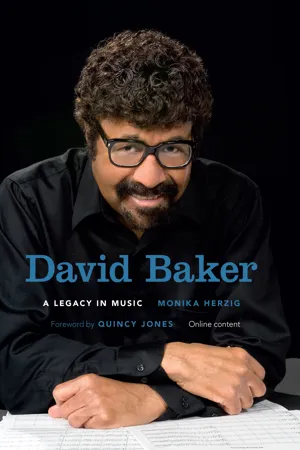
A Living Jazz Legend, musician and composer David Baker has made a distinctive mark on the world of music in his nearly 60-year career—as player (chiefly on trombone and cello), composer, and educator. In this richly illustrated volume, Monika Herzig explores Baker's artistic legacy, from his days as a jazz musician in Indianapolis to his long-term gig as Distinguished Professor and Chairman of the Jazz Studies department at Indiana University. Baker's credits are striking: in the 1960s he was a member of George Russell's "out there" sextet and orchestra; by the 1980s he was in the jazz educator's hall of fame. His compositions have been recorded by performers as diverse as Dexter Gordon and Janos Starker, the Beaux Arts Trio, the Composer's String Quartet and the Czech Philharmonic. Featuring enlightening interviews with Baker and a CD of unreleased recordings and Baker compositions, this book brings a jazz legend into clear view.
The story of David Baker’s life began in 1931 in Indianapolis, Indiana. At that time, nearly 45,000 African Americans lived in the city of approximately 365,000 people.1 Neighborhoods, parks, businesses, and schools were segregated, yet African American children – for the most part – were insulated from the harsh political and racial tensions that marked the times. The eastside neighborhood of Baker’s childhood was a close-knit community in which black children had little contact with white people. A sense of innocence prevailed, with little notion that there was any other way of life. It was a time of strong extended families and neighbors who shared the responsibility of raising children. There was a spirit of hope, optimism, and pride among African Americans, despite the racial indignities of everyday life. As in many communities across the United States in the 1930s and ’40s, life revolved around the local business district, neighborhood schools, and churches.
Indiana Avenue was the business and social thoroughfare of the African American community in Indianapolis, and it offered a vast range of enterprises – from barber shops, beauty salons, and restaurants to bars, pool halls, and nightclubs. In 1927, the Madame Walker Theatre opened its doors and became a mecca for blacks who were not allowed in the same theaters as whites, or – if admitted – were forced to sit in the balcony. The theatre was the realization of a longtime dream of African American businesswoman Madame C. J. Walker, who built a fortune in the early 1900s marketing hair care and beauty products to African American women.2 When she died in 1919, she was the wealthiest black woman in America. Sunday afternoons at “The Madame Walker” were legendary. The Walker Building was an elegant place where African Americans, dressed in their finest clothes, were treated like royalty. After a leisurely Sunday lunch, families often went upstairs to enjoy a movie in the beautiful theater with African-type décor, where patrons were not relegated to the balcony because of skin color.
Lining Indiana Avenue at any given time during the 1930s and ’40s were fifteen to twenty clubs that featured jazz six nights a week. The Sunset Terrace and the Cotton Club often showcased artists of international renown such as Count Basie, Dizzy Gillespie, or Charlie Parker. After-hours clubs provided the opportunity for local musicians to meet after their regular playing engagements to listen to and play with one another. Perhaps the most famous of these was the Missile Room, where the Wes Montgomery Trio was the house band. The trio featured Wes Montgomery on guitar, Melvin Rhyne on organ, and Paul Parker on drums.3 Indianapolis, which was a hub for car and train travel, was host to countless traveling musicians, many of whom ended their evenings at one of these clubs. Talented locals and visiting celebrities engaged in many a late-night battle at Henri’s, where the sign over the door read, “Through these portals pass the world’s finest musicians.”4
The public schools in Indianapolis, like those in many large city school districts across America in the first half of the twentieth century, were very strong and provided children an excellent education. De facto segregation in Indianapolis assured that elementary schools were mostly segregated: however, before 1927 there was not a separate high school for blacks. Members of the Ku Klux Klan dominated the school board and police force in Indianapolis, as well as much of the Indiana state government. Under their leadership, support for a “separate but equal” high school for blacks grew. Despite strong opposition from black organizations such as the Indianapolis branch of the NAACP and the black press, the Indianapolis School Board voted to construct a separate high school for African Americans.5 Just four years before David Baker’s birth, the all-black Crispus Attucks High School opened its doors amidst considerable controversy. It soon became a cultural center and a source of great pride for the African American community. Indianapolis poet Mari Evans writes,
The neighborhood was sustaining. Children were protected and insulated by classrooms manned by Black teachers who cared passionately about their charges’ futures, who saw promise in them, loved them, chastised them promptly, and encouraged them to be more than even they envisioned. Those schools were places where Black children understood above all else they were loved, and being cared for with love.6
In the mid-1920s, prior to the opening of Crispus Attucks High School, approximately 800 black students were enrolled at three Indianapolis high schools: Shortridge, Emmerich Manual, and Arsenal Technical. Although Attucks had been designed to accommodate 1,000 students, more than 1,350 students arrived on opening day.7 Influenced by the progressive education movement and a greater emphasis on secondary education, African American families increasingly valued formal education and personal intellectual development. Many black children who had earlier withdrawn from other high schools, as well as those who had not attended high school at all, enrolled at Attucks now that there was a high school where blacks were supported and embraced. Norman Merrifield, who graduated from Arsenal Technical High School in 1923, recalls that before Attucks opened, “Negro students were not encouraged to complete high school and get diplomas.”8 Ironically, Crispus Attucks High School, a byproduct of the segregationist philosophy of the Klan, provided unprecedented opportunities for African American students and became a beacon of excellence and a source of great pride.
On December 21, 1931, David Nathaniel Baker, Jr., was born to working-class parents in the center of this culturally rich environment, which was nurturing and at the same time riddled with contradictions. His father, who moved to Indianapolis from Kansas City, Missouri, in 1928, held a degree in carpentry from Hampton Institute in Hampton, Virginia. Despite his training and credentials, he wasn’t able to work as a carpenter because of the Indianapolis labor union’s racially closed policies. Ultimately, as many blacks did at the time, he went to work in public service. David’s mother died when he was four, and his father remarried. David’s immediate family included his younger sister, Shirley; his half-sister, Cleela; and stepbrother, Archie. Although there is no evidence of significant musical background in David’s family, his father played the alto saxophone while at the Hampton Institute and “messed around” playing boogie-woogie on the piano when David was a child. Unsubstantiated family lore holds that while in Kansas City, his father played violin in an orchestra with Ben Webster.9
David’s formative years were filled with all types of music. Attracted to the family’s player piano, he spent countless hours pumping the pedals to operate the piano rolls and watching the various configurations of keys. According to his stepmother, “Boys didn’t take piano,” yet he listened with interest as his sister practiced for lessons she was forced to take. When David was a child, his grandmother enlisted his help winding the Victrola at his aunt’s teenage parties. There he was exposed to the dance music of the time such as Peggy Lee’s rendition of “Why Don’t You Do Right,” and Al Hibbler’s “Don’t Get Around Much Anymore.” His father frequently listened to the radio, and favored the music of Louis Armstrong, which David recalls having little interest in at the time, since he much preferred Grand Ole Opry stars Gene Autry and Minnie Pearl. “In the Mood” and “Tuxedo Junction” wafted from the jukebox at the skating rink, and Saturdays at his cousin Walt’s barbershop were filled with the bebop tunes of Jay McShann and, later, Charlie Parker and Dizzy Gillespie.10
As a youngster, Baker benefited from a caring school environment and exceptional teachers. His earliest musical experiences were in Mrs. Kirk’s grade-school choir at Francis Parker Elementary School, the neighborhood school just a block from Baker’s house. In addition to music classes once or twice a week, the choir performed at special events such as the annual May Day Celebration. George Bright, Indianapolis saxophonist and contemporary of Baker’s, recalls Clara Reese Kirk was a “really fine teacher who had a box of 78s [records] in her cloakroom, was ‘hip’ to Stan Kenton, and really knew what was going on.”11
In seventh grade at Public School 26, David had his first, albeit brief, introduction to the trombone, which his parents rented from the school. After just two weeks, his band teacher sent the fifty-cent rental fee home with a note saying he had no talent. Fortunately he was still singing in Mrs. Kirk’s choir and the following year, a new band teacher at the school started him on the E
tuba, which he played throughout eighth grade. He even practiced on the streetcar on his way home, much to the dismay of other passengers.12
Crispus Attucks High School had been open for nineteen years when David began his freshman year. A tradition of excellence had been established in many areas, not the least of which was music. When the school opened in 1927, excellent teachers, all with master’s degrees and some with doctorates, were recruited from traditionally black colleges in the South and from segregated high schools in other states. Although the faculty was among the finest in the country, the school often had to settle for secondhand equipment from one of the other high schools in the city.13 In 1932 Attucks’s founding principal, Matthius Nolcox, was replaced by Russell Lane, who had ascended the ranks of the original Attucks faculty. Lane faced a myriad of challenges as he accepted the leadership position at the end of the Great Depression, as sentiments about the school remained mixed among whites and blacks alike. Lane met the situation head on, and strove to expand the curriculum, maintain the best possible faculty, and to inspire and motivate students. He set high standards, encouraging students to do their best and instilling in them a strong work ethic and pride in their accomplishments. The image of him standing in the street in front of the school before the morning bell, shepherding students into the building, is indelibly etched in the memories of many Attucks graduates.14 Lane and the Crispus Attucks faculty believed that the students could be anything they wanted to be. They expected and accepted only the best, encouraging students to refrain from behavior that would promote the stereotypical image of African Americans held by many whites at the time. Crispus Attucks High School symbolized the paradox of segregation. Founded as a result of Ku Klux Klan efforts to keep black children separate, and provided with secondhand resources, it was “programmed to fail, but excelled instead.”15
The attitude of excellence that permeated the school was exemplified by the music department. Instrumental teachers LaVerne Newsome, Norman Merrifield, and Russell W. Brown were outstanding musicians, trained at some of the finest music schools in the country. LaVerne Newsome, a graduate of Northwestern University, taught orchestra, string classes, and music appreciation, and was known for his dedication to his students. Merrifield, chairman of the Attucks music department, was a pianist, choral director, band director, composer, and arranger. He held bachelor and master’s degrees in music education from Northwestern University. The music department thrived under his leadership, embodying the values of post-Reconstruction black American life, which blended African heritage with European art music. The curriculum included offerings in music theory, music appreciation, and humanities – as well as band, choir, and orchestra. A dedicated teacher, Merrifield sought meaningful musical experiences for his students and presented music as a creative art. An exhibit at the Crispus Attucks Museum displays a letter Merrifield wrote to W. C. Handy, in which he asked the composer to communicate with emerging Attucks musicians. Handy’s reply, an autographed copy of a portion of his “St. Louis Blues” manuscript, includes an inspirational note from the composer.16 Baker, who studied music theory with...
Table of contents
Cover
Title
Copyright
Contents
Foreword
Preface
Accessing Audiovisual Materials
Acknowledgments
1 Indiana Avenue and Crispus Attucks High School
2 A Star Is Born
3 New Beginnings
4 Defining Jazz Education
Illustrations
5 21st Century Bebop
6 The Composer
7 David Baker and the Smithsonian: A Personal Perspective
8 Social Engagement
9 Coda
Appendixes
Bibliography Of Written Works by David Baker
Discography
Selected List of Books, Articles, and Other Publications About David Baker
About the Contributors
Index
Trusted by 375,005 students
Access to over 1.5 million titles for a fair monthly price.
Study more efficiently using our study tools.
Frequently asked questions
Yes, you can cancel anytime from the Subscription tab in your account settings on the Perlego website. Your subscription will stay active until the end of your current billing period. Learn how to cancel your subscription
No, books cannot be downloaded as external files, such as PDFs, for use outside of Perlego. However, you can download books within the Perlego app for offline reading on mobile or tablet. Learn how to download books offline
We are an online textbook subscription service, where you can get access to an entire online library for less than the price of a single book per month. With over 1.5 million books across 990+ topics, we’ve got you covered! Learn about our mission
Look out for the read-aloud symbol on your next book to see if you can listen to it. The read-aloud tool reads text aloud for you, highlighting the text as it is being read. You can pause it, speed it up and slow it down. Learn more about Read Aloud
Yes! You can use the Perlego app on both iOS and Android devices to read anytime, anywhere — even offline. Perfect for commutes or when you’re on the go. Please note we cannot support devices running on iOS 13 and Android 7 or earlier. Learn more about using the app
Yes, you can access David Baker by Monika Herzig in PDF and/or ePUB format, as well as other popular books in Media & Performing Arts & Jazz Music. We have over 1.5 million books available in our catalogue for you to explore.