A biographical account of two major thinkers of the twentieth century, a relationship marked as much by estrangement and distance as reunion and friendship.
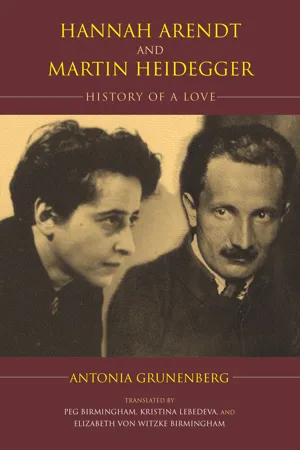
How could Hannah Arendt, a German Jew who fled Germany in 1931, have reconciled with Martin Heidegger, whom she knew had joined and actively participated in the Nazi Party? In this remarkable biography, Antonia Grunenberg tells how the relationship between Arendt and Heidegger embraced both love and thought and made their passions inseparable, both philosophically and romantically. Grunenberg recounts how the history between Arendt and Heidegger is entwined with the history of the twentieth century with its breaks, catastrophes, and crises. Against the violent backdrop of the last century, she details their complicated and often fissured relationship as well as their intense commitments to thinking.
"Focuses on a relationship that began when Arendt was a student in the 1920s, was broken between 1933 and 45, and resumed after the war." —
The Chronicle of Higher Education
eBook - ePub
Hannah Arendt and Martin Heidegger
History of a Love
- 340 pages
- English
- ePUB (mobile friendly)
- Available on iOS & Android
eBook - ePub
Hannah Arendt and Martin Heidegger
History of a Love
About this book
Information
Topic
PhilosophySubtopic
Philosopher Biographies1 | World Out of Joint, or How the Revolution in Philosophy Began |
THE TWENTIETH CENTURY began with a stealthy revolution in politics and culture, art and literature, industry, technology, and science. Everyone spoke of great changes:
Thus it was a world full of antitheses, this “fin de siècle,” where everything was chaotically swirling and surging through each other, at once carnival and Ash Wednesday, powerfully emerging Renaissance and pessimistically tired decadence; imperialistic desire for power and craving for peace at any cost; a time of “restlessness and need for stimulation,” but also of the need for rest, overly satiated with excitement; of losing oneself in the dispersion of the outside world and of longing to regain the inner and the unitary. And the people of this time were moved, on the one hand, plagued from early youth onwards by a complete overestimation of the intellect, and therefore agitated by unspoken and unspeakable moods, and on the other hand, driven practically, functionally, by will and energy toward the external and internal worlds; pessimistic and indifferent, tired and feeble on the one hand, and, on the other, animated by the will to live, energetically and ambitiously striving forward with vitality and love of life; free from prejudices, unbelieving and critical, cold through and through, and at the same time seized by all kinds of mysticism or at least superficially playing with it, full of curiosity and interest for everything enigmatic and secret, for everything profound and otherworldly, and putting science itself in the service of superstition or pretentiously masking it with a form of occult science.1
Theobald Ziegler’s painting of fin-de-siècle mores, created with powerful strokes, has its source in the contradictions of such a rich age. The Intellectual and Social Currents of the 19th Century was first published in 1899. Ziegler was a sensitive observer of change. He recognized that a contradictory world had emerged wherein unequal forces clashed with one another (natural sciences versus humanities; Marxism versus racism; the Industrial Revolution versus traditionalism; modernity versus antimodern myth), a world where new hierarchies were not yet recognizable.
In 1920 the collection of poetry Menschheitdämmerung—Symphonie jüngster Dichtung appeared. Containing poetry from 1910 to 1919, the collection served as an “anti-anthology” sustained by passionate feelings directed against the predominance of the natural sciences and mathematical rationality over humanities and culture. Its editor Kurt Pinthus wrote in the foreword:
The humanities of the expiring nineteenth century—irresponsibly carrying over the laws of natural sciences into spiritual occurrences—contented themselves, in the realm of art, with observing, in accordance with the principles of historical development and influences, the successive and sequential; they saw causally, vertically. This book endeavors to become a collection in a different way: it listens to the poetry of our time … it listens across, it looks all around … not vertically, not successively, but horizontally; it does not separate into pieces what follows in succession, but rather listens to it together, at the same time, simultaneously.… Man as such, not his private affairs and feelings, but rather mankind, is a truly endless theme. These poets felt early on how man sank into twilight … sank into the night of the downfall … in order to reemerge in the clear dawn of a new day.… The poets of this book know this just as I do: it saves our youth; joyfully beginning, initially overflowing, disseminating life.2
Pinthus’s foreword, and this is true of the entire collection, is a manifesto against tradition and a call for a new beginning. It is a skillfully staged call of the young against the old, of life against death and boredom, of the future against the past, of self-confidence against subservience, of anarchic zest against constraining convention.
The eruptions in art, literature, industry, science, and the everyday world took place on public stages, in public discourse, in scientific thought, and in artistic imaginings. The revolutionary moods superimposed themselves upon one another; they provoked one another even as they collided. Each was part of a larger story concocted behind the backs of the actors; it captured and bore them away with the storm of their passions, their desire for disintegration, their creativity, hopes, anxieties, and hubris. And at the center was the longing for a large shocking event that not only Georg Heym yearned for: “Würzburg May 30 [1907] Also I can say: if only there were a war, I would be healthy. One day is like another. No big joys, no big pains.… It all is so boring.”3
Detours to Philosophy: Karl Jaspers
Here we speak of a revolution in philosophy. It announced itself in the proclamations of barely mature young men. It swept across people’s homes, the spacious classrooms of sedate educational institutions, the dormitories of secular boarding schools and Catholic convents, to flow into the universities and public life. Scholarly living rooms, hiking trails, auditoriums, journals, book manuscripts, and letters were its arenas. Friendships were made and unraveled in its name.
The philosophical revolution spread like an avalanche. It swept up ever more people—friends, enemies, and the next generation, whose brightest lights (also women!) had craved something like this since grammar-school days.
In the scholarly world, two friends set this avalanche in motion: Martin Heidegger and Karl Jaspers. The two could not have been more different. One was small from birth, sporty, sensitive, awkward, high-strung, and shy to the point of seeming humble. The other was tall, of a noble stature, self-conscious, self-critical, and sickly. Both wanted to found a new way of thinking, a thinking that expressed the Dasein of mankind in this new time. But only one of them would attain world fame. To him alone did posterity bestow the honor of discovering something truly new: that thought comes not from thinking, but from being.
The young men came from opposite poles of the social world. Martin Heidegger was born in 1889, his father a sexton in Meßkirch. His parents’ home was Catholic, conservative, and not well off.
Karl Jaspers was born in 1883. His father was a banker; he would later become the director of the Spar- und Leihkasse bank in Oldenburg. He became a member of the federal state parliament and chair of the city council in the county and town of Oldenburg. Jasper’s father was a national-liberal and of a tolerant mind.4 Before the start of his studies, the young Jaspers was diagnosed with a secondary cardiac disorder and severe bronchiectasis. This constrained him throughout his life. Yet, advised by his doctor, Albert Fraenkel, and through a great deal of self-discipline, he succeeded in finding a modus vivendi that allowed him to study.5 His intellect was sharp, and his interests were so widespread that at first he was not sure of his direction. All authority was foreign to him, and he openly hated the academy. He chose law, but he found the teachers too mediocre.
An early photo of him as a student shows him on a break in Sils-Maria in August 1902 with the physiologist Fano from Florence and the art historian Carl Cornelius from Freiburg. Jaspers is in the middle, sovereign and physically towering over the other two, holding a big book, shyly smiling for the viewers. The professors Fano and Cornelius are kneeling to each side, laying their right hands on the book from opposite sides; the photo is subtitled “Pledge to the Spirit of Science.” Both scholars apparently had fun kneeling before the student and passing on to him the role of the keeper of knowledge. At that time, he still did not know where his interests were taking him. In long conversations, the older colleagues advised him to change to medicine or at least to the natural sciences. At home he was uneasy about explaining what was provoking him to switch. In August 1902 he composed a note wherein he explained to his parents the path he wished to pursue: “It has been clear to me for a month that I want to give up law and study medicine.… If I had an eminently gifted mind, I would first study the natural sciences and philosophy in order to take up an academic career directly. I would pursue a doctorate in philosophy, and of course also exhaustively study medicine as one of the basic principles upon which physiology and philosophy can be built.… Since, however, the requirements have not been met, I will study medicine.”6 He did not send the note, but in a conversation with his father in Oldenburg he was able to convince him of the need for a change. He then studied medicine in Berlin, Göttingen, and Heidelberg. He was, however, interested in all the other natural sciences and also read philosophy in his free time. In 1908 he passed his state examination in Heidelberg with a grade of “good.” Having received his doctorate for his work on “homesickness and crime” (summa cum laude), he received his physician’s license in Heidelberg in 1909, married and specialized in psychiatry. He wanted to understand both the patient and the illness and to this end he needed psychology and psychiatry. For years, both realms had been recognized as university disciplines. The revolution of the natural sciences in the 1860s and 1870s had paved the way for this. In 1894 Sigmund Freud had first used the concepts “hypnotic” and “clinical-psychological analysis.”7 At first, psychoanalysis influenced this development only marginally, but as the years passed, it proved to be groundbreaking. However, for many in the natural sciences as well as in the humanities, it was psychology and not psychoanalysis that became the guiding science.
For six years Karl Jaspers worked as an assistant in psychiatry in Heidelberg. He was drawn ever more deeply into the field through his experiences with patients, his study of disease patterns and histories and their relationship to the personality of the patient, as well as through reading the professional literature. Much to the dismay of his colleagues who saw medicine as a pure natural science, he engaged in academic debates:
with ever stranger postulates: One must systematically review the psychiatric literature of the previous decades and centuries in order to avoid the permanent relapse into forgetting; one must draw the conclusion that mental illnesses are indeed psychic illnesses and illnesses of personality; one must orient himself towards the humanities, towards psychology and anthropology; one must find a language that allows for a clear and recognizable description of symptoms; above all, one must know what a theory, what science, what a method, what “understanding” means. To this end one needs philosophy. He who pursues psychopathology must first learn how to think.8
His colleagues could not begin to understand his search for a general principle for understanding the social sciences and the humanities. They considered it a waste of time and saw in Jaspers a mischief maker. He, however, had long been caught up in a philosophical train of thought from which he could not detach himself. Also decisive for his turn to psychology was the fact that for some time he had been feeling unfit for the physically demanding work in psychiatry. The frustration resulting from this did not, however, last long: “In looking back it all seems remarkable. What at that time was enforced by my illness and done reluctantly was in fact leading me to the road for which I was destined. From early youth on I had been philosophizing. Actually I had taken up medicine and psychopathology from philosophical motives. Only shyness in view of the greatness of the task kept me from making philosophy my life’s career.”9 Yet not quite, one could say. What also contributed to his ultimate decision was the fact that since he was not paid, he was under no obligation to the clinic. His father still provided for him financially. He thus did not need to consider the judgment of his colleagues and could follow his own path. However, he approached philosophy differently than the majority of his contemporaries who took philosophy to be the world of transcendent certitudes into which one only needs to become integrated. Is philosophy then not self-evident? For his contemporaries, it was only a matter of reading the doctrines of the great philosophers and interpreting them in accordance with the needs of the age. Jaspers, on the other hand, plunged into philosophy with his entire existence and he expected answers from it. His biographer Hans Saner surmises: “This view of philosophy stemmed from the solitude of his student days and from the awareness of the constant threat of illness. What meaning could there be in an existence that was necessarily detached from that of other people? What meaning did the effort of activity have if there were no objective results to be expected because of the probability of an early death? No science could answer this.”10
Only Karl Jaspers himself could find the answer: “there re...
Table of contents
- Cover
- Title Page
- Copyright
- Contents
- Foreword
- Acknowledgments
- Introduction to the English Translation
- Introduction
- 1 World Out of Joint, or How the Revolution in Philosophy Began
- 2 Life’s Transformation, or the Sudden Eruption of Love in Life
- 3 The Failure of the German-Jewish Symbiosis, or Friends Becoming Enemies
- 4 Heidegger absconditus, or the Discovery of America
- 5 The Break in Tradition and a New Beginning, or Arendt and Heidegger in Counterpoint
- 6 Amor Mundi, or Thinking the World after the Catastrophe
- Chronology
- Index
- Illustrations
Trusted by 375,005 students
Access to over 1.5 million titles for a fair monthly price.
Study more efficiently using our study tools.
Frequently asked questions
Yes, you can cancel anytime from the Subscription tab in your account settings on the Perlego website. Your subscription will stay active until the end of your current billing period. Learn how to cancel your subscription
No, books cannot be downloaded as external files, such as PDFs, for use outside of Perlego. However, you can download books within the Perlego app for offline reading on mobile or tablet. Learn how to download books offline
Perlego offers two plans: Essential and Complete
- Essential is ideal for learners and professionals who enjoy exploring a wide range of subjects. Access the Essential Library with 800,000+ trusted titles and best-sellers across business, personal growth, and the humanities. Includes unlimited reading time and Standard Read Aloud voice.
- Complete: Perfect for advanced learners and researchers needing full, unrestricted access. Unlock 1.5M+ books across hundreds of subjects, including academic and specialized titles. The Complete Plan also includes advanced features like Premium Read Aloud and Research Assistant.
We are an online textbook subscription service, where you can get access to an entire online library for less than the price of a single book per month. With over 1.5 million books across 990+ topics, we’ve got you covered! Learn about our mission
Look out for the read-aloud symbol on your next book to see if you can listen to it. The read-aloud tool reads text aloud for you, highlighting the text as it is being read. You can pause it, speed it up and slow it down. Learn more about Read Aloud
Yes! You can use the Perlego app on both iOS and Android devices to read anytime, anywhere — even offline. Perfect for commutes or when you’re on the go.
Please note we cannot support devices running on iOS 13 and Android 7 or earlier. Learn more about using the app
Please note we cannot support devices running on iOS 13 and Android 7 or earlier. Learn more about using the app
Yes, you can access Hannah Arendt and Martin Heidegger by Antonia Grunenberg,Elizabeth von Witzke Birmingham, Peg Birmingham,Kristina Lebedeva in PDF and/or ePUB format, as well as other popular books in Philosophy & Philosopher Biographies. We have over 1.5 million books available in our catalogue for you to explore.