Essays exploring contemporary black fiction and examining important issues in current African American literary studies.
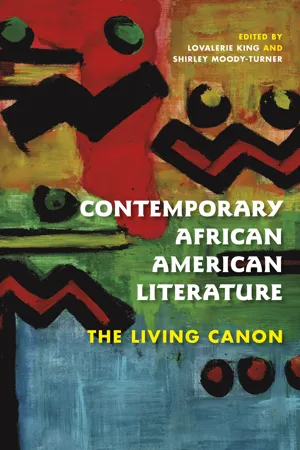
In this volume, Lovalerie King and Shirley Moody-Turner have compiled a collection of essays that offer access to some of the most innovative contemporary black fiction while addressing important issues in current African American literary studies. Distinguished scholars Houston Baker, Trudier Harris, Darryl Dickson-Carr, and Maryemma Graham join writers and younger scholars to explore the work of Toni Morrison, Edward P. Jones, Trey Ellis, Paul Beatty, Mat Johnson, Kyle Baker, Danzy Senna, Nikki Turner, and many others. The collection is bracketed by a foreword by novelist and graphic artist Mat Johnson, one of the most exciting and innovative contemporary African American writers, and an afterword by Alice Randall, author of the controversial parody
The Wind Done Gone. Together, King and Moody-Turner make the case that diversity, innovation, and canon expansion are essential to maintaining the vitality of African American literary studies.
"A compelling collection of essays on the ongoing relevance of African American literature to our collective understanding of American history, society, and culture. Featuring a wide array of writers from all corners of the literary academy, the book will have national appeal and offer strategies for teaching African American literature in colleges and universities across the country." —Gene Jarrett, Boston University
"[This book describes] a fruitful tension that brings scholars of major reputation together with newly emerging critics to explore the full range of literary activities that have flourished in the post-Civil Rights era. Notable are such popular influences as hip-hop music and Oprah Winfrey's Book Club." —
American Literary Scholarship, 2013
eBook - ePub
Contemporary African American Literature
The Living Canon
- 392 pages
- English
- ePUB (mobile friendly)
- Available on iOS & Android
eBook - ePub
Contemporary African American Literature
The Living Canon
About this book
Information
PART ONE
POLITICS OF PUBLISHING, PEDAGOGY, AND READERSHIP
ONE
THE POINT OF ENTANGLEMENT: MODERNISM, DIASPORA, AND TONI MORRISON'S LOVE
We must return to the point from which we started. Diversion is not a useful ploy unless it is nourished by reversion: not a return to the longing for origins, to some immutable state of being, but a return to the point of entanglement, from which we forcefully turned away; that is where we must ultimately put to work the forces of creolization, or perish.
—EDOUARD GLISSANT, “REVERSION AND DIVERSION”
“The hooked C's on the silverware worried me because I thought he took casual women casually. But if doubled C's were meant to mean Celestial Cosey, he was losing his mind.”
—L'S UTTERANCE IN LOVE
Erzulie always holds the idea of love in suspension, for those who serve are after recollections of those experiences that must defeat or question that love.
—COLIN (JOAN) DAYAN, “ERZULIE: A WOMEN'S HISTORY OF HAITI”
CONTINGENT MODERNISM, JOURNALISTIC CRITICISM, AND DIASPORA STUDIES
A glance at selected journalistic assessments of Toni Morrison's novel Love reveals the intellectual shallowness and implicit critical contempt that are hallmarks of journalistic reviews of Black expressivity.1 Here is the judgment on Morrison provided for the New York Times by Michiko Kakutani:
…while there are some beautifully observed passages in this book [Love], where the author's distinctive style (forged into something new from such disparate influences as Faulkner, Ellison, Woolf, and Garcia Marquez) takes over, the story as a whole reads like a gothic soap opera, peopled by scheming, bitter women and selfish predatory men: women engaged in cartoon-violent catfights; men catting around and going to cathouses.2
Kakutani even allows herself the insult that Love is “an awkward retread of Sula and Tar Baby combined.”3
Writing for The Guardian, Elaine Showalter retreads journalistic ineptitude when she suggests that Love is “gothic,” and written by an author who “braids the [African American] cultural background with stories of love and hate in a narrative style influenced by Garcia Marquez and Faulkner.”4 Showalter damns with faint praise. She salutes Morrison's skillful rendering of Christine, one of Love's most damaged actors. According to Showalter, Christine's story “condenses material that would easily provide a dozen novels for another writer…. In the hands of, say, Philip Roth, [Christine's] life history would afford opportunities for rich, sardonic and profound reflections on human experience in the 20th century, beyond, nationality, race, sex, age, class, and ethnicity.”5 In Showalter's judgment, Faulkner and Marquez gave Morrison language, but the author of Love should have contracted Philip Roth to teach her how to use it. Showalter concludes:
Morrison's imaginative range of identification is narrower by choice; although she would no doubt argue—and rightly—that African American characters can speak for all humanity. But in Love, they do not; they are stubbornly bound by their own culture; and thus, while Love is certainly an accomplished novel, its perfection comes from its limitations.6
Showalter's review differs in chronology only from the racialized presumptuousness of critic Louis Simpson, who in 1963 wrote of the Pulitzer Prize–winning African American poet Gwendolyn Brooks as follows:
Gwendolyn Brooks' Selected Poems contains some lively pictures of Negro life. I am not sure it is possible for a Negro to write well without making us aware he [sic] is a Negro; on the other hand, if being a Negro is the only subject, the writing is not important.7
Finally, Laura Miller writing for the New York Times provides an example of a review that sketchily merges journalistic pseudo-profundity with African American class fantasy:
What middle-class blacks in Morrison's fiction gain in order, stability and mutual support—no small blessing in a hostile white-run world—they lose in vitality, in wildness and perhaps in truth. All of her novels constellate around this perplexing transaction, none more so perhaps than Sula, and Love is the sister to the fiery 1974 book. Sula—wayward, ruthless, precious—personifies the kind of love that ransacks the lives of Morrison's characters, leaving them dazed and bereft, with blood on their hands.8
The following assumptions are implicit in the reviews cited. Love can be adequately understood in a traditional Western optic of the modern novel. The Black history required for reviewing Love is the twice-told tale of Southern slavery, Negro emancipation, and Civil Rights demonstrations. Love's rising and falling action, as well as its address to affections and spiritual relations of everyday Black life, can successfully be evaluated by standard codes of Western literary critical conduct. Such assumptions must be resisted if Morrison's novel is to be fitly critiqued. Upon further thought these assumptions are not merely to be resisted, they are to be contested.
Formal, disciplinary contestation alone produces regenerative accounts of expressive culture. Out of such contestation, “The Renaissance” has in recent scholarly shifts been rechristened “The Early-Modern Era.” Modernism is the sign at stake for the criticism of Morrison's oeuvre. Morrison defines modernism's circuits of enunciation not as products of 1920s London intellectuals, but as resonances of the Transatlantic Slave Trade's violent concatenations.
The Transatlantic Slave Trade appropriated millions of African men, women, and children and violently transformed them into commodities to further enrich white men of property and wealth. The Atlantic is the domain of the trade and foregrounds an oceanic critical consciousness as a prerequisite for analyzing Black creativity. Oceanic consciousness is the analytical offspring of ships, trade, and nightmarish terror. It is littoral and tiller for a Black Diaspora Studies that unsettles familiar Western notions of modernism and provides regenerative knowledge and scholarly methods for reviewing and judging Love and its creative kindred.9
In recent years, scholars such as Marcus Rediker, Donna Weir-Soley, Paul Gilroy, Achille Mebembe, Edouard Glissant, Heather Russell, Brent Edwards, and others have acknowledged the Transatlantic as a space of dread, a Middle Passage and mass grave for millions. Gilroy and others brilliantly contest a present-day criticism akin to journalistic reviews that hypothetically entreats: Why not let the dead past bury its dead? Today's artists and critics should invent new canvases to conceal historical horror. Isn't amnesia more nourishing and less painful for race relations? I emphasize that the foregoing is a hypothetical utterance. Despite its hypothetical cast, the utterance captures key tendencies of journalistic reviews. Such reviews are amnesiac with respect to oceans. Diaspora Studies memorializes the Transatlantic and effectively addresses its attendant creativity.10
In The Slave Ship: A Human History, Marcus Rediker writes:
In producing workers for the plantation, the [slave] ship-factory also produced “race.”…The…[Middle Passage] thus transformed those who made it. War making, imprisonment, and the factory production of labor power and race all depended on violence…. [A slave ship's] captain facing a “rage for suicide” [among the ship's African captives] seized upon a woman “as a proper example to the rest.” He ordered the woman tied with a rope under her armpits and lowered into the water. “When the poor creature was thus plunged in, and about halfway down, she was heard to give a terrible shriek, which at first was ascribed to her fears of drowning; but soon after the water appearing all red around her, she was drawn up. And it was found that a shark, which had followed the ship, had bit her off from the middle.”11
Rediker adds: “[The slave ship] was the historic vessel for the emergence of capitalism, a new and unprecedented social and economic system that remade large parts of the world beginning in the sixteenth century.”12
Terror, torture, and murder were instrumental in the operation and discipline of the slave ship. However, as Rediker makes clear, any notion that Transatlantic violence gave birth to “instant” Black abjection like that defined by historian Stanley Elkins as a “Sambo Personality” is no more than dominant-culture fantasy.13 Brutalized by slave-ship incarceration and surveillance, captive Africans were never en masse reduced to quivering “cargoes” devoid of language, affiliation, and collective strategies of revolt. African resilience and its propensity for insurrection were common knowledge among ship captains and ship builders. Armed sailors were in long supply to man the ships. In the center of many vessels was a high barricado fitted with cannons to be used in the event of “cargo insurrection.” Eviscerating disciplinary terror was a staple. Still, as Rediker writes: “[captive Africans] managed a creative, life-affirming response: they fashioned new languages, new cultural practices, new bonds, and a nascent community among themselves aboard the ship. They called each other ‘shipmate,’ the equivalent of brother and sister, and thereby inaugurated a ‘fictive’ but very real kinship to replace what had been destroyed by their abduction and enslavement in Africa.”14 Survival, resistance, and Black creative revolt were constants of the Transatlantic.
What remained (and remains) beyond repair, however, is the “unspeakable” trauma the Transatlantic Slave Trade and colonialism perpetrated in the destruction of African civilizations. In Discourse on Colonialism, Aimé Césaire writes: “I am talking about societies drained of their essence, cultures trampled underfoot, institutions undermined, lands confiscated, religions smashed, magnificent artistic creations destroyed, extraordinary possibilities wiped out…I am talking about…food crops destroyed, malnutrition permanently introduced, agricultural development oriented solely toward the benefit of the metropolitan countries.”15 Armageddon presumes a clash of opposing forces. Colonialism and the slave trade were one-way genocidal assaults. They were bloodbaths for profit. Césaire cites General Gérard's description of the massacre at Ambike: “The native [Senegalese] rifleman had orders to kill only the men, but no one restrained them; intoxicated by the smell of blood, they spared not one woman, not one child…. At the end of the afternoon, the heat caused a light mist to arise: it was the blood of the five thousand victims, the ghost of the city, evaporating in the setting sun.”16
In “Middle Passage,” Robert Hayden celebrates the miracle of African survival as a “voyage through death/to life upon these shores” [my emphasis].17 Yet given scenes of violence like Ambike and the evisceration described by Rediker, how can one imagine a cessation of Black Diaspora trauma? How can one in good faith ignore the enduring psychological and physio-behavioral pathologies of colonialism and enslavement? The smell of blood lingers. There is permanent somatic disorder felt along the pulses: Post Traumatic Stress Disorder (PTSD) is defined as “an anxiety that can develop after exposure to a terrifying event or ordeal in which grave physical harm occurred or was threatened.”18 The oceanic specificity of such trauma is a precondition for a critique of Toni Morrison's Love.
For nearly four decades, Toni Morrison has asserted her creative allegiance with Black Diaspora voices, rhythms, and signification. The psyches and actions of her characters are always functions of Post Traumatic Slave Syndrome (PTSS). Joy Degruy Leary's Post Traumatic Slave Syndrome (PTSS) is mandatory for those who would get Morrison “right.”19 Morrison's fiction presupposes trauma as never ending. It has no “cure” and is always determinative in the under-consciousness of Black Diaspora everyday life. Psychology explains that trauma is “worked through.” But Black life knows PTSS as wake-up call and evening embrace. Flashbacks and dreams of irredeemable insult are its stock-in-trade. PTSS is transgenerational, passing from great ancestors to descendants of the ninth and tenth generations.
Genocide, Holocaust, and imperialist assault (read: Armenian, European Jewry, North Vietnamese Citizenry) are infinite in traumatic duration. Leary reflects on the following: “In America, generations were born into slavery and died there.”20 If dysfunctional, maladaptive, and violent behaviors of other nations and ethnic groups are, at least in part, results of trauma, how can one believe the same is not true for generations of sufferers and descendants of the Transatlantic Slave Trade?
The United States declared emancipation of Black millions in 1863. Indissoluble debt, Jim Crow suppression, convict leasing, lynch law, and white supremacist terror “enslaved” the Black majority (more than 90 percent of the Black population) at the end of the nineteenth century. In our twenty-first millennium, the U.S. prison-industrial complex incarcerates more than 2.2 million people, the majority of whom are Black and Latino. According to a study by the American Civil Liberties Union (ACLU) titled “Race and Ethnicity in America,” in 2006, the U.S. penal population was 41 percent Black and 19 percent Latino.21 In 2004, 21 percent of Black men in their 20s who did not attend college were in jail or prison.22 In Golden Gulag: Prisons, Surplus, Crisis, and Opposition in Globalizing California, Ruth Wilson Gilmore persuasively argues against claims that the prison-industrial complex is a new millennial analogue of Southern plantations.23 She writes: “The problem with the ‘new slavery’ argument is that very few prisoners work for anybody while they're locked up. Recall, the generally accepted goal for prisons has been incapacitation: a do-nothing theory if ever there was one.”24 Gilmore's research and conclusions seem impeccable.
Yet if we consider the continuous genealogy of Black abjection from the festering holds of transatlantic slave ships to our millennium's rotting Black inner-city neighborhoods, we have little choice but to define the plight of the present-day Black majority as “worse than slavery,” to borrow a title phrase from historian David Oshinsky.25 Rampant unemployment, discriminatory criminal justice, remorseless assaults on (and among) Black males, denial of basic literacy, and infinite evictions—all of these and more appear to make twenty-first-century Black majority life inexorably purulent. A journey through Black inner-city death seems by far the exception rather than the rule. How, then, can one speak in good conscience of the eradication of the offices and effects of slavery? How can one believe—after surveying streets of Detroit, or observing certain nocturnal provinces of Kingston, Jamaica—that PTSS has vanished, has been “cured,” or already “worked through”?
To a signatory, the Founding Fathers of our republic embraced a heinous crime against humanity. Their aboriginal affirmation has morphed into a U.S. criminal justice system that finds thousands of young Black men almost certain to spend time in jail, prison, or under the jurisdiction of the criminal justice system at some point in their lives. “The Law” is the new Master. Who does it serve? We might answer in the...
Table of contents
- Cover Page
- Title Page
- Copyright Page
- Dedication Page
- Contents
- Foreword
- Acknowledgments
- Introduction
- Part 1. Politics of Publishing, Pedagogy, and Readership
- Part 2. Alternative Genealogies
- Part 3. Beyond Authenticity
- Part 4. Pedagogical Approaches and Implications
- Afterword
- Annotated Bibliography
- Contributors
- Index
Trusted by 375,005 students
Access to over 1.5 million titles for a fair monthly price.
Study more efficiently using our study tools.
Frequently asked questions
Yes, you can cancel anytime from the Subscription tab in your account settings on the Perlego website. Your subscription will stay active until the end of your current billing period. Learn how to cancel your subscription
No, books cannot be downloaded as external files, such as PDFs, for use outside of Perlego. However, you can download books within the Perlego app for offline reading on mobile or tablet. Learn how to download books offline
Perlego offers two plans: Essential and Complete
- Essential is ideal for learners and professionals who enjoy exploring a wide range of subjects. Access the Essential Library with 800,000+ trusted titles and best-sellers across business, personal growth, and the humanities. Includes unlimited reading time and Standard Read Aloud voice.
- Complete: Perfect for advanced learners and researchers needing full, unrestricted access. Unlock 1.5M+ books across hundreds of subjects, including academic and specialized titles. The Complete Plan also includes advanced features like Premium Read Aloud and Research Assistant.
We are an online textbook subscription service, where you can get access to an entire online library for less than the price of a single book per month. With over 1.5 million books across 990+ topics, we’ve got you covered! Learn about our mission
Look out for the read-aloud symbol on your next book to see if you can listen to it. The read-aloud tool reads text aloud for you, highlighting the text as it is being read. You can pause it, speed it up and slow it down. Learn more about Read Aloud
Yes! You can use the Perlego app on both iOS and Android devices to read anytime, anywhere — even offline. Perfect for commutes or when you’re on the go.
Please note we cannot support devices running on iOS 13 and Android 7 or earlier. Learn more about using the app
Please note we cannot support devices running on iOS 13 and Android 7 or earlier. Learn more about using the app
Yes, you can access Contemporary African American Literature by Lovalerie King, Shirley Moody-Turner, Lovalerie King,Shirley Moody-Turner in PDF and/or ePUB format, as well as other popular books in Literature & African American History. We have over 1.5 million books available in our catalogue for you to explore.