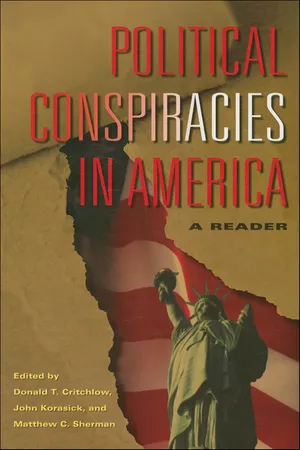
Conspiracy theories have been a part of the American experience since colonial times. There is a rich literature on conspiracies involving, among others, Masons, Catholics, Mormons, Jews, financiers, Communists, and internationalists. Although many conspiracy theories appear irrational, an exaggerated fear of a conspiracy sometimes proves to be well founded. This anthology provides students with documents relating to some of the more important and interesting conspiracy theories in American history and politics, some based on reality, many chiefly on paranoia. It provides a fascinating look at a persistent and at times troubling aspect of democratic society.
eBook - ePub
Political Conspiracies in America
A Reader
- 192 pages
- English
- ePUB (mobile friendly)
- Available on iOS & Android
eBook - ePub
About this book
Trusted by 375,005 students
Access to over 1.5 million titles for a fair monthly price.
Study more efficiently using our study tools.
Information
SECTION ONE
Conspiracy in a New Nation
During the late eighteenth and early nineteenth centuries, the fledgling American political experiment was still far from being a success. As the new nation struggled with establishing a government and its institutions, threats remained. The ocean that provided the nation’s main defense had been routinely traversed for centuries. The nations that were, or could potentially be, hostile—Britain, France, and Spain—all maintained colonial possessions on the North American continent. In addition to military threats, the new republic faced a host of domestic challenges. Among these were conflicts over the form of the new government and over just how much democracy was desirable. These factors gave rise to fears of conspiracies threatening the independence, and even existence, of the new nation and its ideals.
The United States was born of conspiracy, real and imagined. Fears of a ministerial conspiracy to deprive the American colonists of their liberty drove the Americans to war and, ultimately, to independence. During the early years, fears that liberty and democracy would degenerate into licentiousness and mob rule were given credence by social unrest in Pennsylvania and Massachusetts. In addition, fears of domestic conspiracies, designed to undermine or overthrow the government, took root.
Conspiracy fears among American colonists stretch back to the earliest settlements but gained strength by the mid-eighteenth century. Following the French and Indian War (1754–63) and England’s reexertion of control, American colonists became increasing fearful of dark forces at work in Parliament and behind the crown. The Stamp Act (1765) brought the colonists and the British into open conflict. The controversy stemmed from whether or not Parliament had the right or the power to impose taxes on the colonies. Viewing the Parliamentary acts as a conspiracy to deny traditional liberty, and therefore impose slavery on the colonies, the rhetoric grew increasingly hostile. The American belief in a ministerial conspiracy and increasing frustration with the inaction of their supposed defender, King George III, resulted in a protest being transformed into a rebellion. The records of the Continental Congress are replete with references to a ministerial conspiracy prior to the spring of 1776. As the conflict continued, it became clear that the king would not intercede on behalf of the colonists, and the Americans responded with one of the greatest indictments against tyranny in history, the Declaration of Independence.
After the Revolution, new conspiracies against liberty and democracy arose. The war left the nation economically devastated. One reaction to the economic hardships came from Massachusetts, in the form of Shays’ Rebellion (1786), in which farmers led by Daniel Shays sought to prevent foreclosures by closing the courts. The weak central government, under the Articles of Confederation, had been powerless to impact the social and economic conditions that gave rise to Shays’ Rebellion. In response, Federalists called for a strong federal government and a new constitution, while conspiracy theories took root and prospered among their opponents.
In the first years of the nation, the rhetoric of Federalist Party political leaders such as Alexander Hamilton, George Cabot, and Timothy Dwight, among others, led to suspicions of encroaching monarchism. Disputes with France, anti-egalitarianism, and the adoption of the Alien and Sedition Acts during the Adams administration all gave rise to Republican belief in a conspiracy to establish an American monarchy.
The Federalists, for their part, developed conspiracy theories involving Republicans. Unable to come to grips with just how radicalized the nation became during the Revolution, the Federalists, already in decline and no longer in step with contemporary public opinion, adopted reactionary and repressive policies. Many Federalists viewed Jeffersonian Republicans as treasonous. The Whiskey Rebellion (1794), in which Pennsylvania farmers revolted over a tax, as well as domestic disturbances stemming from the ratification of Jay’s Treaty (1795), were viewed as Republican conspiracies aimed at overthrowing the government. Even more serious was the connection between Republicans and the revolutionaries in France.
When the Terror during the French Revolution began, Federalists concluded that the French revolutionaries had little in common with the Americans. The French were completely destroying the social order, denying religion and morality, and spiraling into licentiousness and unrestrained freedom, with no checks to enforce the public good. Thomas Jefferson, the leader of the Republicans, was identified as the greatest proponent of the French revolutionaries. Drawing upon anti-Enlightenment literature, notably Edmund Burke’s “Reflections on the Revolution in France,” Federalist orators took the Republicans to task. In his 1798 sermon “The Duty of Americans at the Present Crisis,” Timothy Dwight maintained that the driving force behind the French chaos was Freemasonry, specifically the Bavarian Illuminati and their anti-Christian licentiousness. He drew heavily from continental literature, including John Robison’s Proofs of a Conspiracy (1797) and Abbé Barruel’s Memoirs Illustrating the History of Jacobinism (1797–98), and charged that Illuminati influence had spread across Europe and reached the United States. Thus in Dwight’s mind there was an international conspiracy to undermine the basic tenets underlying the creation of the United States, and it had domestic support.
After the Republicans gained supremacy in 1801, they too faced political difficulties. The nation was growing rapidly. The Louisiana Purchase effectively doubled the size of the nation. But there remained a divide between the people and the central government, which was only exacerbated by the increase in territory. Once the boundaries of the nation pushed west of the Mississippi River, there arose the possibility of national disintegration, heightened by the conspiracy of Aaron Burr, a rogue general, and others to establish a second republic on the continent. The final details of this conspiracy are lost to history, however; we only know that Burr escaped punishment though clearly something was afoot.
Finally, as the nation became more assured of its viability, some Americans perceived a new threat of immense power and diabolical design: the Freemasons. From the 1820s through mid-century, anti-Masons worked to expose the alleged secrets of Freemasonry, its oaths and practices that they saw as antithetical to American republican ideology. The Masons were viewed as a shadow government, usurping the law and local authority and turning the power of these institutions to their own purposes. Some even spread the notion that the Masons had materially contributed to the election of President Andrew Jackson, himself a Mason of high rank.
Conspiracies, real and imagined, had a real and tangible impact on the early development of the United States, and some of these early conspiracies persisted well into the nineteenth century. They were embraced by those searching for answers to events that could not be easily explained. The Federalists saw the Jeffersonians as disloyal and so attributed their successes to conspiracy. The far-flung reaches of the nation were too far from the centers of power, making them ripe for Burr’s conspiracy to separate them from the rest of the United States. Secret societies, like those Timothy Dwight had warned about, arose on American shores, and anecdotal evidence indicated that they would sanction horrible crimes against those outside their own society. This threat was considered the most insidious of all by conspiracists, because in this case the enemy was in their midst.
To the People of Great-Britain
John Jay
The belief in a ministerial conspiracy to enslave the colonists was a major factor in the outbreak of the American Revolution. Following the Seven Years or French and Indian War, Parliament found the British treasury nearly depleted and thus decided that the colonies should bear some of the cost of the war. The Americans disagreed, seeing the Sugar Act (1764), Currency Act (1764), Quartering Act (1764), Stamp Act (1765), Townsend Acts (1767), Tea Act (1773), and the Coercive Acts (1774)-the latter directed specifically at Massachusetts—as attempts by Parliament to usurp their rights. The controversy stemmed from the traditional method of governing the colonies. At one point Parliament participated only in the governance of Britain itself, leaving the colonies to the crown and its representatives in North America. The colonies developed their own legislatures and worked with the royal governors to govern themselves. But this was tradition rather than rule. When Parliament, which sat no representatives from the colonies, began to take an interest in their operation for the purpose of raising revenue, many perceived a conspiracy, as expressed in the motto “No taxation without representation.”On October 11, 1774, the Continental Congress unanimously approved the appointment of a committee to draft a message to the people of Great Britain and Ireland. The committee members outlined a conspiracy against the colonists’ “British” liberty; they disavowed any intention of seeking independence and did not mention the king as one of their tormentors—in stark contrast with the Declaration of Independence. (From John Jay, William Livingston, and Richard Henry Lee, “To the People of Great Britain,” Journal of the Continental Congress, October 21, 1774, pp. 82–90.)
Friends and fellow subjects,
When a nation, led to greatness by the hand of liberty, and possessed of all the glory that heroism, munificence, and humanity can bestow, descends to the ungrateful task of forging chains for her friends and children, and instead of giving support to freedom, turns advocate for slavery and oppression, there is reason to suspect she has either ceased to be virtuous, or been extremely negligent in the appointment of her rulers.
In almost every age, in repeated conflicts … against many and powerful nations, against the open assaults of enemies, and the more dangerous treachery of friends, have the inhabitants of your island, your great and glorious ancestors, maintained their independence and transmitted the rights of men, and the blessings of liberty to … their posterity.
Be not surprised … that we, who are descended from the same common ancestors; that we, whose forefathers participated in all the rights, the liberties, and … who have carefully conveyed the same fair inheritance to us … should refuse to surrender them to men who found their claims on no principles of reason, and who prosecute them with a design, that by having our lives and property in their power, they may with greater facility enslave you.
The cause of America is now the object of universal attention…. This unhappy country has not only been oppressed, but abused and misrepresented; and the duty we owe to ourselves and posterity to your interest, and the general welfare of the British Empire, leads us to address you on this very important subject.
Know then, that we consider ourselves, and do insist, that we are and ought to be as free as our fellow-subjects in Britain, and that no power on earth has a right to take our property … without our consent. That we claim all the benefits secured … by the English constitution, and particularly … trial by jury. That we hold it essential to English liberty, that no man be condemned unheard, or punished for supposed offences, without having an opportunity of making his defense. That we think the Legislature of Great Britain is not authorized … to establish a religion, fraught with sanguinary and impious tenets, or, to erect an arbitrary form of government, in any quarter of the globe. These rights we … deem sacred. And yet sacred as they are, they have, with many others, been repeatedly and flagrantly violated.
Are not the proprietors of the soil of Great Britain lords of their own property? Can it be taken from them without consent? Will they yield it to the arbitrary disposal of any man, or number of men … ?
Why then are the proprietors of the soil of America less lords of their property … why should they submit it to the disposal of your Parliament, or any other Parliament … not of their election? Can … the sea that divides us, cause disparity in rights, or can any reason be given, why English subjects, who live three thousand miles from the royal palace, should enjoy less liberty than those who are three hundred miles distant from it?
Reason looks with indignation on such distinctions, and freemen can never perceive their propriety. And yet, however chimerical and unjust … the Parliament assert, that they have a right to bind us in all cases … that they may take and use our property when and in what manner they please.… Such declarations we consider as heresies in English polities.…
At the conclusion of the late war—a war rendered glorious by the abilities and integrity of a Minister, to whose efforts the British Empire owes its safety and its fame. At the conclusion of this war, which was succeeded by an inglorious peace, formed under the auspices of a Minister of principles, and of a family unfriendly to the protestant cause, and inimical to liberty—we say at this period, and under the influence of that man, a plan for enslaving your fellow subjects in America was concerted, and has ever since been pertinaciously carrying into execution.
Prior to this era you were content to drawing from us the wealth produced by our commerce. You restrained our trade in every way that could conduce to your emolument.… You named the ports and nations to which … our merchandise should be carried, and with whom we should trade; and though some of the restrictions were grievous, we … did not complain.…
We call upon you yourselves, to witness our loyalty and attachment to the common interest of the … empire. Did we not, in the last war; add all the strength of this vast continent to the force which repelled our common enemy? Did we not leave our native shores … to promote the success of British arms in foreign climates? Did you not thank us for our zeal, and even reimburse us large sums of money, which, you confessed, we had advanced beyond our proportion and far beyond our abilities? You did.
To what causes … are we to attribute the sudden change of treatment, and that system of slavery which was prepared for us at the restoration of peace?
Before we had recovered from the distresses which ever attend war, an attempt was made to drain this country of all its money by the oppressive Stamp Act. Paint, glass, and other commodities, which you would not permit us to purchase of other nations, were taxed…. These and many other impositions were laid upon us most unjustly and unconstitutionally, for the express purpose of raising a revenue. In order to silence complaint, it was … provided that this revenue should be expended in America for its protection and defense. These exactions, however, can receive no justification from a pretended necessity of protecting and defending us. They are lavishly squandered on court favorites and ministerial dependents, generally avowed enemies to America and employing themselves, by partial representations, to traduce and embroil the Colonies. For the necessary support of government here, we ever were and ever shall be ready to provide. And whenever the exigencies of the state may require it, we shall … cheerfully contribute our full proportion of men and money. To enforce this … unjust scheme of taxation, every fence that … our … ancestors erected against arbitrary power, has been violently thrown down in America, and the … right to trial by jury taken away.… It was ordained, that whenever offences should be committed in the colonies against particular acts imposing various duties and restrictions upon trade, the prosecutor might bring his action … in the Courts of the Admiralty.…
When the design of raising a revenue from the duties imposed on the importation of tea into America had … been rendered abortive by our ceasing to import that commodity, a scheme was concerted by the Ministry with the East India Company, and an Act passed enabling and encouraging them to transport and vend it in the colonies. Aware of the danger of giving success to this insidious maneuver … various methods were adopted to elude the stroke. The people of Boston, then rule by a Governor, whom … all America considers as her enemy, were exceedingly embarrassed. The ships which has arrived with the tea were by his management prevented from returning. The duties would have been paid; the cargoes landed and exposed to sale; a Governor’s influence would have procured many purchasers. While the town was suspended by deliberations … the tea was destroyed. Even supposing a trespass was thereby committed, and the proprietors … entitled to damages … the East India Company … did not think proper to commence any suits, nor did they even demand satisfaction.… The Ministry … officiously made the case their own.… Diverse papers, letters, and other unauthenticated ex parte evidence were laid before them; neither the persons who destroyed the tea, or the people of Boston, were called upon to answer the complaint. The Ministry, incensed by being disappointed in a favorite scheme, were determined to recur from the little arts of finesse, to open force and unmanly violence. The port of Boston was blocked … and an army placed in the town. Their trade was … suspended, and thousands reduced to … gaining subsistence from charity, till they should submit to pass under the yoke, and consent to become slaves, by confessing the omnipotence of Parliament, and acquiescing in whatever disposition they might think proper to make of their lives and property.
Let justice and humanity cease to be the boast … examine your records … and show us a single instance of men being condemned to suffer for imputed crimes, unheard, unquestioned, and without even the specious formality of a trial; and … by laws made expressly for the purpose, and which had no existence at the time of the fact committed. If it be difficult to reconcile these proceedings to the genius and temper of your laws and constitution, the task will become more arduous when we call upon our ministerial enemies to justify, not only condemning men untried and by hearsay, but involving the innocent in one common punishment with the guilty, and for the act of thirty or forty, to bring poverty, distress and calamity on thirty thousand souls, and those not your enemies, but your friends, brethren, and fellow subjects.
It would be some consolation to us, if the catalog of American oppressions ended here. It gives us pain to be reduced to the necessity of reminding you that under the confidence reposed the faith of government, pledged in a royal charter … the forefathers of … Massachusetts Bay left their former habitations, and established that great, flourishing, and loyal Colony. Without incurring or being charged with the forfeiture of their rights, without being heard, without being tried, without law, and without justice, by an act of Parliament, their charter is destroyed, their liberties violated, their constitution and form of government changed; and all this upon no better pretence, than because in one of their towns a trespass was committed… and because th...
Table of contents
- Cover
- Half Title
- Title Page
- Copyright Page
- Table of Contents
- Introduction
- Section 1. Conspiracy in a New Nation
- Section 2. Conspiracy in an Age of Democracy
- Section 3. Conspiracy in a Divided Nation
- Section 4. Conspiracy in the Industrial Age through the New Deal
- Section 5. Conspiracy in the Cold War Era
- Section 6. Conspiracy in Contemporary America
- For Further Reading
- Index
Frequently asked questions
Yes, you can cancel anytime from the Subscription tab in your account settings on the Perlego website. Your subscription will stay active until the end of your current billing period. Learn how to cancel your subscription
No, books cannot be downloaded as external files, such as PDFs, for use outside of Perlego. However, you can download books within the Perlego app for offline reading on mobile or tablet. Learn how to download books offline
Perlego offers two plans: Essential and Complete
- Essential is ideal for learners and professionals who enjoy exploring a wide range of subjects. Access the Essential Library with 800,000+ trusted titles and best-sellers across business, personal growth, and the humanities. Includes unlimited reading time and Standard Read Aloud voice.
- Complete: Perfect for advanced learners and researchers needing full, unrestricted access. Unlock 1.5M+ books across hundreds of subjects, including academic and specialized titles. The Complete Plan also includes advanced features like Premium Read Aloud and Research Assistant.
We are an online textbook subscription service, where you can get access to an entire online library for less than the price of a single book per month. With over 1.5 million books across 990+ topics, we’ve got you covered! Learn about our mission
Look out for the read-aloud symbol on your next book to see if you can listen to it. The read-aloud tool reads text aloud for you, highlighting the text as it is being read. You can pause it, speed it up and slow it down. Learn more about Read Aloud
Yes! You can use the Perlego app on both iOS and Android devices to read anytime, anywhere — even offline. Perfect for commutes or when you’re on the go.
Please note we cannot support devices running on iOS 13 and Android 7 or earlier. Learn more about using the app
Please note we cannot support devices running on iOS 13 and Android 7 or earlier. Learn more about using the app
Yes, you can access Political Conspiracies in America by Donald T. Critchlow,John Korasick,Matthew C. Sherman in PDF and/or ePUB format, as well as other popular books in History & North American History. We have over 1.5 million books available in our catalogue for you to explore.