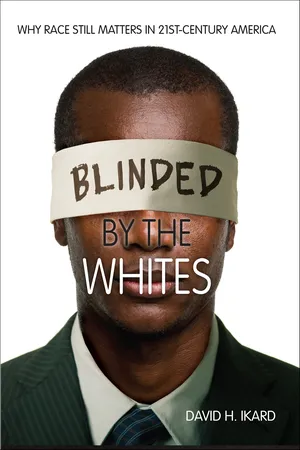
The election of Barack Obama gave political currency to the (white) idea that Americans now live in a post-racial society. But the persistence of racial profiling, economic inequality between blacks and whites, disproportionate numbers of black prisoners, and disparities in health and access to healthcare suggest there is more to the story. David H. Ikard addresses these issues in an effort to give voice to the challenges faced by most African Americans and to make legible the shifting discourse of white supremacist ideology—including post-racialism and colorblind politics—that frustrates black self-determination, agency, and empowerment in the 21st century. Ikard tackles these concerns from various perspectives, chief among them black feminism. He argues that all oppressions (of race, gender, class, sexual orientation) intersect and must be confronted to upset the status quo.
- 192 pages
- English
- ePUB (mobile friendly)
- Available on iOS & Android
eBook - ePub
About this book
Trusted by 375,005 students
Access to over 1.5 million titles for a fair monthly price.
Study more efficiently using our study tools.
Information
Henry had always said that he wanted to be a better master than any white man he had ever known. He did not understand that the kind of world he wanted to create was doomed before he had even spoken the first syllable of the word master.
The Known World, Edward P. Jones
“I did not own my family, and you must not tell people that I did. I did not. We did not. We owned … ” She sighed, and her words seemed to come up through a throat much drier than only seconds before. “We owned slaves. It was what was done, and so that is what we did.”
The Known World, Edward P. Jones
ONE
White Supremacy Under Fire:
The Unrewarded Perspective in
Edward P. Jones’s The Known World
The sexually charged relationship that clara martin, a white widow, has with her lone slave Ralph in Edward P. Jones’s The Known World will strike most readers as schizophrenic. Though she is intensely attracted to Ralph, she goes to mental and social extremes to resist acknowledging her feelings even as she continues to actively pursue him. The event that throws her into this chaotic state of resistance occurs on the first night of a three-day-long storm when, after struggling to comb her wet, thick, unruly hair, she consents to Ralph’s compliment-laced offer to do it for her. Finding the experience both emotionally comforting and intensely erotic, Clara allows him to groom her hair again over the next two nights. When the storm ends she discontinues the grooming without explanation. Shortly thereafter, she conjures up the notion that Ralph is secretly plotting to rape and murder her. At one point, after reading a local newspaper account of a slave, out of spite, putting finely ground glass in her master’s food, Clara becomes so suspicious of Ralph, who has been her cook for twenty-four years, that she abruptly stops eating the food he prepares and loses weight as a result. In addition to declining to eat his food, she has Ralph interrogated, albeit with pointed directives not to “hurt his feelings” or “say anything mean,” by first the slave patrollers and then John Skiffington, the sheriff of Manchester County, neither of whom find evidence of “wrongdoing.”1 Eclipsing the unfounded need to investigate Ralph’s behavior, she begins a nightly ritual of nailing shut her bedroom door and sleeping with two knives – one by her bedside and the other under her pillow “as close as a lover.”2 Despite her expressed fears about Ralph’s motives, Clara collapses into an emotional state of panic after slavery is abolished and Ralph announces that he plans to leave Virginia and go live with his extended family in Washington, D.C. The narrator reports that Clara “cried and cried” when Ralph informed her of his plans to move, entreating him like a desperate lover to remain with her in Virginia.3
Clara’s white crisis is hardly unique in The Known World; it is emblematic of a salient pattern of white identity crises in the novel, afflicting white-identified groups from across class, caste, and gender lines. Neither Barnum Kinsey, the poorest white man in Manchester County, nor William Robbins, the richest, escapes this fate. White supremacist ideology – the root cause of these white identity crises – penetrates the ethical and cultural fabric of antebellum society like secondhand smoke, contaminating the best of intentions by whites to treat African Americans humanely and even igniting white-on-white dehumanization and lethal action. Though the high stakes of legalized freedom complicate the ways that African Americans – slave and free – negotiate their agency as “othered” subjects within white supremacist ideology, those who seek status and economic gain within its strictures suffer similar crises and fates as their white counterparts.
Even as it is illuminating and rich, the scholarship on The Known World, in its paucity, does not directly engage white male supremacist ideology or the various identity crises across race, gender, and class lines that it engenders. Most scholars focus on ways in which the novel corrects, challenges, and/or rewrites the master narratives of slavery and African American struggle at large. Katherine Clay Bassard and Susan V. Donaldson’s foundational analyses on The Known World reflect this trend in focus. Bassard maps the history of black slave-ownership with an eye toward debunking various raced and gendered myths about African American slave-owners. She uses her framework to explain why even benevolent participation in the system, such as buying relatives and loved ones out of slavery, reinforced rather than challenged status quo power relations. More specifically, she argues that former slave Augustus Townsend’s act of buying his wife Mildred and son Henry out of slavery is neither redemptive nor threatening to the white male power structure. This reality is borne out in what she calls Augustus’s tragic (mis)education of Henry, who becomes a prominent slave-owner. Donaldson focuses primarily on Jones’s interrogation of the idea of mastery at different social registers. Situating the novel as a postmodern neo-slave narrative, she argues that it seeks to problematize and revise master narratives of history while remaining keenly aware of its own provisional authoritative status. Donaldson concludes that the novel’s postmodern disruption of history and authority provides the reader with “brief glimpses of the diminished sense of self and world allocated to enslaved people.”4
Filling a gap in the scholarship as it pertains to white supremacist ideology and social consciousness, this chapter will examine the ways that white supremacist ideology goes “awry” and wreaks havoc in the lives of the white-identified groups it was ostensibly designed to empower, as well as to the Africans who adhere consciously and unconsciously to its twisted racial calculus. More specifically, it scrutinizes the power and class disparities within and across race lines that shape the experience of “race,” revealing the wide-ranging stakes involved for adherents to white supremacist ideology with varying levels of agency, self-awareness, moral anxiety, and incentives to oppress and/or identify with oppressors. It becomes clear on one level that white male supremacy covers over rather than collapses the disparities of power among disparate European groups in the United States – namely, by unifying disparate classes of European settlers through denying rights and legal protection to Africans.5 While the white supremacist racial discourse was, to quote Richard Dyer, “terrifyingly effective in unifying coalitions of disparate groups of people,”6 Jones makes clear that it also warped Eurocentric critical perspectives on Africans, Native Americans, and ultimately other Europeans.
By making these socioeconomic dynamics of whiteness visible and treating white supremacy as a pathological mindset run amok, Jones’s The Known World builds on and extends a longstanding liberating strategy in the African American literary tradition7 that “trac[es] the corrupting effects of absolute sovereignty on owners of human chattel and on the individual psyches of slaves exposed to the abuses of that power.”8 Jones makes a unique contribution to this liberating strategy by using the history of African American slave-owners to bring renewed scrutiny to the tenacity and corruptive force of white supremacist ideology on our nation’s collective racial consciousness. Resembling what trauma theorist Ron Eyerman calls a cultural “intellectual,”9 Jones casts light on and attacks normative white supremacy in the contemporary moment by resituating it within established historical narratives as a pandemic of the perverse. Through this narrative prism, Jones demonstrates that the small pocket of African Americans that willingly participate in slavery in The Known World are a reflection, in large part, of the tenacity and corrupting apparatus of white (male) supremacist ideology on African American consciousness. In such an ideologically warped milieu, where African Americans are socially conditioned to see white dominance and the brutal exploitation of black bodies for capital gain as natural, the emergence of African American slaveholders becomes a radical indictment against white (male) supremacist ideology.
As The Known World has come under fire in the public domain for perpetuating the very dynamics of white male supremacy under scrutiny in this chapter, a survey of Jones’s political motives is in order. As he asserts in his essay “We Tell Stories,” Jones’s chief political aim for writing the novel was not specifically to draw attention to the little-known historical fact about African American slave-owners. Rather, he wanted to explore the social variables that prompt African Americans – then and now – to turn “against their own kind” for individual gain.10 He explains that the “kernel” for writing the novel actually was his dismay, while a college student in the 1980s, at the “political climate at that time” that encouraged this self-sabotaging behavior.11 To put the matter plainly, the historical reality of slave-owning African Americans – which he discovered while studying the Holocaust and Jewish turncoats as a teenager – came into play as a focal point of the novel several decades after he first gained knowledge of the practice. Moreover, he viewed the willingness by some to sell out their African Americans peers as deviant – not representative – of African American behavior in the face of white oppression. He ostensibly set out as a writer to examine the socialization process (i.e., internalized white supremacy) that corrupted their moral and cultural outlooks. Writing about the historical reality of African American slave-owners was for Jones a useful starting point for engaging such patterns of complicity and internalized white supremacy in the present day. He notes forthrightly, “Had there been no black slave-owners ever in America, I would not have felt the okay to venture out and manufacture a time and place where they did.”12
The conspicuous critical silence on The Known World – most notably among African American scholars – is no doubt attributable the ways in which such engagements with African American complicity in oppression so easily become political fodder for the extant discourse of white denial. Within this discourse, which displaces the blame for slavery and African American suffering onto African American communities, African American acknowledgement of intraracial failings (such as those that lace the conciliatory rhetoric of, say, President Barack Obama) emerges as “evidence” of African American culpability and white innocence. Further complicating matters is a longstanding white capitalistic practice in the United States of rewarding African Americans – financially and otherwise – for reinforcing white stereotypes of African American pathological behavior.13 Indeed, though the existence of African American slave-owners is news to most Americans, slavery apologists have long tried to use such information to represent slavery as a benign and civilizing experience for Africans and/or to suggest that Africans pathologically sold their own kind into slavery during the transatlantic slave trade. The latter argument, of course, ignores the salient reality that Africa – like Europe and Asia – is, and has always been, an extremely diverse cultural space. It also conspicuously ignores that Europeans invented the idea of a monolithic African culture to serve their imperialist objectives.14 African Americans within and beyond academe have overwhelmingly shouldered the burden of dispelling these and other white distortions of U.S. history and slavery, especially as they concern pathologizing African American consciousness. Though Jones is fiercely committed to fighting against this tide of racial distortion as well, his status as an African American writing about African American slave-owners and complicity in oppression renders his novel vulnerable to white apologists’ claims of white innocence and black culpability. The problem arises, however, when readers confuse this unavoidable racial trap with Jones’s motives for writing the novel, a dynamic he confronts frequently in the public domain.15
Issues of intentionality and critical receptivity aside, James Baldwin’s critique of white (male) supremacist ideology in The Fire Next Time provides a useful framework for unpacking the political impulse in The Known World. In Fire Baldwin treats white supremacy as a social cancer that gnaws away at the ethical fabric of white-identified America, making it difficult for whites to reconcile their inhuman and exploitative behavior toward African Americans and, by extension, toward each other. He notes that African Americans are largely protected from this cancer, at least so far as it causes them to lose their grip on material realities, because they are not mired down mentally with constructed white mythologies, including “that their ancestors were all freedom-loving heroes, that they were born in the greatest country the world has ever seen, … that Americans are invincible in battle and wise in peace, that Americans have always dealt honorably with Mexicans and Indians and all other neighbors or inferiors, that American men are the world’s most direct and virile, [and] that American women are pure.”16
Baldwin explains that these “white mythologies” produce a kind of ideological schizophrenia that keeps whites in emotional conflict with themselves regarding their self-worth. Invoking the metaphor of a mirror to denote the reality of white frailty that white-identified groups seek desperately to avoid by displacing their “unspeakable, private fears and longings” onto African Americans, Baldwin writes:
All of us know, whether or not we are able to admit it, that mirrors can only lie, that death by drowning is all that awaits one there. It is for this reason that [African American] love is so desperately sought [by whites] and so cunningly avoided. Love takes off the masks that we fear we cannot live without and know we cannot live within. I use the word “love” here not merely in a personal sense but as a state of being, or a state of grace – not in the infantile American sense of being made happy but in the tough and universal sense of quest and daring and growth.17
Though Baldwin is somewhat totalizing in his perspectives on whites’ identity crises and African Americans’ insulation from them, he usefully identifies a pattern of racial interdependence that is crucial to understanding how white supremacy operates beyond the social and economic power to oppress. He shows that for white-identified people to maintain the illusion of biological racial supremacy, they must work consciously and unconsciously not to see African American personhood, nor to see the lie that they possess a superior mindset. This “not-seeing” is compounded by their desire to be “loved” unconditionally by the targets of their oppression and to be released from the burden of living up to an impossible standard of superiority.
In Playing in the Dark: Whiteness and the Literary Imagination, Toni Morrison echoes Baldwin’s ideas when she discusses Mark Twain’s Huckleberry Finn and what she calls the “parasitical nature of white freedom.”18 Highlighting Twain’s problematic characterization of Jim, a runaway black slave, Morrison argues that even underclass whites, like Huck, who are marginalized or “othered” from mainstream bourgeois white society, depend parasitically on imagined African American inferiority to affirm their racial identity and humanity. In this particular instance, Twain creates in Jim a runaway slave with a “limitless store of love and compassion” for Huck and white masters, who believes that “whites are what they say they are, superior and adult.”19 Morrison asserts that Twain’s “representation of Jim as the visible other can be read as the yearning of whites for forgiveness and love.”20 The problem is that this “yearning is made possible only when it is understood that Jim has recognized his inferiority (not as slave, but as black) and despises it.”21 Morrison writes that Jim’s slave status and pathological self-hate not only make “play and deferment [of our judgment against Huck for treating him cruelly] possible – but they also dramatize, in style and mode of narration, the connection between slavery and the achievement (in actual and imaginary terms) of freedom.”22 Huck’s liberation from the stuffy and pretentious classed codes of middle-class whiteness requires in Twain’s formulation that Jim remain enslaved and in awe of whiteness. The pressing question that emerges for Morrison is not what Jim’s contradictory impulses and actions tell us about African American identity. Rather, why do Mark Twain, Huck, and Tom so desperately need Jim’s blackness to be inferior in order for them, as whites, to feel human and free?
Jones brings this parasitical racial equation to the forefront, portraying whites and, to a lesser extent, middle-class African American slave-owners as “slightly mad victims of their own brainwashing.”23 The reader is thus able to witness...
Table of contents
- Cover
- Title
- Copyright
- Contents
- Acknowledgments
- Introduction: What Does Black Empowerment in the Twenty-First Century Look Like?
- 1 White Supremacy Under Fire: The Unrewarded Perspective in Edward P. Jones’s the Known World
- 2 Easier Said Than Done: Making Black Feminism Transformative for Black Men
- 3 All Joking Aside: Black Men, Sexual Assault, and Displaced Racial Angst in Paul Beatty’s the White Boy Shuffle
- 4 Boys to Men: Getting Personal about Black Manhood, Sexuality, and Empowerment
- 5 Rejecting Goldilocks: The Crisis of Normative White Beauty for Black Girls
- 6 Stop Making the Rest of Us Look Bad: How Class Matters in the Attacks against the Movie Precious
- Epilogue: So What Does it All Mean?
- Notes
- Bibliography
- Index
Frequently asked questions
Yes, you can cancel anytime from the Subscription tab in your account settings on the Perlego website. Your subscription will stay active until the end of your current billing period. Learn how to cancel your subscription
No, books cannot be downloaded as external files, such as PDFs, for use outside of Perlego. However, you can download books within the Perlego app for offline reading on mobile or tablet. Learn how to download books offline
Perlego offers two plans: Essential and Complete
- Essential is ideal for learners and professionals who enjoy exploring a wide range of subjects. Access the Essential Library with 800,000+ trusted titles and best-sellers across business, personal growth, and the humanities. Includes unlimited reading time and Standard Read Aloud voice.
- Complete: Perfect for advanced learners and researchers needing full, unrestricted access. Unlock 1.5M+ books across hundreds of subjects, including academic and specialized titles. The Complete Plan also includes advanced features like Premium Read Aloud and Research Assistant.
We are an online textbook subscription service, where you can get access to an entire online library for less than the price of a single book per month. With over 1.5 million books across 990+ topics, we’ve got you covered! Learn about our mission
Look out for the read-aloud symbol on your next book to see if you can listen to it. The read-aloud tool reads text aloud for you, highlighting the text as it is being read. You can pause it, speed it up and slow it down. Learn more about Read Aloud
Yes! You can use the Perlego app on both iOS and Android devices to read anytime, anywhere — even offline. Perfect for commutes or when you’re on the go.
Please note we cannot support devices running on iOS 13 and Android 7 or earlier. Learn more about using the app
Please note we cannot support devices running on iOS 13 and Android 7 or earlier. Learn more about using the app
Yes, you can access Blinded by the Whites by David H. Ikard in PDF and/or ePUB format, as well as other popular books in Politics & International Relations & Political History & Theory. We have over 1.5 million books available in our catalogue for you to explore.