Renowned social justice advocate john a. powell persuasively argues that we have not achieved a post-racial society and that there is much work to do to redeem the American promise of inclusive democracy. Culled from a decade of writing about social justice and spirituality, these meditations on race, identity, and social policy provide an outline for laying claim to our shared humanity and a way toward healing ourselves and securing our future. Racing to Justice challenges us to replace attitudes and institutions that promote and perpetuate social suffering with those that foster relationships and a way of being that transcends disconnection and separation.
eBook - ePub
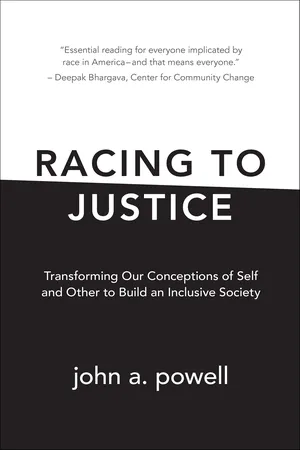
Racing to Justice
Transforming Our Conceptions of Self and Other to Build an Inclusive Society
- 303 pages
- English
- ePUB (mobile friendly)
- Available on iOS & Android
eBook - ePub
Racing to Justice
Transforming Our Conceptions of Self and Other to Build an Inclusive Society
About this book
Information
PART ONE
Race and Racialization
ONE
Post-Racialism or
Targeted Universalism?
We hear it said nowadays that there is no “race problem,” but only a “class problem.” . . . From a practical angle there is a point in this reasoning. But from a theoretical angle it contains escapism in new form. . . . And it tends to conceal the whole system of special deprivations visited upon the Negro only because he is not white.
Gunnar Myrdal, An American Dilemma
Executive and legislative branches, which for generations now have considered these types of policies and procedures, should be permitted to employ them with candor and with confidence that a constitutional violation does not occur whenever a decisionmaker considers the impact a given approach might have on students of different races.
Justice Anthony M. Kennedy, Parents Involved in Community Schools v. Seattle
The United States made history on November 4, 2008, by electing Barack Obama as its first African American president, generating a sense of pride and a collective celebration that was shared worldwide. The installation of a black president who was supported by a significant minority of white voters was an occasion imbued with great political, social, historical, and cultural meaning. That meaning has been interpreted and expressed in many different ways, and Americans will continue to attempt to determine its contours and synthesize its various strands far into the future. As we engage in this process, different segments of society will continue to identify and promote different meanings, any of which may have important ramifications. Perhaps no aspect of the election compares, however, with the milestone that it represents with respect to the history of race. Questions about how we are to understand racial conditions in society and what the proper role of public policy and law should be in addressing – or avoiding – racial issues will gain greater salience as we seek ways of building upon the understandings the election has fostered. These questions about where we are on the issue of race are not just factual or descriptive; they are deeply political as well, having implications for how and when we respond to social problems and how we define the scope of our collective obligations.
RACE, RACISM, AND RACIALIZATION
In exploring these questions, I will add the term “racialization” to the more common terms “race” and “racism,” which are understood in a way that is too limited and specific to fully address these important issues. By racialization, I refer to the set of practices, cultural norms, and institutional arrangements that both reflect and help to create and maintain race-based outcomes in society. Because racialization is a set of historical and cultural processes, it does not have one particular meaning. Instead, it describes conditions and norms that are constantly evolving and interacting with the sociopolitical environment, varying from location to location as well as throughout different periods in history.1 These processes are not uniformly present or static. They respond to what we collectively do and think and are therefore highly contested.2 As a society, however, we are not inclined to consider the nuances of race and racism. Rather, we tend to see them as a limited set of discrete practices that remain constant over time, in spite of social changes.
Even as we use “racialization” to connote the fluid nature of the phenomena we are describing and the broader context in which racial outcomes are manifested and understood, the use of this term will not automatically break us of our reflexive thinking and mental habits around race and racism. In this country, the cultural understanding of racism is most closely associated with Jim Crow. In this context, it is imagined as conscious discriminatory activity, directed at a particular victim, by racist individuals.3 Issues of race and racism, therefore, have come to be understood as explicit acts by individuals or explicit laws or policies implemented by institutions such as school boards or municipal governments.4 This overly individualistic definition of race and racism fits well with our country’s individualistic approach to many life issues. Consequently, issues of race are likely to be seen primarily as deliberate psychosocial events, instigated by individual bad actors or by institutions managed or directed by them. This view was made law in the 1976 case Washington v. Davis, which sets out the Supreme Court’s discriminatory purpose doctrine, requiring that a plaintiff prove intent in racial discrimination claims.5 From the point of view of the Court in this case, the Jim Crow system – a highly institutionalized and extensive regime of racial oppression that was only partly legal – is reduced to the behavior of bigots, whose policies can be purged or reversed in an election cycle or by excising the offending de jure rules. In this individualistic frame of analysis, if one does not engage in conscious acts of racism, or, better still, does not consciously see race, then there can be no racism or racialization.
This requirement of proof of intentional discrimination became the legal standard at the same time that our society more consciously embraced a public position of racial egalitarianism. Virtually all sectors of society now renounce racism. To call someone racist impugns not only the legality of that person’s actions but also his or her morality. Indeed, to call someone racist today is seen as incendiary and a form of character assassination. The good American refuses to engage in conscious racially motivated behavior and refuses to see race or call it out. He is race-blind, purportedly embracing the dream of Dr. Martin Luther King, Jr., that our children “will one day live in a nation where they will not be judged by the color of their skin but by the content of their character.”6 Unfortunately, this line is too often used to suggest that were Dr. King alive today, he would oppose policies such as affirmative action or race-conscious voluntary integration. This allows the good American to claim that as long as others share this blindness, race does not matter.
RACE BLINDNESS AND POST-RACIALISM
The conservative form of race blindness has been extremely callous at times. Consider the Supreme Court’s 2007 opinion in Parents Involved in Community Schools v. Seattle School District No. 1. The case actually involved two school districts: Seattle, in which racial segregation had not been legally mandated, and metropolitan Louisville, in which court-imposed desegregation had been terminated when the district was deemed “unitary” – meaning that it no longer operated a racially segregated, dual school system. Both districts had created student assignment plans that took race into account in order to maintain diversity, equality of opportunity, and broad support for public schools. Writing for a plurality of the Court, Chief Justice Roberts adopted language from the struggle to remove racial barriers to education, but uncoupled it from both history and current patterns of racialization:
Before Brown, schoolchildren were told where they could and could not go to school based on the color of their skin. The school districts in these cases have not carried the heavy burden of demonstrating that we should allow this once again – even for very different reasons. . . . The way to stop discrimination on the basis of race is to stop discriminating on the basis of race.7
The chief justice seems to be arguing that when school districts devise student assignment plans that foster diversity and integration, it is as injurious a practice as intentional race-based exclusion. From this perspective, racial hierarchy is legally irrelevant to the constitutional principle of Equal Protection. Other conservatives assert that “moving beyond race” is not just an aspiration or a description of where we ought to be, but is also the best means to get us there. They are all but indifferent to segregation and other forms of racial stratification unless the intent to create or foster them can be located in the conscious minds of specific perpetrators. This position not only ignores the policies, structures, and conditions of racial marginalization; it also ignores the extent to which our behavior and motivation are unconscious.
Though Chief Justice Roberts asserts that color blindness is the appropriate mechanism for addressing racial hierarchy, a race-blind stance not only does not address racialized conditions, such as failing minority-majority schools; it also fails to avoid the divisiveness that many conservatives say they are attempting to mitigate through this form of denial. In fact, this use of color blindness bars engagement on the issue of race. It also precludes intervention. It offers a narrative that supports the racial status quo, even blaming marginalized groups for their status and conditions.8 Fortunately, eloquent voices are raised in dissent, as in Justice Stevens’s reminder that “the history books do not tell stories of white children struggling to attend black schools. In this and other ways, the Chief Justice rewrites the history of one of this Court’s most important decisions.”9
Color-blind conservatives focus only on the purity of the conscious mind with respect to awareness of race, which allows them to remain purposefully unconcerned with racial realities or the complicity of the unconscious mind. The evil they seek to guard against is the psychological state of those in power – the noticing of race – not the condition of various racial groups or current and historical patterns in the distribution of opportunity.10 Indeed, if conservatives do take notice of them, they are likely to explain existing racial arrangements as caused by a non-white “culture of poverty,” a term often used to excuse the lack of effort to improve conditions in low-income communities of color by implying that the problems are caused by blameworthy and immutable group behavior. Justice Thomas, for example, expresses indifference to racial arrangements, practices, and conditions, telling us that real harm ensues when we see race, whether our intentions are benevolent or malign.11 In Parents Involved, Thomas and the plurality assert that only harms caused by intentionally discriminatory state action can be remedied using race, with a very limited set of exceptions.12
This is not the position of many of the liberals who supported President Obama. The term “post-racialism” has been adopted to describe their race blindness. Like their conservative counterparts, many liberals believe that racialization is primarily a psychological event and that good Americans are beyond race.13 “Race doesn’t matter!” – much.14 These liberals focus, as do conservatives, primarily on the conscious mind, the least important area for understanding our motivation and actions. Growing evidence reveals that even if the conscious mind does not notice race, the unconscious is likely to notice and to impel actions based on this awareness. Unlike color-blind conservatives, post-racial liberals are willing, under some conditions, to be race-sensitive, but they agree that a frontal attack on racial conditions is divisive.
Naturally, in the wake of President Obama’s victory, the question of where we are with regard to race has surfaced again and again. The president has specifically rejected the claim that we are in a post-racial world, citing continuing racial disparities:
When I hear commentators interpreting my speech to mean that we have arrived at a “postracial politics” or that we already live in a color-blind society, I have to offer a word of caution. To say that we are one people is not to suggest that race no longer matters – that the fight for equality has been won, or that the problems that minorities face in this country today are largely self-inflicted. . . . [A]s much as I insist that things have gotten better, I am mindful of this truth as well: Better isn’t good enough.15
Yet there is and likely will continue to be stubborn insistence that we are in a post-racial world, evidenced most poignantly by President Obama’s own success.16
For both color-blind conservatives and liberal post-racialists, we are all but beyond race. In their view, a few old-style racists may remain, especially in the South, but those individuals, like many civil rights activists, are still stuck in old paradigms, locked in a struggle that is antiquated, outmoded, and distracting. The alternative to this tired old battle is post-racialism. Adolph Reed asserts that we should stop using race and deal with the real issue of class.17 Some post-racialists also use changing demographics to support the claim that we are beyond race.18 From these perspectives, the question of where we are with regard to race then becomes binary. We are either in a divisive space from the past where we continue to assert the dominance of conscious racism, or we are in a post-racial world where race really does not matter to most Americans.
To post-racialists, white support of President Obama is proof ...
Table of contents
- Cover
- Half title
- Title
- Copyright
- Dedication
- Contents
- Foreword
- Acknowledgments
- Introduction Moving beyond the Isolated Self
- Part One Race and Racialization
- Part Two White Privilege
- Part Three The Racialized Self
- Part Four Engagement
- Afterword
- Notes
- References
- Index
Trusted by 375,005 students
Access to over 1.5 million titles for a fair monthly price.
Study more efficiently using our study tools.
Frequently asked questions
Yes, you can cancel anytime from the Subscription tab in your account settings on the Perlego website. Your subscription will stay active until the end of your current billing period. Learn how to cancel your subscription
No, books cannot be downloaded as external files, such as PDFs, for use outside of Perlego. However, you can download books within the Perlego app for offline reading on mobile or tablet. Learn how to download books offline
Perlego offers two plans: Essential and Complete
- Essential is ideal for learners and professionals who enjoy exploring a wide range of subjects. Access the Essential Library with 800,000+ trusted titles and best-sellers across business, personal growth, and the humanities. Includes unlimited reading time and Standard Read Aloud voice.
- Complete: Perfect for advanced learners and researchers needing full, unrestricted access. Unlock 1.5M+ books across hundreds of subjects, including academic and specialized titles. The Complete Plan also includes advanced features like Premium Read Aloud and Research Assistant.
We are an online textbook subscription service, where you can get access to an entire online library for less than the price of a single book per month. With over 1.5 million books across 990+ topics, we’ve got you covered! Learn about our mission
Look out for the read-aloud symbol on your next book to see if you can listen to it. The read-aloud tool reads text aloud for you, highlighting the text as it is being read. You can pause it, speed it up and slow it down. Learn more about Read Aloud
Yes! You can use the Perlego app on both iOS and Android devices to read anytime, anywhere — even offline. Perfect for commutes or when you’re on the go.
Please note we cannot support devices running on iOS 13 and Android 7 or earlier. Learn more about using the app
Please note we cannot support devices running on iOS 13 and Android 7 or earlier. Learn more about using the app
Yes, you can access Racing to Justice by john a powell,john a. powell in PDF and/or ePUB format, as well as other popular books in Law & Civil Rights in Law. We have over 1.5 million books available in our catalogue for you to explore.