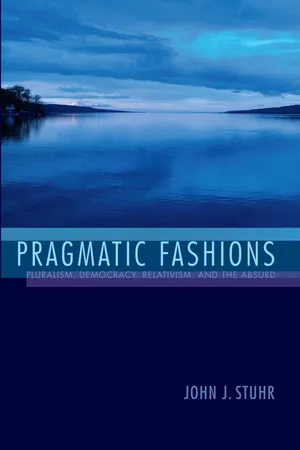
John J. Stuhr, a leading voice in American philosophy, sets forth a view of pragmatism as a personal work of art or fashion. Stuhr develops his pragmatism by putting pluralism forward, setting aside absolutism and nihilism, opening new perspectives on democracy, and focusing on love. He creates a space for a philosophy that is liable to failure and that is experimental, pluralist, relativist, radically empirical, radically democratic, and absurd. Full color illustrations enhance this lyrical commitment to a new version of pragmatism.
- 272 pages
- English
- ePUB (mobile friendly)
- Available on iOS & Android
eBook - ePub
About this book
Information
Topic
PhilosophieSubtopic
Pragmatismus in der Philosophie1Chance Vistas and Sincerity in the Cosmic Labyrinth
I do not pretend to place myself at the heart of the universe nor at its origin, nor to draw its periphery. I would lay siege to the truth, only as animal exploration and fancy may do so, first from one quarter and then from another, expecting the reality to be not simpler than my experience of it, but far more extensive and complex. I stand in philosophy exactly where I stand in daily life; I should not be honest otherwise.
George Santayana, “Preface,” Scepticism and Animal Faith
Viewed from a sufficient distance, all systems of philosophy are seen to be personal, temperamental, accidental, and premature. They treat partial knowledge as if it were total knowledge. . . . In a word, they are human heresies. . . . I can imagine a man becoming a philosopher without being a heretic. . . . It [doing so] lies in confessing that a system of philosophy is a personal work of art which gives a specious unity to some chance vista in the cosmic labyrinth. To confess this is to confess a notorious truth; yet it would be something novel if a philosopher should confess it, and should substitute the pursuit of sincerity for the pursuit of omniscience.
George Santayana, “Philosophical Heresy,” Obiter Scripta
Santayana on Philosophy, Literature, and Dogma
Differences and multiplicities and variations among individual lives and whole cultures are large and remarkable.1 People employ multiple systems of signs and symbols, speak or fail to speak different languages, and both find and build for themselves and others different narratives. They inhabit one or a few of a great many vistas in the cosmic labyrinth. They are sustained or undone by various associations and networks, have different kinds of friends and families, wear all sorts of clothes, seek different kinds of shelter, eat different foods, use tools characteristic of particular times and places, make different music on a multitude of instruments, play different games, tell different stories, find different things sad or funny or convincing and often find what others take to be sad or funny or convincing to be none of these things, take on a wide array of habits and exhibit multiple visions and also multiple blindnesses, undertake dissimilar inquiries, set forth anything but universally held assertions and theories, take different things as obvious and natural, pursue plural passions and realize fulfillment in different loves, suffer different fears and pains, fight different battles, worship different gods, and imagine different ideals. Sometimes these differences appear as an immense resource and a profound wealth, remarkable triumphs of life and will and spirit in different times and different places. At other times these differences may appear as resilient roadblocks, parochial barriers to common enterprises, shared community, and a wider beauty, justice, truth, and meaning.
To repeat: people live differently from other people. These differences extend to, and include, philosophy or, more accurately, philosophies. People hold, defend, and develop different systems of belief and philosophies. The long history of philosophy makes this evident, and even a short poll of persons in a single large city across generations—or, often, just one college classroom at a given time—would yield further evidence of this fact. Consider the philosophies of Aristotle, Jesus, Augustine, Hobbes, Zera Yacob, Spinoza, Mulla Sadra, Kierkegaard, Marx, William James, Santayana, Ayn Rand, and Derrida: surely these are different philosophies.
How should these and so many other differences among philosophies be understood? This is an important question because it seems in many respects that ongoing disagreement or difference is a persistent feature of the activity of philosophizing and its resulting philosophies. The answer to this question depends in large part on how one characterizes these many evident differences. Consider two possibilities. First, differences in philosophies might be understood as different perspectives on the world, the one world, a single and shared world. On this view, there is a world that different people see differently. Those who characterize differences among philosophies in this way are, or tend to be, monists about reality—there is just one reality, one world, one actual state of affairs—and monists about truth—there may be many different and conflicting claims about reality, but on any given issue there is at most only one claim that is true, one claim that gets things right, one claim that captures how things (really) are (for everyone). This way of characterizing differences among philosophies (or, for that matter, differences among views that have little to do with philosophy) generates two massive undertakings: first, an ontology enterprise dedicated to distinguishing what is real from what is only apparent or experienced, and second, an epistemology industry dedicated to distinguishing what is true from what only seems or is experienced as true.
If they are to function effectively, this ontology enterprise and this epistemology industry, beginning as they do with different philosophies, must find a way to move beyond, to transcend, these different perspectives on the world. They must take up “the view from nowhere,” in the words of Thomas Nagel.2 Nagel, presumably writing at some place and at some time, stated that he was confronting a single problem: “how to combine the [subjective] perspective of a particular person inside the world with an objective view of the same world, the person and his viewpoint included.” He immediately continued:
It is a problem that faces every creature with the impulse and the capacity to transcend its particular point of view and to conceive of the world as a whole. . . . I find it natural to regard life and the world in this way. . . . To acquire a more objective understanding of some aspect of life or the world, we step back from our initial view of it and form a new conception which has that view and its relation to the world as its object. In other words, we place ourselves in the world that is to be understood. The old view then comes to be regarded as an appearance, more subjective than the new view, and correctable or confirmable by reference to it. The process can be repeated, yielding a still more objective conception.
Noting that our ability to occupy this “view from nowhere” is “probably limited,” Nagel continued:
But since we are who we are, we can’t get outside of ourselves completely. Whatever we do, we remain subparts of the world with limited access to the real nature of the rest of it and of ourselves. . . . The radical form of this recognition is philosophical skepticism, in which the objective standpoint undermines itself by the same procedures it uses to call into question the prereflective standpoint of ordinary life in perception, desire, and action. . . . In general, I believe that skepticism is revealing and not refutable, but that it does not vitiate the pursuit of objectivity. . . . In any case, we seem to have no choice but to make the attempt.3
Now, I do not share Nagel’s view that thoughtful persons have no choice but to seek the view from nowhere, or even a view increasingly close to the view from nowhere or on the margins of nowhere, or just in the general neighborhood of nowhere. I do not think that philosophers have no choice but to strive to become Nowhere Men and Women, or that philosophy needs to be consigned to Nowhere Land (thank you, Lennon and McCartney). The way to escape trying to think and live from nowhere is to reject this demand’s motivating assumption: that there is a subjective/objective or subject/object dualism in matters of truth or reality.
Perhaps a second possible way to characterize philosophical differences provides a way to avoid pursuing or, worse yet, desiring or even pretending to have acquired, the view from nowhere. Consider this second possibility: differences in philosophies might be understood as different expressions of different lives. That is: there are different, irreducibly different, experiences and realities that are expressed and encountered in different ways. Those who characterize differences among philosophers in this way are, or tend to be, pluralists—either radical empiricists like James, for whom plural, different experiences constitute plural worlds (and not just plural worldviews), or materialists like Santayana for whom plural, different expressions are so many different personal expressions in the natural world that gives rise to and briefly sustains them all.
This way of characterizing differences among philosophies (or, for that matter, differences among views that have little to do with philosophy) also generates two large undertakings—though ones that have little to do with traditional, now professionalized ontology or traditional, now professionalized epistemology. The first task is metaphilosophical and constitutes a reconstruction (if you like John Dewey’s language) or confession (if you prefer Santayana’s) of philosophy’s self-understanding. This task amounts to recognizing different philosophies as different personal works of art and imagination, and so: giving up ontology and epistemology for a broad sort of cultural aesthetics; giving up the single vocabulary of disagreement for vocabularies of difference; giving up the view from nowhere for the view from somewhere—plural somewheres; giving up the supposed sharp divide between thought and feeling (and the valorization of reason) for the realization, as William James explained, that rationality is a sentiment; giving up the sharp divide between logic and rhetoric (and the valorization of icy argument and proof) for (the human warmth of) storytelling and picture painting; giving up the sharp divide between all other kinds of writing and philosophy for a recognition of philosophies understood as autobiographies, diaries, dramas, genealogies, problem-solving proposals, novels, poems, and so on—even paintings, sculptures, dances, and sports; and, giving up, as James noted, the one for the many and, in so doing giving up, as Santayana observed, dogma for sincerity.
This view of differences among philosophies leads directly to the view that philosophies are fashions. I develop this expressivist view of philosophy more fully in the next chapter, and I employ or put to use this view throughout the rest of this book. Both James and Santayana, among others, supply substantial resources for the view of philosophy as fashion.
At the same time, this view of philosophy leads in a second direction. Let me introduce this second undertaking by means of a question. I am going to state this question in a very general, abstract, and provisional manner, and I then will make it, and my answer to it, more specific and concrete and considered. Here is the question: How should philosophers write? Put this generally, it is tempting to respond with an equally general answer: It depends; it depends on context, on purpose and audience and medium and subject matter and talents and many other things. I think this contextualism is correct. It makes little sense to demand that philosophy in general take the form, for example, of aphorism alone, or manifesto alone, or only numbered propositions.
How should philosophers write? Let me make this question a little bit less general and abstract. If one holds with James that philosophies are expressions of personal temperaments or with Santayana that philosophies are personal expressions, personal works of art, how should one write? If a philosopher or anyone else—for example, you or I—wanted to acknowledge how he or she felt the whole push and saw the whole drift of life, how best might such a philosophy be written? If a philosopher wanted to pursue sincerity and honesty rather than omniscience, how should he or she write—that is, write (or otherwise express) sincerely?
Here is a passage by Santayana that I have always found to be, like many passages by Santayana, immensely illuminating. At the very end of the dialogical “Epilogue” to his novel, The Last Puritan, Santayana wrote the following, also in the form of a dialogue or conversation:
“. . . However, suppose I am wrong about the facts. Shall I tear the book up, or will it do as a fable?”
“As a fable you may publish it. It’s all your invention; but perhaps there’s a better philosophy in it than in your other books.”
“How so?”
“Because now you’re not arguing or proving or criticizing anything, but painting a picture. The trouble with you philosophers is that you misunderstand your vocation. You ought to be poets, but you insist on laying down the law for the universe, physical and moral, and are vexed with one another because your inspirations are not identical.”
“Are you accusing me of dogmatism? Do I demand that everybody should agree with me?”
“Less loudly, I admit, than most philosophers. Yet when you profess to be describing a fact, you can’t help antagonizing those who take a different view of it, or are blind altogether to that sort of object. In this novel, on the contrary, the argument is dramatized, the views become human persuasions, and the presentation is all the truer for not professing to be true.”4
How should philosophers, philosophical writers, write if they are to avoid prescribing a doctrine as universally true or uniquely authorized, if they are to avoid making assertions supposedly certain or complete? How should philosophers write if they are to avoid being dogmatists? Should they write at all, or should they take up Socratic practices attuned to a digital age? Hmmm . . . how is it possible to answer this question without being a dogmatist, without insisting, if only indirectly, on laying down the law?
I confess: I’m not sure. Here’s how some of this seems to me, someone who usually can’t stop with a smile until it has grown into a laugh at philosophical systems, someone drawn to books with titles like The World as I Found It and Space and Place: The Perspective of Experience and A Pluralistic Universe rather than The View from Nowhere or The Nature of Reality or The Critique of Pure Reason, someone alive here and now, and someone who suspects that experience outstrips language and that animal faith outstrips knowledge. A sincere confession that philosophies are personal works of art...
Table of contents
- Cover
- Half title
- Title
- Copyright
- Dedication
- Contents
- Acknowledgments
- Introduction: Expressivism and Pragmatism
- 1 Chance Vistas and Sincerity in the Cosmic Labyrinth
- 2 Philosophies as Fashions
- 3 Does Philosophy Progress?: Criticism without Critique
- 4 Convergence and Difference: Immanent Pluralism
- 5 It’s All Relative: Beyond Absolutism and Nihilism
- 6 Expressions of Nature: Refashioning the Hudson River School
- 7 Old Ideals Crumble: War and the Limits of Philosophy
- 8 Democracy as Public Experiment: Beyond Mission Accomplished and Mission Impossible
- 9 A Terrible Love of Hope: Toward Peace Before Death
- 10 Absurd Pragmatism
- 11 The Spring Collection: Intermedia Moralia; or, a Romance of Our Incoherence
- Notes
- Index
Trusted by 375,005 students
Access to over 1.5 million titles for a fair monthly price.
Study more efficiently using our study tools.
Frequently asked questions
Yes, you can cancel anytime from the Subscription tab in your account settings on the Perlego website. Your subscription will stay active until the end of your current billing period. Learn how to cancel your subscription
No, books cannot be downloaded as external files, such as PDFs, for use outside of Perlego. However, you can download books within the Perlego app for offline reading on mobile or tablet. Learn how to download books offline
Perlego offers two plans: Essential and Complete
- Essential is ideal for learners and professionals who enjoy exploring a wide range of subjects. Access the Essential Library with 800,000+ trusted titles and best-sellers across business, personal growth, and the humanities. Includes unlimited reading time and Standard Read Aloud voice.
- Complete: Perfect for advanced learners and researchers needing full, unrestricted access. Unlock 1.5M+ books across hundreds of subjects, including academic and specialized titles. The Complete Plan also includes advanced features like Premium Read Aloud and Research Assistant.
We are an online textbook subscription service, where you can get access to an entire online library for less than the price of a single book per month. With over 1.5 million books across 990+ topics, we’ve got you covered! Learn about our mission
Look out for the read-aloud symbol on your next book to see if you can listen to it. The read-aloud tool reads text aloud for you, highlighting the text as it is being read. You can pause it, speed it up and slow it down. Learn more about Read Aloud
Yes! You can use the Perlego app on both iOS and Android devices to read anytime, anywhere — even offline. Perfect for commutes or when you’re on the go.
Please note we cannot support devices running on iOS 13 and Android 7 or earlier. Learn more about using the app
Please note we cannot support devices running on iOS 13 and Android 7 or earlier. Learn more about using the app
Yes, you can access Pragmatic Fashions by John J. Stuhr in PDF and/or ePUB format, as well as other popular books in Philosophie & Pragmatismus in der Philosophie. We have over 1.5 million books available in our catalogue for you to explore.