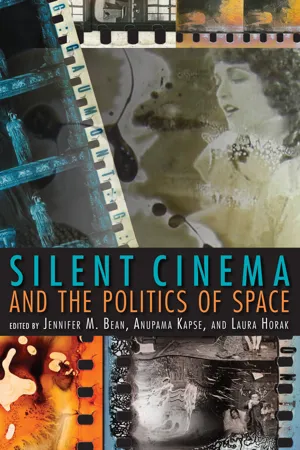
In this cross-cultural history of narrative cinema and media from the 1910s to the 1930s, leading and emergent scholars explore the transnational crossings and exchanges that occurred in early cinema between the two world wars. Drawing on film archives from around the world, this volume advances the premise that silent cinema freely crossed national borders and linguistic thresholds in ways that became far less possible after the emergence of sound. These essays address important questions about the uneven forces–geographic, economic, political, psychological, textual, and experiential–that underscore a non-linear approach to film history. The "messiness" of film history, as demonstrated here, opens a new realm of inquiry into unexpected political, social, and aesthetic crossings of silent cinema.
eBook - ePub
Silent Cinema and the Politics of Space
- 360 pages
- English
- ePUB (mobile friendly)
- Available on iOS & Android
eBook - ePub
Silent Cinema and the Politics of Space
About this book
Trusted by 375,005 students
Access to over 1.5 million titles for a fair monthly price.
Study more efficiently using our study tools.
Information
Subtopic
Film History & CriticismPART I
PICTURING SPACE
Introduction
The mirror is, after all, a utopia, since it reflects a placeless place.
Michel Foucault, “Of Other Spaces”
ONE OF THE most useful insights of scholarship that considers the conversion of 35mm films to 3D is the reminder that the latter’s appearance is not a mere novelty. Such revivals are not, as Kristen Whissel points out, a way of rescuing a seemingly threatened (U.S.) film industry in view of the coming of newer and more profitable technologies of viewing and consuming visual media. Rather, 3D is better approached as a practice that “has migrated across a broad range of platforms and media, including television, smart phones, photography, tablets, video games, and live theatrical performances.”1 Which is to say that the spatial vision of 3D—its direct, tactile address to the spectator, its mutations of time and space, its loosening of the film frame—is not a phenomenon that emerged in the crisis of the fifties, as is commonly believed. Rather, such attempts need to be understood within an archaeology of media forms that have, since the late nineteenth and early twentieth century, continued to relay moving images in a variety of spatial formats which include the history of binocular and stereoscopic vision.
Nor can we assume that such frank play with time and space is restricted to silent films made before World War I. Indeed, both Hugo (Martin Scorcese, 2011) and The Artist (Michel Hazanavicius, 2011) unhinge the very idea of the material stability (or endurance) of celluloid by restaging film itself as the fiction now resident in digital or 3D formats. In the words of Thomas Elsaesser, such transformations have made their reappearance “as only one part of an emerging set of new default values—about how to locate ourselves [and the medium of film] in simultaneous spaces [and] multiple temporalities.”2 If both Hugo and The Artist reconceptualize the ontology of silent film by inserting its history into a seamless, invisible continuum of time and space, then the essays in this section make silent film history visible at the disciplinary level in several different ways. In the most basic sense, they intervene in the existing historiography of silent cinema by expanding its time and place to manifestly include the present. Still more, they shift the critical object away from the United States to include what were, in the days of the silent era, “small” nations like Denmark and India. Seen this way, the critical space of what can no longer simply be called early cinemas invites approaches that can encompass a range of not only media forms but also other places and periods. What happens, then, if we turn to what can only provisionally be called early cinemas elsewhere in Europe and Asia? While the focus here comes from neither stereoscopy nor 3D vision, “Picturing Space” takes stock of location as an exemplary film practice that could radically destablize the early film viewer’s experience of and interaction with lived space. Take, for example, the Danish film Løvejagten (The lion hunt; 1907), which was marketed as a film about an African lion hunt but was shot in a Hamburg zoo. Then again, what happens if we shift the focus to a one-reel Edison film, The Relief of Lucknow (1912; henceforth Relief) which was made in the United States, set in the India of 1857, but shot in the Bermuda of 1912? While it is reasonably safe to assume that both Løvejagten and Relief were addressed to local spectators in Denmark and the United States, respectively, it is also clear that both films depend on fictions of an Africa and India that immediately broaden the rhetoric of how cinema can “reach” out to the spectator in direct and often unexpected ways.
Mark B. Sandberg shows how Danish locations could be passed off as sites in New York, while Priya Jaikumar reveals just how small physical knowledge of Lucknow could be in a larger geopolitical space: so small that Bermuda could be passed off as Lucknow. Still more, rather than starting with the work of Denmark’s Nordisk film company, Sandberg begins with the recent example of The Kite Runner (2007), drawing attention to the paradoxical implications of “location” shooting in this transnational production: a film like The Kite Runner makes us believe that we are seeing a Kabul situated in Afghanistan, although the film was actually shot in a town named Kashgar, located in China. Moreover, information about the fakeness of the location is not hidden but made explicit through special features on a DVD that can be viewed on demand with the main feature. By acknowledging the gap between actual place and filmic space, such information throws the unmappable quality of cinematic place (China or Afghanistan?) into stark relief: as Sandberg puts it, “the possibilities for substitution and misidentification are endless.” The deeper implications of altering place emerge sharply when he delineates a rhetoric of place substitution whereby he himself translocates the instance of The Kite Runner to the Nordisk Film Company in silent-era Denmark.
The results of such an inquiry are extraordinary: location emerges as the productive force which allowed Nordisk to capture an international market by erasing Denmark’s local landmarks from its cinematic topography. In other words, Denmark literally expanded its position as a national cinema in the global mediascape by mobilizing apparently distant, inaccessible locations which included both Africa and the United States. Displacement and dispersal abound here: even makeup, or the dressing up of a location (not necessarily of people), emerges as a metaphor for the trickery of cinematic placelessness, one that converts known places into formidable, Other spaces. Sandberg lists a number of ways in which cinematic sites can be not merely simulated but openly enhanced, even replaced or substituted, like the Copenhagen zoo, which can be passed off as sub-Saharan Africa. While both theater and cinema have always had the ability to mask the actual place, set, or site of shooting by using of painted backdrops, fake locations, or clever camera angles that block, reconstruct or even fabricate film space—such a move insists that we be alert to cinema’s deterritorialization of national maps by virtue of its hypermobile staging of location. Put differently, location emerges as the governing principle of a “façade aesthetics”: a cinematic drive that is always already fraught with deceptions, strategies of overcompensation, and “sleights of location” that pervade a majority of genres in Danish silent cinema—hunt films, erotic melodramas, and science fiction—spilling over into a vast, related domain of film production which comprises set design, location photography, publicity material, and “how it was done” fan discourse. Here the problematization of cinematic place enables glimpses into a “smaller” or distinctive mode of production that proves to be the exception when seen in relation to U.S. silent cinema, one that can by turn controvert, imitate, or, as we will see again and again in this volume, appropriate American strategies of filmmaking in order to compete with that “large” nation.3 Although Nordisk came from what Sandberg characterizes as the “small” nation of Denmark, it could compete in the European market by deploying—even preempting—the same tactics that eventually made American cinema so successful. Concomitantly, we may think of the subsequent return of the national as characterized by an insistence on the authenticity of location (for example, in the films of Carl Dreyer and the Dogme 95 Manifesto), as a turn that explicitly fetishizes the local over the global. Above all, Sandberg argues that the incompleteness and imminent failure of place substitution could well be its most compelling feature. To this end, he points out those moments when the “here” of the actual place supplants the “there” of the imagined and the fictional: moments when made-up locations betray their origins (a resident of Denmark knows instantly when he or she sees it and looks right through the cinematic fiction).
As such, this chapter is particularly noteworthy in its articulation of what Edward Soja calls “a geographical or spatial imagination” that can break critical silence about “milieu, immediate locales and provocative emplacements” and intervene in modes of historicism that privilege the authenticity and representational illusionism of cinematic space.4 Michel de Certeau’s distinction between place (lieu) and space (espace) is also instructive here: “The law of the proper rules ‘place’—the elements taken into consideration are beside one another, each situated in its proper and distinct location, a location it defines”; while space “is composed of intersections and mobile elements.… Space occurs as the effect that is produced by the operations that orient it, situate it, temporalize it.… In contradistinction to the place, it has none of the univocity or stability of a ‘proper.’”5 Collectively, Sandberg and Jaikumar dismantle the “proper” elements of place to reveal cinema’s spatial practices, which are shown to be contingent on competing economies of production, variable temporalities, ideologies of power, local sensoria, and individualized modes of spectatorship. Furthermore, this “spatial turn,” defined by Soja as “an unprecedented diffusion of critical spatial thinking across an unusually broad spectrum of subject areas,” uncovers the silences of older modes of film historicism of which Euro- or U.S.-centrism is only one example.6
Edward Said’s well-known formulation about the imperial control of space immediately comes to mind: “The actual, geographical possession of land is what empire in the final analysis is all about.”7 Within this formulation, geography, or the geographical sense, is geared toward “projections—imaginative, cartographic” in a tussle that locks colonizer and colonized in an endless quest for power, control, and ownership. However, it is worth noting that Said was speaking of the tightly demarcated “narrative space” of the novel here, a form deeply imbricated in the bourgeois control of marriage and private property. Projections of power collapse easily when the viewer who lives in Lucknow confronts it on film and personal memories of lived space, whether British or Indian, intrude upon the narrative and space of representation. In a dazzling reconceptualization, Jaikumar turns away from both the logic of representation in film theory and the issue of represented space in cinema to focus instead on what Henri Lefebvre describes as a “trial by space,” by which he means an analysis that “embraces production and reproduction … the particular locations of each social formation … representations of space, and representational space” (my emphasis).8 Rather than situating The Relief of Lucknow as a product of the Edison film company, Jaikumar approaches it as a film that unveils Lucknow’s spatial unconscious; that is, it activates, in the space that falls outside the logic of representation, repressed memories of a city that launched India’s first rebellion against British rule in 1857. Such memories are usually obscured in British accounts (official and novelistic) of what came to be known as “the Indian mutiny” and not as the first war of independence. Not surprisingly, the insurgency fired the imagination of British novelists, who exploited its intrigue and sensational violence to crank out narratives of kidnapped Englishwomen, “brown-faced” Englishmen, and double-crossing Indian spies.
Soon, the tight master narrative of betrayal would be loosened in an outbreak of photographs, personal albums, and letters. With the coming of photography, the British public could, for the first time, capture and share the images of an empire ruined in stunning detail. The proliferation of the telegraph and its instantaneous circuits of communication simply aided the rapid circulation of this exciting news. Drawing attention to a remarkable perceptual shift, Jaikumar writes, “Unlike literature, location shooting is a medium-specific industrial and aesthetic practice with its own history in cinema.” Taking an altogether different approach to space, she goes well beyond a strident—and long overdue—revision of Saidian notions of spatial control. For Jaikumar, space, understood as a destabilizing mechanism produced by shooting on location, loosens the notion of place as something narrowly tied to territory and dominion. In the case of Lucknow, pre-cinematic media such as the photographic album document a perceived rather than secondhand sense of Lucknow—as a space rather than a place, mobilizing the affective value of location for both colonizer and colonized and straddling a competing set of demands. To be sure, the Italian photographer Felice Beato transformed Lucknow into a sensational global site of disaster tourism. However, the flurry of personal photographs collected over a period of time in family albums or the subsequent emergence of postcards would interrupt the smooth manifestation of disastrous effects, foregrounding a plethora of intimately observed sensations and details. Here personal memory and the immediacy of photographic capture accumulate meanings that overlay the touristic, anticipating cinema’s play with received history and thereby rupturing the precise idea of place as a knowable entity. In skirting the diktats of representational illusionism, the photographic album shows how these smaller, more moffusil media could defy the very notion of historical truth. Thus the album produces space as a series of views, rather than as a singular image of the city of Lucknow: it becomes part of an ongoing historical chain that is suffused with the contradictory optics of local remembrance.
The Reverend Thomas Moore’s album Cawnpore and Lucknow during the Mutiny of 1857 is a case in point. Jaikumar contrasts the album’s dynamic imagery with the imposing still photographs of the so-called mutiny of official accounts which were “massive in s...
Table of contents
- Cover
- Title Page
- Copyright
- Contents
- Acknowledgments
- Introduction
- Part I. Picturing Space
- Part II. Prints in Motion
- Part III. Impertinent Appropriations
- Part IV. Cosmopolitan Sexualities and Female Stars
- Bibliography
- Contributors
- Index
Frequently asked questions
Yes, you can cancel anytime from the Subscription tab in your account settings on the Perlego website. Your subscription will stay active until the end of your current billing period. Learn how to cancel your subscription
No, books cannot be downloaded as external files, such as PDFs, for use outside of Perlego. However, you can download books within the Perlego app for offline reading on mobile or tablet. Learn how to download books offline
Perlego offers two plans: Essential and Complete
- Essential is ideal for learners and professionals who enjoy exploring a wide range of subjects. Access the Essential Library with 800,000+ trusted titles and best-sellers across business, personal growth, and the humanities. Includes unlimited reading time and Standard Read Aloud voice.
- Complete: Perfect for advanced learners and researchers needing full, unrestricted access. Unlock 1.5M+ books across hundreds of subjects, including academic and specialized titles. The Complete Plan also includes advanced features like Premium Read Aloud and Research Assistant.
We are an online textbook subscription service, where you can get access to an entire online library for less than the price of a single book per month. With over 1.5 million books across 990+ topics, we’ve got you covered! Learn about our mission
Look out for the read-aloud symbol on your next book to see if you can listen to it. The read-aloud tool reads text aloud for you, highlighting the text as it is being read. You can pause it, speed it up and slow it down. Learn more about Read Aloud
Yes! You can use the Perlego app on both iOS and Android devices to read anytime, anywhere — even offline. Perfect for commutes or when you’re on the go.
Please note we cannot support devices running on iOS 13 and Android 7 or earlier. Learn more about using the app
Please note we cannot support devices running on iOS 13 and Android 7 or earlier. Learn more about using the app
Yes, you can access Silent Cinema and the Politics of Space by Jennifer M. Bean, Anupama Kapse, Laura Horak, Jennifer M. Bean,Anupama Kapse,Laura Horak, JENNIFER M BEAN, ANUPAMA P KAPSE, LAURA EVELYN HORAK in PDF and/or ePUB format, as well as other popular books in Media & Performing Arts & Film History & Criticism. We have over 1.5 million books available in our catalogue for you to explore.