"A book that is an ambitious, well-researched and provocative scholarly reflection on soul in the Platonic corpus." —
Polis
By focusing on the immortal character of the soul in key Platonic dialogues, Sara Brill shows how Plato thought of the soul as remarkably flexible, complex, and indicative of the inner workings of political life and institutions. As she explores the character of the soul, Brill reveals the corrective function that law and myth serve. If the soul is limitless, she claims, then the city must serve a regulatory or prosthetic function and prop up good political institutions against the threat of the soul's excess. Brill's sensitivity to dramatic elements and discursive strategies in Plato's dialogues illuminates the intimate connection between city and soul.
"Sara Brill takes on at least two significant issues in Platonic scholarship: the nature of the soul, and especially the language of immortality in its description, and the relationship between politics and psychology. She treats each one of these topics in a fresh and nuanced way. Her writing is beautiful and fluid." —Marina McCoy, Boston College
- 272 pages
- English
- ePUB (mobile friendly)
- Available on iOS & Android
eBook - ePub
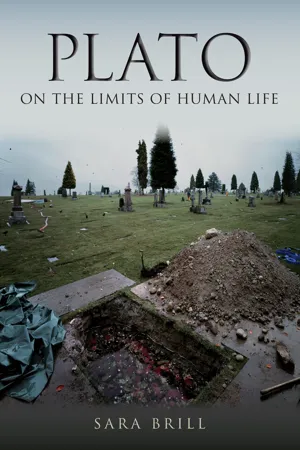
Plato on the Limits of Human Life
About this book
Information
Topic
PhilosophySubtopic
Ancient & Classical PhilosophyPART I
PHAEDO
FROM A ZOOLOGICAL perspective, the Phaedo contains a bestiary to be reckoned with. References to swans and swallows, bees and bulls, ants, frogs, and dogs, to name just a few, appear throughout its pages. This profusion of living beings is matched in the Phaedo by a profusion of kinds of accounts. During the course of the dialogue we encounter the musikē of poetry and song, the quasi-clinical utterances of incantation and charm, the language of mathematical Pythagoreanism, the eschatological beliefs associated with Orphic poetry, and the threat of eristic. Amid this proliferation of logos, we also encounter four logoi about the immortality of the soul whose flaws as demonstrations have been noted by scholars spanning both decades and schools of thought,1 and a myth whose discursive excesses have led to an inverse paucity of discussion in contemporary Phaedo commentary.2
It is within the milieu of these flowering forms of zōon and logos that the Phaedo's investigation of soul takes place. Indeed, it is the very profusion of zōon and logos that opens up a crucial dimension of the Phaedo as a whole, namely, its overarching concern with the relationship between modes of discourse about death and that entity so powerfully and, for contemporary readers, enigmatically associated with life, soul. Thus, in order to determine what contributions the Phaedo makes to Plato's investigation of soul, we will need to sort out how this investigation is both inspired and determined by the overarching interconnection between zōon and logos that the dialogue posits.
The question that motivates an investigation of soul in the Phaedo, however, is not what the soul is, but whether it is immortal. An inquiry into the soul's immortality is an inquiry into the manner in which human life is circumscribed by limits in which the soul is somehow implicated but to which the soul itself may not be subject. To assert that the soul is deathless is to attribute to the soul a certain limitlessness that is not exemplified by human life and that finds only uneasy expression in it. Thus, the Phaedo's exploration of the soul involves an investigation of how the soul's limitlessness affects human life. This focus on the human soul should be noted even if, as the dialogue strongly suggests, understanding the human soul requires understanding living being as such and the cosmos as a whole.
Most immediately, the dramatic context of the dialogue draws into sharp relief the extent to which giving an account of one's life requires one to acknowledge the opinions about one's soul that have influenced one's actions. For the life that is most immediately at stake in the dialogue is the life of a particular human being, Socrates, and it is Socrates's confidence in the face of his imminent demise that ultimately inspires the specific focus in the dialogue on the question of whether or not the soul is immortal. When compelled to defend this confidence to his friends, Socrates provides an account of a course of life, which he describes as philosophic and espouses as best, whose assumptions about the endurance of the soul beyond death prove sufficiently dubious to his interlocutors as to provoke them to ask for further demonstration of the soul's deathlessness. In the conversation that ensues, Socrates engages in a series of accounts, on the one hand, which he characterizes as attempts to soothe his interlocutors’ fear of death (77c–78b), and, on the other, an elaborate myth, which Socrates hopes will illustrate the need to care for one's soul (107c–d).
Thus, Plato's depiction of a music-practicing Socrates who cheerfully greets his death situates the investigation of soul undertaken by Socrates and his interlocutors within a consideration of the influence one's opinions about death and the soul have on one's life. Indeed, one of the dialogue's most compelling features is its demonstration that the fear of death, with all of its power to influence one's actions, implies certain assumptions about the nature of the soul. Socrates's expressly therapeutic efforts to contend with this fear require both the articulation and critical assessment of the assumptions about the soul that inspire it. Plato presents Socrates's discussion of immortality as motivated, in part, by the wish to replace his interlocutors’ sadness about his death with the desire to care for their own souls.
Because Socrates's therapeutic endeavors are expressly identified as a persuasion about the nature of the soul,3 the Phaedo possesses an irreducibly rhetorical dimension, a dimension that deploys the persuasive power of a number of discursive registers from a variety of sources. At the same time, Socrates's own careful qualification of many of his claims demonstrates the necessity of a critical engagement with the beliefs about the soul available to Socrates and his interlocutors. The Phaedo thus includes a reflection upon both what is required in order to investigate the soul and why such an investigation is philosophically significant. Indeed, depicting Socrates's conversation with his friends on the day of his death allows Plato to (a) critically assess several influential beliefs and theories about the nature of the soul and reflect upon the experiences they attempt to account for; (b) explore the importance of the investigation of soul for philosophy; and (c) illustrate the need for a reflective comportment toward death that neither asserts unwarranted optimism about one's knowledge of the soul, nor paralyzes inquiry into what the soul is.
The possibility of such paralysis is illustrated (and risked) throughout the dialogue in a series of passages which emphasize the mortality of logos itself.4 The connection between the dialogue's logoi about living and dying on the one hand, and its allusions to the life and death of logos on the other, suggests an intimacy between zōon and logos that receives perhaps its fullest articulation in the dialogue in Socrates's account of his own life (95e–102a). This mutual implication of zōon and logos is, as we will observe, intimately related to the dialogue's investigation of soul.
The next three chapters will argue that one of the Phaedo's most significant contributions to Platonic psychology is its demonstration of the soul's plasticity and the challenges that this malleability poses to a philosophical investigation of soul. Reducible to neither changeless permanence nor uninterrupted transformation, the soul presents to Socrates and his interlocutors an entity subject to myriad changes in condition whose very capacity to undergo such changes marks it as unique. Once this plasticity has been illustrated, the task taken up by a good portion of the dialogue is to develop as complex and subtle a means of delimiting the various conditions of soul as possible. This is to say that the dialogue's emphasis on the soul's malleability determines its exploration of soul as an exploration of the various conditions of soul. It is this task that the variety of kinds of living beings and forms of logoi serve.
This interplay between the substance of the dialogue and its structure challenges any strict hierarchical distinction between the Phaedo's dramatic and argumentative elements. Indeed, the necessity of the variety of living beings and discursive registers to the dialogue's psychological inquiry remains concealed if one does not take into account the intertwining of structure and function that unites the dialogue as a whole. More specifically, the mutual implication of zōon and logos outlined above, and its importance for the dialogue's investigation of soul, is obscured if one focuses on the four logoi about the immortality of the soul in isolation from the full range of utterance presented in the dialogue. However, with few exceptions, the centrality of the demonstrative logoi has been assumed throughout contemporary Phaedo commentary. The reasons for this are complex and best addressed in the course of examining the passages themselves. At this juncture I will simply note one effect of this focus, namely, the broadly dubious reception of the myth of the earth that follows upon these logoi. Such a response is not, I believe, sufficiently attentive to the dialogue's permeation by myth throughout, from the early allusion to Theseus to the later description of the true earth.5 In fact, the four logoi are themselves infused with mythic imagery, from their start in the ancient saying that souls reside in Hades (70c) to their use of Homeric and Pythagorean imagery in what has come to be called the Affinity Argument (78b–84b). In the Phaedo, muthos and logos function in such a manner as to be neither reducible to one another nor understood in isolation from one another.6
In what follows, I take this interdependence between logos and muthos to be intended by Plato and to be necessitated by the dialogue's particular investigation of soul; thus, the relationship between muthos and logos in the Phaedo cannot be understood in isolation from their collective contribution to the dialogue's psychological inquiry, nor can the dialogue's contribution to psychology be adequately discerned without taking into account Plato's deployment of muthos and logos. I will argue that both the four logoi about the immortality of the soul and the muthos about the true earth serve the dialogue's overarching and persistent effort to develop as subtle and precise an account of the varieties of soul's conditions as possible. Further, each does so by critically engaging with and appropriating a number of culturally embedded conceptions of soul espoused by Socrates in his defense of his confidence in the face of death and by his interlocutors in their engagement with this defense.7 While the four logoi about the soul's immortality involve a critical engagement with mathematical, religious, and poetic conceptions of the soul, they ultimately fail to be fully persuasive because they rely upon an incomplete conception of the relationship between body and soul, a conception that denies them meaningful reference to the lives and deaths of embodied beings. The myth of the true earth provides, I will show, a necessary complement to these logoi by offering a critical engagement with the very perspective from which Socrates and his interlocutors assess these conceptions—thereby providing a dimension of self-critique that is called for by the four logoi—and by locating the question of the relationship between soul and body within the context of living and dying.
The following three chapters will attempt to make good on these claims by focusing upon three sections of the Phaedo: Socrates's defense, which encapsulates the main themes that will be subject to scrutiny throughout the rest of the dialogue (chapter 1); the four demonstrative logoi, including the interludes between demonstrations (chapter 2); and the concluding myth (chapter 3). Because the dialogue's psychological insights hinge upon the reciprocity between its structure and substance, I make every effort to remain sensitive to the complex texture of the dialogue by grounding my discussion of these sections within the context of the dialogue as a whole. Bearing in mind the choices Plato makes in framing the entire discussion, I take quite seriously Socrates's critical assessment of the demonstrative logoi (the arguments), his insistence on their limitations (that they are neither comprehensive nor complete), and on the need continually to investigate their claims, as well as his persistent refusal to insist upon the veracity of the myth that he tells toward the dialogue's end. Doing so requires a denial of the doctrinal character of any of the discussions in the dialogue. To attribute such a status to them is to treat a question as though it were an answer, thereby committing what is for Plato a fatal philosophical error. Instead, we need to scrupulously observe that Plato has his Socrates utter claims about which he is ultimately uncertain, and we must begin by asking what philosophical end is served by staging the elaboration and critical assessment of these claims.
1 Socratic Prothumia
SOCRATES'S DEFENSE OF the calmness with which he confronts his death unfolds within a theological framework with which he has a vital, if also uneasy, relationship. Indeed, he is granted the opportunity of giving this defense because of a delay in his execution due to a religious observation: the citywide observance of a vow to Apollo, involving a ritual mission to Delos in memory of Theseus, prohibits the civic pollution that accompanies executions. Further, Socrates's attempts to give both an account of himself and of the “true” philosopher are ...
Table of contents
- Cover Page
- Title Page
- Copyright Page
- Dedication Page
- Contents
- Acknowledgments
- Introduction
- Part I. Phaedo
- Part II. Republic
- Part III. Laws
- Notes
- Works Cited
- Index
- About the Author
Trusted by 375,005 students
Access to over 1.5 million titles for a fair monthly price.
Study more efficiently using our study tools.
Frequently asked questions
Yes, you can cancel anytime from the Subscription tab in your account settings on the Perlego website. Your subscription will stay active until the end of your current billing period. Learn how to cancel your subscription
No, books cannot be downloaded as external files, such as PDFs, for use outside of Perlego. However, you can download books within the Perlego app for offline reading on mobile or tablet. Learn how to download books offline
Perlego offers two plans: Essential and Complete
- Essential is ideal for learners and professionals who enjoy exploring a wide range of subjects. Access the Essential Library with 800,000+ trusted titles and best-sellers across business, personal growth, and the humanities. Includes unlimited reading time and Standard Read Aloud voice.
- Complete: Perfect for advanced learners and researchers needing full, unrestricted access. Unlock 1.5M+ books across hundreds of subjects, including academic and specialized titles. The Complete Plan also includes advanced features like Premium Read Aloud and Research Assistant.
We are an online textbook subscription service, where you can get access to an entire online library for less than the price of a single book per month. With over 1.5 million books across 990+ topics, we’ve got you covered! Learn about our mission
Look out for the read-aloud symbol on your next book to see if you can listen to it. The read-aloud tool reads text aloud for you, highlighting the text as it is being read. You can pause it, speed it up and slow it down. Learn more about Read Aloud
Yes! You can use the Perlego app on both iOS and Android devices to read anytime, anywhere — even offline. Perfect for commutes or when you’re on the go.
Please note we cannot support devices running on iOS 13 and Android 7 or earlier. Learn more about using the app
Please note we cannot support devices running on iOS 13 and Android 7 or earlier. Learn more about using the app
Yes, you can access Plato on the Limits of Human Life by Sara Brill in PDF and/or ePUB format, as well as other popular books in Philosophy & Ancient & Classical Philosophy. We have over 1.5 million books available in our catalogue for you to explore.