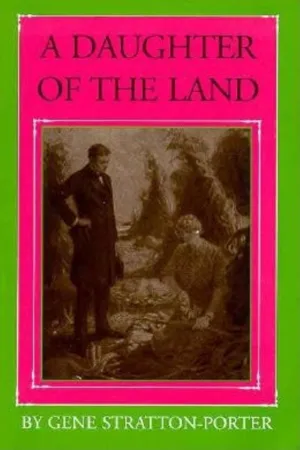
A young Midwestern woman resists her family's demands and pursues the dream of a farm of her own in this early twentieth-century classic.
As the youngest child, and female, in a large prosperous farm family, Kate Bates has been designated as her mother's helper in old age. Kate finds this unfair, since all of the brothers have been given land and the older sisters sent to teacher training.
With the help of a nephew and sister-in-law, she defies her parents, becomes a teacher, and leaves home. Her real ambition, however, is to own and cultivate a large farm. After rejecting the easy path to her dream, she suffers through a bad marriage—but refuses to let go of her goal—in this inspiring novel by the author of
A Girl of the Limberlost,
Laddie, and other beloved stories.
- 352 pages
- English
- ePUB (mobile friendly)
- Available on iOS & Android
eBook - ePub
A Daughter of the Land
About this book
Information
Print ISBN
9780253211385
Subtopic
Littérature généraleCHAPTER IV
A Question of Contracts
“HELLO, folks!” cried Kate, waving her hand to the occupants of the veranda as she went up the walk. “Glad to find you at home.”
“That is where you will always find me unless I am forced away on business,” said her brother as they shook hands.
Agatha was pleased with this, and stiff as steel, she bent the length of her body toward Kate and gave her a tight-lipped little peck on the cheek.
“I came over as soon as I could,” said Kate as she took the chair her brother offered, “to thank you for the big thing you did for me, Agatha, when you lent me that money. If I had known where I was going, or the help it would be to me, I should have gone if I’d had to walk and work for my board. Why, I feel so sure of myself! I’ve learned so much that I’m like the girl fresh from boarding school: ‘The only wonder is that one small head can contain it all.’ Thank you over and over and I’ve got a good school, so I can pay you back the very first month, I think. If there are things I must have, I can pay part the first month and the remainder the second. I am eager for payday. I can’t even picture the bliss of having that much money in my fingers, all my own, to do with as I please. Won’t it be grand?”
In the same breath said Agatha: “Procure yourself some clothes!” Said Adam: “Start a bank account!”
Said Kate: “Right you are! I shall do both.”
“Even our little Susan has a bank account,” said Adam, Jr., proudly.
“Which is no reflection whatever on me,” laughed Kate. “Susan did not have the same father and mother I had. I’d like to see a girl of my branch of the Bates family start a bank account at ten.”
“No, I guess she wouldn’t,” admitted Adam dryly.
“But have you heard what Nancy Ellen has started?” cried Kate. “Only think! A lawn mower! The house and barn to be painted! All the dinge possible to remove scoured away, inside! She must have worn her fingers almost to the bone! And really, Agatha, have you seen the man? He’s as big as Adam, and just fine looking. I’m simply consumed with envy.”
“Miss Medira, Dora, Ann, cast her net,And catched a man!”
recited Susan from the top step, at which they all laughed.
“No, I have not had the pleasure of casting my optics upon the individual of Nancy Ellen’s choice,” said Agatha primly, “but Miss Amelia Lang tells me he is a very distinguished person, of quite superior education in a medical way. I shall call him if I ever have the misfortune to fall ill again. I hope you will tell Nancy Ellen that we shall be very pleased to have her bring him to see us some evening, and if she will let me know a short time ahead I shall take great pleasure in compounding a cake and freezing custard.”
“Of course I shall tell her, and she will feel a trifle more stuck up than she does now, if that is possible,” laughed Kate in deep amusement.
She surely was feeling fine. Everything had come out so splendidly. That was what came of having a little spirit and standing up for your rights. Also she was bubbling inside while Agatha talked. Kate wondered how Adam survived it every day. She glanced at him to see if she could detect any marks of shattered nerves, then laughed outright.
Adam was the finest physical specimen of a man she knew. He was good looking also, and spoke as well as the average, better in fact, for from the day of their marriage, Agatha sat on his lap each night and said these words: “My beloved, today I noted an error in your speech. It would put a former teacher to much embarrassment to have this occur in public. In the future will you not try to remember that you should say, ‘have gone,’ instead of ‘have went’?” As she talked Agatha rumpled Adam’s hair, pulled off his string tie, upon which she insisted, even when he was plowing; laid her hard little face against his, and held him tight with her frail arms, so that Adam being part human as well as part Bates, held her closely also and said these words: “You bet your sweet life I will!” And what is more he did. He followed a furrow the next day, softly muttering over to himself: “Langs have gone to town. I have gone to work. The birds have gone to building nests.” So Adam seldom said: “have went,” or made any other error in speech that Agatha had once corrected.
As Kate watched him leaning back in his chair, vital, a study in well-being, the supremest kind of satisfaction on his face, she noted the flash that lighted his eye when Agatha offered to “freeze a custard.” How like Agatha! Any other woman Kate knew would have said, “make ice cream.” Agatha explained to them that when they beat up eggs, added milk, sugar, and cornstarch it was custard. When they used pure cream, sweetened and frozen, it was iced cream. Personally, she preferred the custard, but she did not propose to call a custard, cream. It was not correct. Why persist in misstatements and inaccuracies when one knew better? So Agatha said iced cream when she meant it, and frozen custard, when custard it was, but every other woman in the neighborhood, had she acted as she felt, would have slapped Agatha’s face when she said it: this both Adam and Kate well knew, so it made Kate laugh despite the fact that she would not have offended Agatha purposely.
“I think—I think,” said Agatha, “that Nancy Ellen has much upon which to congratulate herself. More education would not injure her, but she has enough that if she will allow her ambition to rule her and study in private and spend her spare time communing with the best writers, she can make an exceedingly fair intellectual showing, while she surely is a handsome woman. With a good home and such a fine young professional man as she has had the good fortune to attract, she should immediately put herself at the head of society in Hartley and become its leader to a much higher moral and intellectual plane than it now occupies.”
“Bet she has a good time,” said young Adam. “He’s awful nice.”
“Son,” said Agatha, “ ‘awful,’ means full of awe. A cyclone, a cloudburst, a great conflagration are awful things. By no stretch of the imagination could they be called nice.”
“But, Ma, if a cyclone blew away your worst enemy wouldn’t it be nice?”
Adam, Jr., and Kate laughed. Not the trace of a smile crossed Agatha’s pale face.
“The words do not belong in contiguity,” she said. “They are diametrically opposite in meaning. Please do not allow my ears to be offended by hearing you place them in propinquity again.”
“I’ll try not to, Ma,” said young Adam; then Agatha smiled on him approvingly. “When did you meet Mr. Gray, Katherine?” she asked.
“On the foot-log crossing the creek beside Lang’s line fence. Near the spot Nancy Ellen first met him, I imagine.”
“How did you recognize him?”
“Nancy Ellen had just been showing me his picture and telling me about him. Great Day, but she’s in love with him!”
“And so he is with her, if Lang’s conclusions from his behavior can be depended upon. They inform me that he can be induced to converse on no other subject. The whole arrangement appeals to me as distinctly admirable.”
“And you should see the lilac bush and the cabbage roses,” said Kate. “And the strangest thing is Father. He is peaceable as a lamb. She is not to teach, but to spend the winter sewing on her clothes and bedding, and Father told her he would give her the necessary money. She said so. And I suspect he will. He always favored her because she was so pretty, and she can come closer to wheedling him than any of the rest of us excepting you, Agatha.”
“It is an innovation, surely!”
“Mother is nearly as bad. Father furnishing money for clothes and painting the barn is no more remarkable than Mother letting her turn the house inside out. If it had been I, Father would have told me to teach my school this winter, buy my own clothes and linen with the money I had earned, and do my sewing next summer. But I am not jealous. It is because she is handsome, and the man fine looking and with such good prospects.”
“There you have it!” said Adam emphatically. “If it were you, marrying Jim Lang, to live on Lang’s west forty, you would pay your own way. But if it were you marrying a fine-looking young doctor, who will soon be a power in Hartley, no doubt, it would tickle Father’s vanity until he would do the same for you.”
“I doubt it!” said Kate. “I can’t see the vanity in Father.”
“You can’t?” said Adam, Jr., bitterly. “Maybe not. You have not been with him in the Treasurer’s office when he calls for ‘the tax on those little parcels of land of mine.5 He looks every inch of six feet six then, and swells like a toad. To hear him you would think sixteen hundred and fifty acres of the cream of this county could be tied in a bandanna and carried on a walking stick, he is so casual about it. And those men fly around like buttons on a barn door to wait on him and it’s ‘Mister Bates this’ and ‘Mister Bates that,’ until it turns my stomach. Vanity! He rolls in it! He eats it! He risks losing our land for us that some of us have slaved over for twenty years, to feed that especial vein of his vanity. Where should we be if he let anything happen to those deeds?”
“How refreshing!” cried Kate. “I love to hear you grouching! I hear nothing else from the women of the Bates family, but I didn’t even know the men had a grouch. Are Peter, and John, and Hiram, and the other boys sore, too?”
“I should say they are! But they are too diplomatic to say so. They are afraid to cheep. I just open my head and say right out loud in meeting that since I’ve turned in the taxes and insurance for all these years and improved my land more than fifty per cent., I’d like to own it, and pay my taxes myself, like a man.”
“I’d like to have some land under any conditions,” said Kate, “but probably I never shall. And I bet you never get a flipper on that deed until Father has crossed over Jordan, which with his health and strength won’t be for twenty-five years yet at least. He’s performing a miracle that will make the other girls rave, when he gives Nancy Ellen money to buy her outfit; but they won’t dare let him hear a whisper of it. They’ll take it all out on Mother, and she’ll be afraid to tell him.”
“Afraid? Mother afraid of him? Not on your life. She is hand in glove with him. She thinks as he does, and helps him in everything he undertakes.”
“That’s so, too. Come to think of it, she isn’t a particle afraid of him. She agrees with him perfectly. It would be interesting to hear them having a private conversation. They never talk a word before us. But they always agree, and they heartily agree on Nancy Ellen’s man, that is plainly to be seen.”
“It will make a very difficult winter for you, Katherine,” said Agatha. “When Nancy Ellen becomes interested in dresses and table linen and bedding she will want to sew all the time, and leave the cooking and dishes for you as well as your schoolwork.”
Kate turned toward Agatha in surprise. “But I won’t be there! I told you I had taken a school.”
“You taken a school!” shouted Adam. “Why, didn’t they tell you that Father has signed up for the home school for you?”
“Good Heavens!” said Kate. “What will be to pay now?”
“Did you contract for another school?” cried Adam.
“I surely did,” said Kate slowly. “I signed an agreement to teach the village school in Waiden. It’s a brick building with a janitor to sweep and watch fires, only a few blocks to walk, and it pays twenty dollars a month more than the home school where you can wade snow three miles, build your own fires, and freeze all day in a little frame building at that. I teach the school I have taken.”
“And throw our school out of a teacher? Father could be sued, and probably will be,” said Adam. “And throw the housework Nancy Ellen expected you to do on her,” said Agatha, at the same time.
“I see,” said Kate. “Well, if he is sued, he will have to settle. He wouldn’t help me a penny to go to school, I am of age, the debt is my own, and I don’t owe it to him. He’s had all my work has been worth all my life, and I’ve surely paid my way. I shall teach the school I have signed for.”
“You will get into a pretty kettle of fish!” said Adam.
“Agatha, will you sell me your telescope for what you paid for it, and get yourself a new one the next time you go to Hartley? It is only a few days until time to go to my school, it opens sooner than in the country, and closes later. The term is four months longer, so I earn that much more. I haven’t gotten a telescope yet. You can add it to my first payment.”
“You may take it,” said Agatha, “but hadn’t you better reconsider, Katherine? Things are progressing so nicely, and this will upset everything for Nancy Ellen.”
“That taking the home school will upset everything for me, doesn’t seem to count. It is late, late to find teachers, and I can be held responsible if I break the contract I have made. Father can stand the rac...
Table of contents
- Cover
- Half Title
- Title Page
- Copyright Page
- Dedication
- Table of Contents
- I The Wings of Morning
- II An Embryo Mind Reader
- III Peregrinations
- IV A Question of Contracts
- V The Prodigal Daughter
- VI Kate’s Private Pupil
- VII Helping Nancy Ellen and Robert To Establish a Home
- VIII The History of a Leghorn Hat
- IX A Sunbonnet Girl
- X John Jardine’s Courtship
- XI A Business Proposition
- XII Two Letters
- XIII The Bride
- XIV Starting Married Life
- XV A New Idea
- XVI The Work of the Sun
- XVII The Banner Hand
- XVIII Kate Takes the Bit in Her Teeth
- XIX “AsaManSoweth”
- XX “For a Good Girl”
- XXI Life’s Boomerang
- XXII Somewhat of Polly
- XXIII Kate’s Heavenly Time
- XXIV Polly Tries Her Wings
- XXV One More for Kate
- XXVI The Winged Victory
- XXVII Blue Ribbon Corn
- XXVIII The Eleventh Hour
Trusted by 375,005 students
Access to over 1.5 million titles for a fair monthly price.
Study more efficiently using our study tools.
Frequently asked questions
Yes, you can cancel anytime from the Subscription tab in your account settings on the Perlego website. Your subscription will stay active until the end of your current billing period. Learn how to cancel your subscription
No, books cannot be downloaded as external files, such as PDFs, for use outside of Perlego. However, you can download books within the Perlego app for offline reading on mobile or tablet. Learn how to download books offline
Perlego offers two plans: Essential and Complete
- Essential is ideal for learners and professionals who enjoy exploring a wide range of subjects. Access the Essential Library with 800,000+ trusted titles and best-sellers across business, personal growth, and the humanities. Includes unlimited reading time and Standard Read Aloud voice.
- Complete: Perfect for advanced learners and researchers needing full, unrestricted access. Unlock 1.5M+ books across hundreds of subjects, including academic and specialized titles. The Complete Plan also includes advanced features like Premium Read Aloud and Research Assistant.
We are an online textbook subscription service, where you can get access to an entire online library for less than the price of a single book per month. With over 1.5 million books across 990+ topics, we’ve got you covered! Learn about our mission
Look out for the read-aloud symbol on your next book to see if you can listen to it. The read-aloud tool reads text aloud for you, highlighting the text as it is being read. You can pause it, speed it up and slow it down. Learn more about Read Aloud
Yes! You can use the Perlego app on both iOS and Android devices to read anytime, anywhere — even offline. Perfect for commutes or when you’re on the go.
Please note we cannot support devices running on iOS 13 and Android 7 or earlier. Learn more about using the app
Please note we cannot support devices running on iOS 13 and Android 7 or earlier. Learn more about using the app
Yes, you can access A Daughter of the Land by Gene Stratton-Porter in PDF and/or ePUB format. We have over 1.5 million books available in our catalogue for you to explore.