An analysis of how city dwellers interact with their social and materials worlds in everyday life and how this affects their bodies.
Space and place have become central to analysis of culture and history in the humanities and social sciences.
Making Place examines how people engage the material and social worlds of the urban environment via the rhythms of everyday life and how bodily responses are implicated in the making and experiencing of place. The contributors introduce the concept of spatial ethnography, a new methodological approach that incorporates both material and abstract perspectives in the study of people and place, and encourages consideration of the various levels—from the personal to the planetary—at which spatial change occurs. The book's case studies come from Costa Rica, Colombia, India, Austria, Italy, the United Kingdom, and the United States.
"Rich, diverse, and provocative meditations on place and identity formation . . . it builds on the previous scholarship on bodies, memory and place while also moving our understanding of this theme in a refreshing and engaging direction." —Abidin Kusno, University of British Columbia
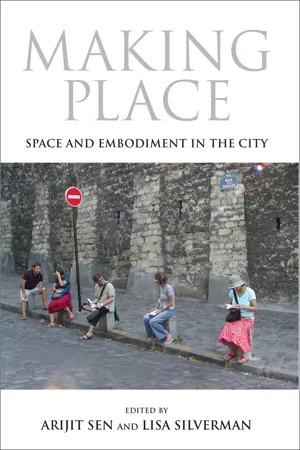
eBook - ePub
Making Place
Space and Embodiment in the City
- 218 pages
- English
- ePUB (mobile friendly)
- Available on iOS & Android
eBook - ePub
About this book
Information
1.
Placemaking and Embodied Space
Within the field of space and culture there has been increasing interest in theories that include the body and walking as bodily movement as integral parts of spatial analysis. These concerns have been addressed partially through the historical analysis of the docile body to social structure and power in work of Michel Foucault, and sociologically in the notions of habitus by Pierre Bourdieu and “structuration” by Anthony Giddens, as well as the works of many others.1 Nonetheless, many researchers, architects, and landscape practitioners need theoretical formulations that provide an everyday material grounding and experiential, cognitive, and/or emotional understanding of the intersection and interpenetration of body, space, and culture.2 I call this material and experiential intersection “embodied space.” These understandings require theories of body and space that are experience-near and yet allow for linkages to be made to larger social and political processes.
Spatial analyses in fields that deal with the built environment—for example, cultural landscape studies, architecture and vernacular architecture, material culture, and cultural anthropology and geography—often neglect the body because of difficulties in resolving the dualism of the subjective and objective body and distinctions between the material and representational aspects of body space. The concept of embodied space, however, draws these disparate notions together, underscoring the importance of the body as a physical and biological entity, as lived experience, and as a center of agency, a location for speaking and acting on the world. Embodied space actually allows these disparate disciplinary and methodological modes of practice and analysis to come together through a focus on bodies as they create space through mobility and movement.
The term “body” refers to its biological and social characteristics, and “embodiment” as an “indeterminate methodological field defined by perceptual experience and mode of presence and engagement in the world.”3 “Embodied space” is the location where human experience and consciousness take on material and spatial form. In earlier publications I have discussed the theories of the body, proxemics, phenomenology, language and discourse, and spatial orientation that I employ to construct the concept of embodied space.4 Here, I would like to focus more on the “placemaking” potential of embodied space. To do so, I draw on one component of that conceptualization—spatial orientation—and add a second conceptual element, that of mobility and movement, particularly through walking.5 I define and briefly review the literature that I am drawing upon and then illustrate the spatial orientation and movement approach with an ethnographic description of everyday paths and routines from my research on the Costa Rican plaza. Based on this discussion, embodied space is posited as a foundational concept for understanding the creation of place through spatial orientation, movement, and action.
Spatial Orientation
Nancy Munn begins her analysis of spatial orientation of the body through the notion of spacetime “as a symbolic nexus of relations produced out of interactions between bodily actors and terrestrial spaces.” Drawing in part upon Lefebvre's concepts of “field of action” and “basis of action,” and his insistence that space is produced and consumed actively through embodied practices and experiences, Munn constructs the notion of a “mobile spatial field.”6 I have found her notion useful for understanding how the body creates and makes its own space in that her spatiotemporal construct can be understood as a culturally defined, corporeal-sensual field stretching out from the body at a given locale or moving through locales.
Munn illustrates this notion of the body as a mobile spatial field through an ethnographic example derived from the spatial interdiction that occurs when Australian Aborigines treat the land according to ancestral Aboriginal law. She is interested in the specific kind of spatial form being produced: “a space of deletions or of delimitations constraining one's presence at particular locales” that creates a variable range of excluded or restricted regions for each person throughout their life.7 For instance, in following their moral-religious law, Aborigines make detours that must be far enough away to avoid seeing an ancient place or hearing the ritual singing currently going on there. By detouring, actors carve out a “negative space” that extends beyond their spatial field of vision. “This act projects a signifier of limitation upon the land or place by forming transient but repeatable boundaries out of the moving body.”8 Munn applies this idea to contemporary Aborigines’ encounters with powerful topographic centers and “dangerous” ancestral places.
The importance of this analysis is the way Munn demonstrates how the ancestral law's power of spatial limitation becomes “embodied” in an actor-centered, mobile body, separate from any fixed center or place. “Excluded spaces” become spatiotemporal formations produced out of the interaction of actors’ moving spatial fields and the terrestrial spaces of body action. Further, these detours, what Munn calls the production of “negative space,” are a new kind of spatialization of respect and a model for understanding the relationship of distance, detour, social regard, and status in other cultural groups, including our own. The power of this idea is that she suggests constructing the person (actor) as an embodied space, in which the body, conceived of as a moving spatial field, makes its own place in the world.
Stuart Rockefeller radicalizes this notion of actors’ mobile spatial fields into a theory of public places formed by the individual movement, trips, and digressions of migrants crossing national boundaries. Starting with Munn's idea that the person makes space by moving through it, he traces how movement patterns collectively make up locality and reproduce locality. Places, he argues, are not in the landscape, but simultaneously in the land, people's minds, customs, and bodily practices.9
Movement and Walking
Other theorists have emphasized the importance of movement in placemaking, conceptualizing space as movement rather than a container.10 For example, the geographer Allan Pred traces the history of microgeographies of daily life in southern Sweden to determine how everyday movement and behavior generate spatial transformations in land tenure that result in changes in the local social structure. He concludes that place always involves “appropriation and transformation of space and nature that is inseparable from the reproduction and transformation of society in time and space,” and he demonstrates how social change occurs through everyday bodily practices.11 Michel de Certeau's insightful analysis of the spatial tactics of orientation and movement also focuses on how the mundane acts of walking and meandering resist state order and regimes of city planning.12
John Gray, in his ethnographic research on sheep herding in the Scottish borderlands, draws inspiration from de Certeau by emphasizing the analogy of walking and language, with walking designated as the equivalent of speaking (la parole), rather than language (la langue) and the appropriation of space. Like de Certeau's urban dwellers, the hirsel, a unified place that includes both a shepherd's sheep and their grazing area, is constituted by the shepherd's walking and biking in the hills to care for his animals. The act of shepherding, or “agoing” around the hill, is a kind of space-making requiring a shepherd's detailed knowledge of not only the terrain but also how the sheep bond to parts of the terrain, and how these parts are linked together by paths to form a hirsel. The emphasis on walking the hills demonstrates how places, which may be separately named and recalled, are connected to one another and form a unified whole.13
Rachel Thomas is more concerned with “mobility” than simply walking in the urban context. Mobility and access are complex concepts that involve the perceptible environment, the perception of the pedestrian, and the ability of the body to express itself. In her research on urban accessibility to public space, she emphasizes the role of sensory perception in the choice of route based on fieldwork in Grenoble.14
Tim Ingold's seminal research on walking and linear movement connects these approaches through the integration of psychology and anthropology influenced by the work of James Gibson on perceptual systems.15 Gibson argues that perception is a psychosomatic act that can only be experienced through the body.16 Similar to Maurice Merleau-Ponty, who claims the body is a vehicle in the world, Gibson asserts that all perception is embodied.17 Ingold suggests that linear movement connects body movement and visual perception through lines of vision and the lines and paths of walking. He contrasts lines as free-flowing movement in an open landscape with lines that connect predetermined points of arrival and departure, and suggests that places are constituted by these lines of movement. Multiple forms of linear movement integrate the person, memory, experience, and the environment and include everything from the path to the locomotor mode accompanied by gestures, rhythm, and cadence.
Ethnographic research carried out in 2004–2005 in northeast Scotland by Ingold and Jo Lee Vergunst takes the notions of lines and body movement and applies them to walking, an activity that is fundamental to everyday life. They argue that the relationship between walking, embodiment, and sociability is crucial: “That is, we do not assume a priori that walking affords an experience of embodiment, or that social life hovers above the road we tread in our material life. Rather, walking affords an experience of embodiment to the extent that it is grounded in an inherently sociable engagement between self and environment.”18 Based on their study of Aberdeen walkers, Ingold and Vergunst conceptualize the relationship between bodies and environments in three ways: (1) the walker may look or sense the environment; (2) the walker may turn inward to thoughts, memories, or stories while experiencing the sensory perception; and (3) walkers may become aware of or even cross the boundary of the body and environment through their embodied and emotional interactions. The details of steps are integral to how the walk proceeds, while emotions are engendered not only by grand vistas but also by the care taken in maintaining balance or way-finding.
Vergunst's analysis of the lines and rhythms of walking on Union Street weaves the history and contemporary ethnography of Aberdeen, Scotland, with a study of walking and the street.19 Although Vergunst does not go as far as to argue that walking and the accompanying gestures of arm swinging and turns and twists create embodied space, he does explore the way that embodiment is materially inscribed in the city. Using sound, movement, rhythm, and shape of the walker's body, he uses walking the street as a means for understanding the historical development of the city. By interviewing walkers while they are walking, he is able to trace their way-finding decisions and adjustments in speed, tempo, and diversion. His discussion of “walking the mat,” a walk down Union Street in a small, single-sex group and during the walk meeting up with another group of the opposite sex, is reminiscent of narratives about la retreta and el paseo in Spanish American culture.
Embodied Space Fieldwork Illustration
The theoretical premise that individuals as mobile spatiotemporal fields create space and locale and the importance of walking in the creation of space are illustrated by a field study of walking and bodily movements and activities undertaken as part of a fifteen-year ethnography of two plazas in the center of San José, the capital city of Costa Rica.20 I collected these data on walking and body movement long before I had theorized the body's role in placemaking. As a modern dancer I felt that a significant part of the spatial experience of the plaza was created by the movement of people, not just by the users who spent their days there. Vicki Reisner, a dance ethnologist at the Library of Congress, and I struggled to find a way to record and communicate this ephemeral but profoundly material aspect of space and place.
Parque Central represents Costa Rica's Spanish colonial history in its spatial form and context. Its relatively long history spans the colonial, republican, and modern periods, and a number of historical photographs and portrayals of earlier periods of plaza design and social life were available in local archives. During the research period of 1985 through 1987, Parque Central was a vibrant center of traditional Costa Rican culture, inhabited by a variety of largely male workers, pensioners, preachers and healers, tourists, shoppers, female sex workers, and people who just wanted to sit and watch the action. When I returned in 1993 and 1994, it was under construction: the cement kiosk was being renovated and the surrounding benches, pathways, and gathering spaces were in the process of being redesigned. By 1997 it had reopened, and its design and use had changed.
The Plaza de la Cultura, a contemporary plaza only one block west and one block north of Parque Central, is a more recently designed urban space heralded as an emblem of the “new Costa Rican culture.” Because it was opened in 1982, I was able to interview individuals involved in its design and planning, while at the same time it could be studied as a well-established place. The Plaza de la Cultura proved to be an excellent comparison to Parque Central, providing contrasts in design, spatial configuration, surrounding buildings and institutions, activities, and kinds of inhabitants and visitors.
These two urban spaces were planned, built, designed, and maintained in different historical and sociopolitical contexts, and both were constrained by limits imposed by the available resources as well as by the central government's political objectives. The environments thus produced are observably different: Parque Central is a furnished and enclosed space of trees, paths, and benches, while the Plaza de la Cultura is an open expanse with few places to sit, providing an open vista leading to a view of the National Theater. Using movement maps derived from dance choreography, behavioral maps from environmental psychology, interviews with people who remember the ritualized courtship walks...
Table of contents
- Cover Page
- Title Page
- Copyright Page
- Contents
- Acknowledgments
- Introduction: Embodied Placemaking: An Important Category of Critical Analysis
- 1. Placemaking and Embodied Space
- 2. Visualizing the Body Politic
- 3. Inside the Magic Circle: Conjuring the Terrorist Enemy at the 2001 Group of Eight Summit
- 4. Eating Ethnicity: Spatial Ethnography of Hyderabad House Restaurant on Devon Avenue, Chicago
- 5. Urban Boundaries, Religious Experience, and the North West London Eruv
- 6. “Art, Memory, and the City” In Bogotá: Mapa Teatro's Artistic Encounters with Inhabited Places
- 7. Jewish Memory, Jewish Geography: Vienna before 1938
- Contributors
- Index
Trusted by 375,005 students
Access to over 1.5 million titles for a fair monthly price.
Study more efficiently using our study tools.
Frequently asked questions
Yes, you can cancel anytime from the Subscription tab in your account settings on the Perlego website. Your subscription will stay active until the end of your current billing period. Learn how to cancel your subscription
No, books cannot be downloaded as external files, such as PDFs, for use outside of Perlego. However, you can download books within the Perlego app for offline reading on mobile or tablet. Learn how to download books offline
Perlego offers two plans: Essential and Complete
- Essential is ideal for learners and professionals who enjoy exploring a wide range of subjects. Access the Essential Library with 800,000+ trusted titles and best-sellers across business, personal growth, and the humanities. Includes unlimited reading time and Standard Read Aloud voice.
- Complete: Perfect for advanced learners and researchers needing full, unrestricted access. Unlock 1.5M+ books across hundreds of subjects, including academic and specialized titles. The Complete Plan also includes advanced features like Premium Read Aloud and Research Assistant.
We are an online textbook subscription service, where you can get access to an entire online library for less than the price of a single book per month. With over 1.5 million books across 990+ topics, we’ve got you covered! Learn about our mission
Look out for the read-aloud symbol on your next book to see if you can listen to it. The read-aloud tool reads text aloud for you, highlighting the text as it is being read. You can pause it, speed it up and slow it down. Learn more about Read Aloud
Yes! You can use the Perlego app on both iOS and Android devices to read anytime, anywhere — even offline. Perfect for commutes or when you’re on the go.
Please note we cannot support devices running on iOS 13 and Android 7 or earlier. Learn more about using the app
Please note we cannot support devices running on iOS 13 and Android 7 or earlier. Learn more about using the app
Yes, you can access Making Place by Arijit Sen, Lisa Silverman, Arijit Sen,Lisa Silverman in PDF and/or ePUB format, as well as other popular books in Social Sciences & Cultural & Social Anthropology. We have over 1.5 million books available in our catalogue for you to explore.